

惯性聚合 高效追踪和阅读你感兴趣的博客、新闻、科技资讯
阅读原文 在惯性聚合中打开

推荐订阅源

Threat Intelligence Blog | Flashpoint
WordPress大学
WordPress大学
N
Netflix TechBlog - Medium
宝玉的分享
宝玉的分享
V
Visual Studio Blog
S
Securelist
P
Palo Alto Networks Blog
A
Arctic Wolf
T
Tor Project blog
P
Proofpoint News Feed
I
InfoQ
博客园 - 三生石上(FineUI控件)
T
Threat Research - Cisco Blogs
G
GRAHAM CLULEY
M
MIT News - Artificial intelligence
Cyber Security Advisories - MS-ISAC
Microsoft Security Blog
MongoDB | Blog
MongoDB | Blog
C
CXSECURITY Database RSS Feed - CXSecurity.com
Apple Machine Learning Research
S
Secure Thoughts
Cyberwarzone
Cyberwarzone
Blog — PlanetScale
Blog — PlanetScale
Simon Willison's Weblog
博客园 - 【当耐特】
大猫的无限游戏
大猫的无限游戏
腾讯CDC
Latest news
Latest news
Project Zero
Project Zero
V
Vulnerabilities – Threatpost
Y
Y Combinator Blog
S
SegmentFault 最新的问题
Schneier on Security
C
CERT Recently Published Vulnerability Notes
W
WeLiveSecurity
罗磊的独立博客
Stack Overflow Blog
Stack Overflow Blog
酷 壳 – CoolShell
酷 壳 – CoolShell
L
LINUX DO - 热门话题
N
News and Events Feed by Topic
PCI Perspectives
PCI Perspectives
C
Cisco Blogs
Application and Cybersecurity Blog
爱范儿
爱范儿
T
The Exploit Database - CXSecurity.com
The Last Watchdog
The Last Watchdog
人人都是产品经理
人人都是产品经理
GbyAI
GbyAI
Know Your Adversary
Know Your Adversary
U
Unit 42

Scientific American

Former deputy surgeon general Erica Schwartz nominated as new CDC chief NASA Artemis II astronauts say thank you to the world Congress grills RFK, Jr., about vaccines and cuts to health budget How the Grand Canyon formed is a surprisingly messy story. Here's the latest clue How far from humanity were the astronauts of Artemis II? The answer will surprise you Effect of antiamyloid Alzheimer’s drugs ‘absent or trivial,’ Cochrane review finds The Trump administration is looking to experts to weigh in on peptides When a naked mole rat queen dies, that usually means war—but not for this colony NASA needs nuclear power for its moon base. Here’s the White House plan to get it Why do older people have fewer seasonal allergies? 250-million-year-old fossil proves mammal ancestors laid eggs A face-swapping illusion can unlock childhood memories 30 years of Pokémon—how the Japanese franchise mirrors real-world science Sperm whales may make their own vowel sounds, similar to human language Colombia will euthanize Pablo Escobar’s invasive ‘cocaine hippos’ NASA’s Artemis III will pit SpaceX against Blue Origin The East Coast could see blazing hot temperatures this week. Here’s why Scientists just discovered 5.6 million bees under a New York State cemetery The real science of Pokémon How chemists engineer the signature smells of luxury perfumes How two mathematicians solved a cryptography mystery The engineering marvels hidden inside six-figure watches Expensive versus affordable binoculars—what’s the difference? How physicists found a new type of magnet hiding in plain sight A hot pair of supplements, creatine and methylene blue dye, may not work together Unlikely paths to discovery The baffling ecological disaster that's killing America’s freshwater mussels Poem: ‘How I Became a Spitfire Pilot during My Cataract Operation’ DARPA built an AI to fact-check enemy weapons claims Mathematicians created an ‘impossible’ shape that shouldn’t exist How cosmic rays are helping mining companies find critical minerals underground New evidence links heart disease to inflammation—and drugs can stop it An asteroid extinguished all the dinosaurs except for birds. Here’s why Math Puzzle: A disassembly job May 2026: Science History from 50, 100 and 150 Years Ago Readers respond to the January 2026 issue How to build a space hotel The humble ham sandwich inspired a math theorem for sharing food fairly Imperiled ‘cloud jaguar’ spotted in Honduran mountains for the first time in a decade Person functionally cured of HIV after bone marrow transplant from sibling Dream Chaser space plane faces uncertain future in NASA’s push for the moon Bizarre ‘compleximers’ break the rules of both glass and plastic This method to reverse cellular aging is about to be tested in humans The Artemis II mission worked—but should we really keep returning to the moon? How DNA forensics is transforming studies of ancient manuscripts Beetle larvae mimic flower scents to attract bee hosts See NASA’s Artemis II mission around the moon in 12 stunning photos New study shows how the brain weighs evidence to make decisions What NASA’s Artemis II tells us about the ‘overview effect,’ moon joy and awe New metal with triple copper’s heat conduction challenges fundamental physics NASA’s Artemis II reveals why humans still love the moon NASA’s Artemis II moon mission splashes down The Expanse authors James S. A. Corey explore alien war in new book The Faith of Beasts New particle mass measurement deepens quantum mystery NASA’s Artemis II crew returns today—here’s what to know ahead of splashdown Why bombing Iran’s nuclear power plant could cause an environmental disaster Mysterious heart neurons maintain blood pressure to prevent fainting NASA’s Dragonfly mission will send a nuclear-powered flying drone to Titan This sci‑fi twist on Moby-Dick will blow your mind Medieval aurora poetry provided clues to historic solar storms White House budget puts 54 NASA science missions on the chopping block NASA’s Artemis II moon mission is on track for Friday splashdown Timeline of the Artemis II moon mission’s return to Earth Why can’t humans regenerate limbs? New research offers a clue How the wildlife trade boosts the chance of a disease jumping from animals to humans Two hundred chimpanzees are embroiled in a ‘civil war’ NASA’s Artemis II moon mission preps for its last full day in space How China could still win the new moon race Lyme disease is spreading, but a new vaccine could curb infections No, Shroud of Turin DNA analysis doesn't show relic's origins, experts say What’s the deal with the Artemis II music? The crew finally gave us some answers The world’s deepest sensors will detect earthquakes around the world from far below Antarctica Why Artemis II’s reentry may be the moon mission’s greatest challenge yet NASA’s Artemis II moon mission is focusing on its return to Earth What is the quantum ‘Ghost Murmur’ purportedly used in Iran? Scientists question CIA’s claim of long-range heartbeat detection How well GLP-1 weight loss drugs work may depend on your genetics NASA’s Artemis moon missions are a game changer for astronomy Tracking Artemis II—after its historic lunar flyby, NASA’s moon mission heads home NASA’s Artemis program has sparked a race to land U.S. rovers on the moon Do people see robots as having race? New studies clash as humanoids enter the real world Health experts warn of rising measles cases in undervaccinated communities In a first, Artemis II moon mission astronauts make ‘ship to ship’ call to ISS The mathematically correct way to slice a pizza See NASA’s Artemis II mission’s first incredible photos of the moon, Earth and a total solar eclipse In an echo of Apollo 8, NASA’s Artemis II astronauts witness stunning ‘Earthrise’ and ‘Earthset’ NASA’s Artemis II astronauts celebrate epic lunar flyby with stunning new images NASA’s Artemis era may finally solve three major moon mysteries NASA’s Artemis II ‘free return’ trajectory lets gravity do the driving Trump speaks with NASA's Artemis II astronauts after historic moon flyby NASA’s Artemis II crew experience total solar eclipse from space NASA’s Artemis II moon mission reaches greatest distance from Earth NASA’s Artemis II astronauts break Apollo’s distance record Watch live—NASA’s Artemis II’s moon flyby is underway Bypass the Strait of Hormuz with nuclear explosives? The U.S. studied that option in the 1960s NASA’s Artemis II mission is about to pass behind the moon NASA’s Artemis II, endangered species and oil, low western U.S. snowpack Where is Artemis II? NASA astronauts near the moon for first time in more than 50 years NASA’s Artemis II laser communications system is beaming 4K video from the moon NASA’s Artemis II moon mission is gearing up for its lunar flyby What will NASA’s Artemis II astronauts see on the moon?
Why NASA’s Artemis moon program could fall victim to SpaceX’s AI ambitions
2026-05-04 · via Scientific American

SpaceX’s AI pivot promises the stars. Could it cost NASA the moon?

Massive investments in AI may bring synergy and revenue to SpaceX, or could create problems for it and NASA, especially if the AI bubble pops

By Ramin Skibba edited by Lee Billings
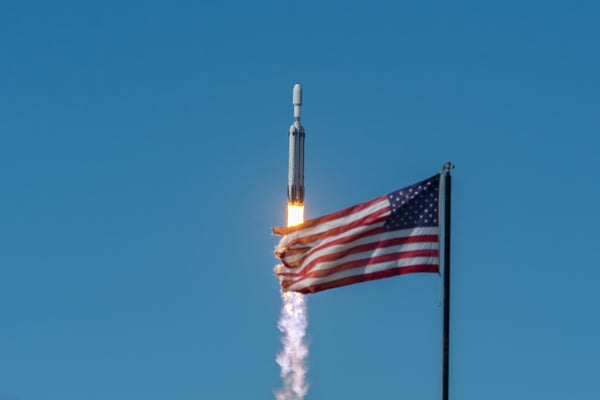
A SpaceX Falcon Heavy rocket launches into a clear blue sky, with a billowing American flag in the foreground.

A SpaceX Falcon Heavy rocket soars past an American flag located at NASA’s Launch Complex 39 Press Site on June 25, 2024.

Brandon Moser/Getty Images

SpaceX, the world’s biggest space company, announced a deal in April with Cursor, an AI-code-writing start-up based in San Francisco, signaling the rocket firm’s intention to acquire it for $60 billion. That’s more than twice NASA’s current annual budget—and also about how much capital SpaceX could raise from its upcoming initial public offering (IPO) in June.

The plan to snap up Cursor is part of a huge shift at SpaceX toward AI. The company bought Elon Musk’s xAI in February and, following the template set by SpaceX’s highly profitable Starlink satellite megaconstellation, is vigorously pursuing the prospect of creating a vast network of data centers in space. Meanwhile Musk’s other trillion-dollar-plus company, Tesla, is expanding its own investments in AI and robotics.

“It’s going to be interesting to see whether the Cursor acquisition goes through or whether this is posturing before the IPO,” says Jordan Bimm, a space historian at the University of Chicago. He also points out that the purpose of all this AI-related investment is not yet clear. “Is space going to be the place where AI is used, or is AI going to be the means for us to do more in space?” he asks.


On supporting science journalism

If you're enjoying this article, consider supporting our award-winning journalism by subscribing. By purchasing a subscription you are helping to ensure the future of impactful stories about the discoveries and ideas shaping our world today.


SpaceX’s move comes as it struggles with the delayed development of its massive Starship rocket—a necessary asset for the company’s orbital-data-center ambitions, as well as for NASA’s Artemis program to return astronauts to the moon. SpaceX is contracted with the space agency to provide a Starship-based Human Landing System (HLS) for the Artemis IV mission targeted for 2028, and precursor tests of the HLS in Earth orbit are set for next year’s Artemis III. SpaceX has been growing as a prime U.S. defense contractor as well; it has been providing a military-grade version of Starlink called Starshield and handling most launches for the Pentagon. At the same time, the company’s lofty talk of space exploration beyond the moon, especially of Mars, has notably lessened.

SpaceX’s supporters, partners and critics alike now seek to understand its AI pivot. “This speaks to the—optimistically, the nimbleness—but also the idiosyncrasies and fickleness of having a space company led by a single person, rather than a space program run by and for the public,” says Casey Dreier, chief of space policy at the nonprofit Planetary Society.

AI can mean a lot of things, and Starlink has already been using traditional AI tools for maneuvering its teeming satellites and avoiding collisions. But now SpaceX’s investments reveal a new focus on generative AI: it sees a vast $22.7 trillion market in AI for businesses, according to its recent S-1 regulatory filing, required for companies planning to go public.

These investments might pay off in the long run, or they might prove to be a distraction. NASA in 2020 had awarded SpaceX a $135 million contract to develop its HLS lunar lander for the Artemis program’s long-awaited moon landing, previously planned for 2024. Then, last fall, NASA reopened the contract to competitors, perhaps in a sign of the space agency’s frustration over delays—or concern that China’s ambitious space program may beat the U.S. at sending astronauts to the lunar surface for the first time since the Apollo era. And in February Musk announced that SpaceX was prioritizing the creation of a “self-growing city” on the moon over the company’s long-held goal of bringing human civilization to Mars.

NASA’s concerns about the company’s focus are legitimate, says Wendy Whitman Cobb, a professor of strategy and security studies at the School of Advanced Air and Space Studies at Air University. “Up until recently, SpaceX didn’t see the moon as a big thing to do,” she says. “It’s only been with Blue Origin coming up and nipping at SpaceX’s heels, in terms of lunar activities, where you now see SpaceX and Elon Musk changing their tune.”

In the meantime, the broader space economy landscape continues to evolve. Blue Origin, founded by rival billionaire Jeff Bezos, has commenced commercial launches of its own gargantuan reusable rocket, New Glenn—although not without major problems. And another launch upstart, Rocket Lab, is trying to nab smaller launch contracts that previously would have gone to SpaceX’s Falcon 9 with its own Electron and soon-to-debut Neutron rockets. Newer companies, such as Firefly Aerospace, Stoke Space and Relativity Space, are also striving to rise to the competition.

There’s no shortage of companies large and small betting on space-based data centers as the next big thing. But only one currently has the capability to launch on a near-daily cadence and for a relatively low cost, and that’s SpaceX. That would allow SpaceX to leverage its ongoing launch dominance and its considerable control over its own supply chain to outmatch many competitors. “This is just the boldest version yet of SpaceX’s general strategy of vertical integration and finding ways of making their existing and past successes magnified into future success,” says Matthew Weinzierl, a Harvard Business School researcher who studies the private space sector.

In January SpaceX applied with the Federal Communications Commission for authorization to launch up to one million solar-array-powered satellites for orbital data centers. Nvidia-backed start-up Starcloud filed plans in February for a network of 88,000 data-center satellites. And Blue Origin filed in March for a constellation of more than 50,000 spacecraft.

The engineering challenges posed by waste heat, space radiation and latency, not to mention the costs involved, are formidable. In addition, these projects would flood already unsustainably congested orbits with thousands of satellites. It’s not clear that they’re feasible, as SpaceX itself acknowledged in a pre-IPO filing in April: “Our initiatives to develop orbital AI compute and in-orbit, lunar, and interplanetary industrialization are in early stages, involve significant technical complexity and unproven technologies, and may not achieve commercial viability.”

Some observers, like Dreier and Whitman Cobb, understandably view the transition to AI investment with some skepticism. Musk is prone to hype, after all, and he previously claimed SpaceX would send astronauts to Mars in the 2020s. (The company is nowhere close to reaching that objective.) Furthermore, SpaceX is already stretched thin: in addition to everything else, it’s trying to ramp up Starlink Mobile, which aims to provide global satellite-to-phone Internet and connectivity, while also seeking to further increase its share of Pentagon contracts as it plays a role in developing prototype space-based interceptors for the Space Force’s Golden Dome missile-defense system. Advancing so many business endeavors at once can be risky.

SpaceX’s sudden burst of AI investments also means the company is vulnerable to any deflating AI bubble. OpenAI recently missed revenue and user growth targets, a possible sign of the unstable financial foundations of the AI industry, with concerning implications for Oracle and other companies banking on it. For its part, xAI had been losing $1 billion per month when it merged with SpaceX.

But, for now, SpaceX itself remains so flush with cash that Musk has used the currently private company to secure favorable loans for himself and to prop up his other ventures. And the IPO that is coming soon could bring SpaceX a whopping valuation of $1.75 trillion. Nevertheless, even if the company’s focus on AI fares poorly, competing companies remain behind it in the near term, and NASA and the Pentagon will continue depending on it as a top contractor, Dreier says. “It’s hard to overstate SpaceX’s dominance.”