


A mere 12 percent of Americans say they trust the U.S. Centers for Disease Control and Prevention’s recommendations “a great deal”
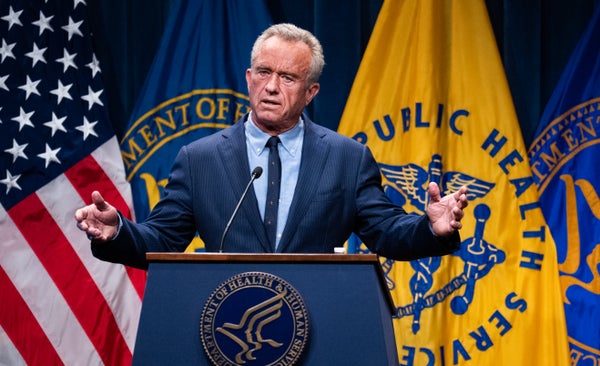
Secretary of Health and Human Services Robert F. Kennedy, Jr., conducts a news conference to discuss a survey from the Centers for Disease Control and Prevention’s Autism and Developmental Disabilities Monitoring (ADDM) Network on April 16, 2025.
Tom Williams/Getty Images
Join Our Community of Science Lovers!
Americans’ trust in the U.S. Centers for Disease Control and Prevention has nose-dived during President Donald Trump’s second term, a new poll from Harvard University and the de Beaumont Foundation found. Just 50 percent of respondents said they trust health recommendations from the CDC at all—a steep drop from 77 percent who said they trusted the CDC in 2025.
Since last year’s poll was conducted, the Trump administration has overhauled U.S. health and science agencies. Secretary of Health and Human Services Robert F. Kennedy, Jr., has fired longtime agency vaccine scientists, while multiple senior leadership figures at the CDC, as well as other health agencies, have resigned or accused Kennedy of pushing them out. The CDC has also stopped coordinating closely with international public health agencies, such as the World Health Organization, and sought to reduce the number of recommended vaccines for children. And the Department of Health and Human Services has altered the U.S. food pyramid to encourage Americans to eat more red meat. (Some of these moves have been challenged in court.)
All of these changes have been criticized by public health experts, researchers and medical and science associations as endangering the health of Americans, especially children.
On supporting science journalism
If you're enjoying this article, consider supporting our award-winning journalism by subscribing. By purchasing a subscription you are helping to ensure the future of impactful stories about the discoveries and ideas shaping our world today.
The new poll included about 2,200 adults and was conducted between March 19 and April 1, 2026. Democrats and Independents have particularly lost faith in the CDC: just 34 percent of Democrats and 47 percent of Independents said they “somewhat” trust the agency’s recommendations, down from 92 percent and 77 percent in 2025, respectively. Meanwhile about 67 percent of Republicans said they trust the agency—up from 63 percent in 2025.
Other wings of HHS also saw low levels of trust in 2026: Just 53 percent of poll respondents trust the U.S. Food and Drug Administration and the National Institutes of Health to improve health. HHS did not immediately respond to a request for comment from Scientific American.
When the poll’s authors asked participants about their support for changes at the U.S. health agencies under the current administration, 86 percent of Democrats said they “disapprove” of agency actions. Republicans, on the other hand, overwhelmingly said they “approve” of the changes (with 80 percent in favor). Still, the majority of all adults, about 60 percent, said the U.S. government has gone too far in cuts to research.
Americans haven’t lost all trust in medical professionals themselves, however. Nurses, doctors and pharmacists, as well as health groups such as the American Heart Association (AHA) and American Cancer Society (ACS), had the broad support of 80 percent or more of respondents.
It’s Time to Stand Up for Science
If you enjoyed this article, I’d like to ask for your support. Scientific American has served as an advocate for science and industry for 180 years, and right now may be the most critical moment in that two-century history.
I’ve been a Scientific American subscriber since I was 12 years old, and it helped shape the way I look at the world. SciAm always educates and delights me, and inspires a sense of awe for our vast, beautiful universe. I hope it does that for you, too.
If you subscribe to Scientific American, you help ensure that our coverage is centered on meaningful research and discovery; that we have the resources to report on the decisions that threaten labs across the U.S.; and that we support both budding and working scientists at a time when the value of science itself too often goes unrecognized.
In return, you get essential news, captivating podcasts, brilliant infographics, can't-miss newsletters, must-watch videos, challenging games, and the science world's best writing and reporting. You can even gift someone a subscription.
There has never been a more important time for us to stand up and show why science matters. I hope you’ll support us in that mission.