





 Summarize this articleHere’s what you need to know:
As a product manager at Castlery, a D2C furniture brand, I’m no stranger to the pressure of endless requests and competing priorities. We all want to build fantastic products that customers love, but with limited resources, choosing the right project can feel like a shot in the dark.
Data-driven pretotyping is our secret weapon for ensuring we’re always creating the most value for the business.
The idea comes from Google’s Alberto Savoia, and it’s how you make sure you’re building the right “it” before you build it right. Pretotyping is creating a low-effort mockup that offers an opportunity to rapidly test ideas to see if they have legs.
A pretotype:
Think of it as a sneak peek into the future, a chance to ask “should we even invest in building this?” before diving headfirst into full-fledged development. Where prototyping answers “Can we build it?” pretotyping seeks to answer “Will people even use this?”
To identify opportunities where pretotyping can help move the needle, I like to follow three steps:
1. Reframe the problem into a hypothesis, and brainstorm ways to validate it with existing functionality.
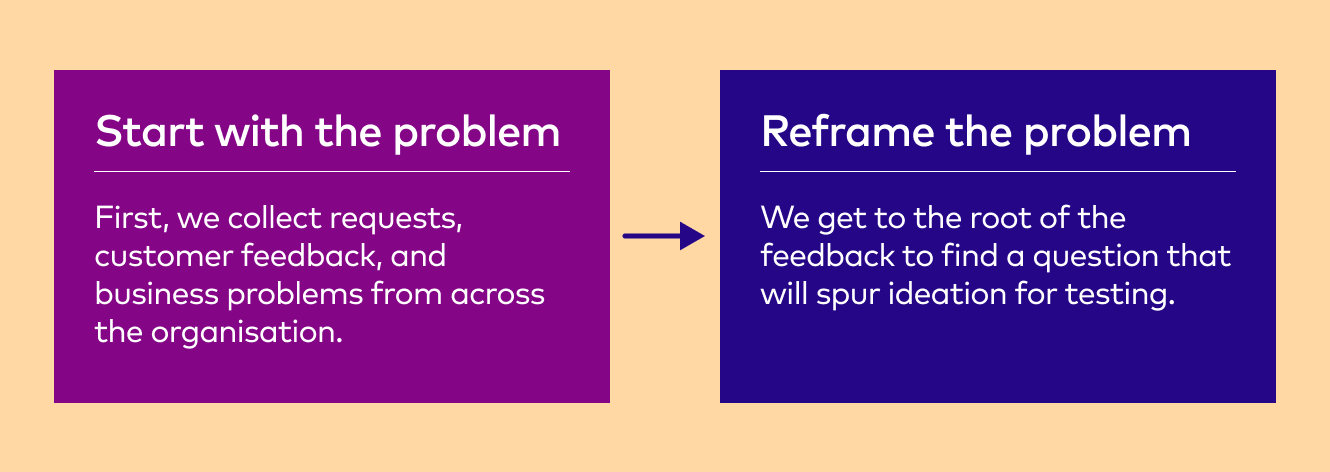
We get a lot of prescriptive requests from across the business and our customers, but we can’t always trust that their proposed solutions are the right ones for the overarching problem. Reframing the problem helps us make sure we’re seeing beyond the prescriptive.
2. Assess the proposed impact versus effort.

I like to use the “t-shirt” sizing method when thinking about the ideal ratio of effort to impact: Pretotypes should require the smallest amount of work across technical, design and business stakeholders (think XXS-S) and should indicate whether a fully delivered feature would provide high impact (M-XXL).
3. Analyze the data and share insights.
Communicating these results internally is just as crucial as gathering them. We don’t shy away from sharing the insights of our pretotypes, even the imperfect ones. We have monthly product and tech meetings where we share the outcomes and impacts of our experiments. This transparency builds trust with stakeholders and ensures everyone is aligned on data-driven decision-making.
I’ve seen firsthand how pretotyping empowers me to prioritize effectively. I don’t need to rely on guesswork or opinion; the data guides my decisions, saving my team valuable time and effort, and helping build trust quickly with stakeholders and development team members alike.
Here are a few concrete examples of how data-driven pretotyping has fueled our success:
In surveys, customers told us they wanted a ‘comparison tool’ for products. Instead of building a feature likely used by only a small percentage of customers, we reframed the question. “How can we help customers understand the subtle differences between products that appear similar, especially when they can’t physically see them in our showroom?” This led to a simple pretotype to validate whether customers really want guidance: A pop-up highlighting comparison articles within product pages for specific items customers frequently compared. The results? A 8-10% click-through rate on the articles (demand) and a 20% increase in add-to-cart rates for those who read them – clear evidence that customers valued this type of guidance.
We thought customers often struggled to envision how furniture would look in their homes. Our hypothesis? Providing styling advice, beyond just product photos, could overcome this hurdle and boost sales. We tested this by embedding shoppable images curated by our stylists on select product pages. The results? A 100% increase in engagement and an 80% increase in add-to-carts – a stunning validation of the styling feature’s potential. This data helped us secure the green light for a dedicated room designer tool, now a cornerstone of our website, that continues to drive conversions.
We wondered if online quizzes could replicate the personalized experience our showroom stylists offer in terms of product discovery. We paid for a monthly low-cost quiz tool on our sofa page in the US asking about preferences, budget, and family size. Although not elegant, it was easy to implement and took less than two days to create. The results were remarkable: more than half opened the quiz, 95% finished it, and those who did were 15% more likely to add something to their cart. This data propelled the feature development to the top of our backlog, showing the clear value it offered to customers.
So, the next time you face a product dilemma, remember the power of data-driven pretotyping. It’s the bridge between ideas and reality, the compass that navigates you towards building the right thing, the first time, allowing the product managers to build trust with stakeholders and save team bandwidth.
Embrace the spirit of experimentation, let the data be your guide, and you might just stumble upon the next big thing.
此内容由惯性聚合(RSS阅读器)自动聚合整理,仅供阅读参考。 原文来自 — 版权归原作者所有。