
惯性聚合 高效追踪和阅读你感兴趣的博客、新闻、科技资讯
阅读原文 在惯性聚合中打开

推荐订阅源

SecWiki News
SecWiki News
OSCHINA 社区最新新闻
OSCHINA 社区最新新闻
V
Visual Studio Blog
博客园 - 叶小钗
S
SegmentFault 最新的问题
IT之家
IT之家
大猫的无限游戏
大猫的无限游戏
博客园_首页
Apple Machine Learning Research
钛媒体:引领未来商业与生活新知
钛媒体:引领未来商业与生活新知
月光博客
月光博客
酷 壳 – CoolShell
酷 壳 – CoolShell
腾讯CDC
D
Darknet – Hacking Tools, Hacker News & Cyber Security
V
V2EX
阮一峰的网络日志
阮一峰的网络日志
L
Lohrmann on Cybersecurity
量子位
C
Cyber Attacks, Cyber Crime and Cyber Security
T
Tor Project blog
J
Java Code Geeks
cs.CL updates on arXiv.org
博客园 - 三生石上(FineUI控件)
Attack and Defense Labs
AI
AI
The Cloudflare Blog
T
Tailwind CSS Blog
S
Schneier on Security
爱范儿
爱范儿
PCI Perspectives
PCI Perspectives
Stack Overflow Blog
Stack Overflow Blog
S
Secure Thoughts
Exploit-DB.com RSS Feed
T
The Exploit Database - CXSecurity.com
博客园 - 【当耐特】
V2EX - 技术
V2EX - 技术
S
Securelist
P
Proofpoint News Feed
T
Threat Research - Cisco Blogs
Help Net Security
Help Net Security
C
Cisco Blogs
N
News and Events Feed by Topic
人人都是产品经理
人人都是产品经理
B
Blog RSS Feed
K
Kaspersky official blog
T
The Blog of Author Tim Ferriss
G
Google Developers Blog
S
Security Affairs
freeCodeCamp Programming Tutorials: Python, JavaScript, Git & More
Simon Willison's Weblog

Mastercard Dynamic Yield

Email, SMS and push done right: A marketing leader’s guide to channel selection How Valamar engages travelers earlier with real-time booking context Gartner Recognizes Mastercard Dynamic Yield as an 8‑Time Leader in Personalization Engines— Mastercard Dynamic Yield 2026 Personalization Maturity: Disruption Is Redefining E-Commerce Success Modern customer journey orchestration: Latest capabilities, best practices and omnichannel strategies — Mastercard Dynamic Yield Saks Fifth Avenue Elevated Luxury With AI Personalization 2025 Personalization Maturity Report for E-commerce - ES — Mastercard Dynamic Yield 2025 Personalization Maturity Report for E-commerce - PT — Mastercard Dynamic Yield How to Drive More Subscribers to Your Mailing List: Proven Strategies for MarketersMastercard Dynamic Yield Reconnect by Mastercard Dynamic Yield: Smarter Customer Journey Orchestration Send-Time Optimization — Mastercard Dynamic Yield Channel Prioritization — Mastercard Dynamic Yield Real-Time Adaptation and Dynamic Optimization — Mastercard Dynamic Yield Post-click Experiences — Mastercard Dynamic Yield Search Ranking Optimization — Mastercard Dynamic Yield Visual Search — Mastercard Dynamic Yield Semantic Search — Mastercard Dynamic Yield How Bergzeit Increased Conversions 3x with Conversational AI Email Deliverability Best Practices: Reach the Inbox. Deliver the Experience. The enterprise guide to IP warming: Boost deliverability, ensure compliance, and power seamless journeys Visual Search Meets Multimodal AI: A New Era of Product Discovery Where human ingenuity fits in the AI-driven marketing era Infographic: The state of personalization maturity in e-commerce - 2025 AI and Personalization Are Revolutionizing E-commerce Search Transform product discovery with Experience Search: AI that understands your shoppers AI Fuels New Demands for Personalization — Is E-Commerce Maturing Fast Enough? From Fragmentation to Connection: Mastering User Identification for Personalization — Mastercard Dynamic Yield 2026 Personalization Maturity Report for E-commerce - PDF — Mastercard Dynamic Yield Add To Cart Recommendation Modal — Mastercard Dynamic Yield Shoppable Video Notification — Mastercard Dynamic Yield Dynamic Yield by Mastercard Recognized as a Leader by Gartner® and Forrester Leroy Merlin Gains 32% Purchases with ML Recommendations Conversational Commerce: Your Guide to This Market-Shifting Technology Your Global Test Could Be Limiting Your Personalization Growth — Mastercard Dynamic Yield Personalize with Empathy to Meet Evolving Customer Needs The Resource Constraints Blocking Banks’ Personalization Gain Steering by Data: How to Avoid Assumptions and Motivate Your Team — Mastercard Dynamic Yield AI and personalization can close the empathy gap between brands and their customers A Leader in the Gartner Magic Quadrant for Personalization - Dynamic Yield Black Friday Is Coming—Is Your Personalization Strategy Airtight? Personalization Blueprint Survey - Dynamic Yield by Mastercard How Personalization Fuels Success in Latin America's Digital Boom Signet Jewelers Sees 88% Conversion Lift from Personalization Solving Data Issues for Financial Services with Personalization — Mastercard Dynamic Yield How to Executive Reporting Can Help You Grow Your Personalization Program Breaking the personalization barrier for banks Bring the personal back to shopping this holiday season​ with Shopping Muse Dynamic Yield makes Personalization a Breeze for Issuer Dynamic Yield by Mastercard Is Making Personalization a Breeze for Banks How to Deliver a Less Frustrating Online Shopping Experience VIDEO: Banking's Personalization Revolution: Data-Driven Transformation Bunnings' Buyer Center Casas Bahia's Buyer Center Magalu's Buyer Center Carrefour's Buyer Center 3 Tips to Integrate GenerativeAI into Your Personalization Workflow — Mastercard Dynamic Yield TUI Cruises Sees 10.3% Uplift in Add to Cart from Personalization The Revenue Gains From Personalization That FIs Can’t Ignore Calling All UK Banks: Personalisation Is Crucial to Meeting the New Consumer Duty Mandate What Marketers Miss in the GenAI Discussion vidaXL's Buyer Center The 2 Breakthrough Technologies Driving Smarter Product Recommendations Fashion Retailers: Your Product Feed Needs Spring Cleaning, Too — Mastercard Dynamic Yield Tommy Hilfiger's Buyer Center G-Star Raw's Buyer Center Hunkemöller's Buyer Center Here's Why Your Customers Are Tuning You Out Intersport's Buyer Center How AI Is Ushering in the Future of Interactive Commerce Mastering Channel Prioritization: How to Optimize Re-Engagement with a Winning Strategy Clark's Buyer Center Optimized messaging for purchase completion Affinity-powered triggered messages - personalization use cases Anticipate customer's next best item - personalization use cases Charlotte Tilbury's Buyer Center Rituals' Buyer Center The Dynamic Duo of A/B Testing and Personalization Müller's Buyer Center Next's Buyer Center La Redoute's Buyer Center Why Gen Z Craves Personalized Restaurant Experiences The human advantage in the age of AI and personalization Sky Personalizes Subscription Management for Millions On Leverages Personalization to Build Community Build-A-Bear Workshop's Buyer Center Oak Furnitureland's Buyer Center Coach's Buyer Center The Perfect Match: Marry Your CMS and Personalization Systems for Customer Love 4 Signs You Need to Move Beyond Your ESP's Email Personalization Functionality Sainsbury's, meet Dynamic Yield Charles Tyrwhitt's Buyer Center Burberry's Buyer Center Personalization in QSR: The Possibilities You Didn’t Know Existed The State of Personalization Maturity in Grocery/CPG Chanel's Buyer Center Swarovski's Buyer Center Building the Right It: How “Pretotyping” Guides Product Decisions with Concrete Data The Power of a Primary Audience Strategy for Financial Services Similarity Badge — Mastercard Dynamic Yield How Deep Learning is Adding Predictive Personalization Prowess to User Affinity Profiling
An introduction to product recommender systems — Mastercard Dynamic Yield
2020-01-31 · via Mastercard Dynamic Yield

Summarize this articleHere’s what you need to know:

  • Recommender systems personalize the shopping experience: These systems leverage machine learning to analyze customer data and suggest relevant products, boosting engagement and sales.
  • Data drives the recommendations: The effectiveness of recommender systems hinges on the quality and quantity of data available about users, products, and their interactions.
  • Variety of strategies for diverse needs: Recommender systems adapt to different user profiles and data availability. Popular items, similar product suggestions, and collaborative filtering are some common strategies.
  • Beyond just recommendations: These systems can be used to personalize various aspects of the shopping experience, like search results, promotions, and content.
  • Measurable benefits: Recommender systems can demonstrably improve customer experience, drive sales growth, and enhance a company’s bottom line.

Product recommender systems surface items available for purchase across web pages, mobile apps, within emails, or on any connected screens, such as kiosks and various IoT devices. One of the most popular methods used by retailers, recommendations guide visitors to products they are likely interested in, improving the discovery process and helping them find what they want more efficiently.

Today, retailers often have thousands (and sometimes millions) of products in their inventories, making it difficult for consumers to dig up exactly what they are looking for. And with personalized recommendations, brands can help users easily find relevant products based on their affinities, trends, interests, and behavior, with an end goal of driving sales, upsells, cross-sales, larger cart sizes, and higher average order values (AOVs).

Recommendations are currently used by some of the world’s most innovative brands. Amazon, for example, has been refining and tweaking its algorithm for two decades. Powered by the company’s unprecedented access to massive amounts of consumer data, its recommendation system has completely transformed the way customers are matched with products they are most likely interested in purchasing.
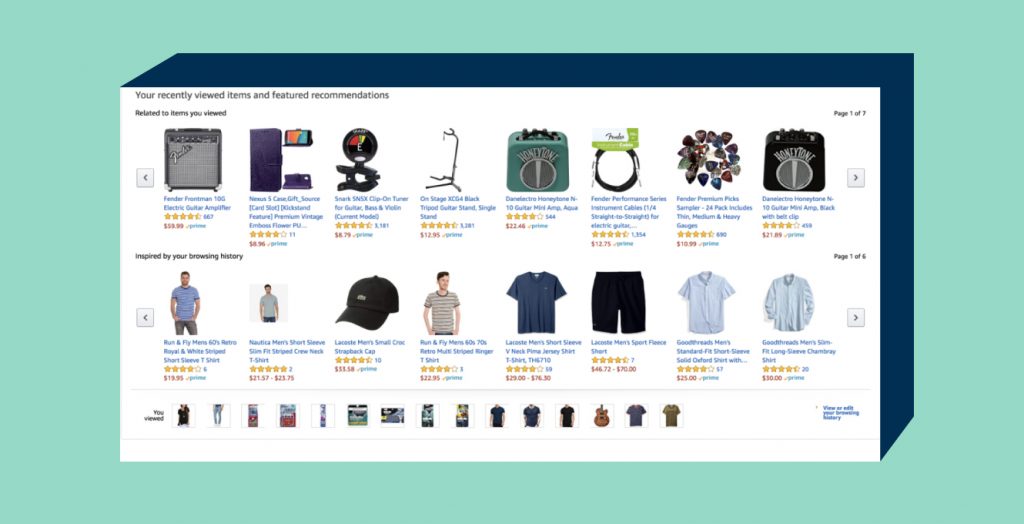
amazon recommendations single session

An example of just one of the ways Amazon serves users recommendations on its desktop site

What are product recommender systems?

Powered by machine learning, a product recommender system is the technology used to suggest which products are shown to individuals interacting with a brand’s digital properties. Fueled by a number of algorithmic decisions, recommendation algorithms mine user, product, and contextual data – both onsite and offsite – to present every user with a personalized experience.

Improving the discovery process, this helps users find what they are looking – and sometimes products they don’t even realize they are looking for. In doing so, businesses can learn more about each user’s unique preferences and interests, optimizing performance in real-time while simultaneously refining their testing roadmaps for the long-term.

And when it comes to product recommendations, there is no archetypal strategy marketers should use for every widget. Different strategies must be applied for different users, depending on the amount of information available about the customer, their behavior, and the context of products on a site. This includes site behavior, status, geo-location, time of day, past purchases, and more.

The strategies behind recommender systems

Recommendations can provide key insights and the opportunity to better understand who a customer is in order to delight them, add value, and improve the overall relationship with a brand. And when it comes to the strategies behind each of them, there are three primary tiers:

  • Global recommendation strategies
  • Contextual recommendation strategies
  • Personalized recommendation strategies

Each of these strategies dictates which products are included in an experience. Examples of different recommendation strategies that fall under each tier are listed in the figure below.

rec strategies

Picking a recommendation strategy

When picking a strategy to use, marketers must first assess the amount of user and product data available, as well as a user’s location in the purchase funnel, allowing this information to dictate which strategy to deploy.

Global strategies
These strategies tend to be the easiest to implement, simply serving any user – both known and unknown – the most frequently purchased, popular, or trending products in a recommendation widget.

Contextual strategies
These strategies rely on product context, assessing product attributes, such as color, style, the category it falls under, and how frequently it is purchased with other products, to recommend items to shoppers.

Personalized recommendation strategies
Personalized strategies, the most sophisticated of the tiers, don’t just simply heed context, but also the actual behavior of users themselves. They take the available user data and product context into consideration to surface relevant recommendations for each user on an individual level. This means, in order to effectively deploy them, a brand must have access to behavioral data about the user, such as purchase history, affinities, clicks, add-to-carts, and more.

In certain situations, the user’s interaction history can even be coupled with the history of all other users on a site to recommend products. For example, using a “Collaborative Filtering” strategy, users are recommended items based on the preferences and interactions of site visitors expressing similar behaviors. Meanwhile, affinity-based recommendations are based on data a recommender system automatically aggregates to build affinity profiles for each customer, suggesting items according to understood user preferences.

personalized recs

Global strategies can be used for every type of site visitor, whether new, returning, or loyal. And contextual and personalized strategies can be used within the first session or pageview if contextual or behavioral data is available for the user, such as their geo-location (contextual) or their affinities (personalized).

The potential to drive revenue increases when recommendations are best suited to user context and behavior. For example, marketers should use contextual or personalized strategies for frequent shoppers and VIP users, who they have ample user data on. Additionally, these strategies are strengthened when layered atop each other, maximizing the impact of the deployed recommendations.

Crafting product recommendations

The strategies behind recommendations must be identified in advance and must explain the logic behind the recommendations themselves. Examples of this logic include:

  • Recently viewed
  • Most popular
  • Show similar items to the item currently in view
  • Show items based on the visitor’s browsing history
  • Show items that are viewed together with an item currently in view

most popular

An example of a “Most Popular” recommendation widget on a category page

These strategies will enhance (or limit) the recommendations served to each user, allowing marketers to tailor the widgets to best optimize performances and the desired objective. Once a marketer has selected a strategy to use for a recommendation widget, they can set up rules, such as “exclude recently purchased items” or “only include items that cost $25 max” to narrow down which products are featured in each widget.

Additionally, certain strategies are better suited for specific pages. For example, “Viewed Together” is ideal for product pages, as they relate to products already in view. “Purchased Together” is a good fit for cart pages, especially right after a user adds an item to their cart. And “Most Popular” is a great homepage recommendation strategy, helping to kickstart the discovery process for both new and returning visitors.

Combining context and intent

Recommendation strategies and algorithms employed should vary according to each user’s displayed intent, and user signals help infer and identify the likelihood of a conversion.

  • Users with low levels of intent are often new visitors, unidentifiable, arrive via search or social, or are on a mobile device.
  • Users with a medium level of intent are often returning visitors, identifiable, arrive directly to the site or via email campaign, or interact with a site on a desktop device.
  • Users with a high level of intent have either made a purchase in the past, have added items to their cart, or search products directly on the site.

These intent level classifications inform the strategies and rules each marketer chooses for a test. For example, for users with low intent levels, the “Viewed Together” strategy will encourage further product discovery and exploration. Meanwhile, for a user with a high level of intent, such as a past purchaser, a “Purchased Together” strategy is a better fit, increasing the likelihood of cross-selling the visitor.

Data and recommender systems

In order to effectively deploy recommendations, you need data. Both implicit and explicit, this data is automatically ingested by the system, allowing it to identify which products to serve to each user in a recommendation widget. A recommendation engine can collect online behavioral data about every single user. Sites collect first-party data, while data from third-party sources, such as CRM or offline purchase data, can be onboarded. The more data available, the stronger your targeting strategy becomes.

Types of user data

Being able to access the following types of user data can help power smarter recommendations:

  • Location data: The country, region, or city a user is located in
  • Tech data: The type of device a user is accessing a site from, the browser-type they are using, their operating system, and more
  • Demographic data: A user’s gender, age, marital status, etc.
  • Behavioral data: Actions a user takes on-site, including clicks, add-to-carts, hovers, number of pages viewed, etc.
  • Affinity-based data: The interests and preferences displayed by a user on-site
  • Online and offline purchase data: The products a user purchased on-site or in-store
  • Traffic source data: The source of traffic a user is visiting from, including direct traffic, paid traffic, social traffic, and referral traffic
  • 3rd-party data: Information about a user from outside sources, onboarded through a DMP.

Access to this data helps marketers identify buyer personas and understand purchase habits, which can inform segmentation strategies. Other elements, like knowing a user’s traffic source or the device they are using when interacting with a brand, can inform targeting strategies.

The more a user visits and interacts with your site, the more data becomes available. The system can then use this data to predict what users are most likely to purchase, make smarter segmentation decisions, and serve more relevant recommendations.

Visitor Type

Data Available

First-time visitors

Only context (IP / geo, traffic source)

2+ visits

Some usage data, some product-viewed data

Repeat visitors

Purchase history, deeper usage data, user affinities

Types of product data

Product data is also essential, as they give recommender systems the ability to put the right items in front of the right users. Product data feeds, which house a retailer’s entire product catalog, can be synced with recommender engines. Product feeds include basic information about the products available on a site, including, but not limited to:

  • SKU
  • Product name
  • Product URL
  • Price
  • In-stock status
  • Images
  • Keywords

Marketers can customize product feeds, adding in more product data that can later be used for targeting, such as color, size, style, etc. The more product data is available, the stronger your contextual and personalized recommendation strategies become.

The power of product recommendations

Product recommendations are a great way to improve the overall user experience, guiding visitors through the discovery process while simultaneously generating more revenue for your organization. And with machine learning doing much of the heavy lifting, marketers can experiment with different strategies, segmentation practices, and widgets at scale, exposing more products to users than ever before to generate ROI and boost their companies’ bottom lines.