


 Summarize this articleHere’s what you need to know:
Many retailers start their personalization journeys with recommendations—digitally translating the in-store sales associate’s best practice of aiding a customer in their product discovery—and seemingly instantly generate meaningful results. Yet, financial institutions (FIs) haven’t been able to achieve the same degree of success with one of the most straightforward types of personalization.
This partially has to do with the industry’s long consideration phase, as it’s much easier to say yes to new home decor than it is to a new home loan. However, FIs exacerbate the problem by limiting their recommendations strategy to only include products when they could be serving educational resources, offers, and content to inform and help customers feel understood.
In this post, we’ll touch on why financial services should leverage recommendations and what they need to do so, with examples of where and how to use them.
Many FIs have prioritized personalization as a majority of customers have already moved to primarily digital relationships, with 45% using mobile and 27% managing their everyday banking needs from the web.
However, this adoption of digital banking and its concurrent growth has elongated product research and decision-making cycles. With more options than ever across a growing arena of financial services players, customers need education and guidance to aid in the selection process.
Additionally, according to a 2023 Forrester report:
And while many FIs have created high-quality content, few have effectively used personalization to facilitate learning and discovery – recommending the right information, advice, or products to customers based on the digital signals they leave behind. In eCommerce, “guided selling” is a concept that online retailers have adopted to help, educate, and streamline the process through which information and products are discovered. Starting in the early stages of a customer relationship, this establishes an understanding of the user and helps set customers on the right track of their journey.
Though not a one-to-one translation of guided selling, FIs can take a page from eCommerce’s book and pave the way for more personalized, relevant, and seamless customer engagement across channels, offering up product and resource recommendations based on cues from the user.
To ensure value is being derived from recommendations, FIs should consider the following factors:
With these in mind, they can begin to piece together an approach, which I’ll dive deeper into below.
An easy way to set goals is to focus on which KPIs need improving.
Some examples of personalization KPIs for financial services include:
Knowing which action you’d like your audience to take will help guide you towards which recommendation strategy will be most effective, and where to place the recommendations on your digital property.
Teams can take an FI-specific audience strategy approach, identifying impactful segments to build recommendation experiences around. A good way to get started is by identifying 3-4 primary audiences to consistently target, analyze, and optimize towards. These audiences should be based on a single segmentation principle and comprise 100% of the site’s traffic for maximum efficiency.
Some examples of segmentation principles for financial services include:
Each of these audience segments has its own set of questions and needs, making them more (or less) conducive to the various types of recommendations. For example, serving a high-engagement customer a recommendation for a boat loan based on their recent browsing history makes sense – but not a low-engagement prospect who may benefit more from educational content at this point in their customer journey.
A data feed is the source of truth for all things recommendations, responsible for powering the different types of products, offers, resources, or content showcased. And while more data is better, if each asset has not been tagged with the proper metadata based on its attributes, it won’t be able to generate valuable results.
A good place to get started is by creating a data feed that correctly tags product metadata based on the product category it is associated with (e.g. Checking, Saving, Credit Card, Lending, Wealth Management). Some product types may also have additional attributes, so it’s important to account for these when tagging as well. For example, credit cards also offer various categories of perks (e.g. Travel, Dining, or General Cashback).
Certain products can also be tagged by target audience segments, such as customer status, so an FI can showcase recommendations that would appeal to a new customer as well as those that speak to customers with a long history at the bank. And finally, products can be tagged by engagement. For example, checking, savings, and credit cards would most likely appeal to users with low or no engagement, whereas lending and wealth management would make sense for highly engaged users.
To recap product feed tagging best practices for FI:
Setting up the feed with organized metadata before launching recommendations will position FIs to succeed. However, they must make time for ongoing development and maintenance, as products shift and the personalization program grows.
The overall success of a recommendation campaign hinges on an understanding of which strategies align with each audience segment and the available information on each user.
Different recommendation strategies include:
Different pages on an FI’s site serve different purposes and indicate different levels of intent from visitors. The customer expectations for each on-site location make certain types of recommendations more or less relevant, and tailoring recommendations accordingly will improve their relevance.
Typically, FIs should consider three main areas:
Let’s look at three ways FI can effectively use recommendations. We’ll walk through each example using the framework above:
Chatbots are a great way to recreate an in-person consultative experience, which can be integrated with the product catalog to provide personalized recommendations right away. Helpful for influencing conversion rate (e.g. apply click, application start and complete, etc.) among new or unknown visitors who are unfamiliar with your products and services, an FI might consider placing a chatbot recommendation experience on multiple pages early in the customer journey, such as the homepage or category page. Results could then be populated through an affinity recommendation strategy that leverages direct input from the visitor collected throughout the conversation, matching them with the right educational resources, offers, or content.

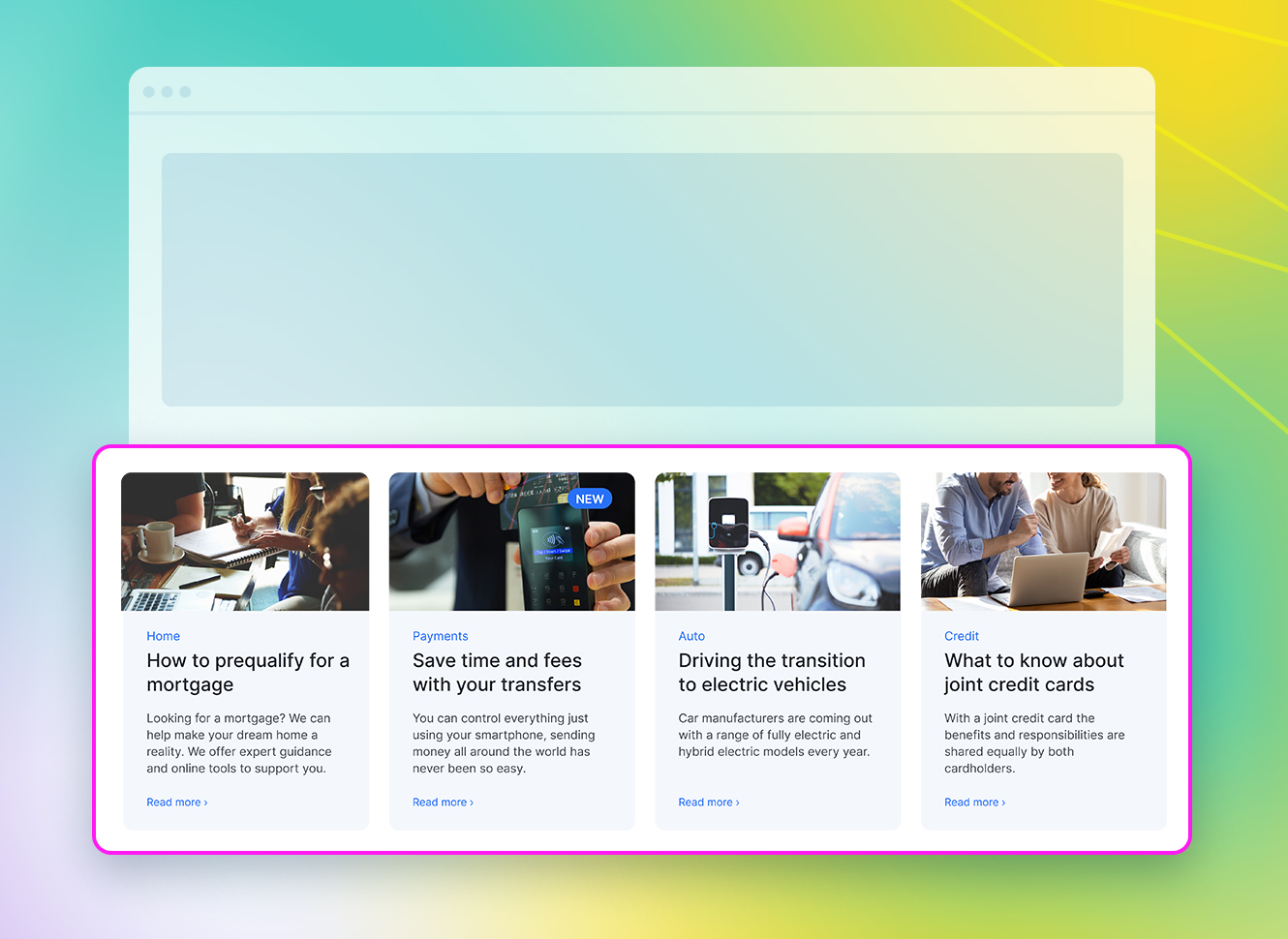
Blogs and articles are crucial for the education of prospects as well as cross selling and upselling, and can be recommended to help users advance along their journey. The goal of article recommendations is to increase engagement and pageviews, particularly for those who have not shown much activity and likely require more information. An FI could take advantage of its existing blogs page to recommend additional content based on a ‘Viewed Together’ or ‘Similarity’ strategy – running an experiment to determine the best performing one for this particular audience.
Especially crucial for current cardholders given they can make or break an FI’s top of wallet position, if able to recommend exciting offers, cardholders will reach for that card first. To make this a reality, we’ll set to influence ‘offer engagement click’ as the main KPI of an offer recommendations experience, which makes sense to target an audience of ‘cardholders or one product attainment.’ A prime area for placement would be on the homepage (before login), where an FI could test between an affinity-based recommendation strategy and one that highlights popular offers that are ending soon.

Financial institutions are well aware of what it takes to acquire, engage, and retain customers, but increased competition from new market entrants and higher than ever consumer expectations has made it impossible to go on without incorporating personalization across the customer lifecycle. Recommendations are a great place to start, and with the right methodology (which incorporates not just products but also offers and educational resources), teams can help customers gain confidence that they’re making the right financial decisions – leading to improved business metrics in the form of reduced acquisition costs and greater lifetime value.
此内容由惯性聚合(RSS阅读器)自动聚合整理,仅供阅读参考。 原文来自 — 版权归原作者所有。