
惯性聚合 高效追踪和阅读你感兴趣的博客、新闻、科技资讯
阅读原文 在惯性聚合中打开

推荐订阅源

Threat Intelligence Blog | Flashpoint
C
CXSECURITY Database RSS Feed - CXSecurity.com
L
LINUX DO - 热门话题
S
Secure Thoughts
TaoSecurity Blog
TaoSecurity Blog
Security Archives - TechRepublic
T
Threat Research - Cisco Blogs
AI
AI
B
Blog RSS Feed
S
Schneier on Security
雷峰网
雷峰网
Schneier on Security
Help Net Security
Help Net Security
Cloudbric
Cloudbric
L
LINUX DO - 最新话题
罗磊的独立博客
有赞技术团队
有赞技术团队
Recent Commits to openclaw:main
Apple Machine Learning Research
P
Proofpoint News Feed
酷 壳 – CoolShell
酷 壳 – CoolShell
The Hacker News
The Hacker News
博客园 - Franky
Attack and Defense Labs
The Cloudflare Blog
Webroot Blog
Webroot Blog
Last Week in AI
Last Week in AI
Exploit-DB.com RSS Feed
博客园 - 叶小钗
美团技术团队
L
Lohrmann on Cybersecurity
T
The Blog of Author Tim Ferriss
The Last Watchdog
The Last Watchdog
T
Troy Hunt's Blog
H
Hackread – Cybersecurity News, Data Breaches, AI and More
Vercel News
Vercel News
Know Your Adversary
Know Your Adversary
O
OpenAI News
博客园 - 【当耐特】
Hacker News - Newest:
Hacker News - Newest: "LLM"
C
Cybersecurity and Infrastructure Security Agency CISA
让小产品的独立变现更简单 - ezindie.com
www.infosecurity-magazine.com
freeCodeCamp Programming Tutorials: Python, JavaScript, Git & More
PCI Perspectives
PCI Perspectives
H
Heimdal Security Blog
I
InfoQ
GbyAI
GbyAI
T
Threatpost
C
Cisco Blogs

Mastercard Dynamic Yield

Email, SMS and push done right: A marketing leader’s guide to channel selection How Valamar engages travelers earlier with real-time booking context Gartner Recognizes Mastercard Dynamic Yield as an 8‑Time Leader in Personalization Engines— Mastercard Dynamic Yield 2026 Personalization Maturity: Disruption Is Redefining E-Commerce Success Modern customer journey orchestration: Latest capabilities, best practices and omnichannel strategies — Mastercard Dynamic Yield Saks Fifth Avenue Elevated Luxury With AI Personalization 2025 Personalization Maturity Report for E-commerce - ES — Mastercard Dynamic Yield 2025 Personalization Maturity Report for E-commerce - PT — Mastercard Dynamic Yield How to Drive More Subscribers to Your Mailing List: Proven Strategies for MarketersMastercard Dynamic Yield Reconnect by Mastercard Dynamic Yield: Smarter Customer Journey Orchestration Send-Time Optimization — Mastercard Dynamic Yield Channel Prioritization — Mastercard Dynamic Yield Real-Time Adaptation and Dynamic Optimization — Mastercard Dynamic Yield Post-click Experiences — Mastercard Dynamic Yield Search Ranking Optimization — Mastercard Dynamic Yield Visual Search — Mastercard Dynamic Yield Semantic Search — Mastercard Dynamic Yield How Bergzeit Increased Conversions 3x with Conversational AI Email Deliverability Best Practices: Reach the Inbox. Deliver the Experience. The enterprise guide to IP warming: Boost deliverability, ensure compliance, and power seamless journeys Visual Search Meets Multimodal AI: A New Era of Product Discovery Where human ingenuity fits in the AI-driven marketing era Infographic: The state of personalization maturity in e-commerce - 2025 AI and Personalization Are Revolutionizing E-commerce Search Transform product discovery with Experience Search: AI that understands your shoppers AI Fuels New Demands for Personalization — Is E-Commerce Maturing Fast Enough? From Fragmentation to Connection: Mastering User Identification for Personalization — Mastercard Dynamic Yield 2026 Personalization Maturity Report for E-commerce - PDF — Mastercard Dynamic Yield Add To Cart Recommendation Modal — Mastercard Dynamic Yield Shoppable Video Notification — Mastercard Dynamic Yield Dynamic Yield by Mastercard Recognized as a Leader by Gartner® and Forrester Leroy Merlin Gains 32% Purchases with ML Recommendations Conversational Commerce: Your Guide to This Market-Shifting Technology Your Global Test Could Be Limiting Your Personalization Growth — Mastercard Dynamic Yield Personalize with Empathy to Meet Evolving Customer Needs The Resource Constraints Blocking Banks’ Personalization Gain Steering by Data: How to Avoid Assumptions and Motivate Your Team — Mastercard Dynamic Yield AI and personalization can close the empathy gap between brands and their customers A Leader in the Gartner Magic Quadrant for Personalization - Dynamic Yield Black Friday Is Coming—Is Your Personalization Strategy Airtight? Personalization Blueprint Survey - Dynamic Yield by Mastercard How Personalization Fuels Success in Latin America's Digital Boom Signet Jewelers Sees 88% Conversion Lift from Personalization Solving Data Issues for Financial Services with Personalization — Mastercard Dynamic Yield How to Executive Reporting Can Help You Grow Your Personalization Program Breaking the personalization barrier for banks Bring the personal back to shopping this holiday season​ with Shopping Muse Dynamic Yield makes Personalization a Breeze for Issuer Dynamic Yield by Mastercard Is Making Personalization a Breeze for Banks How to Deliver a Less Frustrating Online Shopping Experience VIDEO: Banking's Personalization Revolution: Data-Driven Transformation Bunnings' Buyer Center Casas Bahia's Buyer Center Magalu's Buyer Center Carrefour's Buyer Center 3 Tips to Integrate GenerativeAI into Your Personalization Workflow — Mastercard Dynamic Yield TUI Cruises Sees 10.3% Uplift in Add to Cart from Personalization The Revenue Gains From Personalization That FIs Can’t Ignore Calling All UK Banks: Personalisation Is Crucial to Meeting the New Consumer Duty Mandate What Marketers Miss in the GenAI Discussion vidaXL's Buyer Center The 2 Breakthrough Technologies Driving Smarter Product Recommendations Fashion Retailers: Your Product Feed Needs Spring Cleaning, Too — Mastercard Dynamic Yield Tommy Hilfiger's Buyer Center G-Star Raw's Buyer Center Hunkemöller's Buyer Center Here's Why Your Customers Are Tuning You Out Intersport's Buyer Center How AI Is Ushering in the Future of Interactive Commerce Mastering Channel Prioritization: How to Optimize Re-Engagement with a Winning Strategy Clark's Buyer Center Optimized messaging for purchase completion Affinity-powered triggered messages - personalization use cases Anticipate customer's next best item - personalization use cases Charlotte Tilbury's Buyer Center Rituals' Buyer Center The Dynamic Duo of A/B Testing and Personalization Müller's Buyer Center Next's Buyer Center La Redoute's Buyer Center Why Gen Z Craves Personalized Restaurant Experiences The human advantage in the age of AI and personalization Sky Personalizes Subscription Management for Millions On Leverages Personalization to Build Community Build-A-Bear Workshop's Buyer Center Oak Furnitureland's Buyer Center Coach's Buyer Center The Perfect Match: Marry Your CMS and Personalization Systems for Customer Love 4 Signs You Need to Move Beyond Your ESP's Email Personalization Functionality Sainsbury's, meet Dynamic Yield Charles Tyrwhitt's Buyer Center Burberry's Buyer Center Personalization in QSR: The Possibilities You Didn’t Know Existed The State of Personalization Maturity in Grocery/CPG Chanel's Buyer Center Swarovski's Buyer Center Building the Right It: How “Pretotyping” Guides Product Decisions with Concrete Data The Power of a Primary Audience Strategy for Financial Services Similarity Badge — Mastercard Dynamic Yield How Deep Learning is Adding Predictive Personalization Prowess to User Affinity Profiling
Segmented A/B tests: Avoiding average experiences
2018-04-20 · via Mastercard Dynamic Yield

Summarize this articleHere’s what you need to know:

  • A/B testing is most effective when you target specific audience segments based on demographics, behavior, and interests. This allows you to deliver more relevant experiences and gather more actionable insights.
  • Begin by targeting high-traffic segments to gather initial data, then use those findings to refine your testing strategy and target smaller, more specific groups.
  • Consider factors like purchase history, recency of visit, location, and even past A/B testing results to create highly targeted segments that yield meaningful data.
  • Focus on the “why” behind your tests. Clearly define what you hope to learn from each A/B test. What customer behaviors or preferences are you trying to understand? What specific actions do you want visitors to take?
  • Don’t just collect data, gain insights. Use the results of your A/B tests to inform strategic decisions about your website, product offerings, and overall business model. A/B testing should be used to drive continuous improvement, not just generate random data.

One of the biggest mistakes companies make when they begin A/B testing efforts in earnest is sticking to a single, simple audience. The problem being, if you want relevant, insightful results, you need a segmentation and personalization strategy in place. 

Targeting the “average” person, usually in the form of “all visitors,” is an easy trap to fall into. The idea is that by casting a wide net, you can catch everyone. In reality, there is no such thing as an “average” visitor. Sure, your website has a bell curve of visitors but that bell curve is actually made up of subgroups of visitors, each with their own bell curves in different places.

I guess a good place to start would be to ask you this:  

Are YOU average?

Chances are that in some ways you’re average, but in some very important and distinct ways, you’re also not.

In terms of your website visitors, some common examples of subgroups are:

  • New vs. returning visitors
  • Men vs. women
  • Mobile visitors vs. desktop
  • Loyal customers vs. one-time shoppers 

Each of these groups will have distinct affinities, and by targeting those groups specifically while running experiments, you can increase the likelihood that you’ll find that group’s drivers for higher conversion rates or increased average order value.

To illustrate why testing against a single unified audience is bad, let’s say that you have an eCommerce store that sells outdoor clothing, and 80% of your visitors are men. If you decide to test a new hero image at the top of the page — one focusing on men’s clothes, the other focusing on women’s — chances are that the male-focused one will always win. Running the test didn’t actually tell you anything that you didn’t already know.

Worse, that same result could actually be masking higher-than-expected results from the women’s hero image. The quickest path to a higher conversion rate may actually be a matter of identifying female visitors and targeting them with relevant content, but that’s not the conclusion you’re likely to get from an “all visitors” unified test. This is just one example of why segmentation is essential in good test design.

Designing your next set of A/B tests

1. Don’t go overboard with segmentation 

It’s one thing to emphasize certain aspects of the site for a specific segment, but you don’t want to be too extreme in your tests. If you know that the person visiting your site is a woman, it makes sense to de-emphasize men’s products. At the same time, you don’t want to completely remove those products from the site experience, because you don’t know what she’s shopping for. She could be buying a gift for her boyfriend or husband, for example.

2. Start big, then get smaller

It’s helpful to start grouping your largest segments first, then work your way into smaller and smaller ones. Larger segments will have more traffic, making it faster and easier to reach statistical significance — so deal with that lower hanging fruit first.  

With the easy stuff knocked out quickly, you can then take your time designing more granular tests for specific segments. The same holds true for various sections of your website – work with higher traffic pages like your homepage first, and only then move towards other, lower traffic pages.

3. Refine your segments

One of the most basic segmentation divisions is between new and returning visitors. It’s a good starting point, but those groups can also be broken down even further. For instance, you can split returning visitors by those who have completed a purchase versus those who haven’t. You can also segment out high-value customers — those who have a high average order value in their carts, complete their purchases, and make fewer returns — versus “tire kickers” who commit to a purchase less often. The more distinct your segments, the more accurate your results become.

4. Weigh site activity and recency in your tests

A shopper who visits your site several times a week isn’t the same as one who hasn’t been on the site within the last 90 days. Even if they are both technically “returning” visitors, odds are that they will respond differently.

5. Segment by customer value

Some customers are more valuable than others, and you should definitely optimize the site for your highest-value customers. Start by identifying the “whales” — your highest value customers. This allows you to emphasize higher-priced products by default, and to suggest products that are preferred by other shoppers with a high average order value.
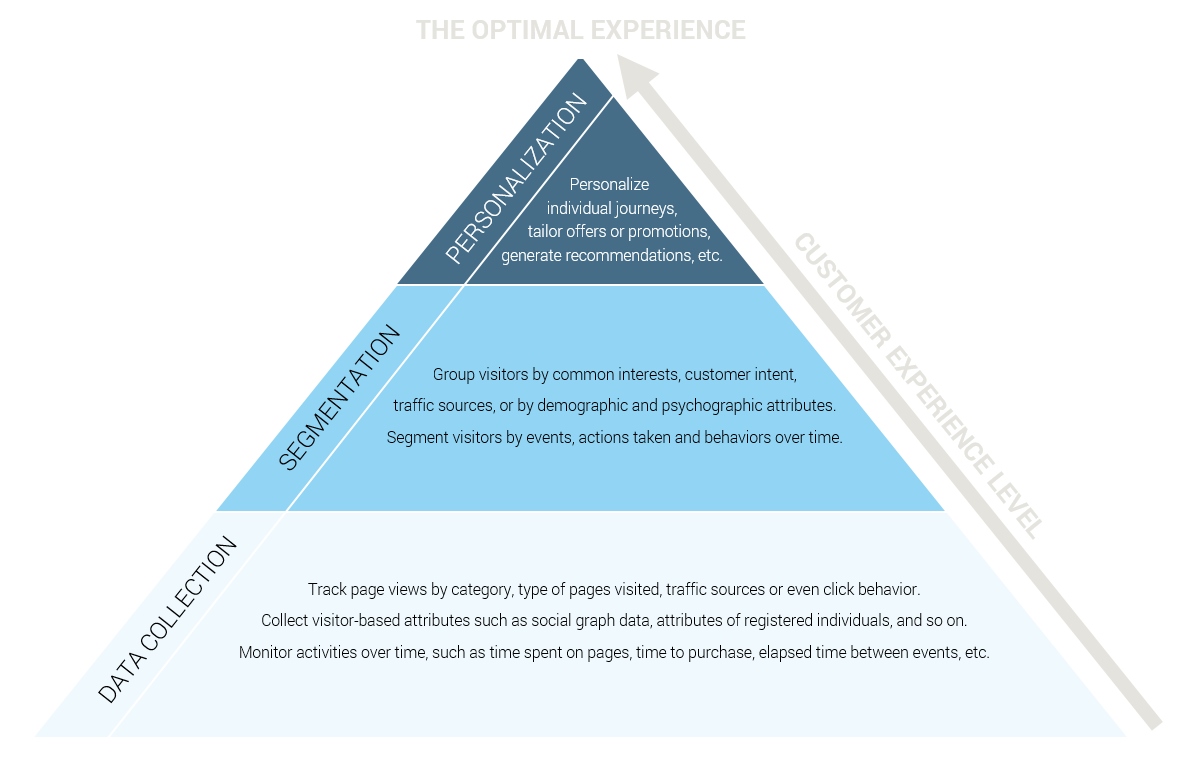
The Personalized Experience Pyramid

6. Consider geography and weather

Some states charge sales tax for online purchases while others don’t. This creates two distinct — and often overlooked — customer segments. Why not test offers for people who live in tax-free states with messaging that highlights the fact that the purchase will be tax-free? As simple as the tactic seems, it will encourage spending a little more.

Along the same lines, weather-based targeting is worth keeping in mind. For example, a person who lives in a city that is experiencing a major snowstorm probably isn’t going to shopping for patio furniture. That same audience, however, may respond strongly to deals on winter clothes and space heaters.

7. Focus on the “why” of the test, not the “what”

When people are new to A/B testing, they generally don’t think through test design. They focus on the “what” of the test — what button size and color combination will generate the most clicks, for example — while overlooking the “why” behind it. Without a central hypothesis driving these tests, the individual test results aren’t all that meaningful – “what” based testing initiatives quickly run out of ideas and lose steam.

It’s not enough to know that one offer performed higher in an A/B test within a certain segment.

  • What are the psychological implications of the test?
  • What does it say about this group of customers?
  • How can the lessons be generalized or used to inform decisions across the entire business?

The better, more meaningful tests, as a rule, have the largest, most far-reaching implications for the business as a whole.

8. Keep your test ideas fresh

It’s easy for people to get stuck in a rut with their testing strategies, or to find their test ideas clustering around one specific kind of test. Design-oriented thinkers often get lost testing endless variations on a UI design, even as those tests yield diminishing returns. If you want your tests to generate clear, impactful insights, you need to try different kinds of tests. You can test any element of your site — offers, copy, images, layout, user experience — and by any segment, so why not take advantage of it?

One final thought

Just because a test gives meaningful results doesn’t mean that the test has merit. Your tests should also have actionable insights into both user psychology and the overall business model. You can create a test offering designer t-shirts for $1 each, and it will definitely provide clear results. Does that mean that selling t-shirts at a heavy loss is a good business decision? Obviously not, but there are countless examples of people making very strategic moves based on optimization tests that are just as flawed.

When possible, your A/B tests should do more than just produce a winner and a loser. They should validate business assumptions, identify new product areas, and tell you more about the people who spend their time with you.