


惯性聚合 高效追踪和阅读你感兴趣的博客、新闻、科技资讯
阅读原文 在惯性聚合中打开

推荐订阅源

S
SegmentFault 最新的问题
月光博客
月光博客
Cyber Security Advisories - MS-ISAC
S
Secure Thoughts
Jina AI
Jina AI
罗磊的独立博客
S
Security @ Cisco Blogs
V
V2EX
PCI Perspectives
PCI Perspectives
N
News and Events Feed by Topic
大猫的无限游戏
大猫的无限游戏
人人都是产品经理
人人都是产品经理
酷 壳 – CoolShell
酷 壳 – CoolShell
AI
AI
www.infosecurity-magazine.com
Hacker News - Newest:
Hacker News - Newest: "LLM"
爱范儿
爱范儿
V
Visual Studio Blog
T
Tor Project blog
Google DeepMind News
AWS News Blog
AWS News Blog
雷峰网
雷峰网
阮一峰的网络日志
阮一峰的网络日志
E
Exploit-DB.com RSS Feed
T
Tenable Blog
The Hacker News
The Hacker News
宝玉的分享
宝玉的分享
WordPress大学
WordPress大学
H
Heimdal Security Blog
腾讯CDC
IT之家
IT之家
A
Arctic Wolf
S
Security Archives - TechRepublic
NISL@THU
NISL@THU
Attack and Defense Labs
博客园 - 司徒正美
钛媒体:引领未来商业与生活新知
钛媒体:引领未来商业与生活新知
博客园 - 三生石上(FineUI控件)
Apple Machine Learning Research
奇客Solidot–传递最新科技情报
奇客Solidot–传递最新科技情报
Spread Privacy
Spread Privacy
Threat Intelligence Blog | Flashpoint
W
WeLiveSecurity
Simon Willison's Weblog
Latest news
Latest news
The Cloudflare Blog
H
Hacker News: Front Page
博客园_首页
V
Vulnerabilities – Threatpost
freeCodeCamp Programming Tutorials: Python, JavaScript, Git & More

Mastercard Dynamic Yield

Email, SMS and push done right: A marketing leader’s guide to channel selection How Valamar engages travelers earlier with real-time booking context Mastercard Dynamic Yield Recognized as a Leader in the 2026 Gartner® Magic Quadrant™ for Personalization Engines 2026 Personalization Maturity: Disruption Is Redefining E-Commerce Success Modern customer journey orchestration: Latest capabilities, best practices and omnichannel strategies — Mastercard Dynamic Yield Saks Fifth Avenue Elevated Luxury With AI Personalization 2025 Personalization Maturity Report for E-commerce - ES — Mastercard Dynamic Yield 2025 Personalization Maturity Report for E-commerce - PT — Mastercard Dynamic Yield How to Drive More Subscribers to Your Mailing List: Proven Strategies for MarketersMastercard Dynamic Yield Reconnect by Mastercard Dynamic Yield: Smarter Customer Journey Orchestration Send-Time Optimization — Mastercard Dynamic Yield Channel Prioritization — Mastercard Dynamic Yield Real-Time Adaptation and Dynamic Optimization — Mastercard Dynamic Yield Post-click Experiences — Mastercard Dynamic Yield Search Ranking Optimization — Mastercard Dynamic Yield Visual Search — Mastercard Dynamic Yield Semantic Search — Mastercard Dynamic Yield How Bergzeit Increased Conversions 3x with Conversational AI Email Deliverability Best Practices: Reach the Inbox. Deliver the Experience. The enterprise guide to IP warming: Boost deliverability, ensure compliance, and power seamless journeys Visual Search Meets Multimodal AI: A New Era of Product Discovery Where human ingenuity fits in the AI-driven marketing era Infographic: The state of personalization maturity in e-commerce - 2025 AI and Personalization Are Revolutionizing E-commerce Search Transform product discovery with Experience Search: AI that understands your shoppers AI Fuels New Demands for Personalization — Is E-Commerce Maturing Fast Enough? From Fragmentation to Connection: Mastering User Identification for Personalization — Mastercard Dynamic Yield 2026 Personalization Maturity Report for E-commerce - PDF — Mastercard Dynamic Yield Add To Cart Recommendation Modal — Mastercard Dynamic Yield Shoppable Video Notification — Mastercard Dynamic Yield Dynamic Yield by Mastercard Recognized as a Leader by Gartner® and Forrester Leroy Merlin Gains 32% Purchases with ML Recommendations Conversational Commerce: Your Guide to This Market-Shifting Technology Your Global Test Could Be Limiting Your Personalization Growth — Mastercard Dynamic Yield Personalize with Empathy to Meet Evolving Customer Needs The Resource Constraints Blocking Banks’ Personalization Gain Steering by Data: How to Avoid Assumptions and Motivate Your Team — Mastercard Dynamic Yield AI and personalization can close the empathy gap between brands and their customers A Leader in the Gartner Magic Quadrant for Personalization - Dynamic Yield Black Friday Is Coming—Is Your Personalization Strategy Airtight? Personalization Blueprint Survey - Dynamic Yield by Mastercard How Personalization Fuels Success in Latin America's Digital Boom Signet Jewelers Sees 88% Conversion Lift from Personalization Solving Data Issues for Financial Services with Personalization — Mastercard Dynamic Yield How to Executive Reporting Can Help You Grow Your Personalization Program Breaking the personalization barrier for banks Bring the personal back to shopping this holiday season​ with Shopping Muse Dynamic Yield makes Personalization a Breeze for Issuer Dynamic Yield by Mastercard Is Making Personalization a Breeze for Banks How to Deliver a Less Frustrating Online Shopping Experience VIDEO: Banking's Personalization Revolution: Data-Driven Transformation Bunnings' Buyer Center Casas Bahia's Buyer Center Magalu's Buyer Center Carrefour's Buyer Center 3 Tips to Integrate GenerativeAI into Your Personalization Workflow — Mastercard Dynamic Yield TUI Cruises Sees 10.3% Uplift in Add to Cart from Personalization The Revenue Gains From Personalization That FIs Can’t Ignore Calling All UK Banks: Personalisation Is Crucial to Meeting the New Consumer Duty Mandate What Marketers Miss in the GenAI Discussion vidaXL's Buyer Center The 2 Breakthrough Technologies Driving Smarter Product Recommendations Fashion Retailers: Your Product Feed Needs Spring Cleaning, Too — Mastercard Dynamic Yield Tommy Hilfiger's Buyer Center G-Star Raw's Buyer Center Hunkemöller's Buyer Center Here's Why Your Customers Are Tuning You Out Intersport's Buyer Center How AI Is Ushering in the Future of Interactive Commerce Mastering Channel Prioritization: How to Optimize Re-Engagement with a Winning Strategy Clark's Buyer Center Optimized messaging for purchase completion Affinity-powered triggered messages - personalization use cases Anticipate customer's next best item - personalization use cases Charlotte Tilbury's Buyer Center Rituals' Buyer Center The Dynamic Duo of A/B Testing and Personalization Müller's Buyer Center Next's Buyer Center La Redoute's Buyer Center Why Gen Z Craves Personalized Restaurant Experiences The human advantage in the age of AI and personalization Sky Personalizes Subscription Management for Millions On Leverages Personalization to Build Community Build-A-Bear Workshop's Buyer Center Oak Furnitureland's Buyer Center Coach's Buyer Center The Perfect Match: Marry Your CMS and Personalization Systems for Customer Love 4 Signs You Need to Move Beyond Your ESP's Email Personalization Functionality Sainsbury's, meet Dynamic Yield Charles Tyrwhitt's Buyer Center Burberry's Buyer Center Personalization in QSR: The Possibilities You Didn’t Know Existed The State of Personalization Maturity in Grocery/CPG Chanel's Buyer Center Swarovski's Buyer Center Building the Right It: How “Pretotyping” Guides Product Decisions with Concrete Data The Power of a Primary Audience Strategy for Financial Services Similarity Badge — Mastercard Dynamic Yield How Deep Learning is Adding Predictive Personalization Prowess to User Affinity Profiling
Personalization & A/B testing with Single Page Applications
Jonatan Ramirez Sales Engineering Team Lead, EMEA at Dynamic Yie · 2021-03-02 · via Mastercard Dynamic Yield

Every day we interact with different sites created using single page application frameworks such as YouTube, Netflix, Facebook, and many others.

An increasingly popular architecture for building web applications and sites, we wanted to provide some clarity on the topic. In this post, we’ll dive into the rise of single page applications, what they are, the pros and cons, as well as how to overcome some common challenges presented when using them within the context of A/B testing and personalization.

Before we dive in, let’s define some common terms we’ll be using throughout this article.

XMLHttpRequest (XHR): An object-based API used to interact with servers (aka send HTTP or HTTPS requests) to retrieve data from the URL without fully refreshing the page.

Single Page Application (SPA): A web application using a single HTML file that dynamically updates the content of the current page based on an interaction occurring on the client-side or browser.

Multi-Page Application (MPA): Traditional web applications conformed by multiple HTML files that reload the entire page and display a new one upon user interaction.

Client-Side: The browser, i.e. Google Chrome, Safari, Internet Explorer, Firefox, etc., where dynamic action is taken. For single page applications, most of the logic and operations are executed client-side.

Server-Side: This is where most of the data processing takes place for traditional multi-page applications – typically developed using server-side languages like PHP, native React, Node JS, and others.

AJAX: A set of web development techniques used for building asynchronous web applications that are executed on the client-side.

Application Programming Interface (API): A collection of methods that enable applications to send requests for a service and receive a response back, usually in the form of a JSON.

The evolution of single page application frameworks

Before SPAs, when technical teams wanted to build a web application, multiple HTML files were created to represent all possible pages visitors could navigate. But as time passed, new technologies like AJAX appeared, making it possible to retrieve data from the server without the need to load individual HTML pages with new content simplifying the navigation experience across pages.

As AJAX matured, a new concept developed where all of the site’s content was preloaded onto a single HTML file, and different sections were shown to visitors based on their interactions. An architecture defined in large by mobile applications, it allowed visitors to move faster across areas of the site by making light internet calls to the server to load the necessary data and content for the desired section.

With these improvements, more and more technical teams began exploring avenues for migrating to SPA frameworks in order to reduce site load times for their visitors. And this trend has only grown as businesses compete to grab and hold the attention of consumers who now expect seamless, fast, and highly tailored experiences online.

To refresh or not to refresh the browser

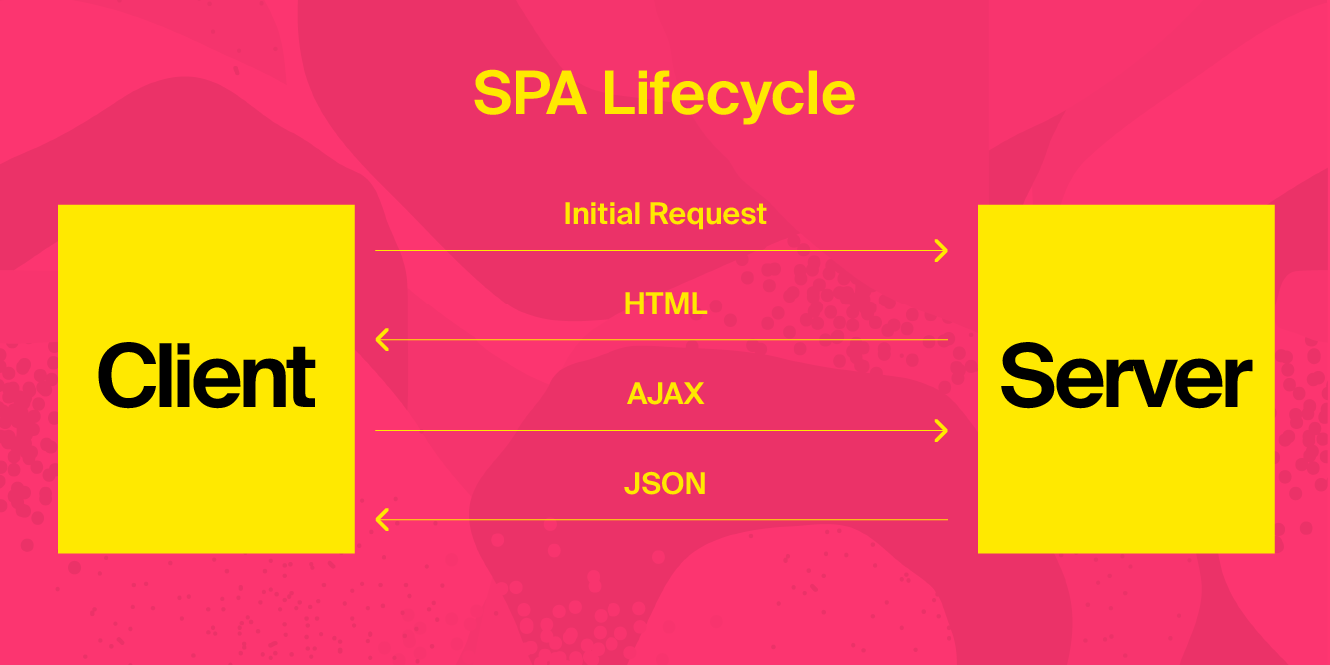
With traditional MPAs, after an action is taken on a website, most of the logic is executed on the server, where numerous processing requests must be made to load each new HTML page. SPAs, on the other hand, move this logic client-side (or the browser), loading all of the required HTML, CSS, and Javascript from the server just once. Subsequent visitor interactions are then handled using lighter XRH to only retrieve the data needed to render the new content or virtual page that must be loaded after the interaction has taken place in the browser.

The key difference between the two being that visitors remain on a single page (typically the homepage or index.html) that loads virtual page views as they engage with different areas of the site, instead of the browser being fully refreshed and loading new HTML, CSS, and Javascript files with every new pageview. As a result, the user experience is faster and much more fluid.
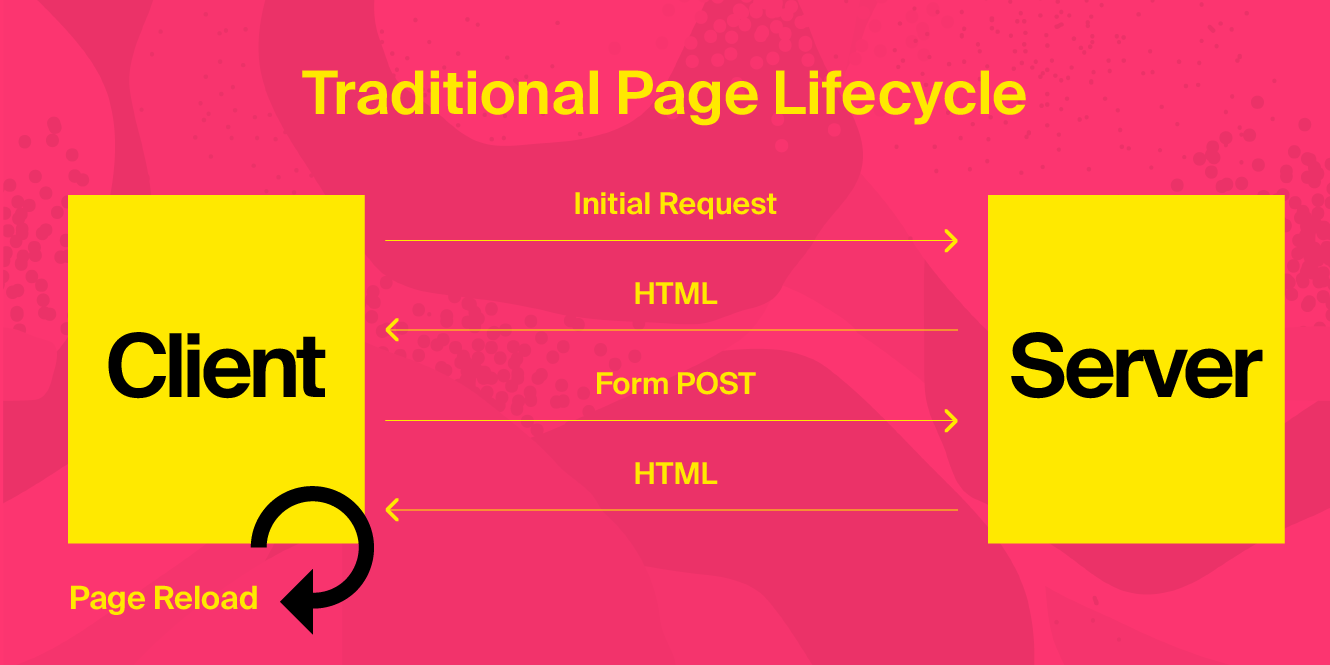
Traditional page lifecycle with MPAs
SPA lifecycle

Some of the main aspects when designing a single page application architecture can be summarized in the following points:

  • Routing: How visitors will navigate across the different sections of the site without having to fully load a new page.
  • Dynamic user interfaces: How the content will be updated based on visitor actions. This is done using very lightweight data structures called JSON, which are used to provide a structured definition of the new state that needs to be used to render the content based on the visitor’s actions.
  • Access to data: How to access data without having to make additional network requests. Typically done by making use of client-side or browser features, where data can be persisted or cached in session variables stored in the local storage provided by the browser.

What are the technologies behind a single page application architecture?

In essence, a single page application is a Javascript framework that also uses HTML5 and CSS3. These become the main components to building SPAs, however, there are a few libraries and frameworks that have emerged and become popular in development using the previous components:

React.js: Developed by Facebook, it is mainly for developing user interfaces, typically in conjunction with Redux to manage the state of the application components.

Angular.js: Developed by Google, it uses a Model View Controller (MVC) architecture that allows for updates to the model every time the view changes, which are managed by the controller.

Vue.js: An MIT licensed open software used not only to build Single Page Applications but also to render content server-side as well sites that are statically generated. React Vue also requires state management handled by Vuex.

Meteor: There are additional packages compatible with Meteor that help to resolve the impact SPAs have on SEO by rendering the pages server-side.

Weighing the pros and cons of single page applications

Much like the debate between client-side vs. server-side testing (which is actually closely related to our conversation on SPAs today), there are always important factors to consider when implementing new technologies or frameworks. Below, find a deeper breakdown into the advantages and disadvantages of utilizing single page applications.

Important factors to consider before implementing SPAs

Upsides

Downsides

Speed

  • Once the first page has loaded, the following interactions will be resolved in shorter periods of time compared to MPA.
  • Dynamic content based on user interactions is loaded faster.
  • Initial page load can be slow due to the size of the files needed to process subsequent virtual page views.

SEO

  • If rendered server-side, SPA will be seen like traditional pages regarding SEO. This is typically possible using solutions like PREACT.
  • A perceived impact on SEO ranking as crawling and indexing becomes more difficult when fully rendering pages server-side. Google is improving the way SPAs are handled by executing the Javascript that handles the rendering of the new content.

Implementation

  • Reduction in code writing as methods and other pieces of functionality become reusable.  Additionally, there are multiple libraries that can be used to minimize the amount of code needed to perform an action.
  • Debugging can be simplified by using browsers like Chrome, where all SPA actions can be monitored.
  • Requires development and Javascript skills.
  • Analytics and interaction events are harder to implement and must be linked to the dynamic changes occurring on the SPA.

Reach

  • Can support offline navigation by using data stored directly in the browser.
  • Ideal for mobile-based sites due to the low levels of data required to load the application, reducing the consumption of mobile network resources.
  • Not available for devices that don’t support Javascript.

Architecture

  • Perfect for serverless architectures as most of the processing usually handled by the server is moved client-side to be handled by the SPA.
  • Multiple frameworks and libraries to develop SPAs.
  • When not managed appropriately, scenarios where visitors leave pages using SPA opened can result in memory leaks that can lead to browser crashes as well as battery drainages in portable devices.

Security

  • SPAs push the architectural boundaries of traditional applications, creating an opportunity to secure existing and new services required to serve SPAs without exposing sensitive information in the browser.
  • Exposure to critical business logic may be reflected in the browser.

User Experience

  • As load times are faster once the first page is loaded, the experience is cleaner for users navigating through different content.
  • Some user journeys become streamlined and linear, maximizing the time the user spends on site.
  • Visitors might experience problems when using browser controls to go back in their history page if this behavior is not handled by the SPA.

SPA-based A/B testing and personalization

Most A/B testing software and personalization platforms rely on complete page loads to render experiences. As this concept is not present when using SPAs like React or Angular, when visitors request new page views, it becomes harder to determine if new content has been added to the page or if the status of existing content has changed – and most importantly, when to inject the personalized content.

A personalization platform must now understand the context of the visitor, i.e. whether they’ve landed on a product listing, detail, or cart page and at what stage the new content should be delivered. This requires keeping up with a constant state of changing modularised React SPA or Angular SPA components and updating the experiences affecting those components in real-time.

Overcoming common challenges in A/B testing and personalization with SPAs

Although not the traditional environment in which A/B testing and personalization has been known to thrive, advancements in technology to keep up with these emerging frameworks have been made to ensure businesses of varying architectures can still effectively implement tailored experiences.

Below, we’ll walk through a few ways that teams are adapting to better meet their SPA needs.

The server-side approach

REST APIs can be used to identify the content, or state of the SPA, to deliver experiences on the server-side. And depending on the platform, non-technical users should be able to define this content via the UI, where different types of variables can be created and fed to the SPA.

Furthermore, businesses can test different variations of the content according to their desired traffic allocation method, allowing them to optimize any given business metric for specific audiences.

The workflow is described in the following diagram:

Server-side personalization with SPAs

  1. The SPA sends an XHR request to the server to get the data to render a new page view or a dynamic component on the browser.
  2. The server makes a REST API call to the personalization platform’s API to retrieve the relevant experience content.
  3. The personalization platform evaluates the targeting conditions defined as well as any priorities, selects the appropriate variation, and then returns a JSON payload to the server with the correct content.
  4. The server returns the personalized content to the SPA for rendering.
  5. Any interactions with the personalized content are tracked by the SPA and passed to the server.
  6. The server passes the interactions to the personalization platform’s API, and these interactions are used for reporting to provide results for the A/B test.

The middle layer approach

An alternative to the pure server-side approach, a personalization platform’s API can be implemented to make calls from the clients to update the state of the SPA components instead of directly from the server. This reduces response times even further as fewer trips are needed for the data to render the content.

Here’s how this would look:
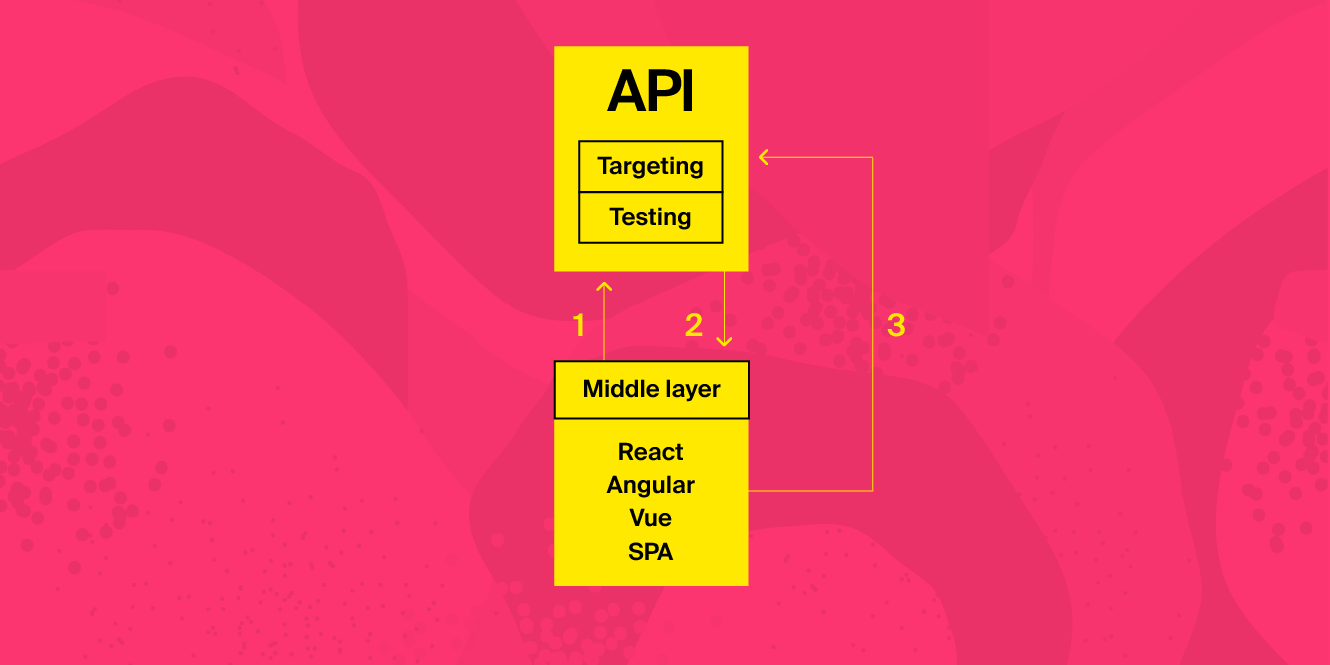
The middle layer approach to personalization and A/B testing with SPAs

  1. The SPA middle layer sends an XHR request to the personalization platform’s API to get the data to render a new page view or a dynamic component on the browser.
  2. The personalization platform evaluates the targeting conditions defined as well as any priorities, selects the appropriate variation, and then returns a JSON payload to the SPA middle layer with the correct content.
  3. The payload received is passed to the SPA to set the new state of the SPA component.
  4. All interactions are passed natively to the personalization platform using its Javascript tag, and these interactions are used for reporting to provide results for the A/B test.

In close

SPAs may become more widely adopted due to improvements in how content is processed and delivered, but it’s important to understand that this new technology does present challenges when integrating with optimization and personalization platforms, which typically work with more traditional MPA setups.

I hope this article has touched on the different aspects of SPAs as well as some alternatives to overcoming those challenges on your mission to delivering faster, more intuitive, and tailored digital experiences to visitors. However, it is recommended to partner with a solution provider that offers seamless support for single page applications, including the ability to automatically detect changes in UI elements and page types for dynamic personalization without interfering with the source code.