


惯性聚合 高效追踪和阅读你感兴趣的博客、新闻、科技资讯
阅读原文 在惯性聚合中打开

推荐订阅源

V2EX - 技术
V2EX - 技术
L
LangChain Blog
IT之家
IT之家
S
SegmentFault 最新的问题
博客园 - 三生石上(FineUI控件)
H
Hackread – Cybersecurity News, Data Breaches, AI and More
T
The Blog of Author Tim Ferriss
Blog — PlanetScale
Blog — PlanetScale
N
Netflix TechBlog - Medium
U
Unit 42
B
Blog RSS Feed
GbyAI
GbyAI
Microsoft Security Blog
博客园 - 司徒正美
Apple Machine Learning Research
T
Threatpost
C
CERT Recently Published Vulnerability Notes
Cisco Talos Blog
Cisco Talos Blog
The Register - Security
Vercel News
Vercel News
S
Schneier on Security
Spread Privacy
Spread Privacy
C
Cyber Attacks, Cyber Crime and Cyber Security
cs.CL updates on arXiv.org
博客园 - 叶小钗
雷峰网
雷峰网
博客园_首页
人人都是产品经理
人人都是产品经理
P
Palo Alto Networks Blog
The Hacker News
The Hacker News
T
Tor Project blog
L
Lohrmann on Cybersecurity
Know Your Adversary
Know Your Adversary
D
Darknet – Hacking Tools, Hacker News & Cyber Security
C
Cybersecurity and Infrastructure Security Agency CISA
P
Privacy International News Feed
钛媒体:引领未来商业与生活新知
钛媒体:引领未来商业与生活新知
T
Tenable Blog
V
Vulnerabilities – Threatpost
大猫的无限游戏
大猫的无限游戏
博客园 - 【当耐特】
V
V2EX
Security Latest
Security Latest
A
About on SuperTechFans
Cloudbric
Cloudbric
S
Security Affairs
MongoDB | Blog
MongoDB | Blog
Y
Y Combinator Blog
Martin Fowler
Martin Fowler
TaoSecurity Blog
TaoSecurity Blog

Mastercard Dynamic Yield

Email, SMS and push done right: A marketing leader’s guide to channel selection How Valamar engages travelers earlier with real-time booking context Gartner Recognizes Mastercard Dynamic Yield as an 8‑Time Leader in Personalization Engines— Mastercard Dynamic Yield 2026 Personalization Maturity: Disruption Is Redefining E-Commerce Success Modern customer journey orchestration: Latest capabilities, best practices and omnichannel strategies — Mastercard Dynamic Yield Saks Fifth Avenue Elevated Luxury With AI Personalization 2025 Personalization Maturity Report for E-commerce - ES — Mastercard Dynamic Yield 2025 Personalization Maturity Report for E-commerce - PT — Mastercard Dynamic Yield How to Drive More Subscribers to Your Mailing List: Proven Strategies for MarketersMastercard Dynamic Yield Reconnect by Mastercard Dynamic Yield: Smarter Customer Journey Orchestration Send-Time Optimization — Mastercard Dynamic Yield Channel Prioritization — Mastercard Dynamic Yield Real-Time Adaptation and Dynamic Optimization — Mastercard Dynamic Yield Post-click Experiences — Mastercard Dynamic Yield Search Ranking Optimization — Mastercard Dynamic Yield Visual Search — Mastercard Dynamic Yield Semantic Search — Mastercard Dynamic Yield How Bergzeit Increased Conversions 3x with Conversational AI Email Deliverability Best Practices: Reach the Inbox. Deliver the Experience. The enterprise guide to IP warming: Boost deliverability, ensure compliance, and power seamless journeys Visual Search Meets Multimodal AI: A New Era of Product Discovery Where human ingenuity fits in the AI-driven marketing era Infographic: The state of personalization maturity in e-commerce - 2025 AI and Personalization Are Revolutionizing E-commerce Search Transform product discovery with Experience Search: AI that understands your shoppers AI Fuels New Demands for Personalization — Is E-Commerce Maturing Fast Enough? From Fragmentation to Connection: Mastering User Identification for Personalization — Mastercard Dynamic Yield 2026 Personalization Maturity Report for E-commerce - PDF — Mastercard Dynamic Yield Add To Cart Recommendation Modal — Mastercard Dynamic Yield Shoppable Video Notification — Mastercard Dynamic Yield Dynamic Yield by Mastercard Recognized as a Leader by Gartner® and Forrester Leroy Merlin Gains 32% Purchases with ML Recommendations Conversational Commerce: Your Guide to This Market-Shifting Technology Your Global Test Could Be Limiting Your Personalization Growth — Mastercard Dynamic Yield Personalize with Empathy to Meet Evolving Customer Needs The Resource Constraints Blocking Banks’ Personalization Gain Steering by Data: How to Avoid Assumptions and Motivate Your Team — Mastercard Dynamic Yield AI and personalization can close the empathy gap between brands and their customers A Leader in the Gartner Magic Quadrant for Personalization - Dynamic Yield Black Friday Is Coming—Is Your Personalization Strategy Airtight? Personalization Blueprint Survey - Dynamic Yield by Mastercard How Personalization Fuels Success in Latin America's Digital Boom Signet Jewelers Sees 88% Conversion Lift from Personalization Solving Data Issues for Financial Services with Personalization — Mastercard Dynamic Yield How to Executive Reporting Can Help You Grow Your Personalization Program Breaking the personalization barrier for banks Bring the personal back to shopping this holiday season​ with Shopping Muse Dynamic Yield makes Personalization a Breeze for Issuer Dynamic Yield by Mastercard Is Making Personalization a Breeze for Banks How to Deliver a Less Frustrating Online Shopping Experience VIDEO: Banking's Personalization Revolution: Data-Driven Transformation Bunnings' Buyer Center Casas Bahia's Buyer Center Magalu's Buyer Center Carrefour's Buyer Center 3 Tips to Integrate GenerativeAI into Your Personalization Workflow — Mastercard Dynamic Yield TUI Cruises Sees 10.3% Uplift in Add to Cart from Personalization The Revenue Gains From Personalization That FIs Can’t Ignore Calling All UK Banks: Personalisation Is Crucial to Meeting the New Consumer Duty Mandate What Marketers Miss in the GenAI Discussion vidaXL's Buyer Center The 2 Breakthrough Technologies Driving Smarter Product Recommendations Fashion Retailers: Your Product Feed Needs Spring Cleaning, Too — Mastercard Dynamic Yield Tommy Hilfiger's Buyer Center G-Star Raw's Buyer Center Hunkemöller's Buyer Center Here's Why Your Customers Are Tuning You Out Intersport's Buyer Center How AI Is Ushering in the Future of Interactive Commerce Mastering Channel Prioritization: How to Optimize Re-Engagement with a Winning Strategy Clark's Buyer Center Optimized messaging for purchase completion Affinity-powered triggered messages - personalization use cases Anticipate customer's next best item - personalization use cases Charlotte Tilbury's Buyer Center Rituals' Buyer Center The Dynamic Duo of A/B Testing and Personalization Müller's Buyer Center Next's Buyer Center La Redoute's Buyer Center Why Gen Z Craves Personalized Restaurant Experiences The human advantage in the age of AI and personalization Sky Personalizes Subscription Management for Millions On Leverages Personalization to Build Community Build-A-Bear Workshop's Buyer Center Oak Furnitureland's Buyer Center Coach's Buyer Center The Perfect Match: Marry Your CMS and Personalization Systems for Customer Love 4 Signs You Need to Move Beyond Your ESP's Email Personalization Functionality Sainsbury's, meet Dynamic Yield Charles Tyrwhitt's Buyer Center Burberry's Buyer Center Personalization in QSR: The Possibilities You Didn’t Know Existed The State of Personalization Maturity in Grocery/CPG Chanel's Buyer Center Swarovski's Buyer Center Building the Right It: How “Pretotyping” Guides Product Decisions with Concrete Data The Power of a Primary Audience Strategy for Financial Services Similarity Badge — Mastercard Dynamic Yield How Deep Learning is Adding Predictive Personalization Prowess to User Affinity Profiling
Mobile Personalization in QSR: The Possibilities and Benefits — Mastercard Dynamic Yield
Yaron Muzikant Director of Product, QSR · 2023-09-14 · via Mastercard Dynamic Yield

Summarize this articleHere’s what you need to know:

  • Personalizing the mobile app experience can significantly boost revenue and customer loyalty for QSRs.
  • Key personalization strategies include tailored product recommendations, dynamic menus, and personalized push notifications.
  • Product recommendations can be driven by purchase history, loyalty program data, and dietary preferences.
  • Dynamic menus cater to different user types, like pickup vs. delivery or known vs. new customers.
  • Personalized push notifications can nudge customers to reorder, encourage loyalty program sign-ups, and deliver exclusive offers.
  • Personalization can also optimize order fulfillment workflows, improving operational efficiency.
  • By personalizing their mobile app experiences, QSRs can create a more convenient and enjoyable experience for customers, ultimately driving revenue and loyalty.

Mobile ordering became table stakes for fast casual restaurants during the pandemic, providing greater convenience while also increasing operational efficiency. And adoption on the part of both businesses and consumers continues to grow, with 52% of quick-service sales expected to be driven by digital by 2025.

Coupled with the fact that many mobile app users are loyal members who have willingly provided some personal information, and most (if not all) are at least known customers with an attached purchase history, the channel presents a special opportunity for QSRs to greatly improve experiences for some of their most engaged customers through personalization.

In this article, we’ll take a deeper look at some of those unique opportunities for mobile app personalization and how QSRs can capitalize on them to not only significantly increase conversion rates, average check size, and incremental revenue but also foster greater loyalty.

Specialized opportunities for mobile app personalization

From the moment a user opens the app until an order is placed, delivered, or picked up, QSRs can individualize each step of the process in a few major ways through:

  • Tailored Product Recommendations
  • Dynamic Menus
  • Personalized Push Notifications

Now let’s explore each area further.

Tailored Product Recommendations

Product recommendations are one of the best tools to reduce exit rates, drive discovery, and increase monetization for every app user. These campaigns can be embedded across the entire order flow and in various locations on the mobile app, including:

  • On the home screen of the app, promoting personalized products
  • On a post-add-to-cart modal, highlighting complementary items
  • On the pre-checkout cart page, suggesting “last minute” products

For registered users, recommendations can take into account all available activity, such as their cross-channel purchase history (i.e. drive-thru, web, and kiosk), loyalty program data, as well as any dietary restrictions or preferences captured through affinity profiling. The end result being recommendation campaigns that strategically highlight the last meal a customer has ordered, meals that qualify for a loyalty reward, or meals that fit their dietary preferences.

Contextual data such as restaurant location (either selected by the user or based on geodata), weather, product popularity, current inventory, and time of day can then be used to further augment these experiences. For example, QSRs can use it to highlight trending or limited-time items, remove out-of-stock or unavailable items, or showcase seasonal recommendations, like hot beverages on a cold day.
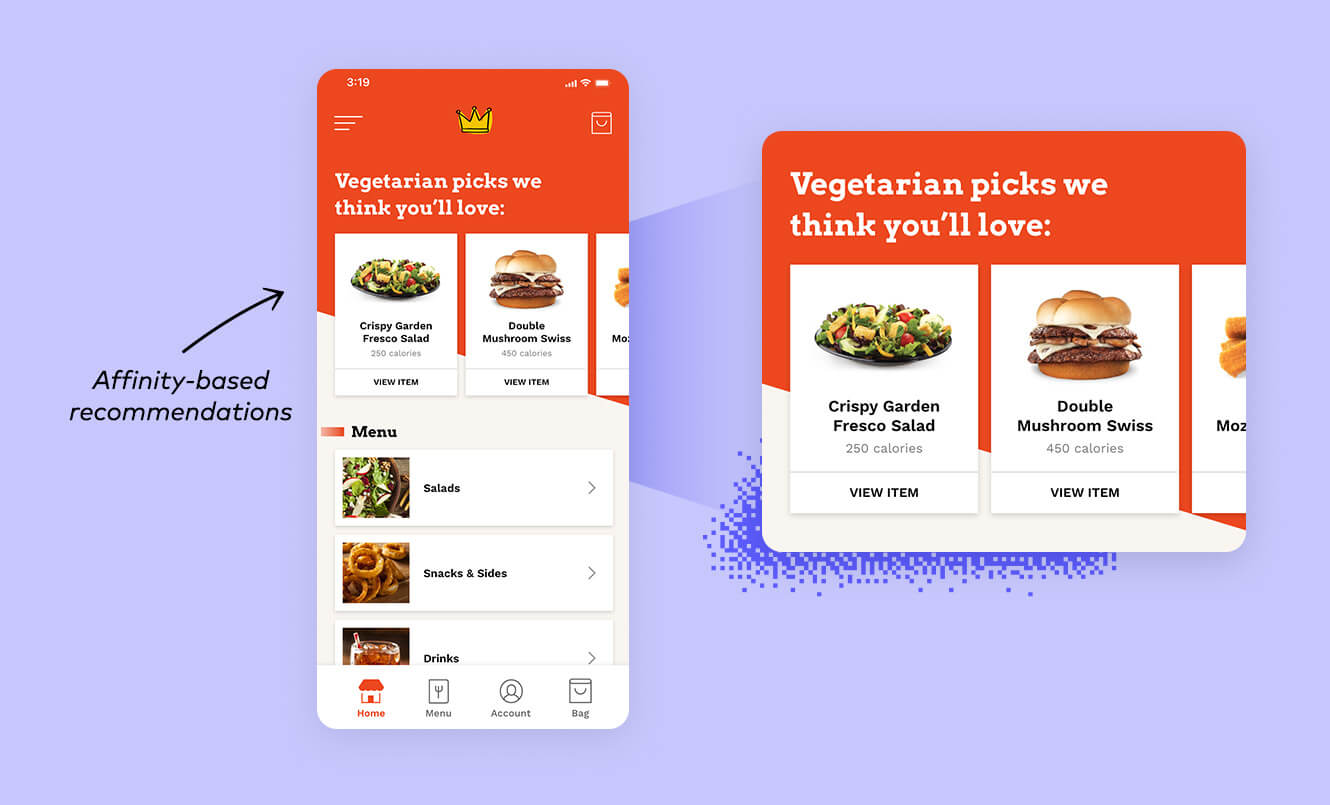
Product recommendations using affinity-based data like dietary preferences (shown above) offer a personal touch that goes beyond a common app experience

Recommendation campaigns don’t have to be limited to products, either. Since mobile apps are usually at the core of the QSR loyalty program, special offers and coupon experiences can be tailored to users as well. These can include store-level promotions or those personalized for loyal members to drive higher engagement and increase revenue.

Dynamic Menus

Serving a single, static menu is a thing of the past, especially given each restaurant has its own unique inventory, promotions, pricing, types of patrons, and more. This is why real-time menu personalization across selling channels, including mobile applications, is so important to QSRs.

On top of every individual guest having their own needs and preferences, here are a few other factors that necessitate different menu experiences:

  • Pickup vs. delivery guests:If both delivery and pickup fulfillment options are available, each can have its own menu to reflect the different ordering parameters (i.e. no frozen goods for delivery), pricing, and so forth (on top of customer preferences).
  • Different day-parts: There are different product catalogs and menus for different parts of the day: breakfast, lunch, and dinner, which can be accounted for with algorithms that feature a unique set of business rules for each to ensure the most accurate offers, messaging, and product recommendations are shown throughout the day.
  • Known vs. unknown users: Experiences can be tailored to highlight menu items that are relevant to known users or remove those that are unfit according to their preferences or dietary restrictions. In practice, a vegetarian customer can automatically be served a menu without any meat options, or a parent may see kid’s meals prominently featured on display.
  • Loyalty members vs. regular customers: A user not yet enrolled in a customer loyalty program may see a message to sign up or a special offer that would be unlocked by doing so, while an existing loyalty member may see a menu populated with point values to incentivize participation as well as other recommendations, content, and offers in line with their past purchase history and affinities.

The goal is to reduce friction throughout the ordering process and guest experience, which can be further streamlined for existing customers by implementing “Click & Collect” or “Or It Again” experiences. This would provide them with the option to quickly reorder their last order, with personalized recommendations supplemented to promote new products and increase check size.

Personalized Push Notifications

Mobile apps present QSRs with the added benefit of being a convenient, consistent channel to send notifications and proactively engage with customers in a way that is personalized and relevant to each individual’s unique situation.

Push notifications are especially helpful for QSRs looking to convert new mobile app users into loyalty program members. For example, content and messaging designed to promote loyalty program sign-ups can be both A/B tested to determine the best-performing variations overall as well as personalized to different segments based on data from the current session, previous interactions, and even historical transactions at the store (for both identified and unidentified customers), increasing the likelihood of conversion.

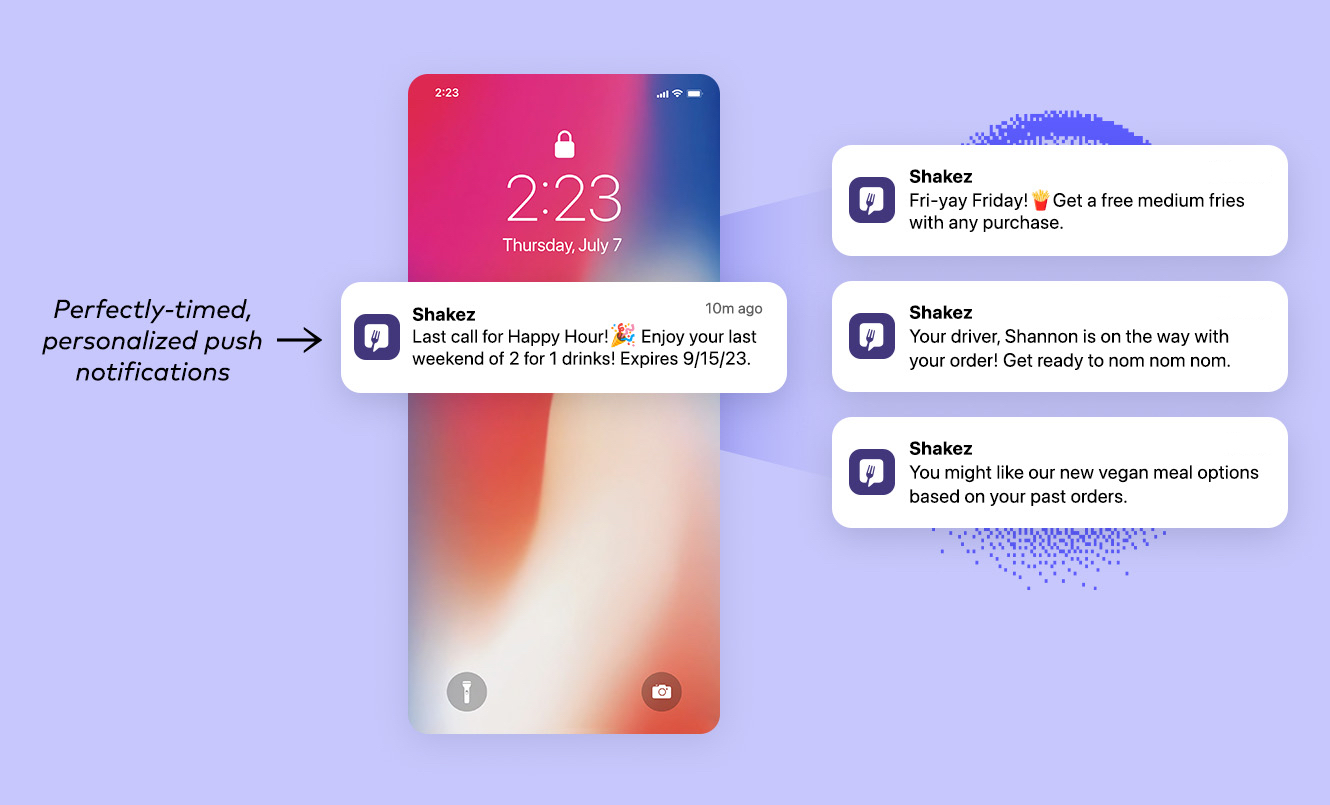
Notifications, either delivered in-app or via push, can also be used to deliver the following tailored messages for different customer-types:
  • Reminders to order again
  • Coupon expiration countdowns
  • Loyalty tier status
  • Exclusive offers or deals
  • Referral incentives

QSRs can take control of the customer journey by incorporating push notifications into the mobile app experience

Operational efficiencies, driven by personalization

Mobile app personalization can also improve QSR operations through the optimization of order fulfillment workflows. For example, pick-up order preparation can start when the customer gets close to the restaurant (based on mobile geo-location) vs. at the point of order confirmation. This eliminates situations where orders sit on the pick-up shelf for extended periods of time and ensures the highest quality and freshness of food for increased customer satisfaction.

Optimizing every experience

A/B testing is a powerful approach that can be seamlessly executed to ensure the most relevant campaigns are launched for a given audience or KPI, whether product recommendations, dynamic menus, or push notifications. Deep learning can also be used to predict the next best series of product recommendations, with the right QSR personalization platform able to train the models to understand and execute against specific nuances only found in the restaurant industry (e.g. take rate says less about business impact than check size).

The future of the app-driven QSR customer experience

Mobile apps represent a huge opportunity in QSR, as they provide data-rich, loyalty-deepening experiences that cannot be replicated in-store or via the drive-thru. Teams can gain a competitive advantage by delivering the tailored experiences consumers have come to expect across industries. Doing so through personalized product recommendations, dynamic menus, and push notifications will not only positively affect order fulfillment workflows and the larger customer experience, but also foster loyalty and increase key business KPIs.