


This article was originally published in QSR Magazine.
Imagine this: a customer pulls into a drive thru at their favorite QSR craving a snack. Something salty, like French fries, or maybe something a little more portable – a milkshake? They’ve only got a couple of minutes to decide before the car behind honks them into an impulse decision.
Wouldn’t it be nice if the menu board already knew what the customer wanted?
This reality is possible with the right personalization strategy and capabilities, but there’s a simple reason it’s uncommon: most QSRs are asking the wrong questions about how to get there. While they’ve been quick to try and translate some of the success eCommerce companies have seen with personalization, QSR is a unique vertical with an exclusive set of consumer behaviors that, when not catered to accordingly, can cause businesses to miss out on revenue and opportunities to forge loyal relationships.
But there’s good news – by asking the right questions from the start, QSRs can more quickly activate personalization into real revenue impact for restaurants and more engaging experiences for consumers.
So, what should I be asking?
Mobile has become a preferred channel for many QSR customers, with takeout and delivery on the rise. As such, personalization for those users is a given for most solution providers – for known mobile consumers, QSRs can make product recommendations based on a user’s previous orders and streamline order pickup. But for all its success, mobile commonly represents just 10% of transactions and takes longer to generate incremental revenue than personalizing for unidentified drive-thru visitors, which represents a larger pool of potential.
By opting for a QSR personalization vendor that is fully integrated with the outdoor menu board and even self-serving kiosks, QSRs can leverage contextual data such as the restaurant location, the weather, traffic, time of day, that restaurant’s product popularity, and current inventory to tailor the digital ordering experience and increase the likelihood of turning these unknown users into known loyal customers.
By incorporating contextual factors like restaurant location, product popularity, and time of day, QSRs can personalize the experience for 100% of guests
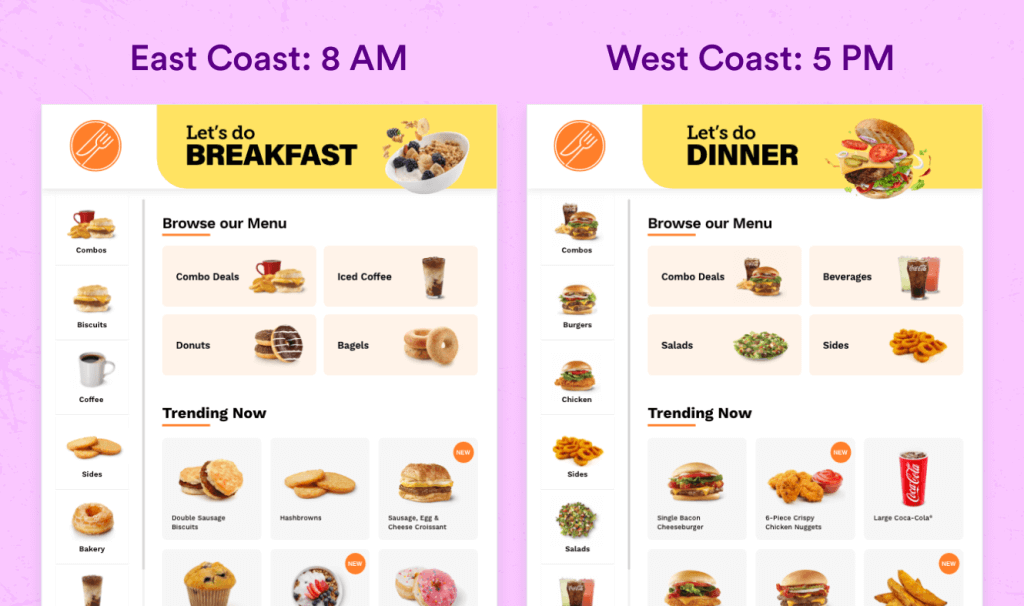
Serving the right menu assortment is crucial to a better consumer experience, and QSRs already have the data they need to activate. However, one major insight is to examine and recommend the most relevant items at the store level – not the regional or state level – which allows the restaurant to be more accurate in their delivery and product inventory management.
Product catalogs and menus should also adapt to different times of day, the weather, as well as known user preferences (vegetarian, coffee lover, breakfast buyer). For example, if data shows that cheeseburgers sell well around dinnertime at a specific store, the menu board should reflect that and leverage suggestive selling to recommend a complementary item, like a side or dessert, not a second cheeseburger.
Similarly, a QSR wouldn’t want to highlight a hot drink in the heat of the summer, or soft serve if the ice cream cone machine was down – all important factors that are considered with the right business rules and decisioning engine.
Here’s where you can really make your personalization work harder for you. With the right decision engine in place to manage the menu, recommendations, and even experimentation, you can more deeply evaluate performance through machine learning.
For example, if a restaurant frequently recommends a fountain soda, algorithms can review every check that product was included in to understand the impact of recommending a fountain soda against various KPIs (i.e., check size, revenue, etc.) as well as across channels, so they know what needs to be optimized.
Today, deep learning recommendation algorithms that go beyond statistical analysis are more widely available and can predict what experience would most effectively move the needle on a specific KPI. And for QSRs, not all metrics should be weighed equally – for example, while commonly effective for other verticals, take rate tells a restaurant less about their business results and incremental revenue than check size.
During the digital acceleration brought on by the pandemic, consumer experiences were completely reimagined, with customers expecting the same quality of experience in-store that they’ve become accustomed to online. In response, QSRs have rushed to meet their needs, and are now investing more heavily in better personalization technology in their stores, using digital menu boards, self-serve kiosks, or store-aware online channels to connect the dots between their mobile app and their in-person experience.
But for QSRs to truly embrace personalization, it all starts with the right foundation. Asking the right questions early in the process – whether during an RFP or an internal evaluation – is the key to effective engagement. As the better they are at meeting consumers’ needs in the moment, the more likely that consumer will be a loyal advocate for the brand.
此内容由惯性聚合(RSS阅读器)自动聚合整理,仅供阅读参考。 原文来自 — 版权归原作者所有。