





 Summarize this articleHere’s what you need to know:
When the web came to be in the 1990s, software development was built upon monolithic, all-in-one architecture that combined the code for the front-end user interface and back-end data access. Back then, entrepreneurs were encouraged to “move fast” and go to market with “minimum viable products” to achieve a make-or-break competitive advantage over their digital laggards.
However, over the past decade, the ideology behind monolithic architecture has rendered these large applications difficult to understand, manage and adapt to current technological standards. Saddled with tech debt, companies set out to find a new approach to customer experience work that would address the need for greater customization, speed, and scale in managing different technologies within the stack.
Fast forward and today, MACH architecture is quickly closing that gap and becoming the industry standard – but what is MACH, how does it relate to composable architecture, how does it differ from a monolithic or composable setup, and what are the benefits to personalization?
MACH, or Microservices, API-first, Cloud-native, and Headless, is a rapidly growing approach to building modern digital technology stacks. MACH technologies fuel what’s called composable infrastructure, made up of pluggable, scalable, and replaceable elements that can be continuously improved through agile development to meet evolving business needs and requirements.
Learn more about how Dynamic Yield is MACH-certified and built for enterprise-grade personalization.
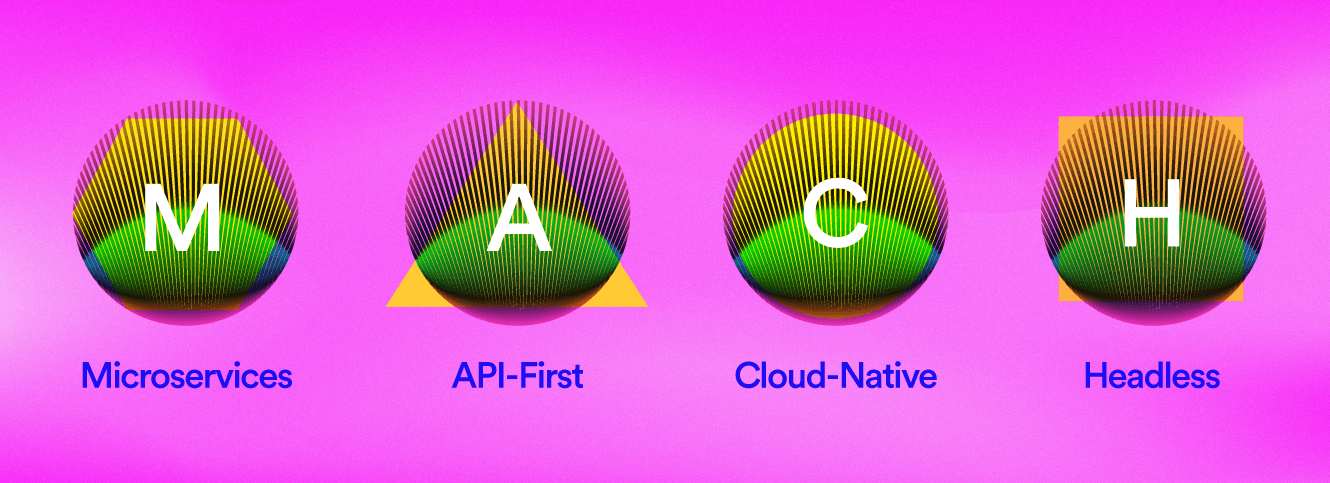
Let’s take a closer look at each of the four key principles of MACH technologies:
Microservices refers to a structural style that breaks apart large applications into smaller, loosely coupled services that take on a specific process without depending on other services and can be developed, deployed, and scaled independently.
API-first means the service or component is designed and built around its API (Application Programming Interface), rather than a user interface, allowing them to more easily communicate and interact with one another.
Cloud-native refers to solutions that are designed to be deployed in a cloud computing environment, which provides greater scalability, security, reliability, and other features. According to a Gartner study “Cloud-native platforms will serve as the foundation for more than 95% of new digital initiatives by 2025 — up from less than 40% in 2021.”
Headless involves an approach to software design where the front and back ends are decoupled, enabling the back end to potentially power several front-end platforms via APIs, each without affecting one another or the overall structure. To learn more about the concept, check out our comprehensive technical guide to headless commerce.
The easiest way to understand the difference between composable enterprises fueled by MACH technologies and those built upon traditional architecture is to walk through the history of enterprise-level software development.
Traditionally, to quickly develop a minimum viable product, all the different functions of an application were tightly coupled and packaged together in a single codebase. This allowed businesses to go to market quickly and stake early dominance against competitors. However, once they engaged enough customers and matured their businesses, they often had to bring on an increasing number of point solutions to solve very specific problems, leading to vendor bloat. Businesses were left with massive systems they couldn’t change without affecting the entire system, leading to difficulties in scalability and flexibility.
Understanding the limitations of this approach, headless platforms started gaining prominence over the past decade. Many monolithic enterprises decoupled their front and back ends to invite third-party solutions to improve their offering for themselves and clients. However, these headless solutions still weren’t generic enough to effortlessly integrate with new services, as their components still stemmed from the original monolithic and proprietary architecture.
To combat this, composable architectures, or modular “swappable” architectures, were designed to foster an ecosystem of pluggable, scalable, replaceable and improvable components. Each MACH-certified service comprises a component responsible for a specific task and can be developed, deployed, and expanded independently.
Many businesses are finding the value in future-proofing their tech stacks through composable technology. In fact, MACH Alliance research shows, as of 2022, “79% of enterprises are on the move from monolith to MACH.”
To further understand the difference between composable architecture using MACH-based technologies and traditional monolithic setups, let’s see how personalized experiences would need to be delivered using each:
Personalization with a monolithic architecture: Marketers would have to build and maintain in-house solutions to help them target, test, analyze, and serve tailored content across every channel (which requires significant know-how and resources) or suffer from the constraints of the basic CMS/eCommerce platform capabilities. This is part of the reason why personalization technology came to be: Businesses can now skirt these issues by dynamically injecting different content throughout the site.
Personalization with MACH architecture: Changes could be rapidly developed within an organization, with different teams working on different parts of the application in parallel and making changes to one service, such as their CMS or CDP, without affecting the rest. Additionally, they could easily plug a new vendor’s MACH-fueled service into their ecosystem if they offered a valuable solution.
MACH-fueled technology brings multiple wins to technical and business teams, including:
Greater development agility
In MACH architecture, microservices allow for different teams to deploy any needed changes without impacting the other modules. Because it is cloud-based, the environment is more open to scaling and can make frequent deployments as needed.
Seamless channel connectivity and scalability
Because MACH-fueled services provide an interface (through APIs) to the front end, multiple user touchpoints can be connected to the back end without requiring a redesign – for example, progressive web apps, kiosks, smartwatches, voice interfaces, and so on. Only one system has to process information, so there is less development effort required to support all touchpoints, and consistency can be maintained across them.
And since MACH applications are cloud-based, they can automatically load balance, ensuring services don’t go offline.
Flexible integration management
The MACH method allows for easier systems integration, both internal and external.
Data can be shared between services via APIs regardless of the programming language or technology used. Additionally, its cloud-native factor means it can easily integrate with other cloud services, like databases, storage, and messaging systems. This flexibility also extends to changing integrations, reducing vendor lock-in, and creating greater opportunities to trial and test new front-end services without affecting back-end services.
Increased data protections
API-connected communications between these modular, independent components additionally help to guardrail against vulnerabilities as the flow of data and interactions between components reduce the chance of security breaches. Additionally, rather than testing the entire system as a whole, testing can be performed on individual components, providing more focused and specific analysis.
Always up-to-date
The MACH Alliance article” 5 Conversations Business and Tech Teams Should Have About Enterprise Data Security,” explains that since monolithic software often has layers of updates and patches built into its operating system, it’s not only more prone to vulnerabilities, but it’s also less likely to be updated in a timely fashion. And since changes or redesigns to the front end are also deployed in tandem with back-end security updates, organizations are often willing to risk staying on outdated versions of software to maintain business as usual. Cloud-based software like Dynamic Yield can automatically deploy the latest updates in security and privacy regulations to its platform without creating any additional dependencies, future-proofing the technology.
By integrating personalization platforms into their MACH architecture, businesses can stay ahead of the curve and meet the rising expectations of consumers for tailored, relevant experiences across all touchpoints.
Limited by legacy internal systems and a monolithic eCommerce platform, Canadian luxury menswear retailer Harry Rosen struggled to match its online shopping experience with the personalized touch delivered in-store for nearly 70 years. Exacerbated by COVID, Harry Rosen’s website was unable to support the increased volume of traffic, leading the team to pursue a more sustainable, MACH-based approach.
Its mission of going headless and partnering with best-in-class tools only took five months, and the payoff was significant: Harry’s online business grew 3x in 2020, and has continued to grow at over 20% annually since. The company also found that a headless set-up enabled the foundations for omnichannel journeys as well as new organizational growth opportunities.
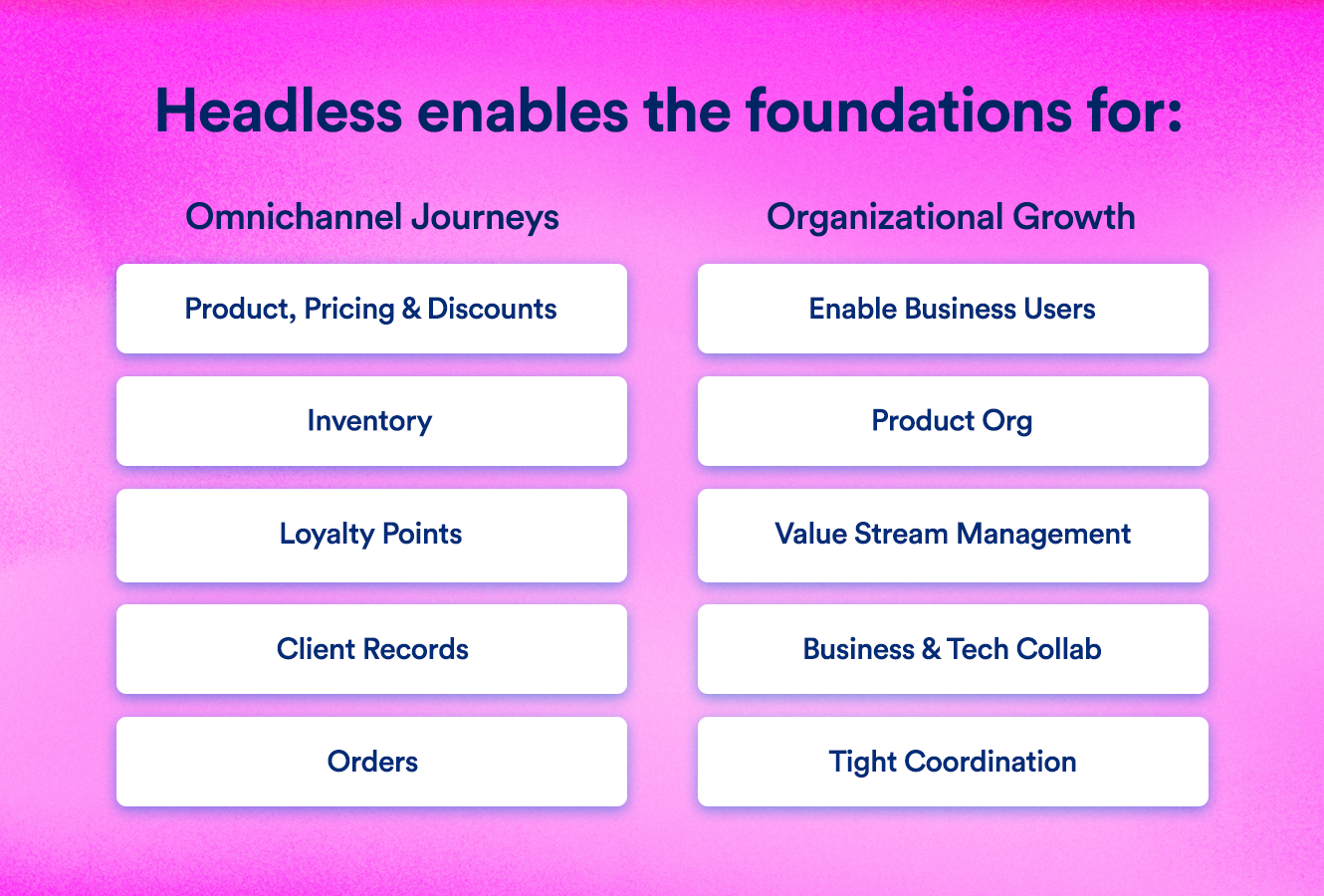
How headless impacts the entire organization, a slide from Harry Rosen’s Keynote on Digitizing Luxury Experiences in a Headless World
To learn more about Harry Rosen’s MACH journey, tune into this on-demand Talk from Tovi Heilbronn, the company’s Director of Digital Product and Experience at a recent Personalization Pioneers event.
MACH doesn’t only stand for an approach to tech architecture, it also represents the consortium of organizations that advocate for its core principles. The MACH Alliance was developed not only to pioneer the transformation to composable tech but also support businesses along their journey through it.
A “not-for-profit industry body that advocates for open and best-of-breed enterprise technology ecosystems,” the MACH Alliance is a vendor-neutral institution that promotes expert-led insights and research to build digital experiences that are scalable, flexible, and easy to maintain with composable technology. The alliance, founded in 2020 by Commercetools, Contentstack, EPAM Systems, and Valtech, has reached over 70 members in less than two years, including Dynamic Yield for MACH-enabled personalization as well as vendors from other categories such as commerce search, media creation, and campaign management – plus, 60+ ambassadors from leading brands globally.
Through easier integration with other system APIs, personalization tech can more easily speak to and collect insights from other channels to power more deeply tailored interactions while also adhering to strict data security protocols. As MACH enables customization, speed and scale, we’ll see more brands put personalization at the heart of their digital customer experience ecosystem.
此内容由惯性聚合(RSS阅读器)自动聚合整理,仅供阅读参考。 原文来自 — 版权归原作者所有。