

惯性聚合 高效追踪和阅读你感兴趣的博客、新闻、科技资讯
阅读原文 在惯性聚合中打开

推荐订阅源

云风的 BLOG
云风的 BLOG
P
Privacy International News Feed
Vercel News
Vercel News
Threat Intelligence Blog | Flashpoint
博客园 - 叶小钗
F
Fortinet All Blogs
Security Archives - TechRepublic
L
LINUX DO - 最新话题
AWS News Blog
AWS News Blog
Engineering at Meta
Engineering at Meta
Attack and Defense Labs
Recent Announcements
Recent Commits to openclaw:main
PCI Perspectives
PCI Perspectives
Cloudbric
Cloudbric
AI
AI
cs.CL updates on arXiv.org
IT之家
IT之家
Exploit-DB.com RSS Feed
J
Java Code Geeks
M
MIT News - Artificial intelligence
Cisco Talos Blog
Cisco Talos Blog
V2EX - 技术
V2EX - 技术
Webroot Blog
Webroot Blog
Microsoft Security Blog
Cyberwarzone
Cyberwarzone
博客园 - 聂微东
G
Google Developers Blog
W
WeLiveSecurity
罗磊的独立博客
P
Privacy & Cybersecurity Law Blog
阮一峰的网络日志
阮一峰的网络日志
A
About on SuperTechFans
WordPress大学
WordPress大学
The GitHub Blog
The GitHub Blog
T
Tailwind CSS Blog
V
Visual Studio Blog
Application and Cybersecurity Blog
H
Hackread – Cybersecurity News, Data Breaches, AI and More
S
Secure Thoughts
Apple Machine Learning Research
Hugging Face - Blog
Hugging Face - Blog
Google DeepMind News
雷峰网
雷峰网
cs.AI updates on arXiv.org
F
Full Disclosure
Blog — PlanetScale
Blog — PlanetScale
The Last Watchdog
The Last Watchdog
P
Proofpoint News Feed

Mastercard Dynamic Yield

Email, SMS and push done right: A marketing leader’s guide to channel selection How Valamar engages travelers earlier with real-time booking context Gartner Recognizes Mastercard Dynamic Yield as an 8‑Time Leader in Personalization Engines— Mastercard Dynamic Yield 2026 Personalization Maturity: Disruption Is Redefining E-Commerce Success Modern customer journey orchestration: Latest capabilities, best practices and omnichannel strategies — Mastercard Dynamic Yield Saks Fifth Avenue Elevated Luxury With AI Personalization 2025 Personalization Maturity Report for E-commerce - ES — Mastercard Dynamic Yield 2025 Personalization Maturity Report for E-commerce - PT — Mastercard Dynamic Yield How to Drive More Subscribers to Your Mailing List: Proven Strategies for MarketersMastercard Dynamic Yield Reconnect by Mastercard Dynamic Yield: Smarter Customer Journey Orchestration Send-Time Optimization — Mastercard Dynamic Yield Channel Prioritization — Mastercard Dynamic Yield Real-Time Adaptation and Dynamic Optimization — Mastercard Dynamic Yield Post-click Experiences — Mastercard Dynamic Yield Search Ranking Optimization — Mastercard Dynamic Yield Visual Search — Mastercard Dynamic Yield Semantic Search — Mastercard Dynamic Yield How Bergzeit Increased Conversions 3x with Conversational AI Email Deliverability Best Practices: Reach the Inbox. Deliver the Experience. The enterprise guide to IP warming: Boost deliverability, ensure compliance, and power seamless journeys Visual Search Meets Multimodal AI: A New Era of Product Discovery Where human ingenuity fits in the AI-driven marketing era Infographic: The state of personalization maturity in e-commerce - 2025 AI and Personalization Are Revolutionizing E-commerce Search Transform product discovery with Experience Search: AI that understands your shoppers AI Fuels New Demands for Personalization — Is E-Commerce Maturing Fast Enough? From Fragmentation to Connection: Mastering User Identification for Personalization — Mastercard Dynamic Yield 2026 Personalization Maturity Report for E-commerce - PDF — Mastercard Dynamic Yield Add To Cart Recommendation Modal — Mastercard Dynamic Yield Shoppable Video Notification — Mastercard Dynamic Yield Dynamic Yield by Mastercard Recognized as a Leader by Gartner® and Forrester Leroy Merlin Gains 32% Purchases with ML Recommendations Conversational Commerce: Your Guide to This Market-Shifting Technology Your Global Test Could Be Limiting Your Personalization Growth — Mastercard Dynamic Yield Personalize with Empathy to Meet Evolving Customer Needs The Resource Constraints Blocking Banks’ Personalization Gain Steering by Data: How to Avoid Assumptions and Motivate Your Team — Mastercard Dynamic Yield AI and personalization can close the empathy gap between brands and their customers A Leader in the Gartner Magic Quadrant for Personalization - Dynamic Yield Black Friday Is Coming—Is Your Personalization Strategy Airtight? Personalization Blueprint Survey - Dynamic Yield by Mastercard How Personalization Fuels Success in Latin America's Digital Boom Signet Jewelers Sees 88% Conversion Lift from Personalization Solving Data Issues for Financial Services with Personalization — Mastercard Dynamic Yield How to Executive Reporting Can Help You Grow Your Personalization Program Breaking the personalization barrier for banks Bring the personal back to shopping this holiday season​ with Shopping Muse Dynamic Yield makes Personalization a Breeze for Issuer Dynamic Yield by Mastercard Is Making Personalization a Breeze for Banks How to Deliver a Less Frustrating Online Shopping Experience VIDEO: Banking's Personalization Revolution: Data-Driven Transformation Bunnings' Buyer Center Casas Bahia's Buyer Center Magalu's Buyer Center Carrefour's Buyer Center 3 Tips to Integrate GenerativeAI into Your Personalization Workflow — Mastercard Dynamic Yield TUI Cruises Sees 10.3% Uplift in Add to Cart from Personalization The Revenue Gains From Personalization That FIs Can’t Ignore Calling All UK Banks: Personalisation Is Crucial to Meeting the New Consumer Duty Mandate What Marketers Miss in the GenAI Discussion vidaXL's Buyer Center The 2 Breakthrough Technologies Driving Smarter Product Recommendations Fashion Retailers: Your Product Feed Needs Spring Cleaning, Too — Mastercard Dynamic Yield Tommy Hilfiger's Buyer Center G-Star Raw's Buyer Center Hunkemöller's Buyer Center Here's Why Your Customers Are Tuning You Out Intersport's Buyer Center How AI Is Ushering in the Future of Interactive Commerce Mastering Channel Prioritization: How to Optimize Re-Engagement with a Winning Strategy Clark's Buyer Center Optimized messaging for purchase completion Affinity-powered triggered messages - personalization use cases Anticipate customer's next best item - personalization use cases Charlotte Tilbury's Buyer Center Rituals' Buyer Center The Dynamic Duo of A/B Testing and Personalization Müller's Buyer Center Next's Buyer Center La Redoute's Buyer Center Why Gen Z Craves Personalized Restaurant Experiences The human advantage in the age of AI and personalization Sky Personalizes Subscription Management for Millions On Leverages Personalization to Build Community Build-A-Bear Workshop's Buyer Center Oak Furnitureland's Buyer Center Coach's Buyer Center The Perfect Match: Marry Your CMS and Personalization Systems for Customer Love 4 Signs You Need to Move Beyond Your ESP's Email Personalization Functionality Sainsbury's, meet Dynamic Yield Charles Tyrwhitt's Buyer Center Burberry's Buyer Center Personalization in QSR: The Possibilities You Didn’t Know Existed The State of Personalization Maturity in Grocery/CPG Chanel's Buyer Center Swarovski's Buyer Center Building the Right It: How “Pretotyping” Guides Product Decisions with Concrete Data The Power of a Primary Audience Strategy for Financial Services Similarity Badge — Mastercard Dynamic Yield How Deep Learning is Adding Predictive Personalization Prowess to User Affinity Profiling
Why Furniture Brands Shouldn't Use Outdated Segmentation Strategies
Harry Hanson-Smith Regional Vice President of Sales · 2023-04-07 · via Mastercard Dynamic Yield

Summarize this articleHere’s what you need to know:

  • Furniture brands need to understand customer intent to personalize the shopping experience. Traditional segmentation based on demographics is no longer effective.
  • Intent-based segmentation identifies customers at different stages of the buying journey, allowing for tailored messaging and offers.
  • Segmentation strategies should consider various intent-driven factors, such as browsing behavior, product interactions, and search queries.
  • Leveraging customer data and machine learning can help furniture brands build accurate intent-based segments.
  • By implementing intent-based segmentation, furniture brands can improve customer engagement, conversion rates, and overall business performance.

We’re living in the age of consumer-centric commerce, where the buyer has seemingly infinite options to choose from. And the expectation from shoppers to see their unique needs and preferences met throughout the buying process is even higher, especially when it comes to big-ticket items such as sofas, beds, and dining furniture. So how can furniture retailers differentiate themselves within a saturated market and make sure the experiences they deliver resonate with a variety of audiences at different points in the customer journey? The answer lies in how well they are able to personalize, which begins with proper segmentation. 

Old habits = outdated segmentation principle

Today 8 out of every 10 consumers have bought furniture on the Internet and over 90% of industry growth is from online sales. That points to a major opportunity for retailers, but only if they prioritize the types of contextualized experiences that elicit sales and drive long-term brand loyalty. Yet many furniture brands still implement traditional segmentation strategies to personalize experiences based on outdated factors such as socio/economic status. Even previous interactions and purchase history can no longer accurately predict what a customer will be interested in today. For example, while a typical sofa could last anywhere between 7 – 15 years, a customer may want to replace it sooner due to a change in lifestyle, location, or personal taste. This is why there should be no place for antiquated demographics or rigid adherence to historical trends within the online furniture experience, and beyond. 

Intent is the new digital currency

Each audience has different needs, wants, and preferences which furniture brands can capitalize on if they recognize the signals. This can be achieved through intent-based segmentation, which divides shoppers by their demonstrated or understood readiness to buy. A variation of the classic marketing funnel theory that depicts individuals progressing through clear stages on their (decidedly non-linear) path to making a purchase, intent segmentation seeks to identify the correct buying stage and adjust the site experience, messaging, and navigation accordingly. In practice, brands can break down these audiences by: 
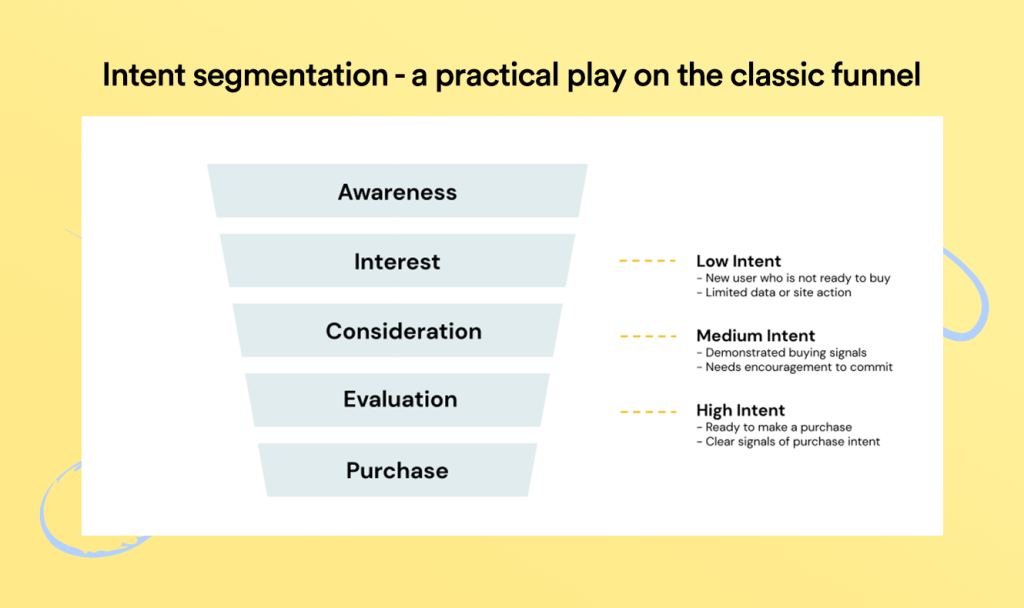
  • Low Intent – New and exploring users with limited data or site action
  • Medium Intent – Some buying signals but users need encouragement
  • High Intent – There are clear signals and the users are ready to buy

Example of how an intent-driven segmentation strategy for furniture brands compares to the traditional funnelIntent segmentation meets customers in the moment they’re in, nudging them down the funnel. And because this method is driven by user action, it flexes with furniture site visitors as they go through the buying stages, and then restarts after a purchase or time between sessions. 

Understand intent, avoid personalization faux pas

Not only does tailoring the digital shopping experience to an audience’s intent level help optimize the purchase funnel, but it can also mean furniture brands don’t mistakenly deliver the wrong content, messages, or offers at the wrong time for the inverse effect.

Take a few of these common situations, which can be avoided and rectified with intent segmentation:

Being overtly pushy with low-intent audiences

Low-intent furniture browsers are not ready to make purchase decisions, so avoid marketing messages around urgency, scarcity, or even discounted sale information.

Instead, offer guided selling with simple-to-use tools at the product category level that help them identify the best product for their needs, e.g. product quizzes and guides. Use plain-speak widget copy to explain why they’re seeing a particular recommendation and offer incentives as a reward for taking actions like a first purchase as well as a loyalty program or newsletter signup.

Distracting medium-intent shoppers

Medium-intent users may have demonstrated some buy signals, but not so many that their buying intent is very clear. They need a push to finalize a buying decision but can be put off by too much choice or overtly promotional messaging. Keep them focused with product recommendations based on items they’ve demonstrated an interest in as opposed to the most popular. Use exit intent experiences, inactive tab notifications, recently viewed recommendations, and comparison pages to help get them back on site and to their preferred purchase options. Live chat can help seal the deal.

Over discounting high intent browsers

This audience is ready to buy, so make the path as linear as possible from site entry to exit. They’re also not afraid to spend more than the average site visitor. Secure sales and boost revenue by focusing promotional messages on complimentary products and accessories rather than on discounting the primary purchase. Finally, win them over with relationship builders in the form of loyalty points, cards, or rewards messaging. Whatever the experience, it’s important to validate its impact through proper A/B testing, which can help teams ensure positive results and optimize them over time.

The modern purchase funnel requires a modern segmentation strategy

Furniture brands and online commerce players alike need to guarantee they speak to customers at the right moment and don’t put too much stock in historical behavior as a predictor of future transactions. Thankfully, the signals traced to intent can be incredibly effective, allowing teams to finally say “goodbye” to ineffective and antiquated approaches to segmentation, and “hello” to higher engagement, conversions, and sales.