惯性聚合 高效追踪和阅读你感兴趣的博客、新闻、科技资讯
阅读原文 在惯性聚合中打开

推荐订阅源

TaoSecurity Blog
TaoSecurity Blog
博客园 - 司徒正美
奇客Solidot–传递最新科技情报
奇客Solidot–传递最新科技情报
博客园 - 【当耐特】
M
MIT News - Artificial intelligence
罗磊的独立博客
让小产品的独立变现更简单 - ezindie.com
Stack Overflow Blog
Stack Overflow Blog
The GitHub Blog
The GitHub Blog
Google DeepMind News
Security Archives - TechRepublic
宝玉的分享
宝玉的分享
N
News and Events Feed by Topic
The Hacker News
The Hacker News
Google DeepMind News
C
CERT Recently Published Vulnerability Notes
F
Full Disclosure
Threat Intelligence Blog | Flashpoint
S
Security @ Cisco Blogs
H
Hacker News: Front Page
L
LangChain Blog
Microsoft Security Blog
Y
Y Combinator Blog
B
Blog RSS Feed
H
Heimdal Security Blog
Google Online Security Blog
Apple Machine Learning Research
博客园 - 三生石上(FineUI控件)
V2EX - 技术
V2EX - 技术
V
Vulnerabilities – Threatpost
Help Net Security
Help Net Security
Hacker News - Newest:
Hacker News - Newest: "LLM"
T
Tailwind CSS Blog
W
WeLiveSecurity
T
Tenable Blog
D
DataBreaches.Net
Martin Fowler
Martin Fowler
Cyberwarzone
Cyberwarzone
Cisco Talos Blog
Cisco Talos Blog
S
Secure Thoughts
O
OpenAI News
L
LINUX DO - 热门话题
Vercel News
Vercel News
阮一峰的网络日志
阮一峰的网络日志
Jina AI
Jina AI
J
Java Code Geeks
Know Your Adversary
Know Your Adversary
IT之家
IT之家
Latest news
Latest news
Cloudbric
Cloudbric

Mastercard Dynamic Yield

Email, SMS and push done right: A marketing leader’s guide to channel selection How Valamar engages travelers earlier with real-time booking context Gartner Recognizes Mastercard Dynamic Yield as an 8‑Time Leader in Personalization Engines— Mastercard Dynamic Yield 2026 Personalization Maturity: Disruption Is Redefining E-Commerce Success Modern customer journey orchestration: Latest capabilities, best practices and omnichannel strategies — Mastercard Dynamic Yield Saks Fifth Avenue Elevated Luxury With AI Personalization 2025 Personalization Maturity Report for E-commerce - ES — Mastercard Dynamic Yield 2025 Personalization Maturity Report for E-commerce - PT — Mastercard Dynamic Yield How to Drive More Subscribers to Your Mailing List: Proven Strategies for MarketersMastercard Dynamic Yield Reconnect by Mastercard Dynamic Yield: Smarter Customer Journey Orchestration Send-Time Optimization — Mastercard Dynamic Yield Channel Prioritization — Mastercard Dynamic Yield Real-Time Adaptation and Dynamic Optimization — Mastercard Dynamic Yield Post-click Experiences — Mastercard Dynamic Yield Search Ranking Optimization — Mastercard Dynamic Yield Visual Search — Mastercard Dynamic Yield Semantic Search — Mastercard Dynamic Yield How Bergzeit Increased Conversions 3x with Conversational AI Email Deliverability Best Practices: Reach the Inbox. Deliver the Experience. The enterprise guide to IP warming: Boost deliverability, ensure compliance, and power seamless journeys Visual Search Meets Multimodal AI: A New Era of Product Discovery Where human ingenuity fits in the AI-driven marketing era Infographic: The state of personalization maturity in e-commerce - 2025 AI and Personalization Are Revolutionizing E-commerce Search Transform product discovery with Experience Search: AI that understands your shoppers AI Fuels New Demands for Personalization — Is E-Commerce Maturing Fast Enough? From Fragmentation to Connection: Mastering User Identification for Personalization — Mastercard Dynamic Yield 2026 Personalization Maturity Report for E-commerce - PDF — Mastercard Dynamic Yield Add To Cart Recommendation Modal — Mastercard Dynamic Yield Shoppable Video Notification — Mastercard Dynamic Yield Dynamic Yield by Mastercard Recognized as a Leader by Gartner® and Forrester Leroy Merlin Gains 32% Purchases with ML Recommendations Conversational Commerce: Your Guide to This Market-Shifting Technology Your Global Test Could Be Limiting Your Personalization Growth — Mastercard Dynamic Yield Personalize with Empathy to Meet Evolving Customer Needs The Resource Constraints Blocking Banks’ Personalization Gain Steering by Data: How to Avoid Assumptions and Motivate Your Team — Mastercard Dynamic Yield AI and personalization can close the empathy gap between brands and their customers A Leader in the Gartner Magic Quadrant for Personalization - Dynamic Yield Black Friday Is Coming—Is Your Personalization Strategy Airtight? Personalization Blueprint Survey - Dynamic Yield by Mastercard How Personalization Fuels Success in Latin America's Digital Boom Signet Jewelers Sees 88% Conversion Lift from Personalization Solving Data Issues for Financial Services with Personalization — Mastercard Dynamic Yield How to Executive Reporting Can Help You Grow Your Personalization Program Breaking the personalization barrier for banks Bring the personal back to shopping this holiday season​ with Shopping Muse Dynamic Yield makes Personalization a Breeze for Issuer Dynamic Yield by Mastercard Is Making Personalization a Breeze for Banks How to Deliver a Less Frustrating Online Shopping Experience VIDEO: Banking's Personalization Revolution: Data-Driven Transformation Bunnings' Buyer Center Casas Bahia's Buyer Center Magalu's Buyer Center Carrefour's Buyer Center 3 Tips to Integrate GenerativeAI into Your Personalization Workflow — Mastercard Dynamic Yield TUI Cruises Sees 10.3% Uplift in Add to Cart from Personalization The Revenue Gains From Personalization That FIs Can’t Ignore Calling All UK Banks: Personalisation Is Crucial to Meeting the New Consumer Duty Mandate What Marketers Miss in the GenAI Discussion vidaXL's Buyer Center The 2 Breakthrough Technologies Driving Smarter Product Recommendations Fashion Retailers: Your Product Feed Needs Spring Cleaning, Too — Mastercard Dynamic Yield Tommy Hilfiger's Buyer Center G-Star Raw's Buyer Center Hunkemöller's Buyer Center Here's Why Your Customers Are Tuning You Out Intersport's Buyer Center How AI Is Ushering in the Future of Interactive Commerce Mastering Channel Prioritization: How to Optimize Re-Engagement with a Winning Strategy Clark's Buyer Center Optimized messaging for purchase completion Affinity-powered triggered messages - personalization use cases Anticipate customer's next best item - personalization use cases Charlotte Tilbury's Buyer Center Rituals' Buyer Center The Dynamic Duo of A/B Testing and Personalization Müller's Buyer Center Next's Buyer Center La Redoute's Buyer Center Why Gen Z Craves Personalized Restaurant Experiences The human advantage in the age of AI and personalization Sky Personalizes Subscription Management for Millions On Leverages Personalization to Build Community Build-A-Bear Workshop's Buyer Center Oak Furnitureland's Buyer Center Coach's Buyer Center The Perfect Match: Marry Your CMS and Personalization Systems for Customer Love 4 Signs You Need to Move Beyond Your ESP's Email Personalization Functionality Sainsbury's, meet Dynamic Yield Charles Tyrwhitt's Buyer Center Burberry's Buyer Center Personalization in QSR: The Possibilities You Didn’t Know Existed The State of Personalization Maturity in Grocery/CPG Chanel's Buyer Center Swarovski's Buyer Center Building the Right It: How “Pretotyping” Guides Product Decisions with Concrete Data The Power of a Primary Audience Strategy for Financial Services Similarity Badge — Mastercard Dynamic Yield How Deep Learning is Adding Predictive Personalization Prowess to User Affinity Profiling
The strategies behind the Amazon recommendation engine
2020-01-14 · via Mastercard Dynamic Yield

This article is an excerpt from Dynamic Yield’s original book about Amazon, “The Chronicles of a Personalization Giant.” An in-depth analysis on how Amazon tailors the customer experience, chapter one outlines the strategy behind the retailer’s product discovery and merchandising tactics, including the sophistication of the Amazon product recommendation engine.

Amazon’s investment in personalization dates back to the early 2000s when it designed a plan to create a robust product recommendation engine after realizing the potential payoffs in becoming a powerful hub for product discovery. And to Amazon, it was clear that building a digital home for product inventory was not enough. Developing and continuously enhancing the Amazon recommendation engine algorithm, with access to an unprecedented amount of consumer data, could completely transform the way customers are matched with items they would most likely be interested in purchasing.

Not only would it work to provide pleasant user experiences, but more importantly, ones that felt personal. Before the era of eCommerce, the way consumers shopped was heavily influenced by the opinions and recommendations of friends and family – a component of product discovery Amazon sought to mimic online. “Discovery should be like talking with a friend who knows you, knows what you like, works with you at every step, and anticipates your needs,” write Brent Smith and Greg Linden, two industry titans specializing in personalization and recommendations at Amazon and Microsoft, respectively. From the onset, the end goal was to harness the power of machines and data to humanize the digital experience for consumers. 

Since filing its first patent for the Amazon recommendation engine in 2001, the company has been uniquely marrying key customer data points across its digital properties to design tailored experiences for both known and unknown site visitors. And while endless variables have contributed to the company’s dramatic rise, its personalization efforts have indisputably played an integral role. As a result, Amazonization has disrupted and eaten up the eCommerce market, serving as a portal for product discovery, all while it continues to rapidly expand its reach into entertainment, subscriptions, food, voice, wearables, and more.

A masterful recommendation strategy

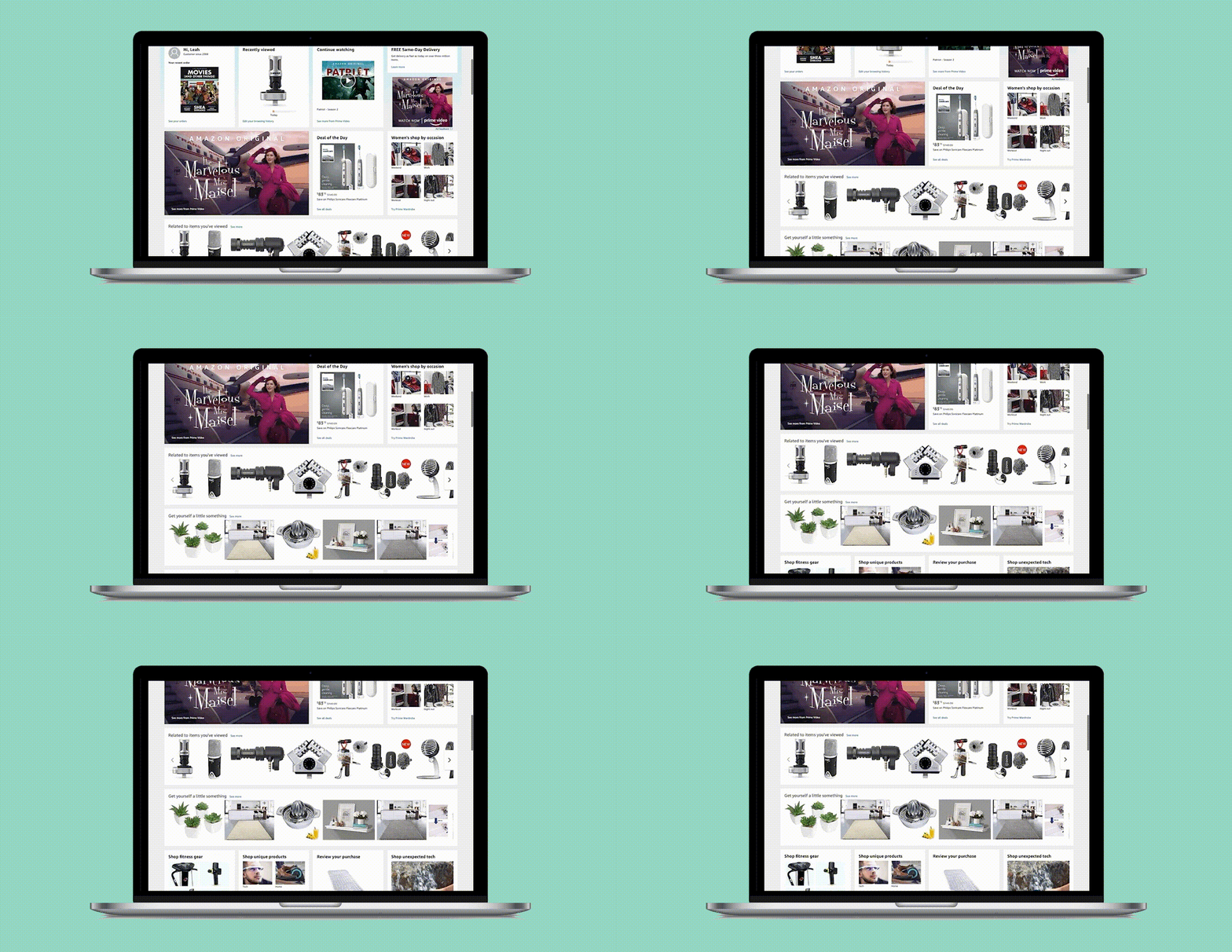
Recommendations truly are the bread-and-butter of Amazon’s personalization operation. By far the most sophisticated and distinguished element of the company’s eCommerce efforts, recommendations are visible across every page, channel, and device, employing dozens of unique and innovative strategies and taking endless forms. Upon conducting our research, 45 different recommendation widgets were visible on the app homepage alone – a true testament to the company’s devotion to promoting product discovery and a signal of the power behind the Amazon machine learning recommendation engine.

Each recommendation widget served is based on a number of variables, including but not limited to:

  • Location
  • Recent purchases
  • Trending: near you / on Amazon / by category / by shopping trend / by season
  • Saved items or lists
  • Deals, bargains, or discounts
  • Purchases other customers have completed after viewing similar products
  • User reviews
  • Curated top picks for customers

As a hub for product discovery, constantly serving recommendations goes back to Amazon’s core belief for retail: never pass up an opportunity to capture a sale. Now that Amazon.com has increasingly become the initial starting point for discovery, the company is doubling down on its top-of-funnel marketing efforts. And a large part of the Amazon recommendation engine revenue generated is a direct result of the company’s sizable investment in personalization.

Having mastered traditional recommendations, Amazon’s approach has matured as it now invests in finding unique ways to uplevel its widgets with unconventional eCommerce tactics. For starters, Amazon tends to include dozens of recommendations on both a single page and also within a single widget. Its eCommerce team has also ensured the experience of browsing through recommendation carousels is consistent across channels, creating a pleasant and familiar user experience on every device. And while Amazon does invest in content discovery, it typically takes the form of banners or email messaging – reserving widgets solely for product recommendations.

The web experience

With millions of products for sale on its site, in pursuit of driving purchases, Amazon relies heavily on recommendations to surface new products tailored to each web user. Never afraid to go a bit overboard, the number of widgets placed across each page is limitless, and the number of products served per widget knows no bounds. 
The mobile experience

Amazon uses its mobile properties as recommendation-focused digital inventory, squeezing as many product and content suggestions on the screen as possible, much like the web experience.

Both the mobile site and app mimic one another, each featuring lengthy homepages with dozens of unique recommendation strategies. For example, some recommendations promote product discovery, while others encourage users to buy items previously purchased before.

The email experience

Amazon finds unique opportunities to leverage email to bring customers back to its site. It views email as prime inventory for showcasing more products and content. Transactional emails often feature recommendation widgets based on previously purchased items, seasonality, and trending products on the site at a given moment. Unlike the web and mobile experiences, however, email widgets are typically limited to just two recommendations per message.

Examples of Amazon’s innovative recommendation strategies

If today’s retailers want to maximize eCommerce conversion rates and revenue, they’ll have to go beyond serving average recommendation experiences. Below are a few of the unique ways Amazon is implementing recommendations, which brands can repurpose and leverage to capture sales and increase average order value (AOV).

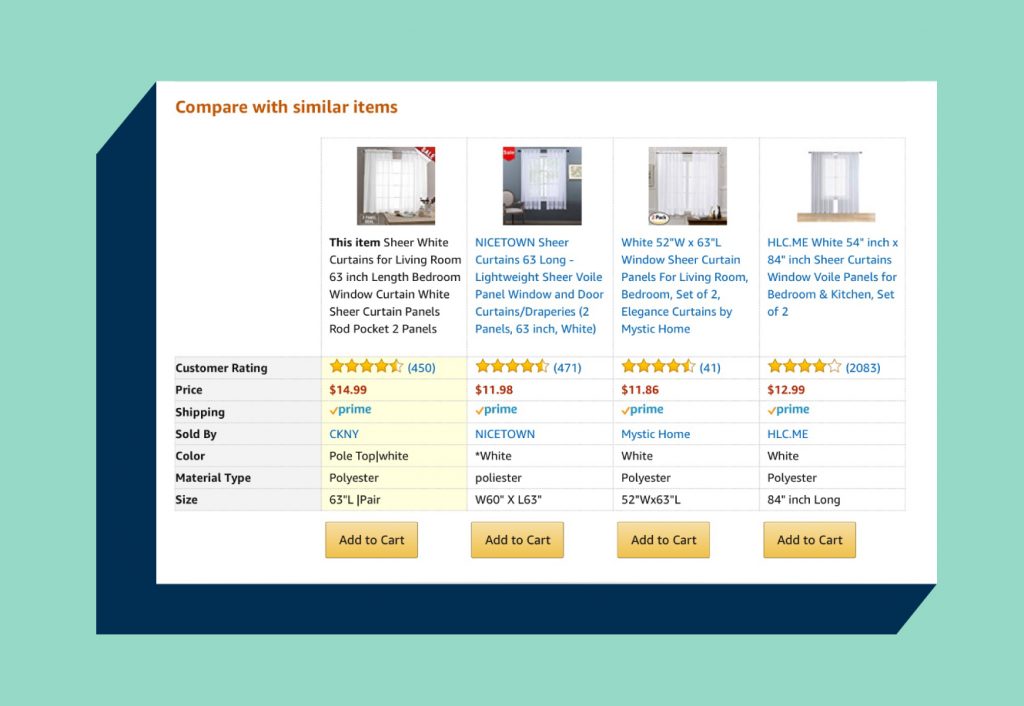
Allowing for easy comparison of similar items

When viewing a product detail page, Amazon places a few recommendation widgets below the fold, appearing after the general info and details about the product in view. This widget, which precedes technical details and product specifications in page order, allows customers to catch a quick glimpse of similar products side-by-side. Details listed include customer ratings, price, delivery information, and size info (when applicable). This widget highlights other available product options and helps site visitors narrow down their purchase decision, allowing them to immediately add the most suitable product to their cart. 
amazon recommendation widget

Nudging users to log-in for better recommendations

It should come as no surprise that today’s brands are able to better personalize site experiences when they know as much about a site visitor as possible. The Amazon recommendation system can tailor experiences on a more granular level when a user is logged in. As a result, it urges logged out and unknown users to sign into their accounts for a richer recommendation experience. For those who do not log-in, the retailer recommends items based on products a user has viewed in that particular session. 

amazon sign in

amazon recommendations single session

Recommending products on category pages 

Amazon goes a step further with its recommendation widgets, placing them not only on product detail pages but across the site, including category and product listing pages. Strategies employed for these widgets include “Recommended for you” and “More top picks for you.” 

amazon product recommendation

Serving subsequent purchase recommendations

Amazon devolves from its standard recommendation widget design to promote products users tend to subsequently purchase after viewing a particular product. A social proof strategy, this approach pushes users further along the purchase funnel by focusing on products most likely to result in a conversion.

complementary product recommendation

Surfacing recommendations for short-term promotions

To create a sense of urgency, Amazon extends recommendations to its time-sensitive product promotions, curating a collection of recommendations from a given day’s “deals.” To further entice users, it lists the previous price of the product, educating users on the savings they will accrue if they choose to purchase the product while it is temporarily discounted.

promotional recommendation

An opportunity to make recommendations work harder

eCommerce merchants may look at Amazon and see the odds stacked against them, but there are endless possibilities when it comes to improving the customer experience which aren’t limited to the retail giant. By taking a page from its book on recommendations, brands can stand taller and reap greater rewards, carving out a piece of the market for themselves.

Interested in deploying Amazon-style recommendations on your site? Learn more about Dynamic Yield’s personalization platform.