


Intel has disclosed advancements in its new frame extrapolation technology, which is engineered to predict user physical interactions during gameplay and generate scenes ahead of time via the processor. This development aims to deliver a continuous visual experience while mitigating control delays.

This architectural shift introduces a novel approach to Artificial Intelligence (AI) frame generation, targeting a primary limitation of existing frame-generation methods: increased latency. Positioned as an evolution of Intel’s XeSS technology, the system analyzes and anticipates player movements before they are rendered on screen.
Traditionally, upscaling solutions like Nvidia DLSS, AMD FSR, and Intel XeSS insert intermediate frames between two rendered frames to increase the frames-per-second (FPS) metric. However, because these generated frames lack fresh hardware input data, players often experience a noticeable delay in control responsiveness. To counteract this issue, Intel is building complementary features designed to forecast motion patterns and behavior within a game. While comprehensive technical specifications remain undisclosed, company executives confirm that multiple ongoing functions aim to optimize multi-frame generation architectures.
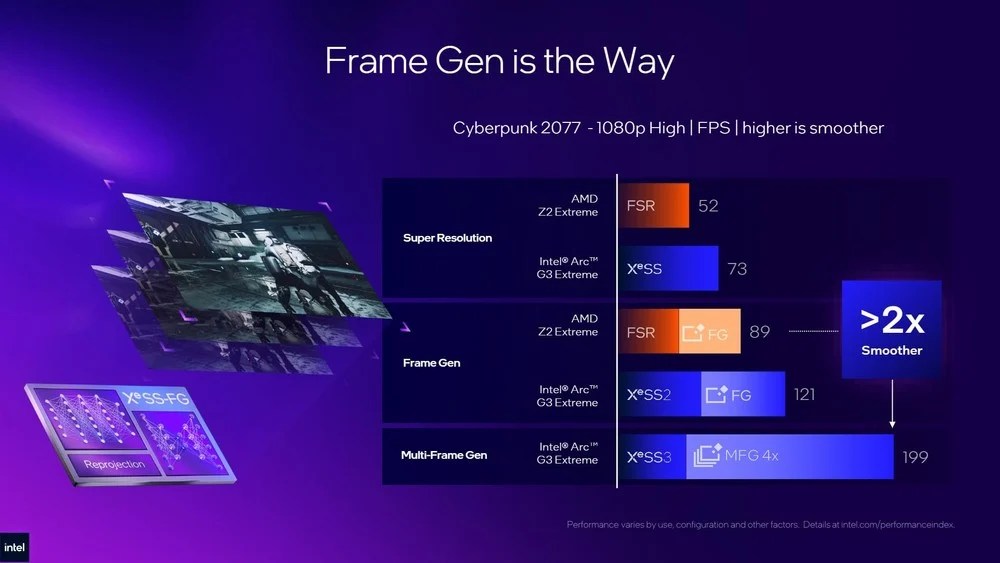
The implementation of this technology holds particular relevance for compact hardware configurations, such as laptops, handheld gaming consoles, and small-form-factor PCs. Utilizing integrated upscaling and frame generation allows these resource-constrained devices to boost visual performance without requiring high-power, standalone Graphics Processing Units (GPUs).
In modern gaming applications, an elevated FPS counter does not automatically equate to true hardware performance improvements, especially if visual consistency cannot be guaranteed at all times. Nevertheless, integrating predictive frame extrapolation provides a viable alternative for standard hardware configurations. The mechanism offers a more fluid gameplay experience, serving as an efficient software solution for casual players prioritizing visual continuity over competitive-grade responsiveness.
Filed in . Read more about AI (Artificial Intelligence), Gaming and Intel.
此内容由惯性聚合(RSS阅读器)自动聚合整理,仅供阅读参考。 原文来自 — 版权归原作者所有。