
惯性聚合 高效追踪和阅读你感兴趣的博客、新闻、科技资讯
阅读原文 在惯性聚合中打开

推荐订阅源

Hacker News: Ask HN
Hacker News: Ask HN
IT之家
IT之家
S
SegmentFault 最新的问题
T
Tailwind CSS Blog
钛媒体:引领未来商业与生活新知
钛媒体:引领未来商业与生活新知
博客园 - 司徒正美
J
Java Code Geeks
博客园 - 聂微东
雷峰网
雷峰网
阮一峰的网络日志
阮一峰的网络日志
The Cloudflare Blog
博客园_首页
大猫的无限游戏
大猫的无限游戏
博客园 - 三生石上(FineUI控件)
让小产品的独立变现更简单 - ezindie.com
博客园 - 【当耐特】
腾讯CDC
Apple Machine Learning Research
酷 壳 – CoolShell
酷 壳 – CoolShell
V
V2EX
宝玉的分享
宝玉的分享
小众软件
小众软件
OSCHINA 社区最新新闻
OSCHINA 社区最新新闻
Hugging Face - Blog
Hugging Face - Blog
月光博客
月光博客
NISL@THU
NISL@THU
T
The Exploit Database - CXSecurity.com
C
CXSECURITY Database RSS Feed - CXSecurity.com
WordPress大学
WordPress大学
有赞技术团队
有赞技术团队
Blog — PlanetScale
Blog — PlanetScale
aimingoo的专栏
aimingoo的专栏
L
LINUX DO - 热门话题
cs.CL updates on arXiv.org
F
Fortinet All Blogs
博客园 - Franky
L
Lohrmann on Cybersecurity
S
Secure Thoughts
量子位
V
Vulnerabilities – Threatpost
Last Week in AI
Last Week in AI
博客园 - 叶小钗
Cyber Security Advisories - MS-ISAC
L
LINUX DO - 最新话题
I
InfoQ
C
CERT Recently Published Vulnerability Notes
Security Archives - TechRepublic
P
Proofpoint News Feed
G
GRAHAM CLULEY
Cisco Talos Blog
Cisco Talos Blog

WeLiveSecurity

Supply chain dependencies: Have you checked your blind spot? Recovery scammers hit you when you’re down: Here’s how to avoid a ‘second strike’ As breakout time accelerates, prevention-first cybersecurity takes center stage Digital assets after death: Managing risks to your loved one’s digital estate This month in security with Tony Anscombe – March 2026 edition RSAC 2026 wrap-up – Week in security with Tony Anscombe A cunning predator: How Silver Fox preys on Japanese firms this tax season Virtual machines, virtually everywhere – but not all protected Cloud workload security: Mind the gaps Move fast and save things: A quick guide to recovering a hacked account EDR killers explained: Beyond the drivers Face value: What it takes to fool facial recognition Cyber fallout from the Iran war: What to have on your radar Sednit reloaded: Back in the trenches What cybersecurity actually does for your business How SMBs use threat research and MDR to build a defensive edge Protecting education: How MDR can tip the balance in favor of schools This month in security with Tony Anscombe – February 2026 edition Mobile app permissions (still) matter more than you may think Faking it on the phone: How to tell if a voice call is AI or not PromptSpy ushers in the era of Android threats using GenAI Is Poshmark safe? How to buy and sell without getting scammed Is it OK to let your children post selfies online? Naming and shaming: How ransomware groups tighten the screws on victims Taxing times: Top IRS scams to look out for in 2026 OfferUp scammers are out in force: Here’s what you should know A slippery slope: Beware of Winter Olympics scams and other cyberthreats This month in security with Tony Anscombe – January 2026 edition DynoWiper update: Technical analysis and attribution Love? Actually: Fake dating app used as lure in targeted spyware campaign in Pakistan Drowning in spam or scam emails lately? Here’s why ESET Research: Sandworm behind cyberattack on Poland’s power grid in late 2025 Children and chatbots: What parents should know Common Apple Pay scams, and how to stay safe Why LinkedIn is a hunting ground for threat actors – and how to protect yourself Is it time for internet services to adopt identity verification? Your information is on the dark web. What happens next? Credential stuffing: What it is and how to protect yourself This month in security with Tony Anscombe – December 2025 edition A brush with online fraud: What are brushing scams and how do I stay safe? Revisiting CVE‑2025‑50165: A critical flaw in Windows Imaging Component LongNosedGoblin tries to sniff out governmental affairs in Southeast Asia and Japan ESET Threat Report H2 2025 Black Hat Europe 2025: Was that device designed to be on the internet at all? Black Hat Europe 2025: Reputation is currency – even in the ransomware economy Locks, SOCs and a cat in a box: What Schrödinger can teach us about cybersecurity Seeking symmetry during ATT&CK® season: How to harness today’s diverse analyst and tester landscape to paint a security masterpiece The biggest catch: How whaling attacks target top executives Phishing, privileges and passwords: Why identity is critical to improving cybersecurity posture MuddyWater: Snakes by the riverbank Oversharing is not caring: What’s at stake if your employees post too much online This month in security with Tony Anscombe – November 2025 edition What parents should know to protect their children from doxxing Influencers in the crosshairs: How cybercriminals are targeting content creators MDR is the answer – now, what’s the question? The OSINT playbook: Find your weak spots before attackers do PlushDaemon compromises network devices for adversary-in-the-middle attacks What if your romantic AI chatbot can’t keep a secret? Can password managers get hacked? Here’s what to know Why shadow AI could be your biggest security blind spot In memoriam: David Harley The who, where, and how of APT attacks in Q2 2025–Q3 2025 ESET APT Activity Report Q2 2025–Q3 2025 Sharing is scaring: The WhatsApp screen-sharing scam you didn’t see coming How social engineering really works | Unlocked 403 cybersecurity podcast (S2E6) Ground zero: 5 things to do after discovering a cyberattack This month in security with Tony Anscombe – October 2025 edition Fraud prevention: How to help older family members avoid scams Cybersecurity Awareness Month 2025: When seeing isn't believing Recruitment red flags: Can you spot a spy posing as a job seeker? How MDR can give MSPs the edge in a competitive market Cybersecurity Awareness Month 2025: Cyber risk thrives in the shadows Gotta fly: Lazarus targets the UAV sector SnakeStealer: How it preys on personal data – and how to stay safe Cybersecurity Awareness Month 2025: Building resilience against ransomware Minecraft mods: When ‘hacking’ your game becomes a security risk IT service desks: The security blind spot that may put your business at risk Cybersecurity Awareness Month 2025: Why software patching matters more than ever AI-aided malvertising: How chatbots can help spread scams How Uber seems to know where you are – even with restricted location permissions Cybersecurity Awareness Month 2025: Passwords alone are not enough The case for cybersecurity: Why successful businesses are built on protection Beware of threats lurking in booby-trapped PDF files Manufacturing under fire: Strengthening cyber-defenses amid surging threats New spyware campaigns target privacy-conscious Android users in the UAE Cybersecurity Awareness Month 2025: Knowledge is power This month in security with Tony Anscombe – September 2025 edition Roblox executors: It’s all fun and games until someone gets hacked DeceptiveDevelopment: From primitive crypto theft to sophisticated AI-based deception Watch out for SVG files booby-trapped with malware Gamaredon X Turla collab Small business, big risk: How SMBs can fight back against ransomware HybridPetya: A Petya/NotPetya copycat comes with a twist Introducing HybridPetya: Petya/NotPetya copycat with UEFI Secure Boot bypass Are cybercriminals hacking your systems – or just logging in? Preventing business disruption and building cyber-resilience with MDR Under lock and key: Safeguarding business data with encryption GhostRedirector poisons Windows servers: Backdoors with a side of Potatoes This month in security with Tony Anscombe – August 2025 edition Don’t let “back to school” become “back to bullying”
Old habits die hard: 2025’s most common passwords were as predictable as ever
Christian Ali Bravo · 2026-01-20 · via WeLiveSecurity

Digital Security

Once again, data shows an uncomfortable truth: the habit of choosing eminently hackable passwords is alive and well

20 Jan 2026  •  , 3 min. read
Old habits die hard: 2025’s most common passwords were as predictable as ever

‘123456’ continues to reign supreme as the most commonly-used password among people across the world, according to two reports, from NordPass and Comparitech, respectively. A full 25 percent of the top 1,000 most-used passwords are made up of nothing but numerals.

In addition, ‘123456’ appealed to people of various age cohorts, as it was the most-favored option among millennials, Generation X and baby boomers alike, and the second most-popular option among Generation Z and the Silent Generation (after ‘12345’). This is according to NordPass’ analysis, which is based on billions of leaked passwords and sheds light on password trends among people in 44 countries.  

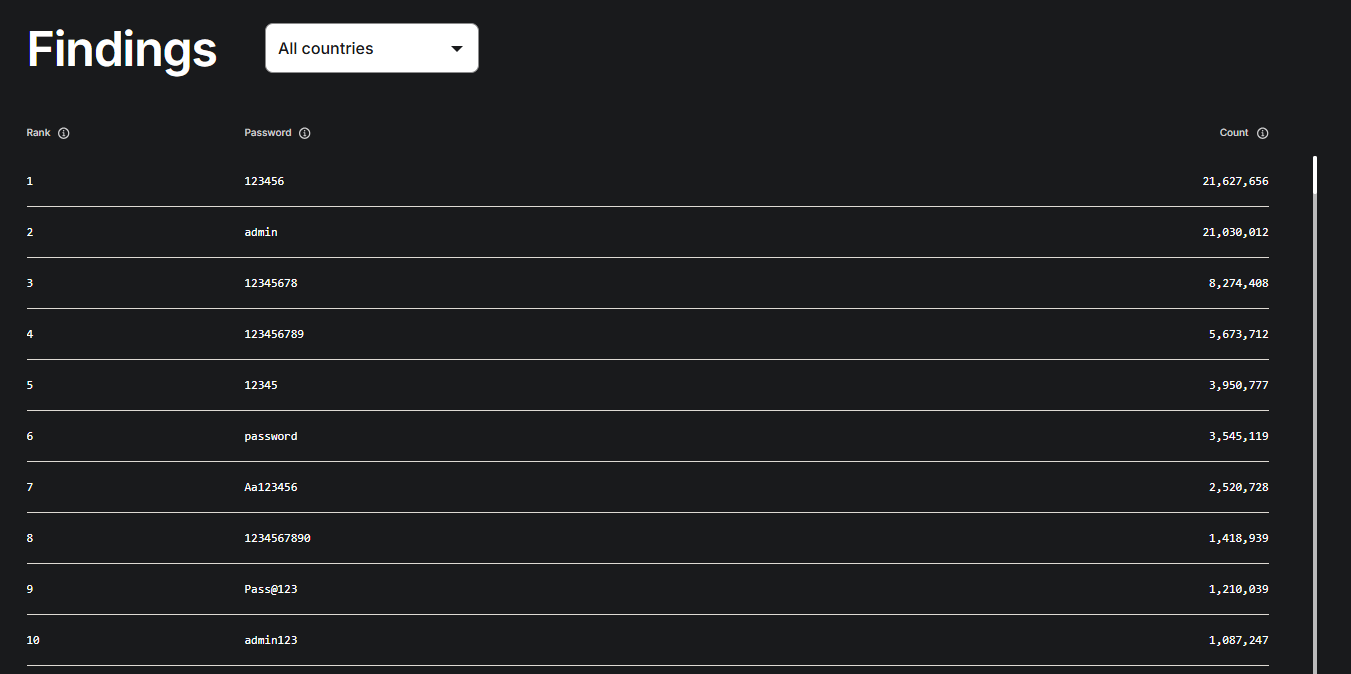
Another all-too-predictable choice, ‘admin’, trailed close behind, with ‘12345678’, ‘123456789’ and ‘12345’ coming next, as many people clearly continue to favor convenience, putting their personal data, money and possibly reputations at risk.
most-common-passwords-2025
The top 10 most common passwords among people in 44 countries (source: NordPass)

In the US and the UK, the overall picture was just as grim, with ‘admin’ taking the top spot in both countries. In the US, the one and only ‘password’ and ‘123456’ took the second and third spots, respectively; in the UK, the two just swapped places.

Much the same picture is painted by Comparitech’s research into two billion real account passwords leaked on data breach forums in 2025, as it had ‘123456’, ‘12345678’ and ‘123456789’ atop its list.

Same old, same old

Using an easily-guessable password is tantamount to locking the front door of your house with a paper latch. It offers no actual resistance, and attackers can use brute-force or credential stuffing techniques that allow them to make quick work of such weak or reused passwords at scale.

It goes without saying, therefore, that if your password made it among those most common password choices, you would be very well advised to change it immediately. Use a strong and unique password or passphrase for each account and ideally, store them in a reputable password manager.

No matter how stubborn, however, a password is still only a single barrier between your account and a hacker. That’s why two-factor authentication (2FA) as an extra layer of security is a non-negotiable line of defense these days, particularly for accounts that contain Personally Identifiable Information (PII) or other important data.

The risks rise sharply in corporate environments. Weak, obvious, or reused passwords can expose not only individual employees, but entire organizations, their customers, and their partners. Indeed, in many cases, the initial point of entry is neither sophisticated nor novel; instead, it’s simply a password that should never have been trusted in the first place. The consequences, meanwhile, are rarely trivial and span financial loss, operational disruption, regulatory scrutiny, and long-term reputational damage. Which is why companies need a combination of technical safeguards and ongoing security awareness training programs for employees.

Meanwhile, the technical barriers for ne’er-do-wells have never been lower. Modern tools can test countless combinations of login credentials in minutes, so the odds are firmly stacked in the attacker’s favor. Plus, in the digital ecosystem built on interconnected services and shared identities, the damage stemming from one account takeover is unlikely to stay contained for long.

Also, passkeys are rapidly becoming commonplace, and many major platforms, including Apple, Google, and Amazon, now offer them as a primary login method.

You might have had many New Year’s resolutions heading into 2026. But if your own passwords appear on either list above, improving your account security should be one of the most important of them.


Let us keep you
up to date

Sign up for our newsletters