
惯性聚合 高效追踪和阅读你感兴趣的博客、新闻、科技资讯
阅读原文 在惯性聚合中打开

推荐订阅源

宝玉的分享
宝玉的分享
Know Your Adversary
Know Your Adversary
T
The Exploit Database - CXSecurity.com
P
Palo Alto Networks Blog
Cloudbric
Cloudbric
Scott Helme
Scott Helme
C
CERT Recently Published Vulnerability Notes
Latest news
Latest news
P
Privacy International News Feed
S
Schneier on Security
Simon Willison's Weblog
S
Security @ Cisco Blogs
N
News | PayPal Newsroom
Exploit-DB.com RSS Feed
AI
AI
MyScale Blog
MyScale Blog
T
Threat Research - Cisco Blogs
cs.CL updates on arXiv.org
Cisco Talos Blog
Cisco Talos Blog
AWS News Blog
AWS News Blog
Webroot Blog
Webroot Blog
C
Cisco Blogs
博客园 - 聂微东
S
Security Affairs
Hacker News - Newest:
Hacker News - Newest: "LLM"
C
CXSECURITY Database RSS Feed - CXSecurity.com
The Cloudflare Blog
Hugging Face - Blog
Hugging Face - Blog
P
Privacy & Cybersecurity Law Blog
D
DataBreaches.Net
博客园_首页
让小产品的独立变现更简单 - ezindie.com
Project Zero
Project Zero
Threat Intelligence Blog | Flashpoint
T
The Blog of Author Tim Ferriss
雷峰网
雷峰网
V2EX - 技术
V2EX - 技术
钛媒体:引领未来商业与生活新知
钛媒体:引领未来商业与生活新知
I
InfoQ
Engineering at Meta
Engineering at Meta
Y
Y Combinator Blog
V
V2EX
I
Intezer
美团技术团队
TaoSecurity Blog
TaoSecurity Blog
Hacker News: Ask HN
Hacker News: Ask HN
Cyberwarzone
Cyberwarzone
Google DeepMind News
Microsoft Security Blog
G
GRAHAM CLULEY

WhatIs

Hims & Hers launches AI agent for lab results Twilio revamps, updates customer engagement platform CISA launches critical infrastructure cyber resilience initiative Most patients find appointment scheduling, billing overly complex Teradata's latest targets putting agentic AI into production AHA, Joint Commission launch cyber resilience program Tableau in transition as AI forces BI vendors to evolve California hospitals sue Elevance over out-of-network penalty CMS Health Tech Ecosystem adds electronic prior auth pledge Atlassian MCP updates take aim at AI token usage Leapfrog: Hospitals improved in 17 patient safety measures United promises another 30% cut to prior auths in 2026 AI outperforms docs on clinical reasoning, but not ready for solo work ServiceNow's Autonomous CRM takes aim at Salesforce New Tableau leader talks vendor's evolution in era of AI Deloitte warns of a "bubble effect" caused by the GLP-1 boom Tableau repositions for AI, unveils new knowledge layer IBM Bob AI coding agent ships, HashiCorp AIOps previewed DOJ forms West Coast Strike Force to stop healthcare fraud Most people benefit from the ACA's free preventive services SAP acquisitions of Dremio, Prior Labs target AI development Bridging the gap: Legacy tools gain enterprise AI support Amazon Connect Talent: AWS enters AI interviewing market AHA, West Health launch health tech adoption initiative How are states preparing for Medicaid work requirements? Medical device security improves, but cyberattacks remain pervasive Weekly news roundup: Musk vs. Altman, Google’s Pentagon AI deal, China and EU hit Meta Skin substitute spending driven by patients, products, prices Clinical AI company Aidoc snags $150M in new funding Qlik's Capone departs after eight years as CEO OIG: CMS paid millions in improper virtual care payments FDA moves toward real-time review of clinical trial data FQHCs in low-income neighborhoods have lower cancer screening rates Solving quantum computing's longstanding no-cloning problem Qdrant boosts performance, reliability to meet AI needs Racial health disparities still impact U.S. as policy changes loom Agentforce Operations tackles workflow orchestration Boehringer's dual agonist obesity drug spurs up to 16.6% weight loss Legacy architecture, awareness gaps stifle microsegmentation adoption in healthcare AMA alerts officials of health plans' No Surprises Act abuse Latest SAS capabilities focus on fostering reliable AI AHA calls for TEFCA individual access SOP delay, citing patient privacy concerns Actian targets secure, compliant AI with new vector database Payers promise standardized electronic prior auths MIT EmTech: 2026 is the year AI goes to work As Claude Design debuts, Adobe users -- and buyers -- shrug GoodData joins agentic AI development mix with Agent Builder Comfort, affordability top drivers of digital mental health tool use CMS accelerates Medicare coverage for breakthrough medical devices Weekly news roundup: Tim Cook exits Apple, Meta layoffs intensify and Anthropic investigates Claude Merck inks $1 billion AI drug development deal with Google Cloud OCR settles four HIPAA investigations, prioritizes risk analysis OpenAI launches ChatGPT for Clinicians 90% of patients re-check AI chatbot health info with other sources Gemini Enterprise Agent Platform adds 'connective tissue' to Vertex AI AMA urges greater oversight of AI mental health chatbots CMS benches BALANCE Model for Medicare Former ransomware negotiator pleads guilty to BlackCat conspiracy New Google TPUs multiply AI infrastructure efficiency When brand-name drugs need a prior auth, brace for delays Google unveils data cloud purpose built for agentic AI Snowflake updates further goal of being control pane for AI UnitedHealthcare eliminates prior authorization for rural providers Yelp launches appointment scheduling button from Zocdoc Oracle takes steps toward CMS Health Tech Ecosystem goals OpenAI debuts AI model GPT-Rosalind to speed up drug discovery Which patient care access barriers deter cancer screening? Redis unveils Feature Form to improve AI, ML workloads Adobe defines its AI-powered customer experience platform How to escape agentification pilot purgatory for scalable AI New HSCC guidance tackles third-party AI risk Data quality, fast failures and quick wins key to AI success Stop Overpaying for Storage: A FinOps Guide for CIOs AWS launches AI-driven tool to speed up early-stage antibody discovery AMA: Clinician burnout in specialties persists as overall rates drop Mental health parity remains elusive in 43 states Before revenue cycle AI, payers and providers need to get along Edge and physical AI poised to upend enterprise networks Salesforce releases Agentforce dev tools, updates Agent Fabric Cyberattack continues to disrupt operations at Signature Healthcare FDA reminds sponsors, researchers to report clinical trial results AI arms race leading to prior auth problems, reimbursement cuts Abridge dives deeper into clinical decision support with NEJM, AMA AI provider search is here. How can health orgs stay visible? Judge dismisses No Surprises Act lawsuit against HaloMD What IT leaders should know from Nutanix .NEXT HubSpot builds answer engine optimization into its platform Sutter Health, MemorialCare face class action lawsuit over AI scribe use Latest Qlik tools target helping users achieve AI goals CMS taps Verily, Noom, 150+ others to participate in ACCESS model Starburst intros AI assistant to boost analysis, exploration Payers face faster prior authorization approvals under CMS proposal Lenovo deploys AI data agent for marketing, UX, e-commerce Cisco Galileo buy reflects blurring lines in AI observability CMS proposes 2.4% IPPS bump, joint replacement model expansion Patients unsure what to trust amid health information overload Nutanix expands flexibility by building out external storage Amazon Pharmacy adds Lilly's obesity pill with same-day delivery ServiceNow AI pricing change takes on enterprise ROI struggles Oracle's Sudha Raghavan on AI's infrastructure renaissance
ServiceNow reintroduces itself as an AI 'security company'
2026-05-05 · via WhatIs

Beth Pariseau

By

Published: 05 May 2026

ServiceNow is seeking to bring enterprise CISOs onto its platform by expanding AI security monitoring and alerting features, following two recent acquisitions.

An access graph from Veza and asset intelligence from Armis were among a series of new features in the Australia release of the ServiceNow AI platform this week. IP from both companies, whose acquisition deals ServiceNow closed in March and April, respectively, surfaced in updates to the AI Control Tower agent governance tool and ServiceNow's Autonomous Risk and Security portfolio.

ServiceNow officials demonstrated the new integrations during a press briefing on April 28, showing AI Control Tower workflows in which Veza's access graph alerted an administrator to a prompt injection and displayed the blast radius of affected systems. The new workflow, which can run autonomously or with human approval, disabled the agent and its tools through a new ServiceNow AI gateway and generated a security incident and audit documentation. These features will enter preview this month and ship in August.

John Aisien, senior vice president and general manager of central product management, security and risk, ServiceNowJohn Aisien

Another press demo previewed how Armis IP will be integrated into AI Control Tower to automatically detect AI assets using agentless network monitoring and add them, through its cyber asset graph, to the ServiceNow Context Engine. The Context Engine will also correlate the asset's access permissions in Veza with activities on the corporate network, using the AI observability tools ServiceNow acquired with Traceloop. This expanded Context Engine will encompass security data from third-party tools, including Microsoft's Agent 365 and Palo Alto Networks.

These updates position ServiceNow to target a new audience, according to John Aisien, senior vice president and general manager of central product management, security and risk at ServiceNow, during the press demonstration.

"This is a representative example of what makes ServiceNow a security company uniquely built for the agentic era based on … three axes: … cyber assets, access and decision context," Aisien said. "We can govern every agent, every identity and permission, every asset, every in-flight or historical process and policy. We can correlate business risk. We can stop exposures in real time, and we can drive remediation before damage is done."

ServiceNow expands from CMDB roots

Adding security data into the knowledge graph that provides context to AI agents is a natural extension of ServiceNow's existing configuration management database (CMDB), said Charles Betz, an analyst at Forrester Research.

It's an area with many competitors, including cloud hyperscalers and other large vendors such as SAP and Salesforce. But "the AI control tower battle is ServiceNow's to lose," Betz said. "I can't think of anybody else who's better positioned than them.

"There's a lot of posturing, a lot of posing. But I just don't see an SAP or a Salesforce having any relevance there. They've not done the homework of understanding the digital infrastructure. Now they're going to jump in and be AI control towers -- maybe an AI walled garden to build an agent or two in. But if you're talking about truly agentic workloads running across a large-scale digital estate, ServiceNow has more than 20 years of struggling and fighting with the CMDB problem."

Another analyst said the proactive alerting features in ServiceNow's AI Control Tower stand out among enterprise agent orchestration platforms.

"I haven't seen anything near the kind of alerts that we saw in the demo from anybody else," said Rebecca Wettemann, CEO at independent research firm Valoir. "ServiceNow already had Impact, which gave a telemetry-infused view of how customers were actually using the platform, and is a great foundation for AI Control Tower and the monitoring capabilities that they built around it."
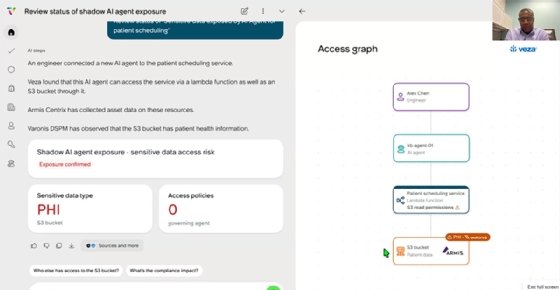
Alt txt: John Aisien ServiceNow Armis Veza AI Control Tower demo
ServiceNow's John Aisien demonstrated Armis and Veza integrations with AI Control Tower during a press briefing April 28.

Taking the pulse of enterprise agent adoption

ServiceNow touted customer wins for its AI Control Tower and Risk and Security Management products, including HDFC Bank, Rossmann, the National Hockey League, and Fortinet. ServiceNow reported strong Q1 2026 earnings on April 22, with revenue of $3.77 billion, up 22% from last year. It also raised 2026 subscription revenue guidance to $15.74–$15.78 billion. ServiceNow wasn't alone in riding a recent wave of AI adoption: AWS, Microsoft and Google also reported gaudy revenue growth in recent earnings calls, attributed to AI services.

But while enterprises are buying in, production AI autonomy remains an aspiration for most so far, Betz said.

Charles Betz, analyst, Forrester ResearchCharles Betz

"People want deterministic and auditable workflows, and those are hard enough to govern," he said. "We do see well-choreographed and well-specified multi-agent architectures that are not that complicated. You simply say, 'I've got an agent that actually creates the thing, and I have another distinct agent that QAs the thing.' And right there, you have a multi-agent architecture."

One enterprise consultant said he's seen similarly limited AI agent adoption among clients so far.

"It's scenario-based usually, and some of them even have success," said Thomas Wieberneit, co-founder, CEO and principal at AheadCRM, a consulting firm specializing in customer resource management, customer experience and AI. "Most of them start with service scenarios, where they want to go beyond [AI assistants] so that the customer actually gets something that helps them instead of a bunch of links that they can sift through."

Rolls-Royce eyes agentic expansion

That's the scenario that has played out at Rolls-Royce, which has ServiceNow's Now Assist agent in production internally as part of its help desk, according to Phil Priest, head of global business services at the industrial manufacturer, during an appearance at the April 28 press briefing. The company has seen a return on that investment in the form of a 54% deflection rate for help desk requests, which has saved human help desk agents 5,000 hours since August 2025, Priest said.

Rolls-Royce plans to expand the Now Assist agents to the rest of the 45,000-employee company, beginning with its HR department, and use the EmployeeWorks portal ServiceNow introduced in February.

However, AI expansion faces further challenges at the company. For example, as other enterprise Now Assist adopters attested during last year's ServiceNow Knowledge conference, getting AI to work autonomously in that context requires careful attention to underlying knowledge base data, Priest said.

"We've realized that as we expand AI assistants beyond our IT to other functions, we really have to almost rewrite our knowledge articles to make them AI-ready," Priest said.

The company is working on an agentic automation system for its accounts payable (AP) area, but must ensure the system maintains strict governance, including the separation of duties required by regulations.

"We have to think very carefully about building these agents in a way that assures that fraud can't happen, for example," Priest said. "And there are numerous laws in the AP space affecting payments, anti-money laundering, bribery and corruption -- we have to use the right oversight of third parties with the right checks when we use AI to do all these tasks."  

Beth Pariseau, senior news writer for Informa TechTarget, is an award-winning veteran of IT journalism. Have a tip? Email her or connect on LinkedIn.

Dig Deeper on Systems automation and orchestration