

惯性聚合 高效追踪和阅读你感兴趣的博客、新闻、科技资讯
阅读原文 在惯性聚合中打开

推荐订阅源

酷 壳 – CoolShell
酷 壳 – CoolShell
H
Hacker News: Front Page
P
Palo Alto Networks Blog
T
ThreatConnect
Apple Machine Learning Research
博客园_首页
T
True Tiger Recordings
P
Privacy & Cybersecurity Law Blog
B
Blog
IT之家
IT之家
Last Week in AI
Last Week in AI
F
Full Disclosure
Hacker News: Ask HN
Hacker News: Ask HN
C
Comments on: Blog
Microsoft Azure Blog
C
Cybersecurity and Infrastructure Security Agency CISA
Microsoft Security Blog
博客园 - 【当耐特】
N
News and Events Feed by Topic
NISL@THU
NISL@THU
腾讯CDC
雷峰网
雷峰网
Security Latest
Security Latest
李成银的技术随笔
M
Microsoft Research Blog - Microsoft Research
L
LangChain Blog
L
Lohrmann on Cybersecurity
cs.CL updates on arXiv.org
C
Check Point Blog
Y
Y Combinator Blog
Recent Announcements
博客园 - Franky
N
News | PayPal Newsroom
V
V2EX
A
About on SuperTechFans
The Register - Security
月光博客
月光博客
奇客Solidot–传递最新科技情报
奇客Solidot–传递最新科技情报
Google Online Security Blog
MyScale Blog
MyScale Blog
Cisco Talos Blog
Cisco Talos Blog
Vercel News
Vercel News
WordPress大学
WordPress大学
C
Cyber Attacks, Cyber Crime and Cyber Security
The Hacker News
The Hacker News
IntelliJ IDEA : IntelliJ IDEA – the Leading IDE for Professional Development in Java and Kotlin | The JetBrains Blog
爱范儿
爱范儿
A
Arctic Wolf
L
LINUX DO - 最新话题
freeCodeCamp Programming Tutorials: Python, JavaScript, Git & More

WhatIs

Private payer rates outpaced Medicare's by 47%: KFF Dell pushes in-place storage upgrades in PowerStore Elite Low digital health literacy hamstrings seniors' health IT use Evolving Alteryx focusing on AI-ready data, logic for agents Informatica update aims to provide trust foundation for AI Latest Alteryx features aim to boost AI-powered automation Telehealth adoption did not drive up healthcare visits, costs HHS reorganizes OCR into three subdivisions Zendesk adds AI tools in pursuit of autonomous service ACA Marketplace deductibles increased by over $1K: KFF Latest from Confluent streamlines use of streaming for AI ACP calls for Medicare Advantage transparency overhaul Why AI in network operations requires human judgment 10 insights on AI adoption in network operations Dell AI Factory gets rack-scale infrastructure refresh Health systems delay EHR purchases amid uncertainty, rising AI investment 385 hospitals get top marks in CMS' 2026 Hospital Star Ratings drop The 'corporate takeover' of physician practices accelerates: study ACP calls for Medicare Advantage transparency overhaul Enterprises fleeing Broadcom move to OpenShift Virtualization Feds hold states to the fire over Medicaid fraud as CA loses $1B Agentic AI discharge summaries linked to safety, clinician wellbeing IT orgs face tricky cost calculus for self-hosted AI inference Workday embeds Sana AI for HR inside Microsoft Copilot Expanded collab brings full Labcorp test menu to Epic platform The AI technology behind SAP's Autonomous Enterprise pitch With patient collections at 31%, is AI providers' new strategy? How SAP sees the future of HR in the age of AI Medicaid managed care plans fall short of AUD, OUD coverage policies Whoop adds telehealth, AI features to wearable fitness tracker Missouri regulators say Conduent is not cooperating in breach investigation Less than half of nurses are using AI, despite interest AMA, providers seek stricter enforcement of No Surprises Act Healthgrades: Communication key to top patient experience rating SAP rolls out customer experience AI agents, assistants Red Hat AI updates target mounting cost, sovereignty worries Alation intros AI governance suite to ensure compliance A tale of two health systems: the threat of hospital consolidation Omada Health reports 42% revenue boost, GLP-1 partnership MongoDB adds new vector, performance capabilities to aid AI WEDI launches testing directory ahead of CMS interoperability rule deadline Hims & Hers launches AI agent for lab results Twilio revamps, updates customer engagement platform CISA launches critical infrastructure cyber resilience initiative Most patients find appointment scheduling, billing overly complex Teradata's latest targets putting agentic AI into production AHA, Joint Commission launch cyber resilience program Tableau in transition as AI forces BI vendors to evolve California hospitals sue Elevance over out-of-network penalty CMS Health Tech Ecosystem adds electronic prior auth pledge Atlassian MCP updates take aim at AI token usage Leapfrog: Hospitals improved in 17 patient safety measures United promises another 30% cut to prior auths in 2026 AI outperforms docs on clinical reasoning, but not ready for solo work ServiceNow's Autonomous CRM takes aim at Salesforce ServiceNow reintroduces itself as an AI 'security company' New Tableau leader talks vendor's evolution in era of AI Deloitte warns of a "bubble effect" caused by the GLP-1 boom Tableau repositions for AI, unveils new knowledge layer IBM Bob AI coding agent ships, HashiCorp AIOps previewed DOJ forms West Coast Strike Force to stop healthcare fraud Most people benefit from the ACA's free preventive services SAP acquisitions of Dremio, Prior Labs target AI development Bridging the gap: Legacy tools gain enterprise AI support Amazon Connect Talent: AWS enters AI interviewing market AHA, West Health launch health tech adoption initiative How are states preparing for Medicaid work requirements? Medical device security improves, but cyberattacks remain pervasive Weekly news roundup: Musk vs. Altman, Google’s Pentagon AI deal, China and EU hit Meta Skin substitute spending driven by patients, products, prices Clinical AI company Aidoc snags $150M in new funding Qlik's Capone departs after eight years as CEO OIG: CMS paid millions in improper virtual care payments FDA moves toward real-time review of clinical trial data FQHCs in low-income neighborhoods have lower cancer screening rates Solving quantum computing's longstanding no-cloning problem Qdrant boosts performance, reliability to meet AI needs Racial health disparities still impact U.S. as policy changes loom Agentforce Operations tackles workflow orchestration Boehringer's dual agonist obesity drug spurs up to 16.6% weight loss Legacy architecture, awareness gaps stifle microsegmentation adoption in healthcare AMA alerts officials of health plans' No Surprises Act abuse Latest SAS capabilities focus on fostering reliable AI AHA calls for TEFCA individual access SOP delay, citing patient privacy concerns Actian targets secure, compliant AI with new vector database Payers promise standardized electronic prior auths MIT EmTech: 2026 is the year AI goes to work As Claude Design debuts, Adobe users -- and buyers -- shrug GoodData joins agentic AI development mix with Agent Builder Comfort, affordability top drivers of digital mental health tool use CMS accelerates Medicare coverage for breakthrough medical devices Weekly news roundup: Tim Cook exits Apple, Meta layoffs intensify and Anthropic investigates Claude Merck inks $1 billion AI drug development deal with Google Cloud OCR settles four HIPAA investigations, prioritizes risk analysis OpenAI launches ChatGPT for Clinicians 90% of patients re-check AI chatbot health info with other sources Gemini Enterprise Agent Platform adds 'connective tissue' to Vertex AI AMA urges greater oversight of AI mental health chatbots CMS benches BALANCE Model for Medicare Former ransomware negotiator pleads guilty to BlackCat conspiracy
Stop Overpaying for Storage: A FinOps Guide for CIOs
2026-04-17 · via WhatIs

Data storage remains a persistent blind spot in enterprise economics, affecting cost-optimization and performance efforts. The result is wasted resources and frequent overspending.

Traditional optimization efforts miss storage because they focus on highly visible consumption, such as compute and application tuning. Unmanaged storage consumption tends to grow quietly in the background.

Applying FinOps principles to data storage results in cost reductions without performance trade-offs, improving business agility, freeing capital for other initiatives and maintaining better data governance.

This article demonstrates how to apply FinOps principles to storage optimization, including practical frameworks, a roadmap and strategic impacts. Key outcomes include cost visibility, lifecycle automation and cross-team accountability.

Why storage remains the most overlooked cost center

Storage tends to be a quiet consumer. Capacity grows slowly over time through backups, logs, analytical datasets, snapshots and compliance-based retention policies. These resources are rarely reviewed after configuration. Because the per-GB price appears low, cumulative impact across environments is unmanaged and underestimated, especially in hybrid on-premises and cloud environments.
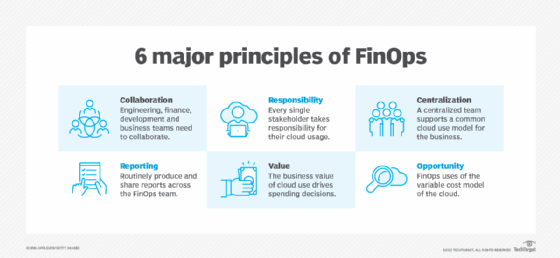
Six FinOps principles.
FinOps principles can be adapted to fit the specific needs of organizations.

Operationally, storage also falls into a governance gap. Compute is actively managed by applications teams and optimized through scaling policies, while storage is often provisioned centrally and left static.

Hidden drivers often include:

  • Orphaned volumes and snapshots.
  • Replication and redundancy defaults.
  • Cloud egress fees and data movement costs.
  • Data sovereignty compliance settings.

Without lifecycle enforcement, data persists indefinitely, making storage an under-optimized component of enterprise storage spending.

Applying FinOps principles to storage optimization

Optimizing storage in enterprise environments means shifting it from a passive infrastructure resource to an actively governed financial asset that impacts business strategy. Taking a FinOps approach to managing storage accomplishes this transformation.

Applying FinOps to storage relies on three foundational practices:

  • Right-sizing storage based on actual (not assumed or predicted) access patterns.
  • Data lifecycle management policies, including retention, archiving and deletion.
  • Tier-aware budgeting aligned to workload value.

Effective management establishes storage cost visibility as a leadership capability that will enable informed decision-making and directly impact operational practices. Management practices can include:

  • Ensuring SLAs with cost discipline.
  • Setting performance guardrails.
  • Establishing workload classification by latency sensitivity.

These practices balance efficient performance and responsible storage spending.

An effective governance model requires cross-team collaboration, with various teams playing specific roles. Examples include:

  • The finance team sets cost guardrails.
  • The platform team enforces policies.
  • The operations team owns consumption and reporting.

Practical frameworks for sustainable storage cost control

Sustainable storage control requires more than one-off cleanup efforts -- it depends on repeatable frameworks that align technical decisions with financial outcomes. For CIOs and IT leaders, the goal is to replace reactive cost management with structured practices that continuously evaluate data value, placement and movement.

The following frameworks translate FinOps principles into operational guardrails by:

  • Identifying low-value data before it accumulates costs.
  • Aligning storage tiers with workload requirements.
  • Preventing avoidable transfer charges.
  • Making spending transparent across teams.

Together, they create a system where storage automatically trends toward the right performance level at the best cost.

Cold data identification framework

Cost control begins with understanding which data no longer requires high-performance storage. Organizations should establish an identification framework for discovering such data using methods such as:

  • Access frequency analysis.
  • Business value tagging.
  • Compliance-driven retention mapping.
  • Candidate selection for archival tiers.

A structured approach to identifying infrequently accessed or low-business-value data enables organizations to reduce costs without impacting operational performance.

Storage tiering strategy framework

Once data value and access patterns are understood, organizations can align storage performance levels with actual workload needs, through:

  • Performance vs. cost matrix.
  • Automated storage tiering across environments.
  • Policy-driven placement and migration.
  • Guardrails for performance-sensitive workloads.

A formal tiering strategy ensures data resides on the most cost-effective medium while maintaining required service levels.

Egress risk reduction model

Unplanned data movement is a frequent source of unexpected storage-related costs. Ways to help prevent these costs include:

  • Data locality planning.
  • Cross-region transfer controls.
  • Workload placement optimization.
  • Forecasting and budgeting for cloud egress fees.

A proactive model for managing data locality and transfer patterns helps organizations anticipate, control and reduce avoidable egress charges.

Financial transparency model

Cost optimization is unsustainable without shared visibility into spending drivers and organizational discipline. Ways to increase shared visibility include:

  • Audit the storage footprint across on-premises and cloud environments.
  • Implement and share storage cost dashboards.
  • Classify data by access frequency and business value.
  • Identify top cost drivers and quick wins.

Establishing standardized reporting, accountability and metrics enables finance and operations teams to manage storage as a measurable business resource.

The 30-60-90-day storage FinOps roadmap

The pace of a FinOps roadmap varies by organization size, cloud complexity and total storage utilization. The roadmap below depicts an update schedule over a three-month period. Longer, more detailed roadmaps are available for more extensive deployments.

Strategic impact for the enterprise

Shifting storage optimization from technical cleanup to a strategic tool enables cost efficiency. Applying FinOps principles to storage delivers predictable cost reductions, stabilizes hybrid cloud spending and improves budget forecasting by identifying hidden growth drivers.

Equally important, it aligns technology investment with business value, ensuring high-performance storage is reserved for revenue-critical workloads. The result is stronger financial discipline without slowing innovation.

CIOs and IT leaders who treat storage as a governed financial asset -- not just infrastructure -- position their organizations to capture immediate savings and long-term efficiency gains. The next step is to operationalize these principles through a structured roadmap that embeds cost awareness into everyday technology decisions.