
ATLANTA – Users of software from the company formerly known as VMware at Red Hat Summit this week recounted their experiences migrating to OpenShift Virtualization in the wake of skyrocketing license costs.
OpenShift Virtualization, based on the open source KubeVirt project, allows traditional VM workloads to be managed by the Kubernetes control plane alongside Linux containers. The project started in 2017 and was integrated into OpenShift in 2018, but Red Hat began beefing up its features in 2021. In late 2024 and early 2025, the vendor expanded the product's roadmap even more aggressively. This latest surge in development came in the wake of widespread customer dissatisfaction with changes to Broadcom's licensing and pricing for VMware products following the close of its $61 billion acquisition in late 2023.
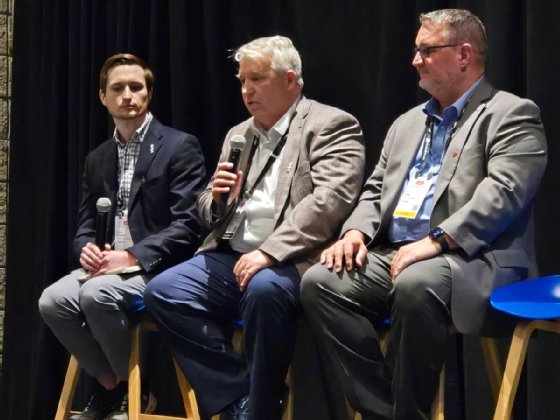
"We had a renewal come up in January 2025 -- cost was obviously a concern. I'm sure everybody's aware of that," said Steven Organiscak, director of information technology infrastructure platform services at Cleveland Clinic, during a panel session Wednesday. "Then we started looking at, 'What else can we do, and where else can we go?'"
The medical center renewed its three-year contract with Broadcom to buy time to find a new vendor for its more than 10,000 VMs. It now has 450 machines migrated to OpenShift Virtualization and expects to move all its machines to the Red Hat platform at a 50% lower total cost of ownership before the license comes up for renewal again, according to co-presenter Ian Willis, executive director of IT infrastructure at Cleveland Clinic.
"We've proven we can do it, we've proven we can move," Willis said. "We've got 19 months and counting now [before the next renewal], and we're going to push -- we're going to try to get every single virtual machine and workload moved over."
The clinic also hedged on this timeframe a bit by buying VxRail systems for some applications, which retain perpetual licensing, Willis said.
Cleveland Clinic is a longtime customer of IBM, Red Hat's parent company, with which it has a partnership to develop quantum computing for clinical use. However, it considered several vendors before choosing OpenShift Virtualization, Willis said in an interview following the presentation.
"We will have some Nutanix in the environment [to replace] our telecom clusters, which were running on a Cisco hyperconverged solution that was VMware-based," Willis said.
But for the rest of the VM fleet, Nutanix's minimum requirements at the time would have meant purchasing more new hardware, according to Willis. Nutanix added external storage options last month.
Cleveland Clinic's disaster recovery team also concluded after proof-of-concept testing that it would be easier to transition an existing Dell Data Domain-based disaster recovery and backup infrastructure to OpenShift Virtualization, he said.
FedHIVE swayed by FedRAMP
In a separate session, a service provider also cited massive cost increases for Broadcom licensing as the impetus for a move, but also chose OpenShift Virtualization over other competitors because of its compliance certifications.
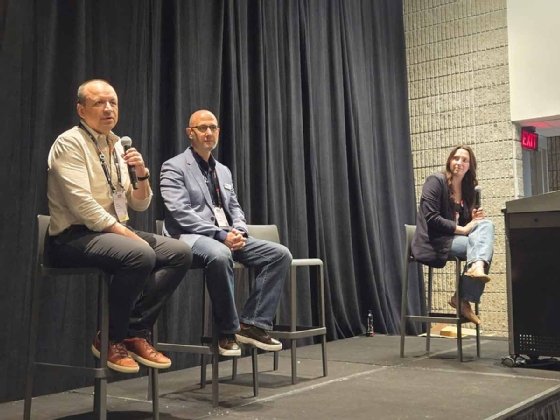
"We're a compliance-as-a-service company, so we take ISVs, we adopt them on our ATO [Department of Defense Authority to Operate], and we wrap security around them and allow them to sell themselves to the government," said Michael Cardaci, CEO of FedHIVE and Human Resources Technologies, Inc. (HRTec), both located in Alexandria, Va.
FedHIVE was set to pay nine times its previous licensing price to Broadcom at renewal, prompting it to explore other options. Red Hat OpenShift and OpenShift Virtualization supported compliance with FedRAMP and ATO requirements for the broadest range of environments, including on-premises, air-gapped, private and public cloud for both containers and VMs "at a price hyperscalers can't match," Cardaci said.
Expanding partnerships between third-party vendors and Red Hat to support OpenShift Virtualization also helped seal the deal for FedHIVE, according to Cardaci's co-presenter Derrick Sutherland, principal solutions architect at Arctiq, a managed service provider that performed the VM migration on FedHIVE's behalf.
Key tie-ins for OpenShift Virtualization included Portworx software-defined storage and HashiCorp Vault for zero-trust security, which tightened following the close of IBM's acquisition in February 2025, Sutherland said.
"Think of it like vSAN for OpenShift or for Kubernetes distributions in general," he said. "What that gives you is the ability to use [any storage] hardware … [in] a virtual storage pool across the entire cluster. It'll do software-defined replication between nodes, and it will do disk-level encryption for those workloads."
OpenShift Virtualization migration caveats
The notion of a unified infrastructure automation platform for both containers and VMs, which sets the stage for application modernization, also motivated the Broadcom defectors. But it comes with inherent limitations and challenges compared to traditional server virtualization, including a steeper learning curve and a complex migration process, according to some Summit presenters.
Emirates National Bank of Dubai (NBD), for example, was able to move more than 9,000 VMs from VMware to Red Hat OpenShift since the migration was publicly disclosed during last year's Red Hat Summit, at a rate of up to 200 machines per night, said Ali Rey, group head of technology platforms, during a session Tuesday.
Of 350 applications, all but three now run on OpenShift Virtualization or OpenShift Container Platform, which the bank, a Red Hat Enterprise Linux (RHEL) customer since 2016, was already using. Rey declined to name the three applications still running on VMware but cautioned other would-be switchers to think carefully about platform architecture before making the leap.
"When you go to containers, you're rearchitecting [your apps] … when you go to KubeVirt, it's more of a re-platforming," Rey said. "But you have to think about, 'How do I manage my storage? How do I manage my network? How do I get the clusters between containers and VMs be able to talk to each other?' It's a completely different thing. The thinking about it is quite different."
Morgan Stanley began considering a move to OpenShift Virtualization from ESX as a bare-metal option for its Kubernetes control nodes five years ago, long before the Broadcom licensing change, but the migration remains a work in progress, said Oscar Sumano, head of Kubernetes engineering for the financial services firm, during the Tuesday session.
"We're trying to get better at figuring out complex architectures on Kubernetes, because we don't have stretch clusters," Sumano said. "That's extremely difficult from an architecture standpoint. We're trying to get better at more automation, more user training and more visibility … we're still learning. You have to respect what ESX has done from an architecture standpoint."
Red Hat rolls out free migration assessment
Red Hat has improved the migration process by developing a set of Virtualization Migration Assessment workshops beginning in 2024 and expanding them in March 2026. This week, it added a free, self-service OpenShift Migration Assessment (OMA) option that doesn’t require a Red Hat subscription.
"[OpenShift Virtualization] is still seen as expensive, even though it's not as expensive as VMware, and maybe even a little bit cheaper than Nutanix," said Rob Strechay, an analyst at TheCube Research and Smuget Consulting.
Migration efforts that typically require professional services engagement with Red Hat or a partner factor into that perception, Strechay said. OMA alleviates the cost of assessment, but not the migration process itself.
"Identifying readiness is just the beginning," he said. "Successful migrations to new platforms oftentimes require skilled resources to augment your existing team. Gathering the info is free -- moving the actual VMs is on you or a partner."
FedHIVE's Cardaci said the engagement with Arctiq was well worth the investment. Arctiq migrated 100 VMs in about six weeks and trained the company's employees on OpenShift Virtualization so they could take over management themselves, he said during a Q&A at his Summit session Wednesday.
"Because the timeline was faster, we were able to get ROI faster," Cardaci said. "The value was there."
OpenShift Virtualization development continues
OpenShift Virtualization has delivered significant new features in the past year, including live migration support for VMs across server clusters, offloading migration processing to external storage arrays to improve performance, which it made generally available in OpenShift 4.21 in March. That same update also included simplified VM management, including a virtual VM network creation wizard. It also moved Changed Block Tracking for faster backups to technical preview, a feature Cleveland Clinic reps said they're looking forward to deploying once it reaches general availability.
"We're having to go parallel with our Dell PowerProtect in order to support our 12-hour backup window, and we're starting to fill that window" as more VMs migrate, Willis said.
This week at Summit, Red Hat also unveiled new cloud support for OpenShift Virtualization, including a VM-only, fully managed IBM Cloud service that can be automatically upgraded to support containers. OpenShift Virtualization support on Google Cloud also became generally available.
"That was one of the last big hurdles for [OpenShift Virtualization] -- IBM Cloud saying, 'Hey, we have a production VM farm,' because IBM used to have one of the largest VMware clouds," Strechay said.
Beth Pariseau, senior news writer for Informa TechTarget, is an award-winning veteran of IT journalism. Have a tip? Email her or connect on LinkedIn.