
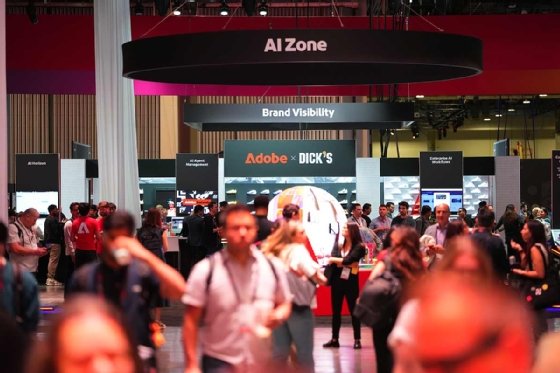
"It's going to be an Adobe killer!" my Uber driver said of Claude Design, parroting the financial news he had heard all day on the radio in his RAV4. He argued this stance all the way from the airport to Adobe Summit last week in Las Vegas.
Anthropic's Claude Design, released April 17 in a "research preview" to Claude Pro, Max, Team and Enterprise subscribers, rattled Wall Street and sent Adobe shares down roughly 2% in reaction to the news, which added to what has been a withering, nearly 60% tumble in market value since December 2024. Competitor Figma -- which Adobe attempted to acquire two years ago -- also dropped 7%.
The investors' logic? This recently minted AI creative tool will somehow untether Adobe Creative Cloud customers from their subscriptions.
It turns out that, just as with the "SaaSpocalypse," Wall Street can be prone to hallucinations.
At Summit, users, agencies and consultants saw Claude Design as many possible things: something small businesses will use to fast-track their marketing efforts; a new input into the Adobe CX Enterprise platform; a tool that distributes creativity to everyone in Anthropic shops -- including nondesigners -- that will produce potentially good and bad results; something with low-fidelity output that can create more work for design and production pros; and a token-burning machine that has to re-render images from scratch to apply the most minor of changes.
Also, some business-minded attendees noted that Adobe Creative Cloud users might use the threat of switching to Claude Design as negotiating leverage when it comes time to renew enterprise contracts -- even though it isn't close, features-wise, to a direct replacement for Adobe applications such as Photoshop and Illustrator.
But no one agreed with the Uber driver.
Basic technical differences
Claude Design doesn't work in the layer-based editing system that designers and production people have used for decades in Adobe tools such as Illustrator and Photoshop, Liz Miller, analyst at Constellation Research, pointed out. That alone may spook some potential users away from Anthropic's upstart image-creation and editing tool.
Another factor could be the cost. While Adobe is known for its pricey subscriptions, Claude Design also requires a Claude subscription. Not only that, even subtle tweaks, such as changing a color in a small area of an image, require a new rendering in Claude Design -- and more AI tokens to pay for it -- versus a few clicks in Adobe tools.
Claude Design might find traction among small businesses that aren't power users, Miller said, but larger enterprises will likely give pause.
"Wall Street and the pundits are looking at outputs; they're not looking at business outcomes," Miller said. "So, we're celebrating outputs? When we start to look at Adobe and others out there, when you start to look at intentional business outcomes a platform creates -- with safeguards and guardrails around that in multiple places, you've thought through the hard stuff -- that's what enterprises are looking for."
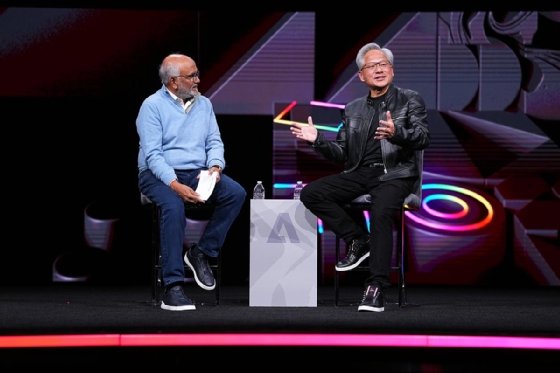
To that end, Nvidia founder and CEO Jensen Huang didn't mention Claude Design, per se, in a Summit keynote conversation with outgoing Adobe CEO Shantanu Narayen.
But he did make what could be interpreted as a veiled reference when describing his company's massive investment in Adobe technology for in-house marketing. He eventually sees the rollout of AI tools for Nvidia customers building their own generative and agentic AI marketing factories that convert raw data into actionable insights using high-performance computing.
"Nvidia marketing is built on Nvidia, and built in Adobe," Huang said. "That factory, in the future, will include AI supercomputers, which is part of the reason why we're working so closely together."
Adobe's Firefly, a text-to-image generative model based on licensed content -- in theory, much less likely to violate copyrights than frontier models from the likes of OpenAI, Anthropic, X and Meta -- will be key to Nvidia's success.
"The work that we do together [is] creating a structured, precise, digital representation of an artifact," Huang said. "It could be a car, it could be a perfume bottle, it could be a person. Whatever it is, that starting point is really vital. From there, we can then integrate it with generative AI and express our creativity through that."
Claude Design's potential
In informal conversations, Adobe users and experts at Adobe Summit did say that Claude Design might be useful in the earliest iterative stages of marketing brainstorming, as Anthropic also suggested upon the tool's release.
It's still very early in the hype cycle, as evidenced by two major agency leaders using the word "play" when discussing the evolution of powerful AI platforms.
AI coding tools are fun to play with, said Stephanie Trunzo, CEO of Merge, a digital marketing agency in healthcare and consumer health, with clients such as Oura Ring and CVS.
It's also easy to "unleash a lot of harm," she added. Users, for example, might expect an AI-coded dashboard to tap real-time data -- and base decisions on what it says -- when, in reality, it's using static spreadsheets as its data source.
"I can be shown a dashboard and be making very bad decisions because someone who is not an actual app developer spun up a dashboard in 30 seconds -- there's no enterprise rigor to it, there's no actual infrastructure, there's no architecture, none of these things," Trunzo said. "I think exactly the same thing is going to happen with design… there is a reason that these skills exist, and they are not skills that can be collapsed, consolidated or sped up."
The potential utility of Claude Design doesn't amount to a "Photoshop killer" or, for that matter, a replacement for Adobe's CX Enterprise -- or other vendors' marketing clouds; one technology tool won't overcome workflow challenges of people and processes in a CX organization, said Abby Godee, chief experience officer at digital consultancy Publicis Sapient.
"Claude Design is pretty cool, and my team loves playing around with it -- there's a lot going on there," Godee said. "If you think about Adobe, Figma, Claude -- all these different players that are in the same space -- there's no question a massive disruption is coming. But Adobe, for instance, has some key capabilities it understands very, very well that Claude's not about to disrupt."
Companies are realizing cost efficiencies and enriching customer experiences with AI tools powered by frontier models, said Ian Kahn, partner, Commercial and Service Excellence Platform leader at global professional services company PwC. Tools like Claude Design show promise in enabling teams to move from concept to product with more speed and creativity as they iterate through more ideas.
From Kahn's point of view, more choices for customers are a good thing, and companies like PwC will help steer those choices. Adobe technologies will continue to have clear use cases.
"There's a real benefit to a platform that has customer data, content, supply chain, analytics, personalization all in one, governed environment, the right integration and quality controls you think about, Kahn said. "It gives me the confidence to deploy AI in my environment."

Human design vs. AI slop
All that said, Adobe -- which did not offer an on-the-record perspective on Claude Design -- last December launched AI agents to provide free access to some Acrobat, Photoshop and Express features in ChatGPT. Users can text-prompt image edits in the generative AI's interface.
Creative tools, however, might be dangerous in the wrong hands. Echoing Trunzo's sentiments, Dan Gardner, co-founder and CEO of the creative tech agency Code and Theory, noted that AI cannot replicate the creative arts. Giving non-creatives tools such as Claude Design is exciting. It will drive some efficiencies.
It will also drive the proliferation of slop.
He sees AI creative tools as a reprise of "my brother can create a website" back in the early days of the web and HTML, which gave rise to companies like Squarespace and GeoCities that hosted cookie-cutter, templated websites.
"There is a role for like anything that democratizes the ability to make things, [and] Claude Design will play a role for a certain type of person, sure," Gardner said. "But just like content AI slop that exists -- we're already seeing the effect of it -- design will have design slop as well. You have to remember that design is more than looking pretty. Taste matters."
Code and Theory serves many Fortune 500 companies in verticals such as financial services, media and sports -- including the launch of the National Football League's app. The code part might bring automation, but artful human design still will inspire customer loyalty.
"There's a reason why brands matter," Gardner said. "If you take away taste and design, you will say that brands don't matter. If brands don't matter, then why do you wear the shoes you wear, or the shirt you wear, or have affinities? And do we think we're going to be in a world where we're all going to buy white label? No, that's not gonna happen. It's just not gonna happen."
Don Fluckinger is a senior news writer for Informa TechTarget. He covers customer experience, digital experience management and end-user computing. Got a tip? Email him.