
惯性聚合 高效追踪和阅读你感兴趣的博客、新闻、科技资讯
阅读原文 在惯性聚合中打开

推荐订阅源

cs.AI updates on arXiv.org
V
Visual Studio Blog
The GitHub Blog
The GitHub Blog
Apple Machine Learning Research
J
Java Code Geeks
T
Tailwind CSS Blog
大猫的无限游戏
大猫的无限游戏
Jina AI
Jina AI
OSCHINA 社区最新新闻
OSCHINA 社区最新新闻
Hugging Face - Blog
Hugging Face - Blog
WordPress大学
WordPress大学
宝玉的分享
宝玉的分享
freeCodeCamp Programming Tutorials: Python, JavaScript, Git & More
罗磊的独立博客
人人都是产品经理
人人都是产品经理
H
Heimdal Security Blog
Last Week in AI
Last Week in AI
博客园 - 【当耐特】
Cyberwarzone
Cyberwarzone
Google DeepMind News
雷峰网
雷峰网
Hacker News: Ask HN
Hacker News: Ask HN
Webroot Blog
Webroot Blog
Microsoft Azure Blog
MyScale Blog
MyScale Blog
A
About on SuperTechFans
V2EX - 技术
V2EX - 技术
小众软件
小众软件
博客园 - Franky
博客园 - 司徒正美
P
Privacy International News Feed
爱范儿
爱范儿
U
Unit 42
博客园 - 叶小钗
The Hacker News
The Hacker News
C
Check Point Blog
奇客Solidot–传递最新科技情报
奇客Solidot–传递最新科技情报
Simon Willison's Weblog
N
News and Events Feed by Topic
D
Docker
T
Threatpost
MongoDB | Blog
MongoDB | Blog
让小产品的独立变现更简单 - ezindie.com
H
Help Net Security
L
LINUX DO - 最新话题
Security Latest
Security Latest
T
The Exploit Database - CXSecurity.com
S
SegmentFault 最新的问题
A
Arctic Wolf
Spread Privacy
Spread Privacy

60 Minutes - CBSNews.com

"Payam Method" hits the right note with piano students, making music education fun and accessible for kids Piano teacher's students sweep national competitions after learning the "Payam Method" Scientists focus on genetically engineering mice to cut Lyme disease transmission Sally Field says she believes "in the resilience of our Constitution" | 60 Minutes AI boom propping up economy as some guardrails are coming off, journalist Andrew Ross Sorkin warns Christopher Nolan imagines every movie is the last he'll ever make Christopher Nolan worked to make "most extreme version of a story possible" with "The Odyssey" Robotaxis coming to London pose a threat to traditional cabbies who memorize 25,000 streets to earn licenses Robotaxis are on the road to London. Cabbies, who pass a grueling test, aren't about to hand over their keys. Suspected insider accounts net $2.4 million on Polymarket Iran war bets with 98% win rate, firm finds Christopher Nolan: The 60 Minutes Interview London cabbies not ready to hand over their keys to AI-powered, autonomous taxis High win rate of bets on military operations a likely sign of insider trading Meet Gout Gout, the Australian sprinting phenom drawing comparisons to Usain Bolt Louisiana's governor on the Supreme Court decision and his suspending of House primary elections Extended interview: Israeli Prime Minister Benjamin Netanyahu Gout Gout, the fastest teen ever in the 200m, got his start when a coach saw him running around with friends Netanyahu wants Israel "to draw down to zero the American financial support" Read the full transcript of Major Garrett's interview with Israeli Prime Minister Benjamin Netanyahu here Israeli Prime Minister Benjamin Netanyahu: The 2026 60 Minutes Interview Louisiana rushes to redraw congressional maps after Gov. Landry suspends primaries Gout Gout: The 60 Minutes Interview Netanyahu wants to phase out U.S. military aid | 60 Minutes Iran war is "not over" until highly enriched uranium is removed, Israel Netanyahu says there's still "work to be done" before Iran war ends | 60 Minutes Historian Jill Lepore on constitutional amendments | 60 Minutes Inside Grasse, where flowers for Chanel No. 5 have been grown for more than a century Grasse, birthplace to Chanel No. 5, is experiencing a perfume revival Birding takes flight after peace deal between Colombia and guerrilla group | 60 Minutes Discover Grasse, the flower-filled French town behind the world's most famous perfume When the volunteer helping after a hurricane is a white nationalist | 60 Minutes Colombia has nearly 2,000 types of birds. Discover some of the species birders flock there to see. Once a hostage of Colombian rebels, he decided to teach his former captors birding Birding paradise flourishes in Colombian region that was once a war zone Some white nationalists swoop in after natural disasters, trying to soften their image while offering help Read the full transcript of Norah O'Donnell's interview with President Trump here Extended interview: President Trump on White House Correspondents' Dinner Fowl play: The criminals stealing elite racing pigeons The Pigeon Mafia: International criminal networks are stealing high-priced pigeons Former Sen. Ben Sasse, living with terminal cancer, sees an opportunity in living on a deadline Former Sen. Ben Sasse, dying of cancer, reflects on family, faith and the future of America Trump "wasn't worried" during White House Correspondents' Dinner shooting Retired Adm. William McRaven, who organized the bin Laden operation, reflects on honor The Pigeon Mafia: How high-priced pigeons became an organized crime target | 60 Minutes Ben Sasse: The 60 Minutes Interview President Donald Trump: The 2026 60 Minutes Interview Trump says he "wasn't making it that easy" for Secret Service during shooting "60 Minutes" to interview President Trump after White House Correspondents' Dinner shooting Ben Sasse was given a few months to live. He credits "providence, prayer and a miracle drug" for giving him more time. José Andrés on how food fits into America's story | 60 Minutes Rachel Goldberg-Polin on grief after Hamas abducted, killed her son | 60 Minutes Animals become Stewart Copeland's bandmates in album preserving the sounds of nature Stewart Copeland album "Wild Concerto" fuses music with sounds of hyenas, monkeys, owls Rock legend, naturalist team up to turn field recordings of animals into music What it would take for the U.S. to secure Iran's highly enriched uranium | 60 Minutes What it could take for the U.S. to remove highly enriched uranium from Iran Rachel Goldberg-Polin, grieving mother who fought for Israeli hostages' return, says she feels like she failed Rachel Goldberg-Polin, whose son Hersh was abducted October 7 and murdered by Hamas: Grief is a "badge of love" Iran's HEU | Sunday on 60 Minutes Wild Concerto | Sunday on 60 Minutes South Africa's great white sharks mysteriously vanished. Scientists can't agree who, or what, is the culprit. Great white sharks started disappearing from a former hotspot years ago, but scientists can The trucking companies evading federal safety enforcement and plaguing U.S. highways Pope Leo and President Trump are at odds over immigration in the U.S. and the Iran war Google CEO Sundar Pichai says "America must take the lead" on AI | 60 Minutes This was a great white shark hotspot. Then they mysteriously vanished | 60 Minutes Trucking fleets shed old identities in scheme to evade federal enforcement | 60 Minutes Pope Leo statements on Iran war and mass deportations inspire American cardinals to speak out Influential U.S. cardinals caution against Iran war, Trump immigration policies Mardi Gras Indians, or Black Masking Indians, spend months, thousands of dollars preparing hand-sewn suits Transportation Secretary Sean Duffy's statement for 60 Minutes' "Ghost Train" report High-speed rail is commonplace in many other countries. Will it track in the U.S.? Other countries have 200 mph passenger trains. Why has high-speed rail not tracked here? RAM pop-up clinics provide free medical, dental, and vision care to uninsured or underinsured Americans After getting help from health care charity RAM, Tennessee man says he "could be a normal human again" Why high-speed rail hasn't tracked in the U.S. | 60 Minutes One of America's last true secret societies: The Mardi Gras Indians | 60 Minutes Evangelist Franklin Graham on the value he believes shaped the U.S. | 60 Minutes Doctors volunteer to help Americans cut off from health care by the cost | 60 Minutes 12/1/2024: ​​Notre Dame; Smith Island; Kate Winslet; Welcome to the Wedding U.S. military must adapt to drones on battlefield or risk losing supremacy, Marine veteran warns D.C. air traffic controller speaks about stressed conditions before midair crash: "It worked until it didn't" Drone arms race transforms war in Ukraine, with U.S. now learning lessons | 60 Minutes Vietnam's Son Doong cave is big enough for a skyscraper to fit inside | 60 Minutes Hall of Fame basketball coach Mike Krzyzewski with a game plan for the country's future 60 Minutes obtains documents showing close calls one day before D.C. midair collision What swimmer Katie Ledecky learned about America in her time with Team USA | 60 Minutes Jamie Lee Curtis doesn't "think it's possible to have a perfect union" | 60 Minutes Bill Ford on the secret to American innovation | 60 Minutes Amanda Gorman on what it means to be an American | 60 Minutes Mike Eruzione reflects on "Miracle on Ice" Olympic hockey game | 60 Minutes 3 of the Holocaust's youngest survivors share a special bond: Their pregnant mothers all deceived the Nazis Miracle babies of Mauthausen find each other decades after the Holocaust | 60 Minutes Ken Burns on what he thinks would surprise the founders of America | 60 Minutes Inside NASA's journey to the far side of the moon with Artemis II | 60 Minutes The Smithsonian secretary's favorite representation of America | 60 Minutes What struck astronaut Suni Williams about the view of America from orbit | 60 Minutes Getting ready for the 250th anniversary of the Declaration of Independence | 60 Minutes Character AI pushes dangerous content to kids, parents and researchers say | 60 Minutes UConn's Dan Hurley on the intensity he brings to coaching, his superstitions, and living up to the family name
Mardi Gras Indians, or Black Masking Indians, carry on tradition in stunning, painstakingly crafted suits
Bill Whitaker, Aliza Chasan, Nichole Marks · 2026-04-06 · via 60 Minutes - CBSNews.com

By

Aliza Chasan

Digital Content Producer

Aliza Chasan is a Digital Content Producer for "60 Minutes" and CBSNews.com. She has previously written for outlets including PIX11 News, The New York Daily News, Inside Edition and DNAinfo. Aliza covers trending news, often focusing on crime and politics.

Read Full Bio

Nichole Marks is a producer at 60 Minutes, where she's covered a wide range of topics, including science, technology, the arts, breaking news and investigations for the last 16 years. Previously, she worked at the CBS Evening News and CBS Weekend News.

Read Full Bio

Emily Cameron

/ CBS News

Add CBS News on Google

Big Chief Demond Melancon is so devoted to making the elaborate, beaded suits he wears on Mardi Gras day that once it lost him his home. 

Melancon participates in New Orleans' Black Masking tradition, better known as the Mardi Gras Indians. Broken up into groups, what they call tribes, Melancon and other members of the community roam some of the city's historically Black neighborhoods each year on Mardi Gras day, chanting and squaring off in mock battles, in competition to show whose suit is, in their words, the prettiest.

It's a culture that has been passed down for generations, and tribe members spend countless hours and thousands of dollars sewing and adorning their suits with tiny beads, plumes and rhinestones over the course of a year, all with the goal of preserving a tradition that historians say dates back to the 1800s. This year, Melancon wore a 10-foot-tall suit that weighed 120 pounds; he needed a U-Haul to move from place to place. 

Putting on the suit is transformative. Melancon becomes "somebody that's ready to honor everything that I was taught by my elders," he said. "And I'm ready to kill you dead with a needle and thread."

The battles between tribes are a competition of artistry and talent, but are rooted in something much deeper. 

Where did the Mardi Gras Indians tradition come from?

Despite the name, Mardi Gras Indians are not Native American tribes. Although, many members of the community told 60 Minutes they have Indigenous heritage.

There's no single definitive origin story for the Mardi Gras Indians, but historians have found references to the tradition dating back to the mid-1800s. According to stories passed down through the tribes for generations, when enslaved people in New Orleans escaped, Native Americans in the bayous gave them refuge. Some believe that the Mardi Gras Indian tradition started as a way to honor those Indigenous tribes while also expressing their African roots. 

Howard Miller is the president of the Mardi Gras Indian Council, a governing body for the tribes, and big chief of the Creole Wild West. He said the culture of Mardi Gras Indians was shaped by resistance to oppression. 
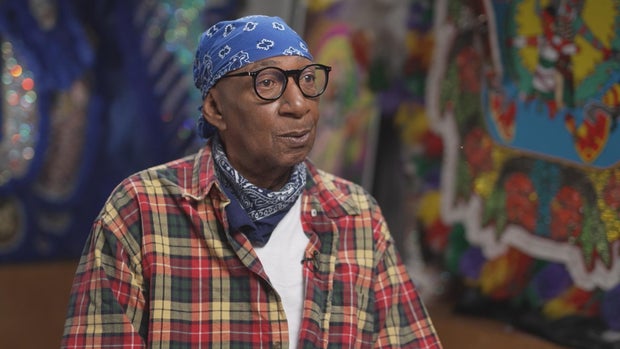
Big Chief Howard Miller
Big Chief Howard Miller 60 Minutes

"Here in America, especially here in the South, everything about Africa was forbidden. So we went behind our masks as Indians to practice our culture," he said. Until the 1990s, many of New Orleans' famed Mardi Gras krewes were segregated. Today, the tribes continue to march through their neighborhoods rather than on the city's parade routes. The Mardi Gras Indian tradition, Miller said, is grounded in community and "about uplifting our people in a proudly manner."

Though the display on Mardi Gras is hard to miss, much of the culture takes place behind closed doors – only tribe members are let in on the making of a Mardi Gras Indian suit. In 1969, a then 12-year-old Miller desperately wanted to join a tribe. It took him six weeks of waiting outside a big chief's home – first outside the gate, then the yard — before eventually working his way onto the front porch. He'd peek through the windows as the big chief worked on his suit. One day, a thunderstorm started as he watched.

"And the chief said, 'That boy still on the porch?' And somebody said, 'Yup.' 'Tell that boy to come on in here.' That's how I got in the house," Miller said. 

Miller is now a big chief. There's a hierarchy of positions in each tribe: the big chief leads, a spy boy is the eyes and ears of the tribe, the flag boy acts as the flag bearer, the wild man works to make space and the big queen holds the tribe together.

The masks — and the suits that go with them

The extravagant suits worn by Mardi Gras Indians are plumed, bejeweled, beaded and sequined. They're handcrafted in secret over an entire year to be unveiled on Mardi Gras day and only worn a handful of times. 

Melancon and his wife, Alicia Winding, sewed beads the size of chia seeds onto canvas to craft the art for Melancon's suit. They stitched rhinestones into place using dental floss. Melancon's fingers were swollen from puncture wounds.

"I sew from 6 in the morning to 12 at night," Melancon said. 

He works on it every day. 

"Without these beads, I couldn't breathe," he said.
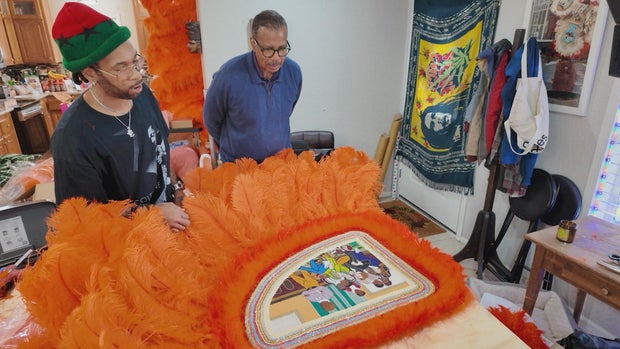
Big Chief Demond Melancon and Bill Whitaker
Big Chief Demond Melancon and Bill Whitaker 60 Minutes

Melancon said he's motivated by the community. 

"It fuels the fire because you're doing it for them. Like, you do this for your community and your people," he said. 

The beaded panels on this year's suit, which he says cost $25,000 to make, told the story of the Amistad, a slave ship seized by captive Africans in 1839. One panel depicted when the Africans won their freedom in a case that went to the U.S. Supreme Court.   

Melancon said that when he dons his suit, the spirits of his ancestors come down. 

"They come in through me to walk in their shoes on the streets of New Orleans like they taught us," Melancon said. "So what we [are] doing is we're preserving it for that next generation to be able to walk like I walked."

Preservation comes at a heavy personal price. For years, Melancon used to work laying concrete and cooking lobsters. He'd pour his spare time and money into his creations. He even lost a home after putting everything he had into a suit. 

Melancon now makes a living as an artist. His suits and beaded portraits have been displayed in museums and galleries around the world. His work will be featured at next month's Venice Biennale in Italy; it's the world's most prestigious recurring art exhibition. 

Inspiring the next generation of Mardi Gras Indians 

Melancon said he hopes his success in the art world will inspire a younger generation to carry on the culture. 

"I pray it does. And I pray one of them picks up a needle and wants to do what I do," he said. 

Time and money aren't the only obstacle. The working-class neighborhoods that sustain the tribes have been thinned and scattered by Hurricane Katrina and gentrification. But Joseph Pierre Boudreaux, better known as Big Chief Monk of the Golden Eagles Tribe, is determined to hold onto the community and legacy. 

"We're going to do it. We're going to do it, let the world know that we're here and we've been here," Boudreaux said. "We ain't just got here. We've been here."

He committed the sounds of the Mardi Gras Indians to vinyl in the 1970s as one of the first musicians to marry the tribes' chants to New Orleans funk music. His albums have earned two Grammy nominations. Boudreaux's son described his impact on the culture as being like the impact "Michael Jordan had on basketball."

"You know, my father, he took something that was made for the culture in the streets, and he was one of the pioneers that took it global," Joseph Boudreaux Jr. said. "There's not a person in the city of New Orleans that sews an Indian suit and they don't put on his music."

For decades, Boudreaux sewed and beaded suits for his children and grandchildren. This year, his family helped the now 84-year-old big chief sew his.

Big chiefs aren't just heads of their tribes; they're mentors and community leaders. Boudreaux is one of the most respected. Just before Mardi Gras, he was diagnosed with cancer. He was too weak to march this year, but the crowds gathered outside his home on Mardi Gras morning as he sent the tribe off with a song. The big chief also had a message to share.

"If you don't keep it going, if you lose it, it's gone forever, it's finished," he said. "And that thing just disappear? Not here in New Orleans."
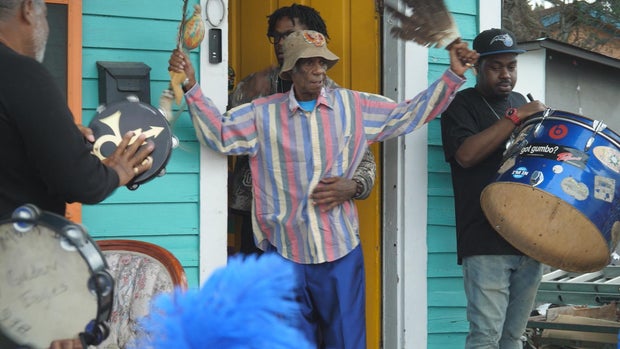
Joseph Pierre Boudreaux, better known as Big Chief Monk of the Golden Eagles tribe
Joseph Pierre Boudreaux, better known as Big Chief Monk of the Golden Eagles tribe 60 Minutes

In: