


/ CBS News
It's hard to exaggerate the role of the train in the American story or the romance of train travel, those iron horses galloping down tracks of steel. Why, then, has high-speed rail — so common in other countries — not tracked in the U.S.? An ambitious state-run project connecting L.A. and San Francisco has lurched, derailed, cost billions and may never happen. One private company is betting that it can succeed where the public sector has not, but that, too, has had its bumps. As U.S. high-speed rail remains a mirage, a ghost train, it's become a stand-in for a broader question: can America get its act together and still build big things?
The very model of modern engineering, it hums across the fruited plains at a top speed of 200 miles-an-hour. It revolutionized travel, it's a source of national pride… in Morocco.
Here in the U.S., high-speed rail looks like this: hardly passenger-ready.
America's hopes for its first high-speed rail were kindled in 2008, when California voters approved a ballot measure for a train connecting Los Angeles to San Francisco in less than three hours. The estimated price tag: $33 billion. Completion date: 2020. It would cut pollution; revitalize local economies, clear gridlock.
Status update: today the state's high-speed rail authority is preparing to lay its first tracks at roughly the same cost. Only, slight course correction here, instead of L.A. to San Francisco, it will run one-third of that distance, connecting… wait for it…the metropolis of Bakersfield and Merced, population 96,000. Oh, and when will it open? 2033. Maybe.
Rep. Vince Fong: I think that the California High-Speed Rail nightmare is the probably quintessential example of government waste and mismanagement.
Jon Wertheim: You say this needs to stop.
Rep. Vince Fong: Needs to stop.
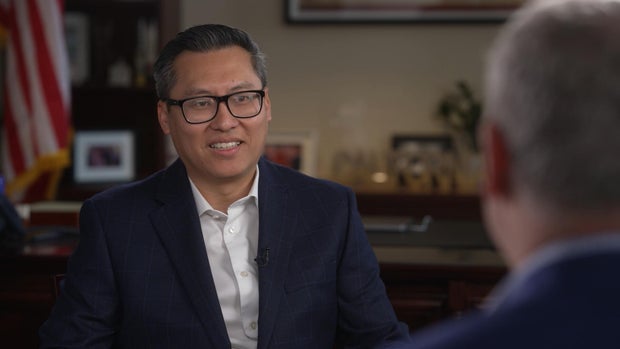
Congressman Vince Fong, a Republican from Bakersfield, sits on the House Transportation Committee. He says that when California voters first approved high-speed rail, the promise and price tag were more marketing campaign than realistic projection.
Rep. Vince Fong: We're now in 2026. There are no trains. There's no track laid. It was a complete bait and switch.
Jon Wertheim: If I vote for a mansion in Malibu by next year, and someone says, "Actually, you know what? In five years, we're gonna have a doghouse in Modesto," How do things go so off the rails?
Rep. Vince Fong: The business plan that was put out in 2008 was very theoretical. You know, "This is what we think is gonna happen." And it became very clear that they didn't have the specifics worked-- worked out.
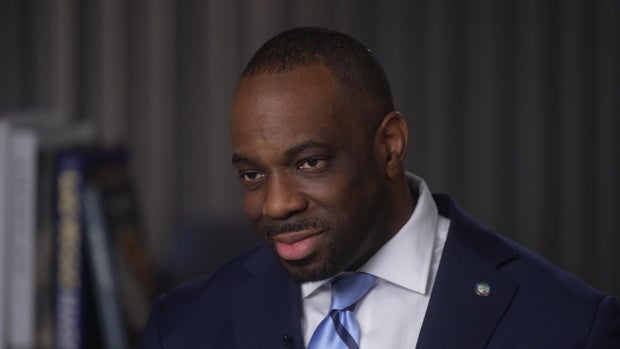
On that point, management doesn't disagree. Toks Omishakin is California's secretary of transportation, and Anthony Williams, a rail authority board member. Both are relatively new to the job, left to answer for their predecessors.
Toks Omishakin: There were mistakes made. Some of the criticism on this pr-- on this project I think are very fair.
Jon Wertheim: What happened?
Toks Omishakin: I don't think the voters fully understood and neither did we in the public sector what it was gonna take to actually get this project delivered.
To get the necessary political buy-in from the whole state, the plan called for the train to run inland, threading the farmland of the Central Valley. Yet, the rail authority hadn't answered basic questions, like precisely where it could lay down its tracks, what's known as right of way.
Toks Omishakin: 3,000 parcels had to be negotiated just for the segments that we're working on today. In the Central Valley.
Jon Wertheim: It seems to me one-- one farmer doesn't want high-speed rail going through his field, and you've got a guy that can gum up the works for-- for a long time.
Toks Omishakin: Yeah, that's what happens-- sometimes in-- in these processes.
More snarl: California's exacting environmental regulations, which triggered all manner of reviews, lawsuits, and delays. As anyone who's renovated a home knows, delay adds to price. So do the high U.S. labor and construction costs — at least compared to many other countries'. And while the federal government contributed modestly under the Obama and Biden administrations, the burden fell largely on the state.
Jon Wertheim: When construction started, was the financing there to complete this-- this rail?
Anthony Williams: It wasn't. Let's be real. We had a lot to learn. We had a lot of growth to do. And, you know, there's-- it's arguable whether, you know, we should have been clearer about that.
By 2019 — costs ballooning and the timeline years off schedule — bipartisan political pressure mounted. Newly elected, Gov. Gavin Newsom said this in his first state of the state:
Gov. Newsom: Right now, there simply isn't a path to get from Sacramento to San Diego, let alone from San Francisco to LA.
Under Newsom, who didn't respond to repeated interview requests — California decided to focus on that initial central Valley segment; a route few clamored for and fewer are likely to ride, though the ultimate goal remains connecting northern and southern California.
Lou Thompson: When you have a project like this, and when the-- when the budget no longer permits you to finish it the way you wanted to, you start cutting off your arms and legs.
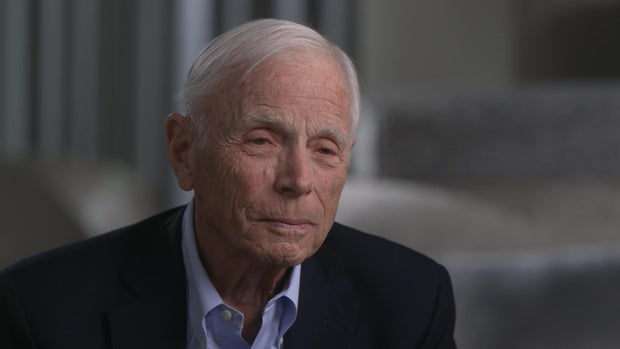
Lou Thompson helped found Amtrak in the 1970s, and until 2024, sat on California's High-Speed Rail Peer Review Group.
Jon Wertheim: We've heard people say, "Time to cut bait." We've heard people saying, "What happened in the past was the past. Failure's not an option."
Lou Thompson: Failure is always an option.
Jon Wertheim: Is that what's gonna happen here?
Lou Thompson: No, I don't think so. But I think what will-- will happen in the short range is that they will cut back and do the best they can with the money they have available.
Here outside Fresno in California's Central Valley, one of the few signs of concrete progress, literally - structures like this. Locals here jokingly refer to it as their own Stonehenge. Ideally, these bridges and viaducts will one day be used to support California high-speed rail. But, for now, these are curiosities in a field, monuments to promises that haven't been met, and plans that haven't been executed.
Ironic because American rail was once the world's envy. In the 1800s, the U.S. government oversaw the birth of the transcontinental railroad, stitching the country together as it expanded westward.
In the 1950s, the Eisenhower administration decided that the transportation vanguard was off the tracks, creating — and, critically, continuously funding — the interstate highway system, fueling the world's proudest car culture.
Meanwhile, Japan's famous bullet train opened in 1964 and today, more than 20 countries have high-speed rail — generally defined as cruising at 150 miles an hour or more.Yes, Germany and France and China. But also Turkey, Indonesia. Egypt has broken ground.
Mike Reininger: The obvious question there is, like, how can it be that we can't get it done and they can get it done, right? We know we can do this.
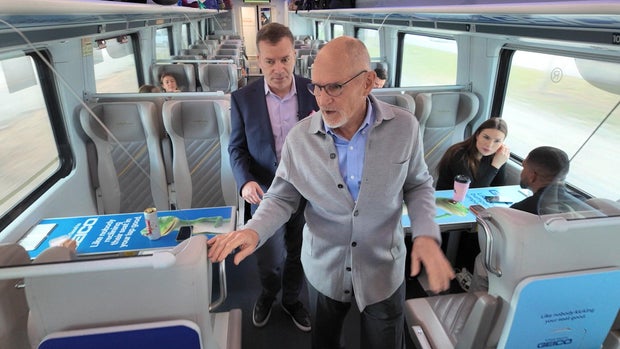
Mike Reininger is managing director of Brightline West, a private company that believes it can achieve what California hasn't.
Jon Wertheim: Oh, wow. Next stop, Zurich. This is like a European train system.
This train, which opened in 2018 and runs between Miami and Orlando, hits top speeds of around 125 miles an hour: not quite high speed; but close. It's akin to a beta test for Brightline's next project: a bullet train connecting L.A. and Las Vegas in just over two hours, a trip that can take five hours by car.
Mike Reininger: Brightline West will be true high-speed rail, first time in the country. And we'll operate at speeds of about 200 miles an hour maximum.
Out West, Brightline is solving the right-of-way issue by running on the median of the I-15 highway. Construction has already begun on some of the station structures. The plan is to start service in 2029.
Jon Wertheim: What are you telling people to get them outta their cars, or getting them to avoid the airport?
Mike Reininger: It's more enjoyable. It's safer. It's reliable. This really is all about changing people's behavior.
Jon Wertheim: You don't think we're just-- this car culture is intractable? It's so hardened, and it's so much a part of the American psyche, it just can't be cracked?
Mike Reininger: I-- I don't think so at all.
Cultural questions aside, Brightline's Florida trains run at street level through crowded neighborhoods. And according to numbers compiled by the Miami Herald and local public radio, more than 200 people have been hit and killed by the trains in the near-decade since operations began. Brightline says that running rail in the desert out West — where track crossings won't be at street level — will be a safer proposition.
Then there are the finances: the stratospheric costs of building and running a rail line vastly outstrip revenues. Analysts have downgraded Brightline's debt to junk, raising questions about private rail as a business.
Jon Wertheim: To what extent, big picture, do you worry about the future financial viability of Brightline?
Mike Reininger: The business has built slower than we originally expected it to build. We thought we would be carrying more passengers today than we are. The business is in fact growing month over month, year over year. That's a great thing. That solidifies in our mind the viability of the business.
Brightline's west coast project has already received some federal funding and is hoping for a $6 billion loan from the Trump administration.
Mike Reininger: If you look around the world, for the most part, the infrastructure systems are funded by the public sector.
Jon Wertheim: You do see a role for government here?
Mike Reininger: Absolutely. We-- we welcome it.
Back in California, the Rail Authority insists state funds can cover the cost of the Central Valley leg. As for the rest?
Jon Wertheim: Just to be clear, as we speak right now, are the funds there to complete L.A. to San Francisco?
Toks Omishakin: The entire amount of money we need, not there today. But do we believe we can get those funds to get the-- the project done? Absolutely.
Jon Wertheim: How much do you estimate it's gonna cost to connect high speed rail, San Francisco to L.A.?
Anthony Williams: Today, we estimate with the right optimization just over $125 billion. I think $126 billion is the current estimate for that.
That's more funding than Amtrak has received in its history and still leaves a shortfall of roughly $90 billion.
Jon Wertheim: That's a big gap to fill.
Anthony Williams: It is a big gap to fill, but again, we have an understanding of how to get there and to fill that gap.
A gap the authority hopes to fill with a new plan to cut costs, lure private investment; and connect to bigger cities much sooner.
But there's another challenge to building anything today: the swirling winds of a political climate in which one party pushes and the other, reflexively, pulls. Remember Gavin Newsom's pessimism? In recent months he's championed the project…
Gov. Newsom: This is not just a transportation project, this is about reimagining the future of this region.
Meanwhile in 2025, President Trump canceled $4 billion in federal grants for the train, swiping at a political nemesis in the process:
President Trump: Did you ever hear of Gavin New-scum? He has got – that train – is the worst cost overrun I've ever seen…
In a statement to 60 Minutes, Secretary of Transportation Sean Duffy said the administration is in favor of high-speed rail, but this project has, quote "...wasted billions in taxpayer dollars yet delivered nothing…"
Jon Wertheim: Can this be done without help from the federal government?
Toks Omishakin: This initial segment, we believe so. The ultimate 494 miles of building this out without the federal government's help will be challenging. There's no doubt about that.
Jon Wertheim: Is this a nonstarter, to build a project like this without federal funding?
Lou Thompson: Well, not only can't it be done; it shouldn't be done-- because a lot of the benefits of the project, the reason why you build a project, is public. Pollution reduction, congestion reduction, improved safety, comfort, reliability. All of those things are public benefits.
There are other ideas for U.S. high-speed rail — say, Dallas to Houston — but nothing else in the building stage, leaving that uneasy, overarching question:
Jon Wertheim: Morocco has high-speed rail, and Serbia, and China, and Japan, and Western Europe. Why don't we? What's your simple answer?
Lou Thompson: Well, the simple answer is they've decided they want to do it and pay for it, and we haven't.
Jon Wertheim: You think we will in our lifetimes?
Lou Thompson: I don't know. I'm dubious. I'm dubious. Absent- a national political will to work with the states to create some of these systems, I think it's gonna be in, of course, my lifetime almost certainly not. But maybe yours, I don't know.
Produced by David M. Levine. Associate producer, Meghan Lisson. Broadcast associate, Mimi Lamarre. Edited by Mike Levine
In: