


惯性聚合 高效追踪和阅读你感兴趣的博客、新闻、科技资讯
阅读原文 在惯性聚合中打开

推荐订阅源

T
Threatpost
奇客Solidot–传递最新科技情报
奇客Solidot–传递最新科技情报
V
Visual Studio Blog
Application and Cybersecurity Blog
Forbes - Security
Forbes - Security
人人都是产品经理
人人都是产品经理
N
Netflix TechBlog - Medium
Recent Commits to openclaw:main
WordPress大学
WordPress大学
Webroot Blog
Webroot Blog
Jina AI
Jina AI
H
Hacker News: Front Page
Attack and Defense Labs
T
Troy Hunt's Blog
TaoSecurity Blog
TaoSecurity Blog
AI
AI
Hacker News - Newest:
Hacker News - Newest: "LLM"
Google Online Security Blog
钛媒体:引领未来商业与生活新知
钛媒体:引领未来商业与生活新知
Help Net Security
Help Net Security
美团技术团队
freeCodeCamp Programming Tutorials: Python, JavaScript, Git & More
博客园 - 叶小钗
P
Privacy International News Feed
A
Arctic Wolf
IT之家
IT之家
云风的 BLOG
云风的 BLOG
S
Security Affairs
Simon Willison's Weblog
The Cloudflare Blog
博客园 - 司徒正美
Vercel News
Vercel News
C
Cyber Attacks, Cyber Crime and Cyber Security
SecWiki News
SecWiki News
K
Kaspersky official blog
cs.CV updates on arXiv.org
N
News and Events Feed by Topic
S
Schneier on Security
OSCHINA 社区最新新闻
OSCHINA 社区最新新闻
有赞技术团队
有赞技术团队
PCI Perspectives
PCI Perspectives
F
Fortinet All Blogs
T
Tenable Blog
Spread Privacy
Spread Privacy
T
The Blog of Author Tim Ferriss
S
Securelist
L
LangChain Blog
Latest news
Latest news
Cloudbric
Cloudbric
博客园 - 三生石上(FineUI控件)

60 Minutes - CBSNews.com

"Payam Method" hits the right note with piano students, making music education fun and accessible for kids Piano teacher's students sweep national competitions after learning the "Payam Method" Scientists focus on genetically engineering mice to cut Lyme disease transmission Sally Field says she believes "in the resilience of our Constitution" | 60 Minutes AI boom propping up economy as some guardrails are coming off, journalist Andrew Ross Sorkin warns Christopher Nolan imagines every movie is the last he'll ever make Christopher Nolan worked to make "most extreme version of a story possible" with "The Odyssey" Robotaxis coming to London pose a threat to traditional cabbies who memorize 25,000 streets to earn licenses Robotaxis are on the road to London. Cabbies, who pass a grueling test, aren't about to hand over their keys. Suspected insider accounts net $2.4 million on Polymarket Iran war bets with 98% win rate, firm finds Christopher Nolan: The 60 Minutes Interview London cabbies not ready to hand over their keys to AI-powered, autonomous taxis High win rate of bets on military operations a likely sign of insider trading Meet Gout Gout, the Australian sprinting phenom drawing comparisons to Usain Bolt Louisiana's governor on the Supreme Court decision and his suspending of House primary elections Extended interview: Israeli Prime Minister Benjamin Netanyahu Gout Gout, the fastest teen ever in the 200m, got his start when a coach saw him running around with friends Netanyahu wants Israel "to draw down to zero the American financial support" Read the full transcript of Major Garrett's interview with Israeli Prime Minister Benjamin Netanyahu here Israeli Prime Minister Benjamin Netanyahu: The 2026 60 Minutes Interview Louisiana rushes to redraw congressional maps after Gov. Landry suspends primaries Gout Gout: The 60 Minutes Interview Netanyahu wants to phase out U.S. military aid | 60 Minutes Iran war is "not over" until highly enriched uranium is removed, Israel Netanyahu says there's still "work to be done" before Iran war ends | 60 Minutes Historian Jill Lepore on constitutional amendments | 60 Minutes Inside Grasse, where flowers for Chanel No. 5 have been grown for more than a century Grasse, birthplace to Chanel No. 5, is experiencing a perfume revival Birding takes flight after peace deal between Colombia and guerrilla group | 60 Minutes Discover Grasse, the flower-filled French town behind the world's most famous perfume When the volunteer helping after a hurricane is a white nationalist | 60 Minutes Colombia has nearly 2,000 types of birds. Discover some of the species birders flock there to see. Once a hostage of Colombian rebels, he decided to teach his former captors birding Birding paradise flourishes in Colombian region that was once a war zone Some white nationalists swoop in after natural disasters, trying to soften their image while offering help Read the full transcript of Norah O'Donnell's interview with President Trump here Extended interview: President Trump on White House Correspondents' Dinner Fowl play: The criminals stealing elite racing pigeons The Pigeon Mafia: International criminal networks are stealing high-priced pigeons Former Sen. Ben Sasse, living with terminal cancer, sees an opportunity in living on a deadline Former Sen. Ben Sasse, dying of cancer, reflects on family, faith and the future of America Trump "wasn't worried" during White House Correspondents' Dinner shooting Retired Adm. William McRaven, who organized the bin Laden operation, reflects on honor The Pigeon Mafia: How high-priced pigeons became an organized crime target | 60 Minutes Ben Sasse: The 60 Minutes Interview President Donald Trump: The 2026 60 Minutes Interview Trump says he "wasn't making it that easy" for Secret Service during shooting "60 Minutes" to interview President Trump after White House Correspondents' Dinner shooting Ben Sasse was given a few months to live. He credits "providence, prayer and a miracle drug" for giving him more time. José Andrés on how food fits into America's story | 60 Minutes Rachel Goldberg-Polin on grief after Hamas abducted, killed her son | 60 Minutes Animals become Stewart Copeland's bandmates in album preserving the sounds of nature Stewart Copeland album "Wild Concerto" fuses music with sounds of hyenas, monkeys, owls Rock legend, naturalist team up to turn field recordings of animals into music What it would take for the U.S. to secure Iran's highly enriched uranium | 60 Minutes What it could take for the U.S. to remove highly enriched uranium from Iran Rachel Goldberg-Polin, grieving mother who fought for Israeli hostages' return, says she feels like she failed Rachel Goldberg-Polin, whose son Hersh was abducted October 7 and murdered by Hamas: Grief is a "badge of love" Iran's HEU | Sunday on 60 Minutes Wild Concerto | Sunday on 60 Minutes Great white sharks started disappearing from a former hotspot years ago, but scientists can The trucking companies evading federal safety enforcement and plaguing U.S. highways Pope Leo and President Trump are at odds over immigration in the U.S. and the Iran war Google CEO Sundar Pichai says "America must take the lead" on AI | 60 Minutes This was a great white shark hotspot. Then they mysteriously vanished | 60 Minutes Trucking fleets shed old identities in scheme to evade federal enforcement | 60 Minutes Pope Leo statements on Iran war and mass deportations inspire American cardinals to speak out Influential U.S. cardinals caution against Iran war, Trump immigration policies Mardi Gras Indians, or Black Masking Indians, spend months, thousands of dollars preparing hand-sewn suits Transportation Secretary Sean Duffy's statement for 60 Minutes' "Ghost Train" report High-speed rail is commonplace in many other countries. Will it track in the U.S.? Other countries have 200 mph passenger trains. Why has high-speed rail not tracked here? Mardi Gras Indians, or Black Masking Indians, carry on tradition in stunning, painstakingly crafted suits RAM pop-up clinics provide free medical, dental, and vision care to uninsured or underinsured Americans After getting help from health care charity RAM, Tennessee man says he "could be a normal human again" Why high-speed rail hasn't tracked in the U.S. | 60 Minutes One of America's last true secret societies: The Mardi Gras Indians | 60 Minutes Evangelist Franklin Graham on the value he believes shaped the U.S. | 60 Minutes Doctors volunteer to help Americans cut off from health care by the cost | 60 Minutes 12/1/2024: ​​Notre Dame; Smith Island; Kate Winslet; Welcome to the Wedding U.S. military must adapt to drones on battlefield or risk losing supremacy, Marine veteran warns D.C. air traffic controller speaks about stressed conditions before midair crash: "It worked until it didn't" Drone arms race transforms war in Ukraine, with U.S. now learning lessons | 60 Minutes Vietnam's Son Doong cave is big enough for a skyscraper to fit inside | 60 Minutes Hall of Fame basketball coach Mike Krzyzewski with a game plan for the country's future 60 Minutes obtains documents showing close calls one day before D.C. midair collision What swimmer Katie Ledecky learned about America in her time with Team USA | 60 Minutes Jamie Lee Curtis doesn't "think it's possible to have a perfect union" | 60 Minutes Bill Ford on the secret to American innovation | 60 Minutes Amanda Gorman on what it means to be an American | 60 Minutes Mike Eruzione reflects on "Miracle on Ice" Olympic hockey game | 60 Minutes 3 of the Holocaust's youngest survivors share a special bond: Their pregnant mothers all deceived the Nazis Miracle babies of Mauthausen find each other decades after the Holocaust | 60 Minutes Ken Burns on what he thinks would surprise the founders of America | 60 Minutes Inside NASA's journey to the far side of the moon with Artemis II | 60 Minutes The Smithsonian secretary's favorite representation of America | 60 Minutes What struck astronaut Suni Williams about the view of America from orbit | 60 Minutes Getting ready for the 250th anniversary of the Declaration of Independence | 60 Minutes Character AI pushes dangerous content to kids, parents and researchers say | 60 Minutes UConn's Dan Hurley on the intensity he brings to coaching, his superstitions, and living up to the family name
South Africa's great white sharks mysteriously vanished. Scientists can't agree who, or what, is the culprit.
Anderson Cooper, Aliza Chasan, Michael H Gavshon · 2026-04-13 · via 60 Minutes - CBSNews.com

By

Anderson  Cooper

Anderson Cooper

60 Minutes Correspondent

Anderson Cooper, anchor of CNN's "Anderson Cooper 360," has contributed to 60 Minutes since 2006. His exceptional reporting on big news events has earned Cooper a reputation as one of television's preeminent newsmen.

Read Full Bio

Aliza Chasan

Digital Content Producer

Aliza Chasan is a Digital Content Producer for "60 Minutes" and CBSNews.com. She has previously written for outlets including PIX11 News, The New York Daily News, Inside Edition and DNAinfo. Aliza covers trending news, often focusing on crime and politics.

Read Full Bio

Michael H Gavshon, Nadim Roberts

/ CBS News

Add CBS News on Google

When great white sharks started vanishing from the coastal waters around Cape Town, South Africa, some scientists and conservationists were mystified.

Those waters teemed with great white sharks when 60 Minutes correspondent Anderson Cooper went diving with the predators in 2010. The area was home to smaller sharks and seals that the great whites hunted, turning it into a hotspot. 

But just a few years later, the sharks started disappearing, confounding scientists and conservationists. South Africa was the first country in the world to protect great white sharks in 1991, but today, some are worried it will be the first to lose that population to local extinction. 

Photographer Chris Fallows, who shot some of the most iconic photographs of great white sharks, said he used to see 250 to 300 great whites a year there, but now there are none. The mystery of why they disappeared has fueled a bitter feud among scientists and conservationists who can't agree on who, or what, is the real culprit. 

"Let's stop bickering about something we can't control, and let's start focusing on the things that we can control," he said. "If we don't start addressing those factors that we can control, I don't believe there's any hope."

When the sharks went missing 

Alison Kock, a marine biologist with South African National Parks, received her first clue in 2015. Divers sent her photographs of smaller shark carcasses on the sea floor with mysterious incisions in them. 

"It looked so surgical from the photographs that I first assumed it must have been done by somebody with a knife," said Kock. 
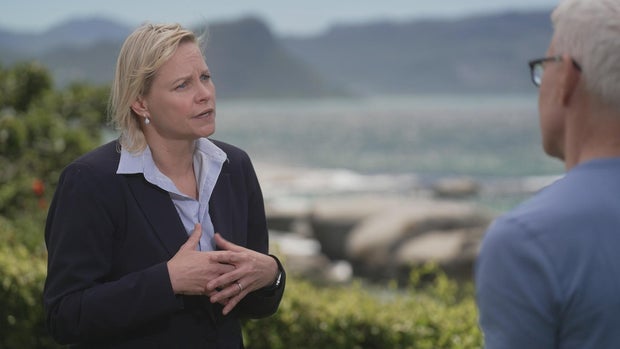
Alison Kock
Alison Kock 60 Minutes

Kock and her colleagues went diving for more evidence and encountered an unlikely suspect in the waters: orcas, also known as killer whales. She describes it as a "light bulb" moment. Two orcas went under their boat in the same area they had just found a shark carcass. 

"Now what we have is that orcas are a real possibility for being the culprit for these carcasses," said Kock. "I feel like a detective. But for a long time, we didn't have all of the pieces of the puzzle." 

Two years later, the carcasses of great white sharks started washing ashore with the same incision marks. Kock and her colleagues performed necropsies and confirmed orcas have been feeding on great whites, eating their livers. 

"It's the most calorie-dense organ out of the whole body. And it takes up almost a third of the shark's body," she said. 

Orcas have lived in the waters off of South Africa for years, though no one had ever seen one kill a great white in the area. Still, the whales had been known to hunt sharks off the coast of California and around Australia. 

Great white sharks were seen as apex predators, so many people struggled to see them as prey for orcas. But orcas are smart hunters and "learning all the time," Kock said. 

Port and Starboard

Whale-watching tour operator David Hurwitz was the first person to see two distinctive male orcas hunting and killing sharks. He named them Port and Starboard.

"They've become world famous, or infamous," Hurwitz said. Infamous because unlike most orcas which hunt in groups called pods, Port and Starboard were hunting sharks for their livers as a pair. 
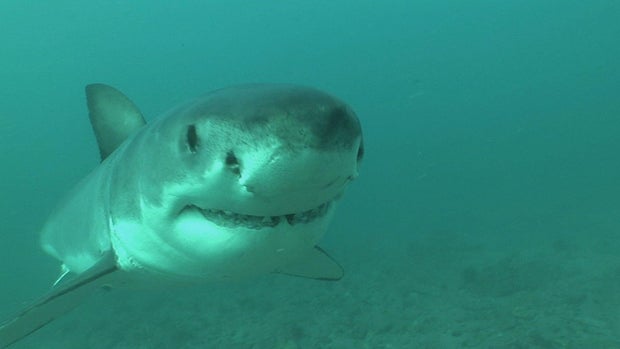
Great white shark
Great white shark 60 Minutes

Scientists now believe Port and Starboard might even be teaching other orcas how to hunt down sharks. In 2022, drone footage captured five orcas working together, stunning and then killing a great white. More recently, single orcas have been seen hunting sharks in South Africa and elsewhere.

Great whites, not used to being prey, fled further up the coast, Kock said. She believes the overall population of great whites in South African waters is stable. 

Humans, not whales, at fault, others say

Not everyone believes the case has been solved. Marine biologist Enrico Gennari, who's been researching great whites in South Africa for 20 years, says the population of great white sharks is in decline. He pins the blame on another culprit: humans. 

Gennari and Fallows, the photographer, say the numbers of great whites plummeted a few years before Port and Starboard began their killing spree.

Together, they've been documenting the impact of commercial fishing boats on smaller shark species that great whites prey on. The boats lay miles of long lines with thousands of hooks attached on the ocean floor. The sharks they catch are exported to Australia, used for cheap fish n' chips. 
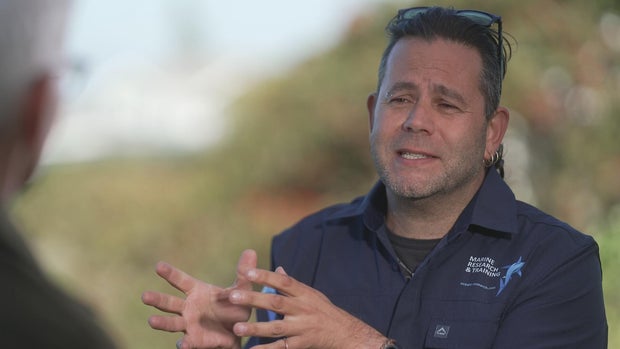
Enrico Gennari
Enrico Gennari 60 Minutes

"Shark longlining is undoubtedly robbing the great white sharks of food," Fallows said. "It's the primary prey source for the great whites when they're not feeding on seals."

Shark nets and baited hooks attached to buoys, which the South African authorities have used to protect swimmers along the coast since the 1950s, are also to blame, the pair say. Nets and hooks kill more than 20 great whites a year.

"The device[s] are designed to kill and lower the population number," Gennari said. "The concept is one less shark, one less chance of an encounter with a human."

Conserving great whites

Instead of nets and hooks, Gennari would like to see South Africa embrace a variety of alternatives to protect swimmers, like underwater magnetic fields which interfere with a sense sharks use for hunting. He also suggested increasing the use of smaller meshed nets, which create a barrier without entangling marine life. The methods used right now, which are all lethal for sharks, are "outdated and unsustainable," he said.

"If we lose the white shark in South Africa, we lose a battle for all nature," Gennari said. "If we can't protect even the most charismatic, most protected species — on paper — in South Africa, what chance [do] the little guys, the other sharks or the other animals, have against unsustainable use? Nothing."

Fallows pointed to the comeback of humpback whales in South Africa's waters as a conservation success story that can be emulated. The population rebounded after a moratorium on commercial whaling was enacted in the 1980s.

"What it's got, I believe, a hundred percent to do with is enlightened governments, passionate individuals, showcasing the whales for what they were: incredibly sentient creatures having an important role to play in our ocean," he said. "It's called balance. A balanced ocean is a healthy ocean. A healthy ocean is a healthy environment for us."

In: