


The coastal waters around Cape Town, South Africa, have long teemed with great white sharks. But about 10 years ago carcasses of these feared predators began washing up on beaches with their livers missing. Now it's hard to find any great whites. Tonight, a story that has all the hallmarks of a whodunnit: one that's fueled a bitter feud among scientists and conservationists who can't agree on who, or what, is the real culprit. They do agree on one thing: the great white sharks that once cruised these waters are gone.
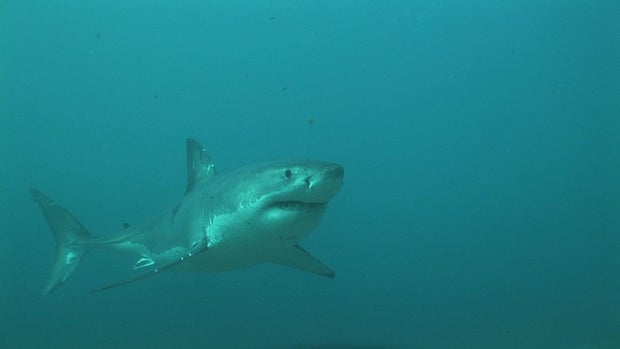
For as long as anyone can remember, the ocean off Cape Town was the best place in the world to see great whites.
There were plenty of smaller sharks for them to hunt, and tens of thousands of seals which live on a small stretch of rock nearby called Seal Island. Early each morning, with a little luck, you could catch sight of these majestic predators flying out of the water.
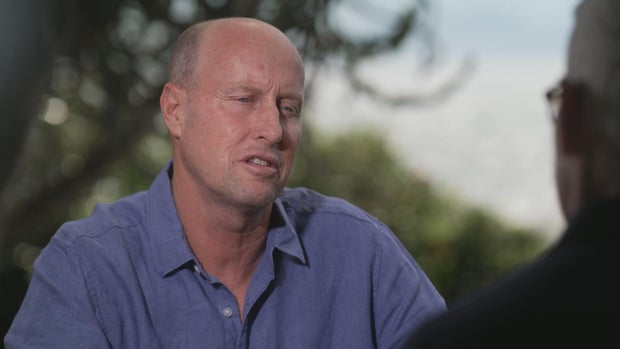
Until a little more than a decade ago Chris Fallows, a photographer and naturalist, used to see 250 to 300 different great white sharks a year. The images he took back then are amongst the most breathtaking of the natural world.
Chris Fallows: It's a sight you-- you never forget. You know, I still kind of get that t-- tingly feeling to see the most spectacular shark on Earth now flying out the water. It was truly incredible to see.
We saw that ourselves in 2010 when we reported on the great whites here, and the tens of thousands of visitors who came each year for a close encounter in cages.
We were taken diving without a cage in water that had been chummed with blood to attract sharks. Immediately, a 15-foot great white swam straight toward us.
Sharks are curious creatures and they circled us constantly. It was extraordinary to be so close to such a massive predator.
Anderson Cooper: That's incredible. It's just unbelievable. Wow. And I'm so happy I'm back up.
But just a few years after that dive, sightings of sharks here began to dwindle and the tourists stopped coming.
Chris Fallows: If you went out and did that today you would see nothing.
Anderson Cooper: Why is that?
Chris Fallows: Because their numbers have simply plummeted. Tragically, we have all but lost the great white shark.
The disappearance of great whites from here mystified scientists. Alison Kock, a marine biologist with South African National Parks, began searching for clues. In 2015, divers sent her these photos of smaller shark carcasses on the sea floor with mysterious incisions in them.
Alison Kock: It looked so surgical from the photographs that I first assumed it must have been done by somebody with a knife.
Anderson Cooper: A fisherman or something.
Alison Kock: Yes. And-- it wasn't until the next time it happened that I managed to retrieve some of the carcasses and study them. And I found tooth marks on the pectoral fins of some of the dead sharks.
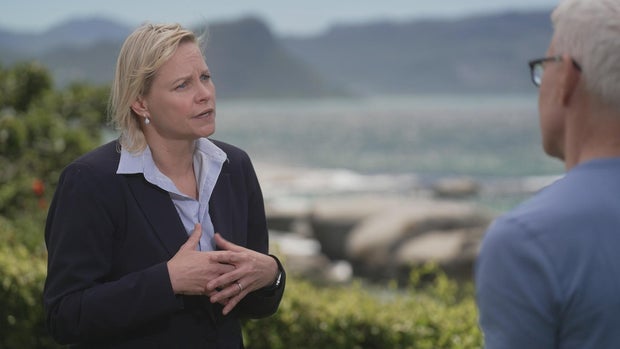
Those tooth marks suggested the culprits couldn't be human. So Kock and her colleagues went diving for more evidence, and encountered an unlikely suspect: orcas — killer whales.
Alison Kock: We'd just retrieved one of the carcasses. And my research partner says, "orca!" And here comes two orcas under the boat in our study area. It was light bulb. They were feeding right in that area where we just found the carcass. Now what we have is that orcas are a real possibility for being the culprit for these carcasses.
Two years later, great whites began washing ashore, with their livers missing.
Anderson Cooper: What's so tasty about a shark liver?
Alison Kock: It's the most-- calorie-dense organ out of the whole body. And it takes up-- almost a third of the shark's body.
Anderson Cooper: So they're not trying to eat the entire shark?
Alison Kock: They're just targeting the liver.
Kock and her colleagues performed necropsies and confirmed orcas were indeed the culprits. They have been in these waters for years, but no one had ever seen one kill a great white here, though they are known to hunt them off California and around Australia.
Alison Kock: For South Africa, this was completely novel.
Alison Kock: Because for a long time, you go, "but white sharks are the apex predators," and this is I think why people struggled to sort of believe that this was happening.
Anderson Cooper: I mean it is like something out of CSI. It's like you're the detective.
Alison Kock: And I feel like a detective. But for-- for a long time, we-- we didn't have all of the pieces of the puzzle.
David Hurwitz helped put the puzzle together. He's a whale-watching tour operator and was the first person to see two very distinctive male orcas hunting and killing sharks. He named them Port and Starboard.
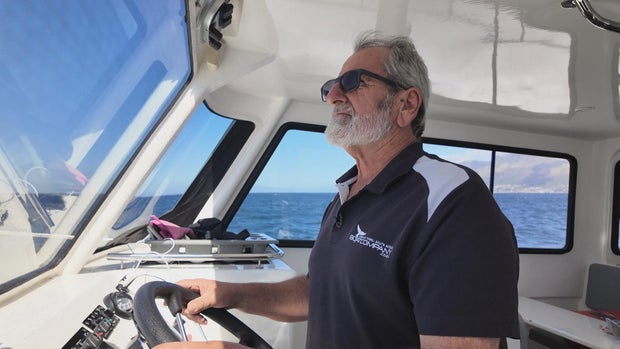
David Hurwitz: What was distinctive about them is that both of their dorsal fins were collapsed, which is very unusual--
Anderson Cooper: Like, collapsed over like that?
David Hurwitz: The one had collapsed to the left, and the other one to the right. And being a nautical man, immediately it came to-- my mind. Let's call them Port and Starboard. And that caught on from there. They've become-- world famous or infamous.
Infamous because unlike most orcas which hunt in groups called pods, Port and Starboard were hunting sharks for their livers as a pair.
Anderson Cooper: They're hunting on their own in ways people here have never seen before. I mean, are these like serial killers?
David Hurwitz: They are definitely not serial killers--
Anderson Cooper: They're eating the livers of-- it's like Hannibal Lector-- eating liver---with fava beans--
David Hurwitz: I am so infatuated by Port and Starboard. You'll never get me to say a bad word against them.
Scientists now believe Port and Starboard might even be teaching other orcas how to hunt down sharks. In 2022, this drone footage captured five orcas working together, stunning and then killing a great white.
Alison Kock: Here's an orca with this big white shark upside down, biting into the area where the liver is.
More recently single orcas have been seen hunting sharks in South Africa and elsewhere. This National Geographic documentary shows an orca striking a great white like a torpedo, stunning it, then taking it in its mouth.
Alison Kock: They're learning. They're learning all the time. I think it's hard for people to kind of understand how smart these animals are.
Kock maintains the presence of these smart hunters has chased the once dominant great whites further along the coast and insists that overall, the population of great whites in South African waters is stable.
Anderson Cooper: The presence of just two orcas, that would drive away hundreds of them?
Alison Kock: The predator eats the prey. And that has an impact on some of the numbers. But one of the biggest things with predation is the fear of predation, or the risk of predation, and what we call the landscape of fear.
Anderson Cooper: But gazelle don't disappear because a lion is killing some gazelle.
Alison Kock: They've evolved alongside of their predator. White sharks have not. White sharks have been the top dog. This was a novel predator for them. They were not used to being predated on by another species.
Enrico Gennari: Orcas have been killing white shark for thousand of years.
Enrico Gennari is an Italian marine biologist who's been researching great whites in South Africa for 20 years. He doesn't agree with Alison Kock that the population is stable.
Enrico Gennari: The question is not the orcas are pushing white shark away. Same thing happen in California. Same thing happen in Australia. The question here in South Africa: Why they are not coming back?
Anderson Cooper: In California, orcas have killed great white sharks, but then the great whites came back?
Enrico Gennari: Up-- up to s-- six n-- nine month, the white shark left, but they always come back.
Gennari and photographer Chris Fallows both agree the numbers of great whites plummeted a few years before Port and Starboard began their killing spree.
Chris Fallows: By the time the great white sharks-- the-- had completely disappeared from Seal Island, we had never once seen Port and Starboard at Seal Island.
Anderson Cooper: You don't buy this argument that it's these two orcas that have made all the great whites here disappear?
Chris Fallows: I don't buy it one bit. How can you blame somebody that wasn't even on the crime scene?
Fallows and Gennari argue humans are ultimately to blame. They have been documenting the impact of commercial fishing boats on smaller shark species that are a staple of the great white's diet. The boats lay miles of long lines with thousands of hooks attached on the ocean floor. The sharks they catch are exported to Australia, used for cheap fish and chips.
Chris Fallows: Shark longlining is undoubtedly robbing the great white sharks of food. It's the primary prey source for the great whites when they're not feeding on seals when you remove the prey, you have a significant impact on the predator.
An even bigger impact on great whites, Fallows and Gennari say, are shark nets and baited hooks attached to buoys, which the South African authorities have used to protect swimmers along the coast since the 1950s. Nets and hooks kill more than 20 great whites a year, along with whatever else gets caught by them.
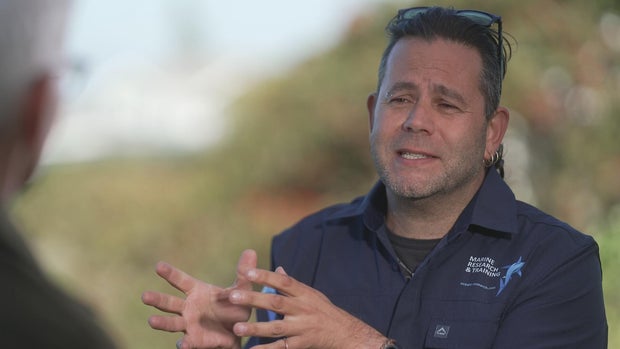
Enrico Gennari: The device are designed to kill and lower the population number. The concept is one less shark, one less chance of an encounter with a human.
Gennari would like to see South Africa embrace a variety of alternatives to protect swimmers, like underwater magnetic fields which interfere with a sense sharks use for hunting, or increasing the use of smaller meshed nets which create a barrier without entangling marine life.
Enrico Gennari: The problem that in South Africa, we only using lethal method. And that is outdated and unsustainable.
Anderson Cooper: If you believe that it's these two orcas which have driven away the great white population, there's not much humans can do about that. What your argument is there's actually a lot humans can do with longline fishing and getting rid of these shark nets, that is something humans can impact.
Chris Fallows: Absolutely. Let's stop bickering about something we can't control, and let's start focusing on the things that we can control. And if we don't start addressing those factors that we can control, I don't believe there's any hope.
In 1991, South Africa was the first country in the world to protect the great white shark. But Enrico Gennari believes those efforts have failed and now fears it may be the first country to lose them.
Enrico Gennari: If we lose the white shark in South Africa, we lose a battle for all nature. If we can't protect even the most charismatic, most protected species, on paper, in South Africa, what chance the little guys, the other sharks or the other animals, have against unsustainable use? Nothing.
Anderson Cooper: There's a lotta people watching that may not have a lotta sympathy with great white sharks. Why should somebody care?
Chris Fallows: I think somebody should care in the same way as we never used to have sympathy with whales. You know, we were wiping these animals-- animals out to the point of extinction.
Chris Fallows: Great whites are no different. So even if we don't like the look of the animal, they're incredibly important for us going forward.
With no great whites to document, Fallows has shifted his focus to photographing humpback whales. Since a moratorium on commercial whaling was enacted in the 1980s, humpbacks have made a remarkable comeback.
Anderson Cooper: Does it have anything to do with the great whites leaving?
Chris Fallows: No, what it's got a hundred percent to do with is enlightened governments, passionate individuals showcasing the whales for what they were: incredibly sentient creatures having an important role to play in our ocean. Therefore, they became protected, and then now their numbers are being allowed to expand naturally.
Anderson Cooper: To you, that's an example that conservation efforts can work?
Chris Fallows: Undoubtedly it can work. I believe, you know, if we take away pressures on animals, if there are enough of them, they will still rebound.
Chris Fallows: It's called balance… a balanced ocean is a healthy ocean. A healthy ocean is a healthy environment for us.
Produced by Michael H. Gavshon. Associate producer, Nadim Roberts. Broadcast associate, Grace Conley. Edited by Matthew Lev.
In:
此内容由惯性聚合(RSS阅读器)自动聚合整理,仅供阅读参考。 原文来自 — 版权归原作者所有。