


Once in a while we get to travel so far off-the-beaten track, there's hardly a track at all. That was the case last year when we went to the mountains of western Colombia. There are some 2,000 species of birds in that South American country, more than anywhere else on Earth – partly because of its diverse geography but also, surprisingly, because of war. Decades of fighting among the Colombian government, left-wing guerrillas, right-wing paramilitaries, and narco-traffickers made some areas so dangerous, few people could go there, preserving the birds' habitat. But since 2016 when Colombia's government signed a peace deal with the FARC, the largest left–wing guerrilla group, it's gotten safer to travel, and all those species of birds in untouched forests have become an important part of a growing ecotourism industry. It brings in millions of dollars to Colombia's economy, and bird watchers - birders, as they're known – are flocking there, hoping to catch even a fleeting glimpse of species you can't find anywhere else on Earth.
On the western slope of the Andes mountains, in an area with few roads in or out, lies Tatamá National Park – a vast stretch of lush rain forest, punctuated by powerful rivers. Delicate flowers blossom in the rain-soaked forest and the sound of birds fills the humid air.
This is one of the wettest places on earth. We set off before dawn in a four-wheel drive vehicle, through untouched forest. Hidden in the lush vegetation were all kinds of birds: some shy, others curious. Their colors as vivid as their names: the Blue-grey tanager, the Cinnamon fly-catcher, the Purple-throated woodstar.
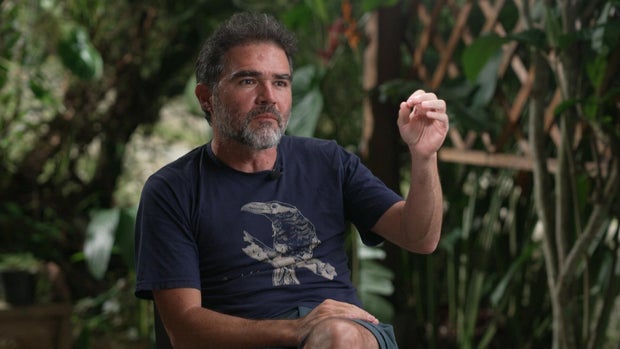
Diego Calderón Franco: Okay, check it out-- check it out this one mate
Diego Calderón Franco knows them all. He's one of Colombia's most famous birding guides.
Diego Calderón Franco: Go above the light.
Anderson Cooper: Uh-huh. Oh, yeah, yeah, yeah, yeah, yeah.
Diego Calderón Franco: The violet-tailed sylph, this is the female.
Anderson Cooper: This little one right there
Diego Calderón Franco: The little one actually
Anderson Cooper: Oh, yeah, yeah…
Diego Calderón Franco: Oh, that's-- that's the, the sylph--
Anderson Cooper: Oh, look at that. Whoa--
Diego Calderón Franco: Look at the tail.
Anderson Cooper: That tail is so beautiful.
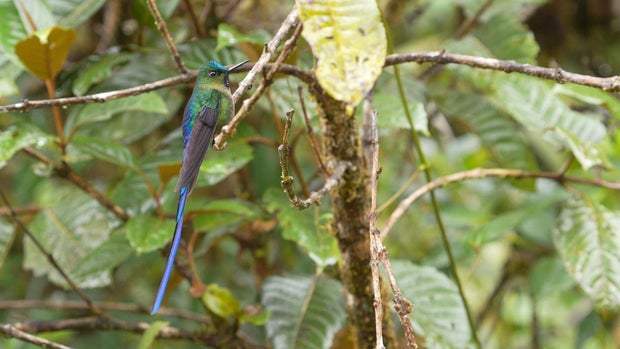
Diego's enthusiasm is infectious.
Diego Calderón Franco: And this is the star here--
Anderson Cooper: Whoa.
Diego Calderón Franco: This thing. Velvet-purple coronet. There you are
Anderson Cooper: Wow, those colors are incredible.
Nearby, we spotted some drama between two hummingbirds.
Anderson Cooper: Is that a family? One of them is just sitting there on a branch. The others seem to be darting about.
Diego Calderón Franco: Actually, they are both Empress brilliants, males. So they're actually probably two males fighting a little bit about territory.
Diego Calderón Franco: Hummingbirds, you know, they look cute but they're real warriors. They-- they will fight for resources.
Anderson Cooper: Really? Hummingbirds do--
Diego Calderón Franco: All day long, all day long.
Anderson Cooper: The pink right underneath the-- like, in the throat--
Diego Calderón Franco: In the throat.
Anderson Cooper: -- is incredible.
Birding may sound dull to some, but in the forest there's always something to watch out for.
Anderson Cooper: Whoa.
Diego Calderón Franco: Watch out.
Anderson Cooper: Ooh. Ooh, jeez.
Diego Calderón Franco: This is dangerous.
Diego has studied the species here so closely, he does their calls the way some people hum music.
Diego Calderón Franco: Something like that that I can--
Anderson Cooper: That's a wren--
Diego Calderón Franco: That would be, like, a wood wren in the forest. There is one here where we are that's called a Munchique wood wren that lives in the highlands. And it's, like, but it's much ha-- it's much happier. It has a different tone so it's more, like, much-- much of a, yeah, cooler vibe.
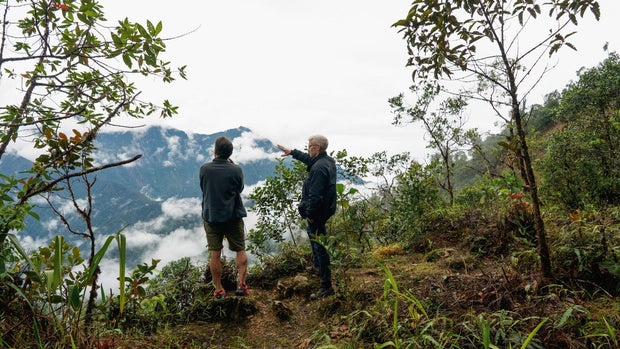
Anderson Cooper: You've said that being a bird guide in Colombia is like being an explorer during the Victorian age.
Diego Calderón Franco: It is, it is--
Anderson Cooper: How so?
Diego Calderón Franco: It is because all these explorers from the Victorian age, they were circumnavigating the globe and exploring and finding new species everywhere. And because our, you know-- troubled past, you can still, you know, be in Colombia, look at that isolated mountain range and you might find a new species for bird for science.
Anderson Cooper: Are there still bird species out there that haven't been discovered?
Diego Calderón Franco: Absolutely. We tend to think that we have explored it all, that we know every corner of the planet, and it's not the case.
Anderson Cooper: This area was a no-go area for a long time.
Diego Calderón Franco: Indeed. The fact that there were illegal armed groups in this area, you know, like, for so long prevented just people coming and-- and slashing and burning the-- the habitats.
Anderson Cooper: No one could disturb the birds but no one could go see them really either.
Diego Calderón Franco: Yeah, exactly, exactly.
More than 450,000 people were killed, most of them unarmed civilians, during decades of fighting between armed groups and government forces in Colombia. Fifty thousand people were kidnapped – Diego Calderón Franco was one of them. In 2004 as a graduate student, he and two colleagues were on an expedition in the mountains of northern Colombia when they were seized by the FARC – Colombia's largest Marxist guerrilla group
Diego Calderón Franco: They didn't believe that we were bird watchers, you know? Like, that they-- we were biologists.
While Diego and his colleagues were held hostage in this remote hideaway and others, birders around the world called for his release.
Diego Calderón Franco: And like 99% of all the other kidnappings in Colombia, it became monetary. It became like, "Okay, let's ask for a ransom to your families." I was 88 days, three months up there.
Anderson Cooper: How did you stay sane?
Diego Calderón Franco: Birds, I would say.
Anderson Cooper: You were being held prisoner but you could--
Diego Calderón Franco: But we could see and hear nature.
He scribbled notes about what he saw on these scraps of cigarette paper
Diego Calderón Franco: And I remember I saw for the first time one bird, that is called slaty brushfinch. And I even made a little drawing and a little note like, "Wow, this is my first slaty brushfinch," kidnapped up there in-- in the Perijá mountains.
His father finally scraped together about $30,000 to free him, and three years after his release, Diego started a business leading birding tours. This was one of his favorite places to stay – a farm at the entrance to Tatamá National Park.
It's owned by Michelle Tapasco and her family. She says they moved here in the 1990s to escape violence by right-wing militias in eastern Colombia, not realizing the left-wing FARC was active here.
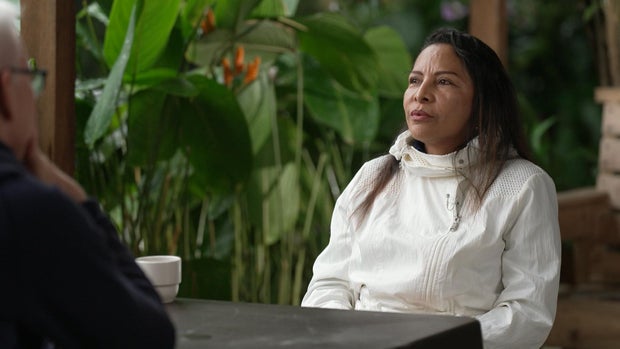
Michelle Tapasco (In Spanish / English Translation): After we got here we realized that it was the flip side of the coin. The guerilla strikes started. There were a lot of confrontations near here between the military, the police and the guerrillas.
In 2008, she says, the FARC kidnapped and killed her partner. She had five daughters to support and thought about leaving. But decided to stay and build a business providing lodging for the occasional visitor.
Anderson Cooper: When you started this business, did some people tell you-- "This is never gonna work"?
Michelle Tapasco (In Spanish / English Translation): Oh, in fact, they would tell me I was crazy. No one would give me a single peso for my project.
Now, thanks to birders, she's fixed the place up and rebranded it as the Montezuma Rain Forest Ecolodge.
Much of the food for guests is grown on the premises.
Michelle makes sure there's plenty of nourishment for Tatamá's hardworking hummingbirds. Colombia is home to more than 160 species of these fast-moving flyers.
Diego Calderón Franco: These guys, they are the very only group of birds in the world that can fly not only forward, normal, but up, down, and backwards.
Anderson Cooper: How fast are they moving their wings?
Diego Calderón Franco: How fast you think? How many times per second is
Anderson Cooper: Per second? 10?
Diego Calderón Franco: 80 times per second
Anderson Cooper: 80?
Diego Calderón Franco: You cannot, you cannot wrap these ideas on your brain
Ten years ago, the Colombian government reached a peace agreement with the FARC and nearly 10,000 fighters gave up their guns. But for peace to work, they needed new ways to make a living. So Diego decided to introduce his former captors to birding, thinking some of them might make good forest guides.
Anderson Cooper: What was it like to go birding with people who had been in FARC, who had been combatants--
Diego Calderón Franco: We totally forgot who we were. They weren't thinkin', "Oh, this is the guy we kidnapped, you know, 15 years ago." Birds connect you so much. And I think they-- that's why they have this healing power
Marcos Guevara was once a FARC guerilla. Now he's a photographer. Diego helped him get his first job. When he joined us at Tatamá, he captured this video of a green-and-black fruit-eater building a nest.
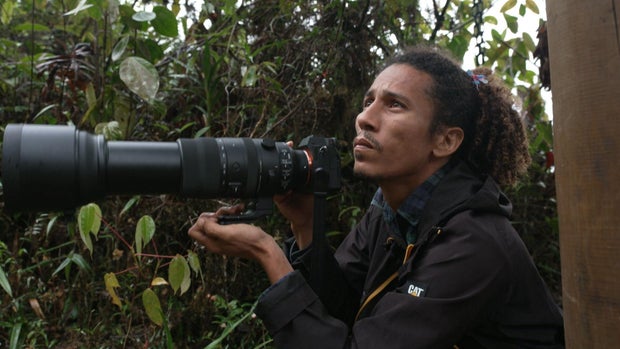
Anderson Cooper: Did you know anything about birding before you met Diego?
Marcos Guevara (In Spanish / English Translation): No, I didn't know anything at all. That was really my introduction to birds. Diego gave us the chance to attend workshops and training sessions. Birdwatching became a doorway for us—not just into conservation and preservation, but also as a way to generate income for ourselves.
Colombia still has plenty of problems. While we were busy birding, bombs went off in Cali, and a presidential candidate was assassinated in Bogota. Eight days ago, 20 people were killed in an explosion officials blamed on a faction of the FARC that refused to disarm. Peace here remains fragile, but more tourists are coming than ever before.
At Michelle's lodge we ran into Gary George and Joseph Brooks of Los Angeles. We bonded over a large bird that surprised us one morning.
Anderson Cooper: Look at that. Oh my God, look at that huge thing. Do you see this? It's right there. Look, there's another one!
Joseph Brooks: Oh, that's a vulture, the black vulture.
Like many serious birders, they have what's called a life list: a count of how many of the roughly 11,000 species of birds in the world they've seen or heard.
Garry George: Some people collect salt and pepper shakers. But we collect bird sightings. And we go around the world to do that.
Anderson Cooper: How many birds have you seen?
Joseph Brooks: We're very close to 8,000.
Anderson Cooper: 8,000. So you've seen the-- the majority of birds--
Joseph Brooks: We've seen a majority of the birds.
Garry George: Like, four-fifths of the-- of the world's birds.
If you didn't notice, those tattoos on Brooks' arms are some of his feathered favorites. He says there's about 50 birds tattooed all over his body.
Joseph Brooks: This is a satin bower bird from Australia. This is a red crowned crane we saw in Japan dancing in the snow–
On this trip, they were searching for the ever-elusive Chami Antpitta. In two prior trips here, they'd never gotten a glimpse of one. But this time they suddenly heard its call.
And then it darted right past them, so fast our camera couldn't catch it.
Joseph Brooks: It's like finding a jewel, like a prize. And being in that moment, everything else goes away. You're not worrying about anything else in your life. You're only present in that moment.
Most birds don't have it as good as those here in Tatamá National Park. Worldwide, 60% of bird species are declining in population – victims of logging, agricultural expansion, and economic development.
At Montezuma Lodge, Michelle Tapasco told us she's working to buy more land to preserve for the birds and now her daughters are pursuing careers in biology, forestry, birding, and conservation.
Anderson Cooper: When you think about it, I mean, did the birds save you?
Michelle Tapasco (In Spanish / English Translation): Yes. They have given me everything I have, everything I am, everything my daughters are today
Anderson Cooper: Two of your daughters got married. Are they married to birders?
Michelle Tapasco (In Spanish): Yes.
Anderson Cooper: I never thought of birds as matchmakers. But it seems like here maybe they are.
Michelle Tapasco (In Spanish / English Translation): I believe so.
On our last day birding, we got to glimpse a species that only lives in this part of the Andes mountains: the Gold-ringed tanager.
Diego Calderón Franco: That's the bird of this place. That's what birders come to see.
Diego Calderón Franco: This type of bird is, like, keystone for dispersin' of seeds, you know? They will chew on the berries, they will travel away from the parental plants, and they will defecate, and they plant those seeds.
A little later, we got an even better look. The tanager may not be the most colorful bird in these forests, but just seeing it did feel like an accomplishment. We knew we'd probably never have the chance to see it again.
Anderson Cooper: Oh wow, that's great.
Diego Calderón Franco: Now you belong to a higher cult of mortals, for you have seen the gold-ringed tanager.
Produced by Andy Court. Associate producer, Annabelle Hanflig. Broadcast associates, Grace Conley and Marcos Caballero. Edited by Patrick Lee.
In:
此内容由惯性聚合(RSS阅读器)自动聚合整理,仅供阅读参考。 原文来自 — 版权归原作者所有。