











Anka Bergman went into labor as the Nazi death train she was packed onto arrived at the Mauthausen concentration camp, where more than 95,000 prisoners died during the Holocaust.
She gave birth to Eva Clarke on April 29, 1945, just one day after the last gassing of prisoners at Mauthausen and shortly before Germany's surrender in early May. Clarke and two others whose mothers also concealed their pregnancies from Nazi guards are among the youngest survivors of the Holocaust.
"Had the train arrived on the 26th or 27th, none of us would've survived," Clarke said.
Clarke is now 80, as are two of her fellow survivors, Hana Berger-Moran and Mark Olsky. Clarke's mother was from Czechoslovakia, as was Berger-Moran's mother, Priska. Olsky's mother, Rachel, was from Poland.
The mothers each fell in love with their husbands as Europe was descending into war. Jews were rounded up in ghettos and sent to camps as Nazis occupied Poland and Czechoslovakia. Olsky's parents spent much of the war in the Warsaw and Lodz ghettos. Clarke's parents were sent to a Czech camp called Terezin, where she was conceived in violation of camp rules.
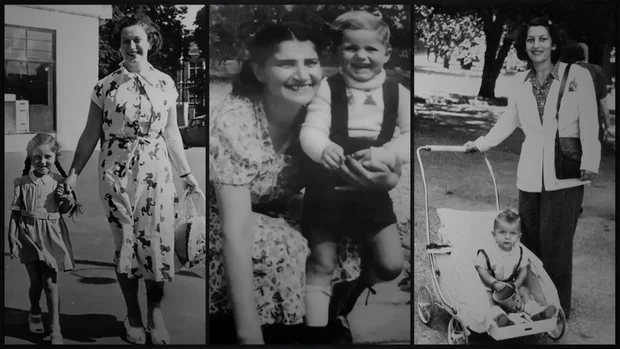
The three young Jewish women were all newly pregnant in 1944 when they were sent to the notorious death camp Auschwitz. Pregnancy was an offense punishable by death in the camps, yet all three women managed to survive horrific conditions, give birth and keep their newborns alive through seemingly impossible twists of fate and luck.
Berger-Moran's parents talked about possible baby names while on the packed train to Auschwitz, even though they knew they were headed toward a death camp.
Families were ripped apart upon arrival at Auschwitz. Most, including mothers, children and the elderly, were sent straight to death in gas chambers where, at their peak, 6,000 people were murdered each day.
Some prisoners, including the mothers of Clarke, Berger-Moran and Olsky, were selected for work as slave laborers. They were stripped, shaven and sent to overflowing barracks.
Berger-Moran's mother saw her father only once after their arrival in Auschwitz, through a barbed wire fence that separated male from female prisoners.
"'Think only good thoughts.' He just kept repeating that sentence," Berger-Moran said her father told her mother.
Berger-Moran never had the chance to meet her father.
Josef Mengele, a Nazi doctor known for his gruesome experiments on camp inmates, often conducted selections of prisoners at Auschwitz, determining who would live or die. Women, including Berger-Moran's mother, were forced to line up, naked, in front of Mengele, who asked her if she was pregnant.
She was faced with a choice: confess, or deny her pregnancy, according to author Wendy Holden, who has studied Auschwitz and written a book about the three women and their children.
"Each of them sensed that they were in the presence of great danger, and they each denied it," Holden said.
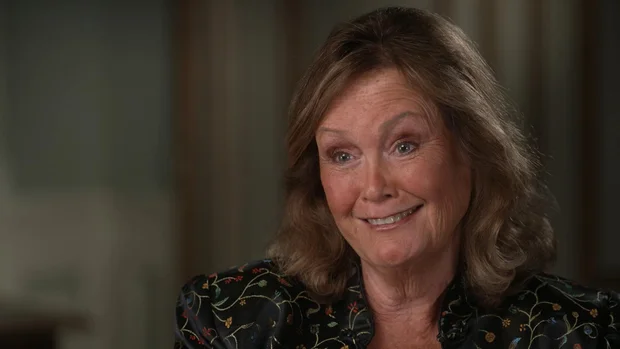
The three pregnant women, who never knew about each other, were sent to a slave labor camp in Freiberg, Germany. They were among more than 1,000 women prisoners manufacturing parts for German fighter planes during 12-hour shifts in a converted porcelain factory.
"Living on really [a] diet of water, ersatz coffee in the morning and thin soup, and then maybe a tiny piece of bread every day," Holden said.
The women were able to conceal their pregnancies because they'd been given baggy dresses, clothing from women who'd been gassed, at Auschwitz, Holden said.
Clarke's mother was there for six months, becoming progressively more starved and more obviously pregnant.
"But fortunately, none of the Germans realized she was pregnant, because had they done so, they might well have sent her back to Auschwitz to be killed," Clarke said.
As the Allies advanced in the spring of 1945, Germany was making plans to get rid of the slave laborers. Before Berger-Moran's mother could be sent anywhere, though, she went into labor on the factory floor on April 12.
"The guards watched. And they took bets on whether it was going to be a boy or a girl," Holden said.
Berger-Moran remembers asking her mother if she had been embarrassed.
"'I didn't have [a] chance to be embarrassed. You were being born. That was all that mattered to me,'" she said she remembers her mother telling her.
Just 36 hours later, the slave laborers and Berger-Moran, newly born, were loaded onto open coal wagons — filthy and open to the skies.
"It was the death train," Berger-Moran said. "They were looking for a camp where they could kill all these women."
They were on the train for 16 days, Clarke said, with no food and hardly any water. At one point, the train was stopped and a farmer walking by saw Clarke's mother.
"He had such a shock. My mother described herself as looking like a scarcely living pregnant skeleton," Clarke said. "And this farmer brought her a glass of milk."
Clarke's mother maintained that glass of milk saved her life.
Olsky's mother, under 70 pounds and nine months pregnant, was put in the sick car on the train, surrounded by sick and dying women. She thought she was going to die, and that she'd give birth to a stillborn. She was wrong. Olsky was born on April 20.
It was Hitler's birthday.
Clarke's mother was the last to give birth, going into labor as the train arrived at Mauthausen, one of the last camps still standing.
"It was April, so there were blossoms and birds singing. And she said she thought it was the most beautiful thing she'd ever seen," Holden said. "And she also thought it would be the last thing that she'd ever see."
The spring blossoms at Mauthausen were not the last thing Clarke's mother ever saw. The last time the Nazis used the gas chamber at Mauthausen was the day before her arrival.
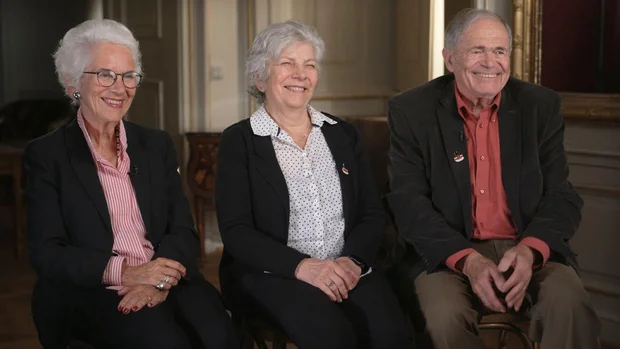
The mothers and their newborns held on and, several days later, a small unit of two dozen soldiers from the 11th Armored Division of Gen. George Patton's Third Army liberated the camp.
When Berger-Moran's mother saw a soldier walk by with a helmet bearing a red cross, she called him over, saying, "I have something to show you." Her baby was covered with infected sores.
"He said to my mother in English, 'I'll get the doctor because your baby needs help.' And he ran and brought the doctor. They took me," Berger-Moran said.
The next day, a nurse brought a bandaged Berger-Moran back to her mother, who never forgot the young American medic who saved her baby's life.
That medic, then 22-year-old Leroy "Pete" Petersohn, never forgot Berger-Moran either.
Petersohn, drafted into the Army in 1942, lived through a jeep explosion and fought in the Battle of the Bulge before his unit liberated Mauthausen. He suffered, years later, from post-traumatic stress disorder.
The official U.S. Army photo of Americans liberating Mauthausen captures the joy of prisoners finally being freed. The photos Petersohn kept in his scrapbook — of piles of emaciated corpses and of a man who died in front of his eyes — show a far darker reality.
Petersohn's job at Mauthausen was to triage which survivors could be helped. He was shocked when he came upon Berger-Moran. Petersohn told his son, Brian, that he and the unit doctor used penicillin, brand-new at the time, to treat Berger-Moran.
He never stopped wondering what happened to the baby girl he'd helped save, Petersohn's son said.
In the weeks after liberation, Berger-Moran and her mother, like many freed prisoners, traveled back to their hometowns across Europe in hopes of finding living family members. The fathers of Berger-Moran, Clarke and Olsky had all died.
Clarke and Olsky's mothers later remarried, but none of the mothers had other children, so Olsky, Clarke and Berger-Moran grew up as only children — survivors born to survivors.
Olsky's mother was reluctant to share details of her time in the camps with her son. When he was young, he was told he'd been born on a train and thought it was cool. He became enraged as he learned the truth.
When he was 12 or 13, he said people would ask him what he wanted to do with his life. He'd tell them he wanted to go to Europe and kill as many Germans as he could. Olsky vividly remembers his mother's response.
"In almost the exact words, she said, 'They took so much from us. If this is what you become like, they will have taken your soul,'" Olsky said.
Berger-Moran's mother raised her in Czechoslovakia. As an adult, Berger-Moran moved to Israel, then to the U.S. for graduate school. Her mother sent her off with a request: try to track down the American medic who'd saved her life.
Berger-Moran didn't even know the name of the medic, but she sent a letter to the 11th Armored Division, which eventually put her in touch with Petersohn, then 81.
The medic and baby met again in May 2005, 60 years after their first meeting.
"I was able to thank him finally, truly thank him, because he saved my life. He did," Berger-Moran said.
All those years later, meeting the baby he'd saved and developing a relationship with her helped with Petersohn's PTSD, his son said.
Berger-Moran said she asked Petersohn if she could call him "Daddy Pete."
"I didn't have a father, you know? So he became my daddy," she said.
Petersohn died five years later in June of 2010. Berger-Moran spent a week with him during his final illness.
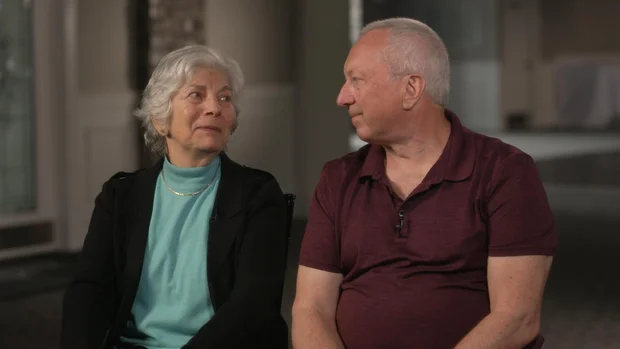
To this day, Petersohn's son Brian considers Berger-Moran his big sister.
"From the past, nobody survived. So I have my family. I am so lucky," she said.
And her family was about to get bigger.
Clarke, who grew up in the U.K., reached out to the 11th Armored Division a few years after Berger-Moran.
She sent a picture of her mother along with three generations of descendants. That photo appeared on the cover of the division's next newsletter. Clarke found Berger-Moran's story as she looked through the newsletter.
"Up to that point, my mother had always thought that we were the only ones," Clarke said.
Clarke and Berger-Moran arranged to meet at Mauthausen, now a memorial, just after their 65th birthdays.
That's where Olsky comes in.
His son, Charlie, was struggling to find a 65th birthday present for his dad and thought he would search to see if there were any photos of him as a baby in the concentration camp. A Google search led him to the 11th Armored Division website, where he saw Clarke's family photo and story. The website's administrator connected him to Clarke and Berger-Moran within an hour.

With just a few weeks to go before Clarke and Berger-Moran's trip, Charlie booked tickets for his father and himself to join them.
"First thing out of his mouth that I heard was, 'Would you like to go to Austria with me around the time of your birthday?' My mind is, 'One of my kids wants to spend a bunch of time with me? Sure. Yeah, I'm there,'" Olsky said.
The three survivors met for the first time in May 2010.
"We spent the whole of the Saturday in one café talking, laughing and crying, and talking about our mothers, and comparing and contrasting their three stories," Clarke said.
That year, at age 65, they marched in the annual commemoration at Mauthausen. This past year, at 80, they marched again. Brian Petersohn also made the trip to honor his father.
"All I am thinking about is, 'I've been here before. I've been here before. I have been here before. But I left,'" Berger-Moran said as she stood in one of the camp's preserved barracks.
She, Clarke and Olsky now describe their relationship as one of siblings.
"We found each other," Olsky said. "We should have been together from day one."
Between them, they have 11 grandchildren. Clarke, Berger-Moran and Olsky's mothers lived to be 96, 90 and 84, respectively.
"My mother occasionally would say, 'And in the end, we won,'" Clarke said.
In:
此内容由惯性聚合(RSS阅读器)自动聚合整理,仅供阅读参考。 原文来自 — 版权归原作者所有。