






This is an updated version of a story first published on Jan. 4, 2026. The original video can be viewed here.
For decades, engineers have been trying to create robots that look and act human. Now, rapid advances in artificial intelligence are taking humanoids from the lab to the factory floor. As fears grow that AI will displace workers, a global race is underway to develop human-like robots able to do human jobs. Competitors include Tesla, startups backed by Amazon and Nvidia, and state-supported Chinese companies. Boston Dynamics is a frontrunner. The Massachusetts company, valued at more than a billion dollars, is hard at work on a humanoid it calls Atlas. South Korean carmaker Hyundai holds an 90% stake in the robot maker. As we first told you in January, we were invited to see the first real-world test of Atlas at Hyundai's new factory near Savannah, Georgia. There, we got a glimpse of a humanoid future that's coming faster than you might think.
Hyundai's sprawling auto plant is about as cutting-edge as it gets. More than 1,000 robots work alongside almost 1,500 humans, hoisting, stamping and welding in robotic unison. This may look like the factory of the future, but we found the future of the future in the parts warehouse, tucked away in the back corner, getting ready for work.
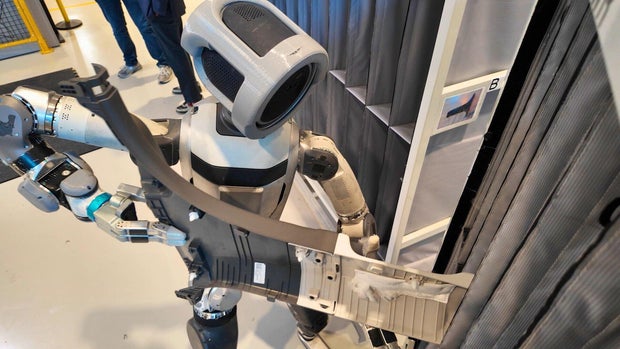
Meet Atlas: A 5'9", 200 pound, AI-powered humanoid created by Boston Dynamics. The rise of the robots is science fiction no more.
Bill Whitaker: I have to say, every time I see it, I just can't believe what my eyes are seeing. Is this the first time Atlas has been out of the lab?
Zack Jackowski: This is the first time Atlas has been out of the lab doing real work.
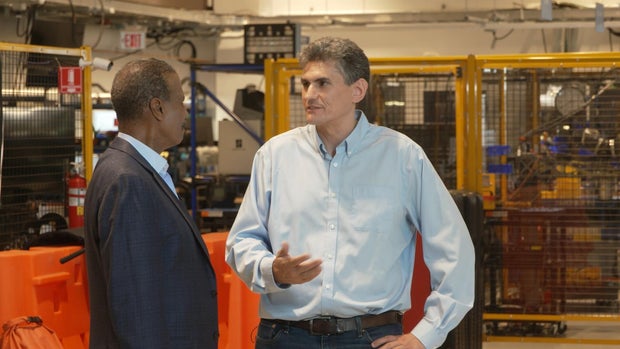
Zack Jackowski heads Atlas development. He has two mechanical engineering degrees from MIT and a mission to turn the robot into a productive worker on the factory floor. We watched as Atlas practiced sorting roof racks for the assembly line without human help.
Bill Whitaker: So he's working autonomously.
Zack Jackowski: Correct
Bill Whitaker: You're down here to see how Atlas works in the field, and you'll be showing Atlas off to your bosses at Hyundai?
Zack Jackowski: Yeah.
Bill Whitaker: Do you feel like a proud papa?
Zack Jackowski: I feel like-- a nervous engineer.
Jackowski has been preparing for this moment for a year. We first met him and Atlas a month earlier at Boston Dynamics' headquarters just outside the city, where he and his team were teaching Atlas skills needed to work at Hyundai. And Atlas, with its AI brain, was gaining knowledge through experience – in other words, it seemed to be learning.
Bill Whitaker: You know how crazy that sounds?
Zack Jackowski: Yeah, a little bit. I-- and I-- I think a lot of our roboticists would've thought that was pretty crazy five, six years ago.
When 60 Minutes last visited Boston Dynamics in 2021, Atlas was a bulky, hydraulic robot that could run and jump. Back then, Atlas relied on algorithms written by engineers. When we dropped in again this past fall, we saw a new generation Atlas with a sleek, all-electric body and an AI brain, powered by Nvidia's advanced microchips, making Atlas smart enough to pull off hard to believe feats autonomously. We saw Atlas skip and run with ease.
Bill Whitaker: Do you ever stop thinking, gee whiz?
Scott Kuindersma: I remain extremely excited about where we are in the history of robotics but we see that there's so much more that we can do, as well.
Scott Kuindersma was head of robotics research, a job he proudly wore on his sleeve.
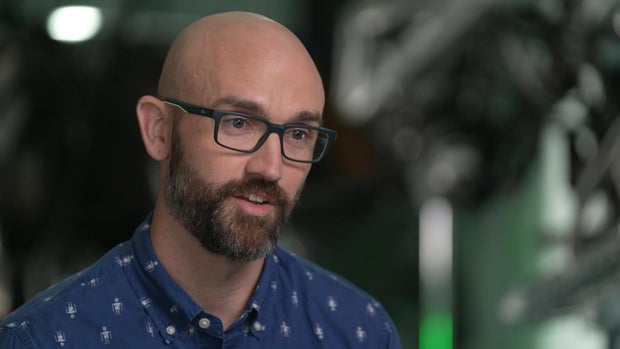
Bill Whitaker: You even have on a robot shirt.
Scott Kuindersma: Well, once I saw that this shirt existed, there was no way I wasn't buying it.
He told us robots today have learned to master moves that until recently were considered a step too far for a machine.
Scott Kuindersma: And a lot of this has to do with how we're going about programming these robots now, where it's more about teaching, and demonstrations, and machine learning than manual programming.
Bill Whitaker: So this humanoid, this mechanical human, can actually learn?
Scott Kuindersma: Yes. And-- and we found that that's actually one of the most effective way to program robots like that.
Atlas learns in different ways. In supervised learning, machine learning scientist Kevin Bergamin – wearing a virtual reality headset – takes direct control of the humanoid, guiding its hands and arms, move-by-move through each task until Atlas gets it.
Scott Kuindersma: And if that teleoperator can perform the task that we want the robot to do, and do it multiple times, that generates data that we can use to train the robot's AI models to then later do that task autonomously.
Kuindersma used me to demonstrate another way Atlas learns.
Scott Kuindersma: That v-- very stylish suit that you're wearing is actually gonna capture all of your body motion to train Atlas to try to mimic exactly your motions. And so you're about to become a 200-pound metal robot.
He asked me to pick an exercise. They captured the way I work as well.
Bill Whitaker: I am here at the AI Lab at Boston Dynamics. All of my movements, my walking, my d-- arm gestures are being picked up by these sensors…
Then engineers put my data into their machine learning process. Atlas' body is different from mine, so they had to teach it to match my movements virtually – more than 4,000 digital Atlases trained for six hours in simulation.
Scott Kuindersma: And they're all trying to do jumping jacks, just like you. And as you can see, they're just starting to learn, so they're not very good at it.
The simulation, he told us, added challenges for the avatars, like slippery floors, inclines, or stiff joints, and then homed in on what works best.
Scott Kuindersma: And it can eventually get to a state where we have many copies of Atlas doing really good jumping jacks.
They uploaded this new skill into the AI system that controls every Atlas robot. Once one is trained, they're all trained.
Scott Kuindersma: So that's what you look like when you're exercising.
Bill Whitaker: Uh-huh.
And what I look like doing my job.
Bill Whitaker: I am here at the AI Lab at Boston Dynamics. All of my movements, my walking, my d-- arm gestures are being picked up by these sensors …
Bill Whitaker: This is mind-blowing.
Through the same processes, Atlas was taught to crawl, do cartwheels. It didn't fare as well with the duck walk.
Scott Kuindersma: Oh, that was fun. And then this happens.
Bill Whitaker: And then this happens.
Scott Kuindersma: We love when things like this happen, actually. Because it's often an opportunity to understand something we didn't know about the system.
Bill Whitaker: What are some of the limitations you see now?
Scott Kuindersma: Well, I'd- I would say that most things that a person does in their daily lives, Atlas or-- other humanoids can't really do that yet. I think we're start--
Bill Whitaker: Like- like what?
Scott Kuindersma: Well, just putting on clothes in the morning, or pouring your cup of coffee and walking around the house with it.
Bill Whitaker: That's too difficult for-- for Atlas?
Scott Kuindersma: Yeah, I think there are no humanoids that do that nearly as well as a person would do that. But I think the thing that's really exciting now is we see a pathway to get there.
A pathway provided by AI. What stands out in this Atlas is its brain. Nvidia chips - the ones that helped launch the AI revolution with ChatGPT - process the flood of collected data, moving this humanoid robot closer to something like common sense.
Scott Kuindersma: So the analogy might be if I was teaching a child how to do free throws in basketball, if I allow them to just explore and come up with their own solutions, sometimes they can come up with a solution that I didn't anticipate. And that's true for these systems as well.
Atlas can see its surroundings and is figuring out how the physical world works.
Scott Kuindersma: So that some day you can put a robot like this in a factory and just explain to it what would– you would like it to do, and it has enough knowledge about how the world works that it has a good chance of doing it.
Robert Playter: There's a lot of excitement in the industry right now about the potential of building robots that are smart enough to really become general purpose.
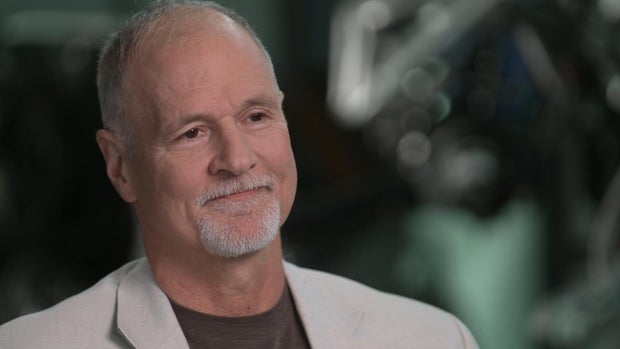
Robert Playter, then CEO of Boston Dynamics, spearheaded the company's humanoid development. He'd been building toward this moment for more than 30 years. The cornerstone was this robotic dog, Spot, introduced about a decade ago. Spots are trained in heat, cold and varied terrain, and roam the halls of Boston Dynamics.
Robert Playter: So we have some cameras-- thermal sensors, acoustic sensors. An array of sensors on its back that lets it collect data about the health of a factory.
Spots carry out quality control checks at Hyundai, making sure the cars have the right parts. They conduct security and industrial inspections at hundreds of sites around the world. What began with Spot has evolved into Atlas.
Robert Playter: So this robot is capable of superhuman motion, and so it's gonna be able to exceed what we can do.
Bill Whitaker: So you are creating a robot that is meant to exceed the capabilities of humans.
Robert Playter: Why not, right? We-- we would like things that could be stronger than us or tolerate more heat than us or definitely go into a dangerous place where we shouldn't be going. So you really want superhuman capabilities.
Bill Whitaker: To a lotta people that sounds scary. You don't foresee-- a world of Terminators?
Robert Playter: Absolutely not. I think if you saw how hard we have to work to get the robots to just do some of the straightforward tasks we want them to do, that would dispel that-- that worry about sentience and rogue robots.
We wondered if people might have more immediate concerns. We saw workers doing a job at the Hyundai plant that Atlas is being trained to perform.
Bill Whitaker: I guarantee you there are going to be people who will say, "I'm gonna lose my job to a robot."
Robert Playter: Work does change. So the really repetitive, really back-breaking labor is really- is gonna end up being done by robots. But these robots are not so autonomous that they don't need to be managed. They need to be built. They need to be trained. They need to be serviced.
Playter told us it could be several years before Atlas joins the Hyundai workforce fulltime. Goldman Sachs predicts the market for humanoids will reach $38 billion within the decade. Boston Dynamics and other U.S. robot makers are fighting to come out on top. But they're not the only ones in the ring. Chinese companies are proving to be formidable challengers. They're running to win.
Bill Whitaker: Are they outpacing us?
Robert Playter: The Chinese government has a mission to win the robotics race. Technically I believe we remain-- in the lead. But there's a real threat there that, simply through the scale of investment-- we could fall behind.
To stay ahead, Hyundai made that big investment in Boston Dynamics.
Zack Jackowski: Four robots…
We were at the Georgia plant when Atlas engineer Zack Jackowski presented Atlas to Heung-soo Kim, Hyundai's head of global strategy. He came all the way from South Korea to check in on the brave new world the carmaker is funding.
Bill Whitaker: What do you think of the progress that they've made with Atlas?
Heung-soo Kim: I think we are on track- about the development. Atlas, so far, it's very successful. It's a kind of-- a start of great journey. Yeah.
The destination? That humanoid future we mentioned at the start – robots like us working beside us, walking among us. It's enough to make your head spin.
Since our story first aired, Boston Dynamics unveiled an upgrade - an Atlas that's taller and stronger than the version we saw. The new Atlas will begin training at Hyundai's Georgia factory this summer.
Produced by Marc Lieberman. Associate producer, Cassidy McDonald. Broadcast associate, Mariah Johnson. Edited by Matt Richman.
In: