



By , Nicole Young
/ CBS News
Christopher Nolan is among the great Hollywood directors of his generation. His blockbusters have won 18 Academy Awards and hauled in more than $6 billion. Next, Nolan will release, this summer, his adaptation of the nearly 3,000-year-old story, "The Odyssey." We met the 55-year-old British American in his office in L.A., where he wrote epics including "Oppenheimer," "Dunkirk," "Inception," "Interstellar" and "The Dark Knight." A Nolan movie is a spectacle, big and loud, at the limits of what's possible. But a Nolan story is grace – imperfect people revealing what it is to be human. "The Odyssey" is Nolan's most ambitious yet. It had to be, he told us, because he imagines every film is the last he will ever make.
Christopher Nolan: I feel a real responsibility to try and get as much on screen for the audience as possible to give the audience the fullest flavor, the fullest set of images and events that we can give them for a given story.
Scott Pelley: What are the essential elements of a Christopher Nolan film?
Christopher Nolan: I always try to have a point of view on the story that's from inside the film. So, I'm not looking at the characters from 30,000 feet; I'm trying to be in the race, in the maze with them. 'Cause I wanna try and give the audience a sense of what a place would smell like, what it would feel like.
Christopher Nolan: But you're also trying to make the most involving, the most extreme version of a story possible.
Nolan's "Odyssey" is an extreme version of the Bronze age war fought by the soldier-king Odysseus— with his Trojan horse deception and 10-year struggle to return home. "The Odyssey" is Nolan's 13th film in 28 years. And unlike many directors, he writes the screenplays.
Christopher Nolan: When I'm writing, I'm visualizing the film as an audience member, as somebody experiencing the story. Then, when I direct the story, I'm trying to take the audience there. So, in the case of "The Odyssey," I'm tryin' to put the audience into that horse.
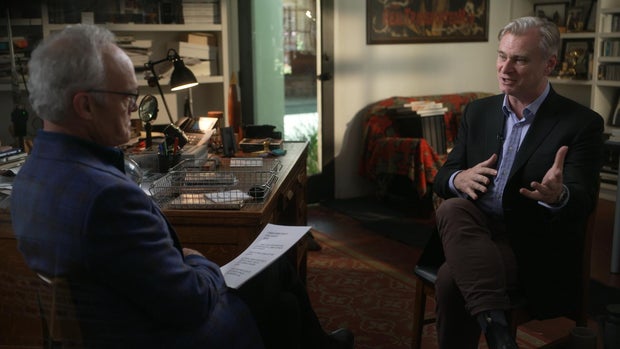
Christopher Nolan: I'm tryin' to put them on the deck of Odysseus's ship.
Scott Pelley: You don't want the audience to watch the film; you want the audience to be in the film.
Christopher Nolan: Very much. Yeah. And have a feeling of having connected with these characters, having lived in the world with these characters.
Scott Pelley: We're sitting next to your desk…
Christopher Nolan: Yep.
Scott Pelley: And I couldn't help but notice there's a book right next to me called "How to Make Good Movies." So, this is it? This is the secret?
Christopher Nolan: That's the secret. Yeah. I tried to tidy up before you came and hide all my secrets, but…
Scott Pelley: It looks like it was written in the 1950s, and there's a guy with a Super 8 camera on the cover.
Christopher Nolan: Very much about Super 8. Yeah, Super 8 home movies. And I'm actually old enough to have started on Super 8. My family had a Super 8 camera instead of a video camera.
Jonathan Nolan: My earliest memories, literally, are of Chris making movies.
Nolan's younger brother, Jonathan, is a Hollywood director who told us that Chris was handed the family eight millimeter camera to keep him busy.
Jonathan Nolan: Our take on "Star Wars," of course, in the basement, blowing up some of my toys with firecrackers. Probably 8 or 9-years-old at that point. I would have been 3 or 4.
Scott Pelley: What was it that fascinated him about the camera?
Jonathan Nolan: I think he's just always been captivated by the idea that you could take this device and use it as a portal into another universe. It was like a door.
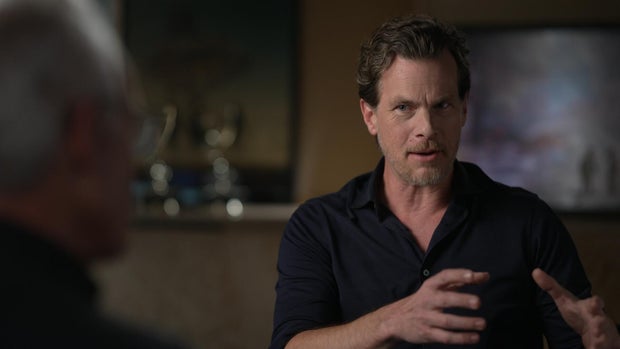
Another universe but a door that, at first, Chris Nolan had to batter through, like the astronaut in "Interstellar."
Scott Pelley: As a young man, you graduated with a degree in literature.
Christopher Nolan: Hmmm.
Scott Pelley: You applied to film school…
Christopher Nolan: Mhmmm.
Scott Pelley: And they turn you down.
Christopher Nolan: How do you know that?
Scott Pelley: Research.
Christopher Nolan: God.
Scott Pelley: You know about research.
Christopher Nolan: Oh yeah. Absolutely. Yes.
Scott Pelley: What did the film school tell you?
Christopher Nolan: Nothing. You just get a letter saying, "No thanks."
Despite "no thanks," he kept shooting films on weekends with friends. Then, in 1999, a turning point, he made "Memento."
It's a complex mystery with an amnesiac investigator who remembers clues through tattoos. This was an early reveal of Nolan's trademark – an intricate plot of shifting timelines that challenges the audience to keep up. But movie executives feared it was confusing.
Scott Pelley: No one wanted to distribute "Memento."
Christopher Nolan: Yeah. Well you don't have to say it quite like that-- quite so sternly. I mean, it had—
Scott Pelley: Well, this story has a happy ending--
Christopher Nolan: This story does have a happy ending. And no, it was-- it was a lesson in humility, it was a lesson in patience-- of independent filmmaking, which is, you know, you finish a film, and you really feel you've achieved something. But convincing the industry of that, the distributors of that, it can take a long time.
It took a year to find someone to distribute "Memento." But audiences found amnesia unforgettable. And the so-called confusing screenplay was nominated for an Oscar.
Emma Thomas: Every "no" that he got just confirmed for him, even more, that he wanted to do this.
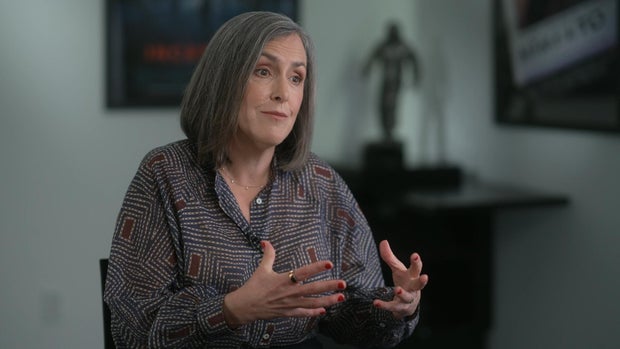
Emma Thomas met Nolan, first day of college. She's produced all of his films and their four children. They've been married 26 years.
Emma Thomas: I cannot imagine Chris, if he wasn't making films. And outside of, you know, family, which is probably the most important thing to him, no, genuinely the most important thing to him. It's horrifying to think how frustrated he would be if he wasn't able to tell stories via the medium of film.
A medium he prefers extra large.
He collapsed an actual building in "The Dark Knight." Nolan uses computer animation, but not if the authentic is humanly possible.
In the film "Tenet," he bought a 747 and built a hanger to crash it into.
In 2024, he blew up the Academy Awards. "Oppenheimer" won seven Oscars, including Nolan's first for best director and best picture.
Scott Pelley: Seems to me you make movies the hard way, and the harder the better as far as you're concerned.
Christopher Nolan: The harder the better right to the point of "The Odyssey," and I think we pushed pretty hard on this one and maybe found some limits.
Nolan's "Odyssey" brought Matt Damon and thousands of cast and crew to Greece, Iceland, Morocco, Italy and Scotland. He shot 2 million feet of IMAX film.
Scott Pelley: Ha! Unbelievable! What do you think when you see that? You've seen it a hundred times.
Christopher Nolan: I've seen it a thousand times. I mean, I think it's a lot of work by a lot of people.
Scott Pelley: I have the sense that you don't think of yourself as the most important person on the set.
Christopher Nolan: I think of myself as the representative of the audience on set. That's-- my north star. That's how I have to be looking at the film. So, in a sense, I am the most important person on the set, because I'm the audience.
Christopher Nolan: In taking on "The Odyssey," it does become about scale. It needed to be the biggest film that we have done. It needed to be challenging to all of us because that's the nature of the story.
Scott Pelley: Looks like you nearly drowned Matt Damon.
Christopher Nolan: We certainly put him through his paces.
Matt Damon: I mean It was the hardest movie I've ever done by far. I mean, not even close.
This is Damon's third Nolan film after "Interstellar" and "Oppenheimer."
Matt Damon: The first meeting I had with him, the-- at the end of the meeting he said, "This-- this movie's gonna be hard." I kind of looked at him, like, I've made, I don't know, a hundred movies or whatever. I looked at him like, "Yeah, I know." And he looked at me and went, "No, this movie's gonna be really hard."
Nolan often returns to his stars, including Cillian Murphy in the Batman films, "Dunkirk" and "Oppenheimer."
Matt Damon: He really understands what actors do and what-- is required of them to do it.
Scott Pelley: He's an actor's director?
Matt Damon: As far as I'm concerned, yeah. people might not think of him that way because the canvas he paints on is so big. But--look at the performances in his movies.
Christopher Nolan: Particularly, in the case of actors, you're handing them a script and you're saying, "Okay. You go away and you become an expert on that character's perspective on the story." So then when I'm on set, they're informing me, you know. They're bringing me information about how that character would see things, how that character plays. So, in a way, it's the opposite of what people think it is.
Matt Damon: I think what separates him from other directors is the stories he wants to tell are incredibly ambitious. And the way he wants to tell them is incredibly ambitious. In this case he wanted to do it 100% in IMAX, which had never been done.
IMAX is Nolan's great ambition.
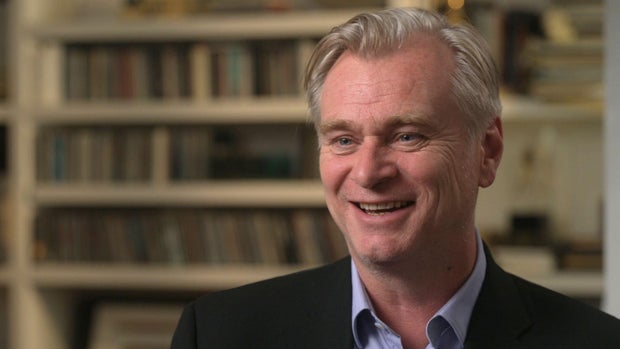
Christopher Nolan: It's really a wonderful way to retain the original image.
"The Odyssey" is the first feature shot completely on the giant film format. When Nolan was 16, he saw an IMAX documentary at a museum and was spellbound by the five story screen. But IMAX is expensive and cumbersome. Digital photography and editing are faster and cheaper, so almost no one does this anymore.
Scott Pelley: Look at the splicing machine. It looks like it was made in the 1940s.
Christopher Nolan: Probably was.
We watched "The Odyssey" being cut and glued together in the last film lab of its kind in the world. Why keep this ancient art alive? Well, the 70 millimeter IMAX frame has resolution, or image quality, up to three times higher than digital — art the hard way.
Christopher Nolan: And there it is.
Scott Pelley: Oh, nice. Very clean...
Hollywood could say IMAX isn't practical — screenplays shouldn't challenge the audience — and computers are cheaper than a 747. But the people we call "artists" are inspired by dreams like a 7-year-old with a Super 8.
Scott Pelley: How would you like Hollywood historians to describe your career?
Christopher Nolan: Long. I'd love to feel that I had added something to the body of work of all the filmmakers I have admired and that great film history that's developing. If I can play some part in moving the language of it forward somehow that would be, that would be a great thing to be remembered for.
Produced by Nicole Young. Associate producer: Kristin Steve. Broadcast associate: Michelle Karim. Edited by Sean Kelly.
In: