


惯性聚合 高效追踪和阅读你感兴趣的博客、新闻、科技资讯
阅读原文 在惯性聚合中打开

推荐订阅源

N
News and Events Feed by Topic
爱范儿
爱范儿
Blog — PlanetScale
Blog — PlanetScale
The GitHub Blog
The GitHub Blog
C
Check Point Blog
小众软件
小众软件
I
InfoQ
罗磊的独立博客
H
Hackread – Cybersecurity News, Data Breaches, AI and More
Engineering at Meta
Engineering at Meta
酷 壳 – CoolShell
酷 壳 – CoolShell
CTFtime.org: upcoming CTF events
Hugging Face - Blog
Hugging Face - Blog
博客园 - 三生石上(FineUI控件)
MyScale Blog
MyScale Blog
The Cloudflare Blog
Last Week in AI
Last Week in AI
腾讯CDC
Y
Y Combinator Blog
钛媒体:引领未来商业与生活新知
钛媒体:引领未来商业与生活新知
雷峰网
雷峰网
B
Blog
T
Tailwind CSS Blog
MongoDB | Blog
MongoDB | Blog
A
About on SuperTechFans
D
Docker
博客园 - 司徒正美
博客园_首页
Recent Announcements
D
DataBreaches.Net
阮一峰的网络日志
阮一峰的网络日志
奇客Solidot–传递最新科技情报
奇客Solidot–传递最新科技情报
G
Google Developers Blog
Microsoft Security Blog
F
Fortinet All Blogs
Stack Overflow Blog
Stack Overflow Blog
aimingoo的专栏
aimingoo的专栏
N
Netflix TechBlog - Medium
OSCHINA 社区最新新闻
OSCHINA 社区最新新闻
博客园 - 聂微东
GbyAI
GbyAI
Jina AI
Jina AI
V
V2EX
Vercel News
Vercel News
IT之家
IT之家
WordPress大学
WordPress大学
M
MIT News - Artificial intelligence
NISL@THU
NISL@THU
V
Visual Studio Blog
C
Cybersecurity and Infrastructure Security Agency CISA

60 Minutes - CBSNews.com

"Payam Method" hits the right note with piano students, making music education fun and accessible for kids Piano teacher's students sweep national competitions after learning the "Payam Method" Scientists focus on genetically engineering mice to cut Lyme disease transmission Sally Field says she believes "in the resilience of our Constitution" | 60 Minutes AI boom propping up economy as some guardrails are coming off, journalist Andrew Ross Sorkin warns Christopher Nolan imagines every movie is the last he'll ever make Christopher Nolan worked to make "most extreme version of a story possible" with "The Odyssey" Robotaxis coming to London pose a threat to traditional cabbies who memorize 25,000 streets to earn licenses Robotaxis are on the road to London. Cabbies, who pass a grueling test, aren't about to hand over their keys. Suspected insider accounts net $2.4 million on Polymarket Iran war bets with 98% win rate, firm finds Christopher Nolan: The 60 Minutes Interview London cabbies not ready to hand over their keys to AI-powered, autonomous taxis High win rate of bets on military operations a likely sign of insider trading Meet Gout Gout, the Australian sprinting phenom drawing comparisons to Usain Bolt Louisiana's governor on the Supreme Court decision and his suspending of House primary elections Extended interview: Israeli Prime Minister Benjamin Netanyahu Gout Gout, the fastest teen ever in the 200m, got his start when a coach saw him running around with friends Netanyahu wants Israel "to draw down to zero the American financial support" Read the full transcript of Major Garrett's interview with Israeli Prime Minister Benjamin Netanyahu here Israeli Prime Minister Benjamin Netanyahu: The 2026 60 Minutes Interview Louisiana rushes to redraw congressional maps after Gov. Landry suspends primaries Gout Gout: The 60 Minutes Interview Netanyahu wants to phase out U.S. military aid | 60 Minutes Iran war is "not over" until highly enriched uranium is removed, Israel Netanyahu says there's still "work to be done" before Iran war ends | 60 Minutes Historian Jill Lepore on constitutional amendments | 60 Minutes Inside Grasse, where flowers for Chanel No. 5 have been grown for more than a century Grasse, birthplace to Chanel No. 5, is experiencing a perfume revival Birding takes flight after peace deal between Colombia and guerrilla group | 60 Minutes Discover Grasse, the flower-filled French town behind the world's most famous perfume When the volunteer helping after a hurricane is a white nationalist | 60 Minutes Colombia has nearly 2,000 types of birds. Discover some of the species birders flock there to see. Once a hostage of Colombian rebels, he decided to teach his former captors birding Birding paradise flourishes in Colombian region that was once a war zone Some white nationalists swoop in after natural disasters, trying to soften their image while offering help Read the full transcript of Norah O'Donnell's interview with President Trump here Extended interview: President Trump on White House Correspondents' Dinner Fowl play: The criminals stealing elite racing pigeons The Pigeon Mafia: International criminal networks are stealing high-priced pigeons Former Sen. Ben Sasse, living with terminal cancer, sees an opportunity in living on a deadline Former Sen. Ben Sasse, dying of cancer, reflects on family, faith and the future of America Trump "wasn't worried" during White House Correspondents' Dinner shooting Retired Adm. William McRaven, who organized the bin Laden operation, reflects on honor The Pigeon Mafia: How high-priced pigeons became an organized crime target | 60 Minutes Ben Sasse: The 60 Minutes Interview President Donald Trump: The 2026 60 Minutes Interview Trump says he "wasn't making it that easy" for Secret Service during shooting "60 Minutes" to interview President Trump after White House Correspondents' Dinner shooting Ben Sasse was given a few months to live. He credits "providence, prayer and a miracle drug" for giving him more time. José Andrés on how food fits into America's story | 60 Minutes Rachel Goldberg-Polin on grief after Hamas abducted, killed her son | 60 Minutes Animals become Stewart Copeland's bandmates in album preserving the sounds of nature Stewart Copeland album "Wild Concerto" fuses music with sounds of hyenas, monkeys, owls Rock legend, naturalist team up to turn field recordings of animals into music What it would take for the U.S. to secure Iran's highly enriched uranium | 60 Minutes What it could take for the U.S. to remove highly enriched uranium from Iran Rachel Goldberg-Polin, grieving mother who fought for Israeli hostages' return, says she feels like she failed Rachel Goldberg-Polin, whose son Hersh was abducted October 7 and murdered by Hamas: Grief is a "badge of love" Iran's HEU | Sunday on 60 Minutes Wild Concerto | Sunday on 60 Minutes South Africa's great white sharks mysteriously vanished. Scientists can't agree who, or what, is the culprit. Great white sharks started disappearing from a former hotspot years ago, but scientists can The trucking companies evading federal safety enforcement and plaguing U.S. highways Pope Leo and President Trump are at odds over immigration in the U.S. and the Iran war Google CEO Sundar Pichai says "America must take the lead" on AI | 60 Minutes This was a great white shark hotspot. Then they mysteriously vanished | 60 Minutes Trucking fleets shed old identities in scheme to evade federal enforcement | 60 Minutes Pope Leo statements on Iran war and mass deportations inspire American cardinals to speak out Influential U.S. cardinals caution against Iran war, Trump immigration policies Mardi Gras Indians, or Black Masking Indians, spend months, thousands of dollars preparing hand-sewn suits Transportation Secretary Sean Duffy's statement for 60 Minutes' "Ghost Train" report High-speed rail is commonplace in many other countries. Will it track in the U.S.? Other countries have 200 mph passenger trains. Why has high-speed rail not tracked here? Mardi Gras Indians, or Black Masking Indians, carry on tradition in stunning, painstakingly crafted suits RAM pop-up clinics provide free medical, dental, and vision care to uninsured or underinsured Americans After getting help from health care charity RAM, Tennessee man says he "could be a normal human again" Why high-speed rail hasn't tracked in the U.S. | 60 Minutes One of America's last true secret societies: The Mardi Gras Indians | 60 Minutes Evangelist Franklin Graham on the value he believes shaped the U.S. | 60 Minutes Doctors volunteer to help Americans cut off from health care by the cost | 60 Minutes 12/1/2024: ​​Notre Dame; Smith Island; Kate Winslet; Welcome to the Wedding D.C. air traffic controller speaks about stressed conditions before midair crash: "It worked until it didn't" Drone arms race transforms war in Ukraine, with U.S. now learning lessons | 60 Minutes Vietnam's Son Doong cave is big enough for a skyscraper to fit inside | 60 Minutes Hall of Fame basketball coach Mike Krzyzewski with a game plan for the country's future 60 Minutes obtains documents showing close calls one day before D.C. midair collision What swimmer Katie Ledecky learned about America in her time with Team USA | 60 Minutes Jamie Lee Curtis doesn't "think it's possible to have a perfect union" | 60 Minutes Bill Ford on the secret to American innovation | 60 Minutes Amanda Gorman on what it means to be an American | 60 Minutes Mike Eruzione reflects on "Miracle on Ice" Olympic hockey game | 60 Minutes 3 of the Holocaust's youngest survivors share a special bond: Their pregnant mothers all deceived the Nazis Miracle babies of Mauthausen find each other decades after the Holocaust | 60 Minutes Ken Burns on what he thinks would surprise the founders of America | 60 Minutes Inside NASA's journey to the far side of the moon with Artemis II | 60 Minutes The Smithsonian secretary's favorite representation of America | 60 Minutes What struck astronaut Suni Williams about the view of America from orbit | 60 Minutes Getting ready for the 250th anniversary of the Declaration of Independence | 60 Minutes Character AI pushes dangerous content to kids, parents and researchers say | 60 Minutes UConn's Dan Hurley on the intensity he brings to coaching, his superstitions, and living up to the family name
U.S. military must adapt to drones on battlefield or risk losing supremacy, Marine veteran warns
2026-03-30 · via 60 Minutes - CBSNews.com

By

Holly  Williams

Holly Williams

Senior Foreign Correspondent

Holly Williams is a CBS News senior foreign correspondent based in the network's CBS London bureau. Williams joined CBS News in July 2012, and has more than 25 years of experience covering major news events and international conflicts across Asia, Europe and the Middle East.

Read Full Bio

Aliza Chasan

Digital Content Producer

Aliza Chasan is a Digital Content Producer for "60 Minutes" and CBSNews.com. She has previously written for outlets including PIX11 News, The New York Daily News, Inside Edition and DNAinfo. Aliza covers trending news, often focusing on crime and politics.

Read Full Bio

Erin Lyall, Georgia Rosenberg

/ CBS News

Add CBS News on Google

Drones have revolutionized warfare, and with relatively cheap technology posing a deadly threat, the U.S. military needs to adapt, Marine veteran William McNulty said.

His venture-capital fund has invested in Ukrainian drone technology, which has evolved rapidly over the course of the war with Russia. Drones are now estimated to inflict around 80% of combat casualties on both sides, according to some estimates.

"There's a real risk that the U.S. would lose its military supremacy if it doesn't adapt to modern conditions on the battlefield," McNulty said. "We're going to be going up against these same unmanned systems that Russia is using against Ukraine."

Shortly after 60 Minutes spoke with McNulty, America went to war, and the Iranian drones began flying. The first Americans killed in the conflict were targeted with a drone. The U.S. military is now learning its lessons in blood, just as Ukraine did.

Drones dominate in Ukraine 

The traditional front line in Ukraine has expanded to a strip of land, around 10 miles wide, called the "kill zone." Anyone who steps foot there can be spotted by a drone operator, and hunted down. 

Tanks have been retrofitted with cages and mesh to deflect drone strikes. Roads close to the front are covered with netting, designed to catch drones before they hit their target. And to evade interference from electronic jammers, the militaries of both Russia and Ukraine launch drones attached to miles-long spools of fiber-optic wire.

The drones are not just in the air. Ukraine has also developed sea drones, including a model called Sea Baby, which can carry around 4,400 pounds of explosives, an operator told 60 Minutes. He said it's enough to take out a Russian warship. 

Sea drones, produced for around $300,000 apiece, have destroyed warships that cost tens of millions of dollars. Ukraine says it has used them to sink or disable 11 Russian vessels.

A ground drone, mounted with a .50-caliber machine gun, recently held off a Russian attack single-handedly for 45 days straight. In January, three Russian soldiers surrendered to a similar model.
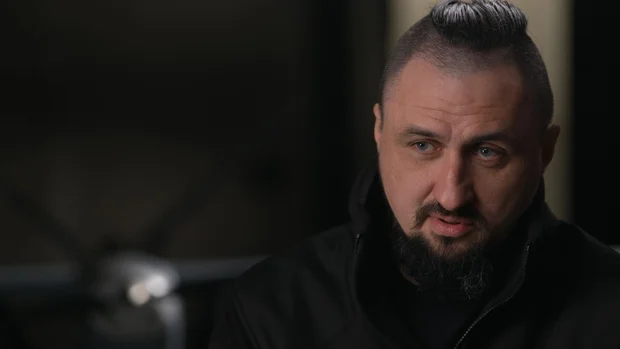
Oleksandr Kamyshin
Oleksandr Kamyshin 60 Minutes

Oleksandr Kamyshin, the architect of Ukraine's drone program, said that over the course of the war, he boosted Ukraine's production from 2,000 to 4 million drones per year. The inexpensive new technology has helped level the battlefield for the outnumbered Ukrainians.

"It's a data-driven war, with big numbers. It's a numbers game," Kamyshin said, adding, "We have to count everything. We have to count [the] number of drones we use, efficiency of each of them, cost to kill for every Russian."

Drone innovation as Ukraine, Russia war continues 

Ukraine's military has set up drone training academies to teach the new technology and the rapid shifts in tactics that come with it. Ukraine says it makes more than 95% of its own military drones – and the country is harnessing talent from some unusual places. Former brewery engineer Roman Tkachenko, for example, founded a company called Tencore, which develops remote-controlled, armored evacuation drones to transport wounded soldiers.
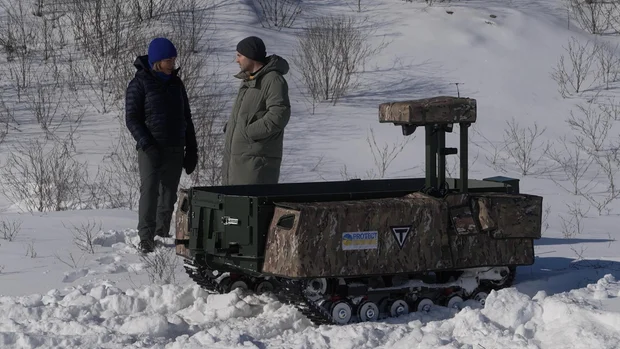
Roman Tkachenko and Holly Williams
Roman Tkachenko and Holly Williams 60 Minutes

Tkachenko says the idea is to "send the robot" so as to "not risk" a human life. 

"So for us, it's a human life is most important," Tkachenko said.

Tkachenko said he works with soldiers on the front lines to create future drone designs. The same drone, which Tkachenko said has saved hundreds of lives, can also be adapted to mount a 40-mm grenade launcher, which can be controlled from a bunker miles from the battlefield. 

The innovation cycle for drones is brief, lasting roughly one week, Kamyshin explained.

"It means from the point you send a drone to the front line, get the feedback, change something, and get the new version, it could be as short as one week," Kamyshin said.

Russia is also innovating in the drone arms race. Kamyshin believes that at this point, it's "equilibrium," and neither country has the edge. 

Preparing for the next conflict 

Forces around the world are confronting the change in warfare. At a NATO training exercise in Estonia last year, commanders tested their vulnerability against drones. Around 1,000 NATO personnel were defeated in the drill by a group of drone operators, some of them Ukrainian.

The U.S. military now has drone innovation labs set up around the world, including at the U.S. Army Garrison Wiesbaden in Germany. Any service member with an idea, or just an interest, can request to spend time in one of the labs. 

Capt. Ronan Sefton, who was first deployed to Germany with the Army's 2nd Cavalry Regiment not long after Russia launched its invasion in 2022, said Americans have been learning from Ukrainians. 

"The first really poignant lesson for us was, there needs to be more drones," Sefton said. "They need to be everywhere involved in the training to add to the realism."
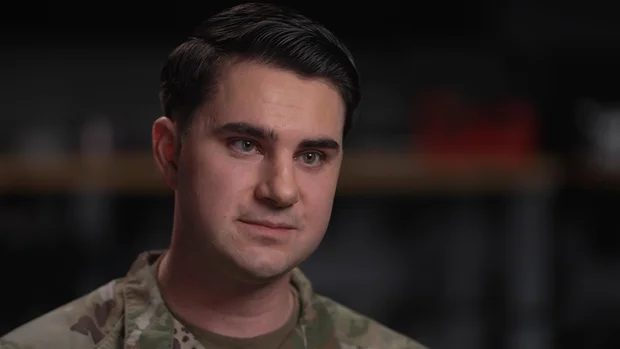
Capt. Ronan Sefton
Capt. Ronan Sefton 60 Minutes

Sefton went to every senior commander he could find to tell them about it. 

"The thing that we wanted to communicate was, 'This is important, it's changing warfare, and here's how we can actually implement it now,'" Sefton said. 

Sefton joined the Army's Ukraine Lessons Learned Task Force, which has the job of translating experience from Ukraine's scrappy fighting force to America's sprawling military. New technology does not make the U.S. military's traditional firepower obsolete, Sefton said, but it needs to adapt, urgently, to counter the drones developed by America's adversaries. 

"The goal there is to become ready for the next conflict. We see it with the armed forces of Ukraine. They have learned these lessons through blood," Sefton said. "There will of course be additional lessons that we will learn, perhaps through blood. But it will only make us better at what we already are."

In: