惯性聚合 高效追踪和阅读你感兴趣的博客、新闻、科技资讯
阅读原文 在惯性聚合中打开

推荐订阅源

P
Proofpoint News Feed
Exploit-DB.com RSS Feed
Microsoft Security Blog
云风的 BLOG
云风的 BLOG
MongoDB | Blog
MongoDB | Blog
Know Your Adversary
Know Your Adversary
K
Kaspersky official blog
人人都是产品经理
人人都是产品经理
IT之家
IT之家
Recorded Future
Recorded Future
Recent Announcements
D
DataBreaches.Net
C
CXSECURITY Database RSS Feed - CXSecurity.com
U
Unit 42
博客园 - 【当耐特】
I
Intezer
Cisco Talos Blog
Cisco Talos Blog
Spread Privacy
Spread Privacy
L
LINUX DO - 热门话题
H
Help Net Security
L
LangChain Blog
T
The Exploit Database - CXSecurity.com
P
Palo Alto Networks Blog
Scott Helme
Scott Helme
The GitHub Blog
The GitHub Blog
博客园_首页
P
Proofpoint News Feed
大猫的无限游戏
大猫的无限游戏
S
Secure Thoughts
The Register - Security
Engineering at Meta
Engineering at Meta
T
Threatpost
OSCHINA 社区最新新闻
OSCHINA 社区最新新闻
Blog — PlanetScale
Blog — PlanetScale
C
Cybersecurity and Infrastructure Security Agency CISA
T
Troy Hunt's Blog
罗磊的独立博客
腾讯CDC
Simon Willison's Weblog
Security Latest
Security Latest
Last Week in AI
Last Week in AI
P
Privacy & Cybersecurity Law Blog
Latest news
Latest news
The Cloudflare Blog
Jina AI
Jina AI
小众软件
小众软件
Cloudbric
Cloudbric
TaoSecurity Blog
TaoSecurity Blog
F
Full Disclosure
V
V2EX

UX Daily - User Experience Daily

Why You'll Frustrate Players on Purpose (And When You Shouldn't) What the Numbers Missed: 4 Times Personas Could Have Saved Millions Can You Design for Someone You Don’t Understand? The Role of Personas in Cross-Cultural UX Design What If Your Users Lie? How Personas Help You Get to the Truth Why Personas Don’t Represent Every User How Personas Shape Stronger Design Decisions How to Get Started with Affinity Diagrams Grounded Theory: Base Findings on Research, Not Preconceptions Personas: What They Are and Why They Matter How to Improve Your UX with HCI Insights 6 Insights to Achieve Agile UX Excellence Top Tips to Create Effective Journey Maps Your Guide to Hamburger Menus Tree Testing: A Complete Guide Enter the World of Social VR UX Designer Job Descriptions: The Comprehensive Guide What Does a Creative Designer Do? Why Do We Not Act on Climate Change? Why Should Designers Become Leaders? How to Apply Incremental Modular Design to Global Challenges What is the UX Design Process? 5 Steps to Success Use Circular Design To Reverse Harm Recycling is Not Enough. Let's Design for Reuse Anything Artificial We Can Design Better How Has Technology Evolved to Affect Your Daily Life? Case Study: How does Gmail use Grouping? How to Use Cultural Probes to Understand Your Users What is Design? How to Get Meaningful Design Feedback from Your Clients How to Create a Perspective Grid Human-Centered Design: How to Focus on People When You Solve Complex Global Challenges How to Design Ethically: Expert Advice from Guthrie Weinschenk Big news: We redesigned the platform and we're hiring new team members! Plan for Incubation Time: When Is Doing Nothing the Best Thing to Do? How to Use Busywork to Enable Your Creativity in Your Daily Planning How to overcome Fixation and Bias in Creative Problem Solving Ideation Method: Multiple Classifications Ideation Method: Embrace Opposites Ideation Method: More Specific and More General Ideation Method: Three-way Comparisons
Stop the Generic Portfolio Trap! Design a Stand-Out Portfolio for Your UX/UI Niche
2025-03-03 · via UX Daily - User Experience Daily
An illustration that demonstrates different UX specializations, in reference to a UX design portfolio.

• 42 min read

Your UX/UI portfolio is your ticket to your dream job, brief or client. It’s your opportunity to show off your expertise, creativity, and the tangible impact of your work. No matter your niche, your portfolio should be as innovative and polished as the projects it represents.

Think of your portfolio as your personal design project—it needs a clear strategy, attention to detail, and a focus on user experience to make an impact.

In UX design, every mistake is a learning opportunity. Watch this video with Morgane Peng, Design Director at Societe Generale CIB, to uncover common pitfalls and learn how to avoid them—set your portfolio up for success from the start.

With that foundation, you’re ready to take your portfolio even further. Here’s how to tailor your portfolio to different UX/UI niches so that it stands out from the competition.

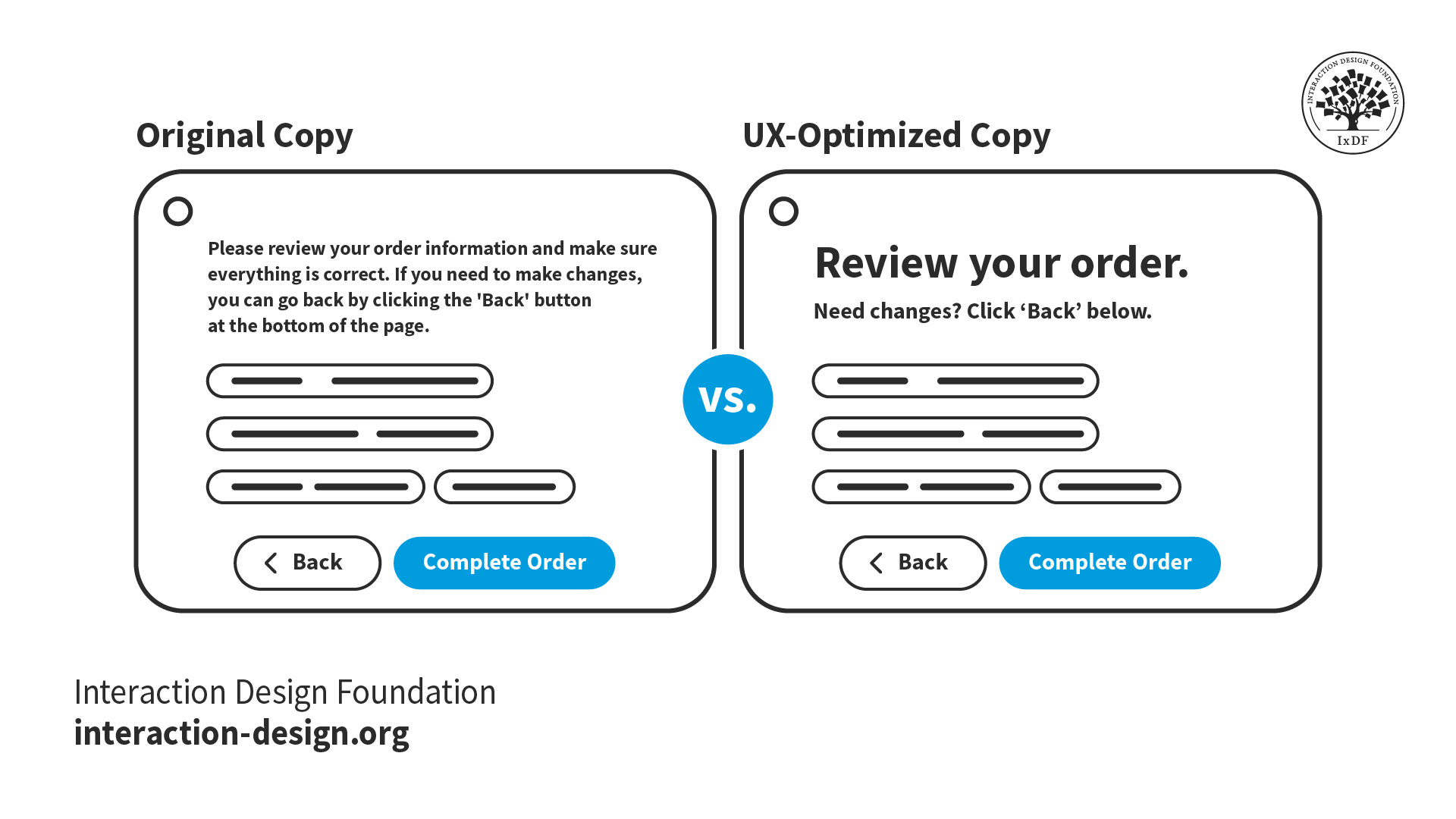
UX Writing: The Power of Words in Design
© Interaction Design Foundation, CC BY-SA 4.0

A well-crafted UX writing portfolio proves that words matter. Focus on case studies that demonstrate how your microcopy clarifies user interactions, reduces friction, and guides users through complex flows.

  • Structure your work around problem-solving: Present projects that highlight challenges, your role in crafting solutions, and measurable outcomes, such as improved conversion rates or reduced errors.

  • Showcase versatility: Include examples like onboarding flows, error messages, or content strategy for complex interfaces.

  • Collaborate and iterate: Emphasize teamwork with designers and developers, and show how feedback refined your copy.

Make your portfolio user-friendly—clear navigation and concise explanations mirror the UX writing principles you apply in your work.

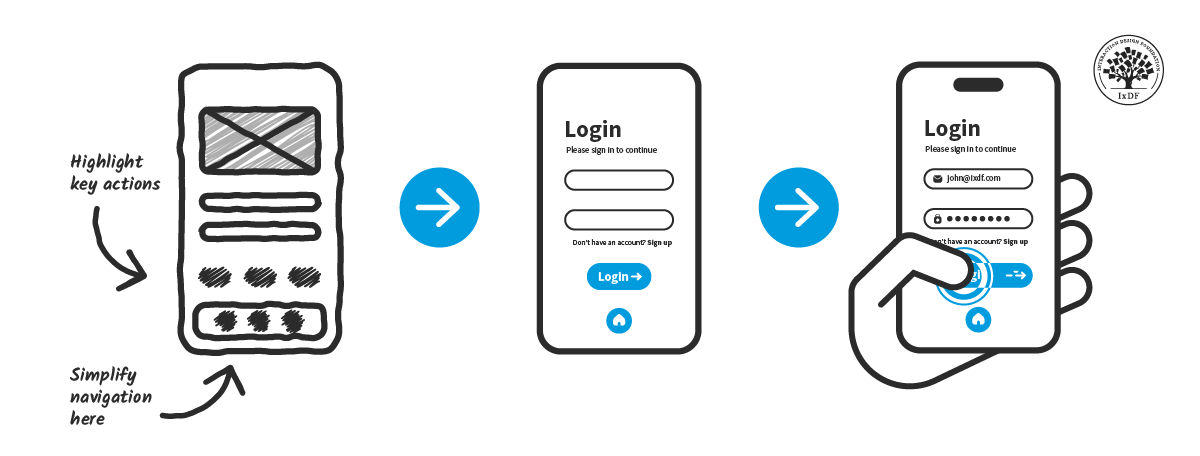
UI Design: Where Aesthetics Meet Usability
© Interaction Design Foundation, CC BY-SA 4.0

A great UI portfolio balances visual appeal with usability. Hiring managers want to see more than polished screens—they want to understand your process and the impact of your designs.

  • Highlight problem-solving: Include case studies where your designs addressed issues like poor navigation or low engagement.

  • Bring your process to life: Use annotated sketches, journey maps, and prototypes to demonstrate your iterative process.

Increase your chances of getting noticed by tailoring your portfolio to specific roles. Show hiring managers the projects in your portfolio they need to see to know you’ll be the right person for the job. For instance, if you’d like to apply for mobile-focused design positions, emphasize responsive design, or if you’d like to apply for SaaS roles, showcase your complex dashboards design experience.

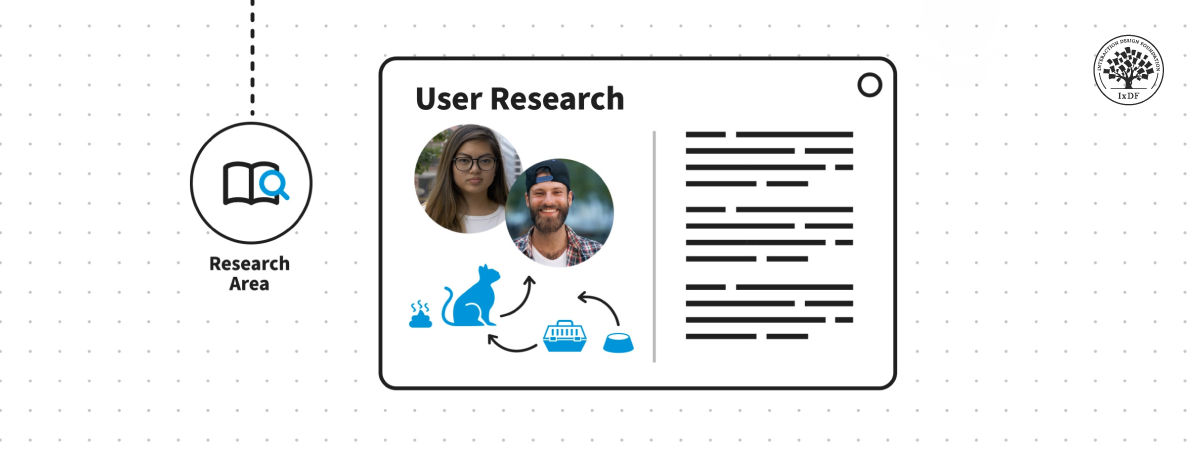
User Research: Turn Insights Into Action
© Interaction Design Foundation, CC BY-SA 4.0

User research portfolios should showcase how your insights directly improved design decisions and user experiences.

  • Show your methodology: Highlight diverse research methods like surveys, interviews, usability testing, or diary studies.

  • Illustrate impact: Use case studies to demonstrate how your findings informed design changes, reduced drop-off rates, or improved user satisfaction.

  • Collaborate effectively: Detail how you worked with designers and stakeholders to turn insights into actionable strategies.

Visual aids such as empathy maps or journey maps help communicate your findings and make your process memorable.

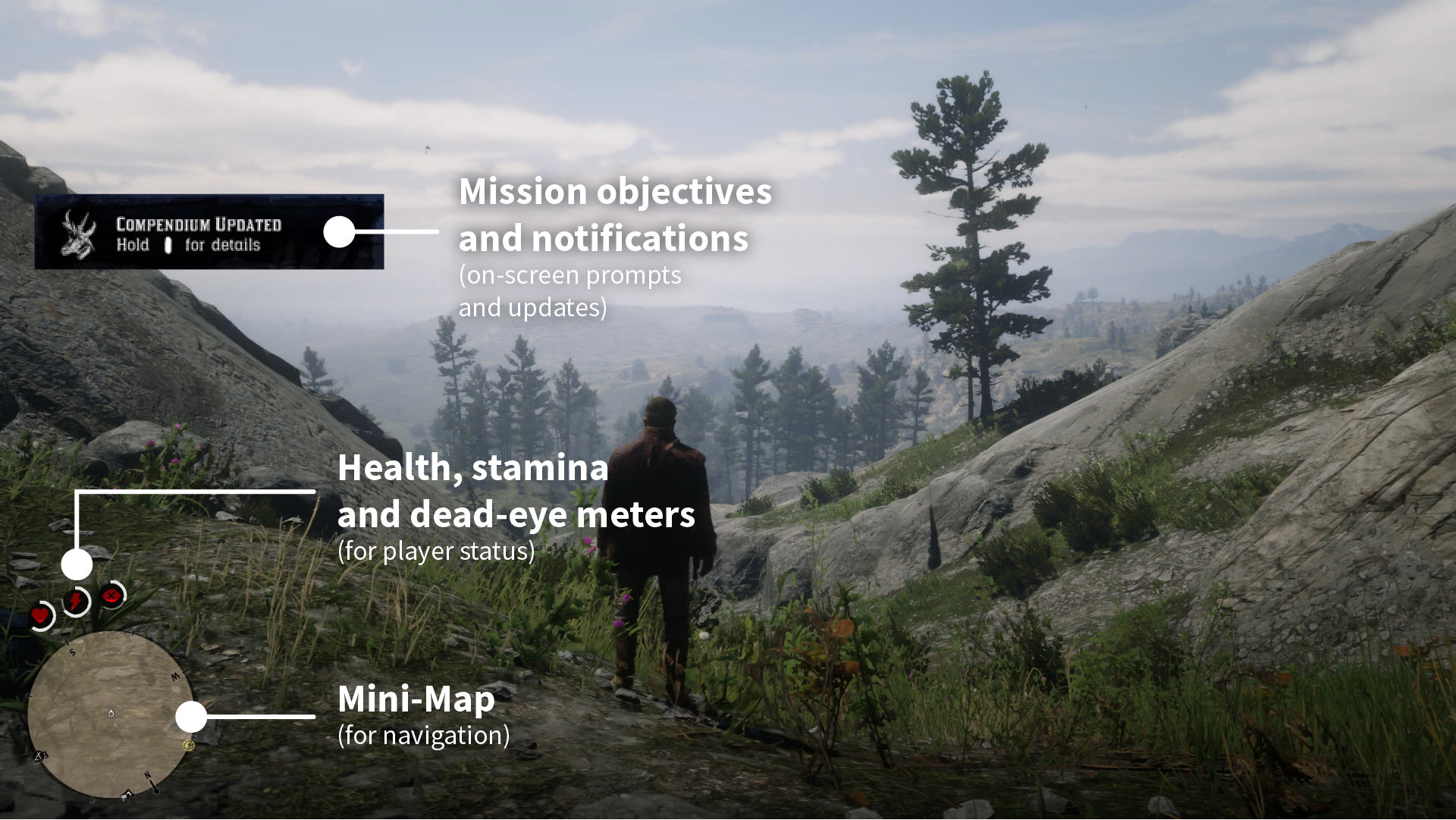
Game UX: Enhance Player Experience
© Interaction Design Foundation, CC BY-SA 4.0

© Interaction Design Foundation, CC BY-SA 4.0

Game UX portfolios should use storytelling to demonstrate the innovative nature of the work being highlighted. Show how your work addresses unique gameplay challenges, improves player engagement, and enhances immersion.

  • Highlight key challenges: Did you simplify complex mechanics, reduce player frustration, or refine tutorials? Use detailed case studies to share your process.

  • Showcase collaboration: Explain how you worked with game designers and developers to create cohesive experiences.

  • Focus on player feedback: Include insights from playtests and the metrics that highlight your impact, such as reduced drop-off rates or increased session times.

Use visuals like annotated screenshots, HUD refinements, and interactive prototypes to showcase your work effectively.

Proven Strategies for Any Portfolio

No matter your niche, these tips will help your portfolio shine:

  • Use storytelling: Craft compelling narratives that walk viewers through your process, challenges, and solutions.

  • Include real-world impact: Share metrics, user feedback, and testimonials that demonstrate the success of your work.

  • Design your portfolio as an experience: Apply UX principles to make your portfolio intuitive, visually appealing, and easy to navigate.

Gain insights from design leaders like Vitaly Friedman, Pablo Stanley, and Niwal Sheikh as they share what truly stands out in a portfolio.

The Take Away

A generic portfolio won't cut it in today’s competitive UX/UI landscape. To rise above the competition, tailor your portfolio to emphasize your niche—demonstrate your expertise, adaptability, and the tangible results of your work. Whether you simplify user flows, design intuitive interfaces, uncover user insights, or enhance player experiences, your portfolio should highlight your unique ability to solve problems and deliver real value.

Show the story behind your work—the challenges you faced, the decisions you made, and the results you achieved. Prioritize storytelling to create an emotional connection, highlight collaboration to demonstrate your teamwork, and include measurable outcomes to prove your impact. With a compelling, results-driven portfolio, you present yourself as a designer (no matter what the specialty) hiring managers and clients can’t afford to overlook.

References and Where to Learn More

Want to create a portfolio that gets you hired? Take our course, Build a Standout UX/UI Portfolio: Land Your Dream Job, and learn how to showcase your skills, tell compelling project stories, and impress employers.

Read the following articles:

  • Stop the Generic Portfolio Trap! Design a Stand-Out Portfolio for Your UX/UI Niche: UX Writing

What You Should Read Next

  • Read full article
    Big news: We redesigned the platform and we're hiring new team members! - Article hero image

    Big news: We redesigned the platform and we're hiring new team members!

    Today is a HUGE day for us. On this day, we’ve launched a head-to-toe redesign of our entire platform—our biggest release ever! Today marks the culmination of more than a year of intensive, painstaking work, and we’re so proud and excited to finally be able to share this with you!Why did we do all t

    Social shares
    645
    Published
  • Read full article
    Human-Centered Design: How to Focus on People When You Solve Complex Global Challenges - Article hero image

    Human-Centered Design: How to Focus on People When You Solve Complex Global Challenges

    When we design products and services, we use human-centered design insights to help us focus on the people. But how do we focus on the people in the context of complex global challenges? What should we be aware of? What are the pitfalls? And when should we reach out to help people? In this video, Do

    Social shares
    590
    Published
  • Read full article
    UX Designer Job Descriptions: The Comprehensive Guide - Article hero image

    UX Designer Job Descriptions: The Comprehensive Guide

    A UX designer creates and optimizes the overall human experience when interacting with digital products, systems, or services. Your role as a UX designer would revolve around working on every aspect of digital product development, which includes design, usability, functioning, and sometimes branding

    Social shares
    730
    Published
  • Read full article
    How to Improve Your UX with HCI Insights - Article hero image

    How to Improve Your UX with HCI Insights

    Design plays a role that’s utterly crucial in our daily lives—it bridges functionality with aesthetics to meet user needs. In product development, it’s design that determines how user-friendly and appealing a product is. The field of human-computer interaction (HCI) is foundational to UX design. To

    Social shares
    599
    Published
  • Read full article
    How to overcome Fixation and Bias in Creative Problem Solving - Article hero image

    How to overcome Fixation and Bias in Creative Problem Solving

    [[video:112]] Sometimes, you get stuck when you’ve been working and working on a problem. Perhaps it’s a crossword or a difficult design issue. You go over the same things again and again, but you don’t make any progress. And the more you try to get unstuck, the harder it becomes to think outside o

    Social shares
    490
    Published
  • Read full article
    Can You Design for Someone You Don’t Understand? The Role of Personas in Cross-Cultural UX Design - Article hero image

    Can You Design for Someone You Don’t Understand? The Role of Personas in Cross-Cultural UX Design

    Can you design for someone you don’t understand? Too often, biases and assumptions creep into the design process. Cultural context shapes the way people navigate, interpret, and engage with digital products, services and experiences. What feels intuitive in one culture might be confusing, or even al

    Social shares
    461
    Published
  • Read full article
    Ideation Method: More Specific and More General - Article hero image

    Ideation Method: More Specific and More General

    [[video:91]] Do you prefer to think abstractly or concretely? It can help you see your problem area from a different perspective if you move between the two types of thinking when you work with ideation and design. In UX design, we often start with quite vague sketches of an abstract idea, but then

    Social shares
    436
    Published
  • Read full article
    How to Use Busywork to Enable Your Creativity in Your Daily Planning - Article hero image

    How to Use Busywork to Enable Your Creativity in Your Daily Planning

    [[video:107]] Busywork is work that keeps us busy, but the work has little value in itself—for example, washing the dishes. These are tasks that you know you can easily do. Busywork is used in many different senses, but always to represent something very uncreative. Sometimes it’s even used for

    Social shares
    386
    Published
  • Read full article
    How to Create a Perspective Grid - Article hero image

    How to Create a Perspective Grid

    When you create a journey map, it can be a challenge to combine research data and the ideas of people in your organization into a map that tells an accurate, simple story. But success in this is critical. An inaccurate map could lead to bad decisions, and one that is too complex may prevent people f

    Social shares
    631
    Published
  • Read full article
    6 Insights to Achieve Agile UX Excellence - Article hero image

    6 Insights to Achieve Agile UX Excellence

    Agile methods boost UX design teams' adaptability. The shift from traditional to agile methods occurred because the former fell short. Agile nurtures a dynamic environment where innovation thrives—it promotes early and frequent testing to minimize risks through short, iterative cycles while teams co

    Social shares
    489
    Published

Top Articles

Top Topic Definitions