惯性聚合 高效追踪和阅读你感兴趣的博客、新闻、科技资讯
阅读原文 在惯性聚合中打开

推荐订阅源

宝玉的分享
宝玉的分享
T
Threat Research - Cisco Blogs
H
Hacker News: Front Page
N
News and Events Feed by Topic
Know Your Adversary
Know Your Adversary
Cisco Talos Blog
Cisco Talos Blog
SecWiki News
SecWiki News
C
Cisco Blogs
D
Darknet – Hacking Tools, Hacker News & Cyber Security
T
Tor Project blog
K
Kaspersky official blog
Forbes - Security
Forbes - Security
Webroot Blog
Webroot Blog
Schneier on Security
P
Privacy & Cybersecurity Law Blog
H
Heimdal Security Blog
Y
Y Combinator Blog
The GitHub Blog
The GitHub Blog
S
SegmentFault 最新的问题
V
Vulnerabilities – Threatpost
T
Tenable Blog
T
Tailwind CSS Blog
P
Privacy International News Feed
WordPress大学
WordPress大学
大猫的无限游戏
大猫的无限游戏
小众软件
小众软件
博客园 - Franky
Hacker News: Ask HN
Hacker News: Ask HN
Jina AI
Jina AI
C
Cybersecurity and Infrastructure Security Agency CISA
CTFtime.org: upcoming CTF events
雷峰网
雷峰网
Vercel News
Vercel News
A
About on SuperTechFans
爱范儿
爱范儿
Simon Willison's Weblog
AWS News Blog
AWS News Blog
The Last Watchdog
The Last Watchdog
Engineering at Meta
Engineering at Meta
Spread Privacy
Spread Privacy
Security Archives - TechRepublic
博客园 - 司徒正美
量子位
博客园 - 三生石上(FineUI控件)
J
Java Code Geeks
Hacker News - Newest:
Hacker News - Newest: "LLM"
Recorded Future
Recorded Future
H
Hackread – Cybersecurity News, Data Breaches, AI and More
Martin Fowler
Martin Fowler
Project Zero
Project Zero

UX Daily - User Experience Daily

Why You'll Frustrate Players on Purpose (And When You Shouldn't) What the Numbers Missed: 4 Times Personas Could Have Saved Millions Can You Design for Someone You Don’t Understand? The Role of Personas in Cross-Cultural UX Design What If Your Users Lie? How Personas Help You Get to the Truth Why Personas Don’t Represent Every User How Personas Shape Stronger Design Decisions How to Get Started with Affinity Diagrams Personas: What They Are and Why They Matter Stop the Generic Portfolio Trap! Design a Stand-Out Portfolio for Your UX/UI Niche How to Improve Your UX with HCI Insights 6 Insights to Achieve Agile UX Excellence Top Tips to Create Effective Journey Maps Your Guide to Hamburger Menus Tree Testing: A Complete Guide Enter the World of Social VR UX Designer Job Descriptions: The Comprehensive Guide What Does a Creative Designer Do? Why Do We Not Act on Climate Change? Why Should Designers Become Leaders? How to Apply Incremental Modular Design to Global Challenges What is the UX Design Process? 5 Steps to Success Use Circular Design To Reverse Harm Recycling is Not Enough. Let's Design for Reuse Anything Artificial We Can Design Better How Has Technology Evolved to Affect Your Daily Life? Case Study: How does Gmail use Grouping? How to Use Cultural Probes to Understand Your Users What is Design? How to Get Meaningful Design Feedback from Your Clients How to Create a Perspective Grid Human-Centered Design: How to Focus on People When You Solve Complex Global Challenges How to Design Ethically: Expert Advice from Guthrie Weinschenk Big news: We redesigned the platform and we're hiring new team members! Plan for Incubation Time: When Is Doing Nothing the Best Thing to Do? How to Use Busywork to Enable Your Creativity in Your Daily Planning How to overcome Fixation and Bias in Creative Problem Solving Ideation Method: Multiple Classifications Ideation Method: Embrace Opposites Ideation Method: More Specific and More General Ideation Method: Three-way Comparisons
Grounded Theory: Base Findings on Research, Not Preconceptions
William Hudson · 2025-03-26 · via UX Daily - User Experience Daily

Preconceptions and biases are like a faulty compass. Whether they creep in through researchers, project teams, or your organization, they throw your user research off course. Enter grounded theory: a proven social research method that keeps your compass pointing true north. With grounded theory, you’ll build solutions that address real problems for your users—not those you’ve imagined.

Grounded theory is a qualitative research methodology we use to develop a theory that is "grounded" in the real world. In this video, William Hudson, User Experience Strategist and Founder of Syntagm Ltd, explains grounded theory.

Grounded theory differs from other research methods because it doesn’t start with a fixed hypothesis or framework; instead, insights emerge naturally from observation and participant interviews. Unlike surveys or usability testing, which we use to validate predefined assumptions, grounded theory helps us uncover unexpected patterns and deeper motivations by continuously analyzing and refining data.

Beyond Preconceptions: Use Grounded Theory to Avoid Bias in User Research

Grounded theory not only combats preconceptions—it is an effective tool against bias, which takes many forms and can occur at almost any stage of research.

Many types of bias exist, but these six are particularly relevant in user research:

  • Availability bias: Research results become skewed because the available participants lack the required background. This can happen when participants exaggerate their experience, especially if the screening questionnaire is poorly designed. Availability bias can also happen when organizations prefer to use their existing customers for research.

  • Confirmation bias: Researchers accept positive feedback but downplay or ignore negative feedback.

  • Cultural bias: Results are colored by researchers' cultural beliefs or attitudes.

  • Framing effect: The wording of a question is not neutral, and responses tend toward an answer suggested in the question. For example, "How difficult do you find the checkout process?" implies that difficulty is expected. "How easy or difficult" would be a neutral wording.

  • Hawthorne effect: People change their behavior when they know they’re being watched. Participants may provide overly cautious or insincere answers in these scenarios.

  • Social desirability bias: Respondents' answers will tend towards more socially acceptable norms. This is why, in market research, figures for toothpaste usage usually exceed toothpaste manufactured! Respondents exaggerate the socially desirable habit of cleaning their teeth. For example, respondents may claim, “I know I should brush twice daily,” even if their actual habits differ. The inverse happens with smoking and alcohol consumption.

Fortunately, you can more easily avoid bias when you ask open-ended questions. These typically take the form of “What are…” or “How do you…” Here are some examples:

  • How do you usually plan your day?

  • How do you decide what products or services to buy online?

  • How do you measure progress or success in your work or personal projects?

  • How do you cope with stress or frustration?

  • How do you learn new skills or information?

  • What are some goals or challenges in your current role or situation?

  • What are some of the features or benefits that you look for in a product or service?

  • What are some of the sources or influences that shape your opinions or decisions?

  • What frustrations or pain points do you encounter when using a product or service?

  • What are some of the things that motivate or inspire you?

Naturally, it is still possible to introduce bias into questions like these. However, you do not prepare these questions in advance. They form part of a more natural dialogue between the researcher and participants.

How to Get Started with Grounded Theory

The grounded theory approach begins with a research question. In persona development, for example, the research question focuses on key aspects of the problem domain. The question should be:

  • Broad enough to include the primary user needs, behaviors, and peripheral issues that you may decide to address in your solution.

  • Not overly broad, as this would require an excessive research effort.

Here’s an example of a well-balanced research question for a fitness app aimed at busy professionals:

"What are the primary health and fitness challenges that busy professionals face balancing exercise with work and personal life?"

This question is broad enough because it allows you to explore:

  • Key user needs like time management and exercise preferences.

  • Behaviors, such as workout routines, frequency, and time.

  • Related issues like diet, stress, or sleep.

At the same time, it remains focused. The question doesn’t require you to research every possible factor about users’ health or professional lives, which would make the research effort too large.

Step-by-Step Guide to the Stages of Grounded Theory

Grounded theory consists of several key stages. However, in many situations—especially when time and budget are limited—you can take a streamlined yet effective approach. This approach alternates between rounds of data collection and data analysis:

  • In grounded theory, data analysis is an ongoing activity where you categorize your research findings. Grounded theory uses a simple approach called “open coding,” where you categorize findings after each research session.

  • When further research no longer produces new categories, you have reached "saturation." At this stage, additional research is unlikely to provide new insights as long as you've included participants with a good range of perspectives.

Therefore, an example process looks like this:
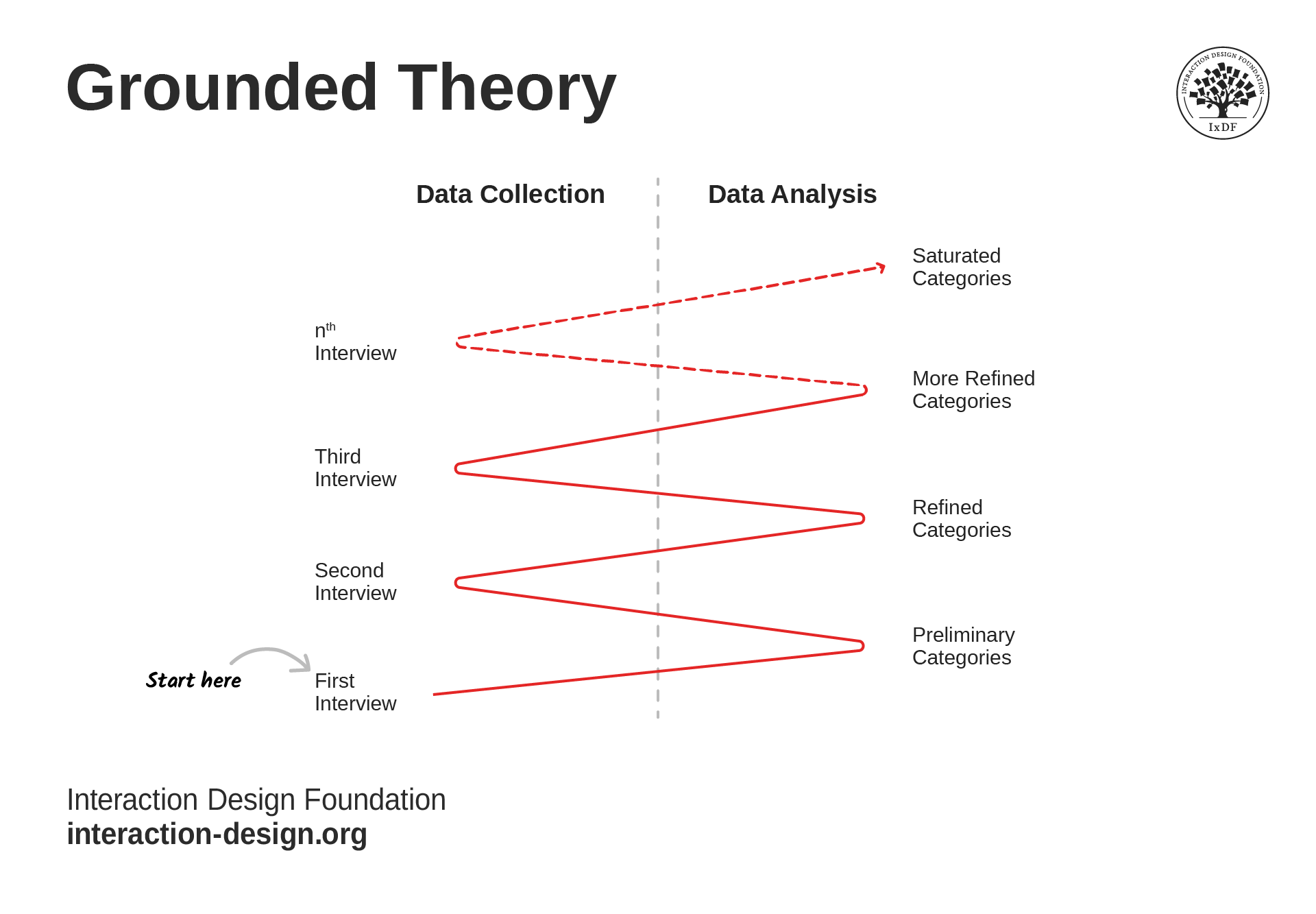
A diagram of grounded theory. Each research interview is followed by data analysis where you refine your categories until no more categories are revealed and no more interviews are required.

Grounded theory cycles between data collection and analysis to ensure insights shape ongoing research. This iterative approach uncovers patterns, improves our understanding, and adapts the focus of the research accordingly. Grounded theory leads to user-centered solutions based on real behaviors, motivations, and challenges.

© John Creswell (Educational Research), Fair use

Download this handy template to help you implement grounded theory in your research. It contains more detail on the grounded theory process and a worksheet to plan and keep track of your research.

Advance Your Career With This Free Template for “Grounded Theory for Persona Research: Base Findings on Research, Not Preconceptions”
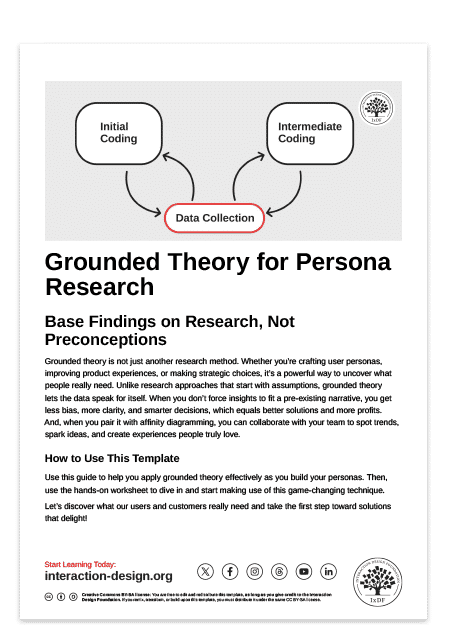
Grounded Theory for Persona Research: Base Findings on Research, Not Preconceptions

The Take Away

Grounded theory gives you a structured approach to user research and helps you avoid preconceptions and biases. It helps you design solutions that address the real problems your users have, not those you make up. In grounded theory, you:

  • Ask general, open-ended questions.

  • Alternate data collection with analysis and coding.

  • Use “open coding” to categorize your discoveries and develop a big picture of your users’ needs.

  • Identify gaps in the big picture where you need more data.

  • Conclude your research when you reach “saturation” and can identify no further gaps.

If you let your research guide you (rather than the other way around), you'll make more impactful discoveries and gain the deep user understanding you need to create meaningful, delightful solutions.

References and Where to Learn More

Read more about grounded theory in user research in our article, Grounded Theory.

Build a solid foundation in grounded theory with Cathy Urquhart’s easy-to-understand book, Grounded Theory for Qualitative Research: A Practical Guide.

Discover grounded theory from its co-creator, Anselm Strauss, in his book with Juliet Corbin, Basics of Qualitative Research: Grounded Theory Procedures and Techniques.

Get Philip Cleave’s top tips on How to Reduce Social Desirability Bias.

Learn more about the Hawthorne Effect in our article, Light up Your User Research – Understanding the Hawthorne Effect.

Find out how to avoid confirmation bias in our article, Confirmation Bias – It’s Not What We Think We Know That Counts.

Hero image: © Interaction Design Foundation, CC BY-SA 4.0
What You Should Read Next

  • Read full article
    A Simple Introduction to Lean UX - Article hero image

    A Simple Introduction to Lean UX

    Lean UX is an incredibly useful technique when working on projects where the Agile development method is used. Traditional UX techniques often don’t work when development is conducted in rapid bursts – there’s not enough time to deliver UX in the same way. Fundamentally Lean UX and other forms of UX

    Social shares
    1.3k
    Published
  • Read full article
    How to Do a Thematic Analysis of User Interviews - Article hero image

    How to Do a Thematic Analysis of User Interviews

    You have been in the field talking to users and you now find yourself with a massive amount of audio, notes, video, pictures, and interesting impressions. All that information can be overwhelming, and it’s difficult to know where to start to make sense of all the data. Here, we will teach you how to

    Social shares
    1.3k
    Published
  • Read full article
    How to Conduct User Interviews - Article hero image

    How to Conduct User Interviews

    You may have noticed in life that few (if any!) people think like you do. So there’s absolutely no reason for you to think your users think like you either! You need to go out and meet your users if you want to properly understand and design for them, and user interviews are a great way to achieve t

    Social shares
    1.3k
    Published
  • Read full article
    14 UX Deliverables: What Will I Be Making as a UX Designer? - Article hero image

    14 UX Deliverables: What Will I Be Making as a UX Designer?

    What does a UX designer actually produce? Here’s a map of the most common UX deliverables, the things you'll make day to day, from early research through testing and launch. You won't make all of the deliverables from day one, and you’ll most likely not make them alone, so think of this as a guide t

    Social shares
    1.2k
    Published
  • Read full article
    Data Analysis: Techniques, Tools, and Processes - Article hero image

    Data Analysis: Techniques, Tools, and Processes

    Data analysis is one of those terms that “is what it sounds like,” although there’s more to it than may meet the eye. In any case, it’s a valuable skill for making better decisions—a skill that you can bring to bear on both your professional and personal life, from personal budgeting to analyzing cu

    Social shares
    1.2k
    Published
  • Read full article
    7 Great, Tried and Tested UX Research Techniques - Article hero image

    7 Great, Tried and Tested UX Research Techniques

    Thinking about conducting some user research? Wondering which techniques are most likely to provide useful results? Then look no further. We’ve compiled a list of 7 excellent techniques which are tried and tested and have been proven to deliver real value in UX projects. Let’s take a look at each te

    Social shares
    1.2k
    Published
  • Read full article
    UX Roles: The Ultimate Guide – Who Does What and Which One You Should Go For? - Article hero image

    UX Roles: The Ultimate Guide – Who Does What and Which One You Should Go For?

    Do you have the ambition and enthusiasm for a career in UX design but don’t know where to start? You’ll be pleased to know there are many paths you can take. Even as a relatively new field, user experience (UX) design has both general and specialist job roles. This variety means there is a role wait

    Social shares
    1.2k
    Published
  • Read full article
    User Research: What It Is and Why You Should Do It - Article hero image

    User Research: What It Is and Why You Should Do It

    User research is an essential part of UX design. Unless we understand who we are designing for and why, how can we even know what to create or where to begin? Depending on your project, requirements and constraints, you can choose different types of research methods, from surveys and tests to interv

    Social shares
    1.1k
    Published
  • Read full article
    How to Conduct User Observations - Article hero image

    How to Conduct User Observations

    Observing users interacting with a product can be a great way to understand the usability of a product and to some extent the overall user experience. Conducting observations is relatively easy as it doesn’t require a huge amount of training and it can be relatively fast – depending on the sample si

    Social shares
    1.1k
    Published
  • Read full article
    Top UX and UI Design Tools for 2026: A Comprehensive Guide - Article hero image

    Top UX and UI Design Tools for 2026: A Comprehensive Guide

    UI/UX design tools, also called user interface and user experience design tools, are specialized software applications that help designers create, modify, and explore user interfaces and user experiences. But they’re more than just software: They’re like bridges in a sense, or a way for you, dear de

    Social shares
    1.1k
    Published

Top Articles

Top Topic Definitions