


Yuri Shirokov/Shutterstock
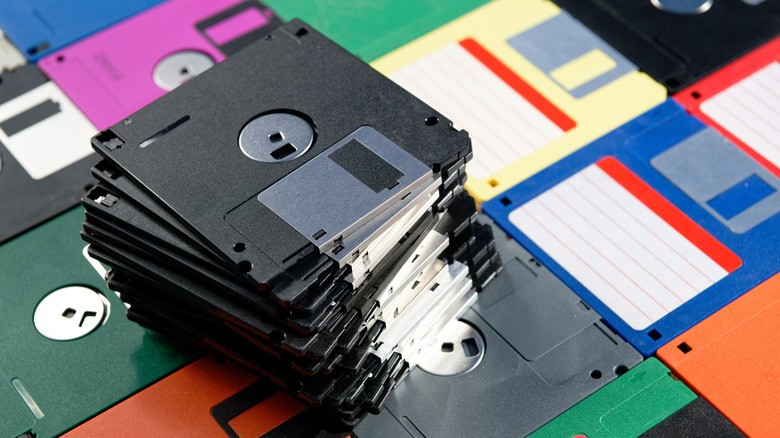
Perhaps the most vital cornerstones of the information age are the abilities to store, send, and receive data. Easily being able to write down a piece of information and convey it to someone on the other side of the world may seem mundane now, but this ability was an absolute game-changer when it was first figured out. The precise means by which we store data, however, has gone through many changes and evolutions over the years, primarily via storage devices like punch cards, floppy disks, and CDs.
While we cracked the concept of storing data decades ago, there has been ongoing work to gradually increase the amount of data we can store, the speed and ease by which it can be delivered, and the level of safety for storing it. Each era of computer development has come with its own main data storage medium, gradually leaving the one before it obsolete despite how essential these old-school computer accessories once were.
Punch cards
A.greeg/Getty Images
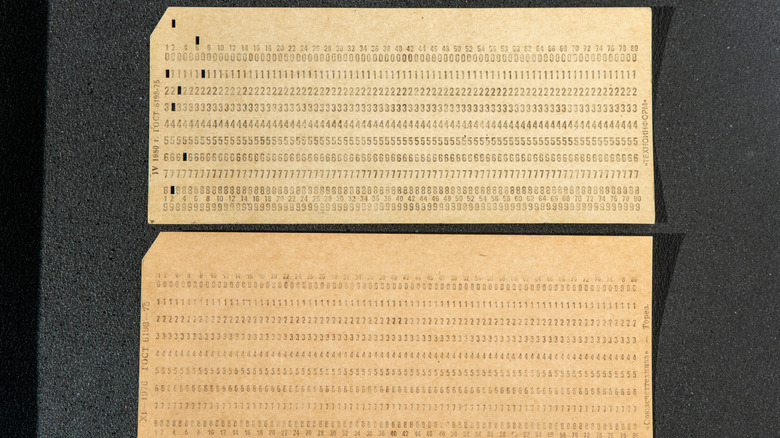
In the earliest, most experimental days of computing, the very idea of quickly storing and reading data was borderline fantasy. Just getting a computer to successfully handle basic calculations was a monumental ordeal with major hardware requirements, and no room or framework for saving those calculations. However, that changed in 1890 with an incredible invention from a humble United States census worker named Herman Hollerith: The punch card.
Hollerith, in pursuit of a more convenient way of tabulating mountains of census data, developed a device that could read information via paper cards with holes punched in them. Every punch card was covered in rows of data points, with holes punched into them to indicate which data point was active. Holerith's machine would run these cards, registering the hole punches in a manner not dissimilar to the sheet music played by a carnival organ. This exponentially simplified the process of tabulating information. While Hollerith's initial invention was only meant for this purpose, when computing arose in earnest in the 1950s, his punch cards became the means of storing and retrieving information, largely popularized by one of IBM's game-changing inventions.
Cassette tapes
hydra viridis/Shutterstock
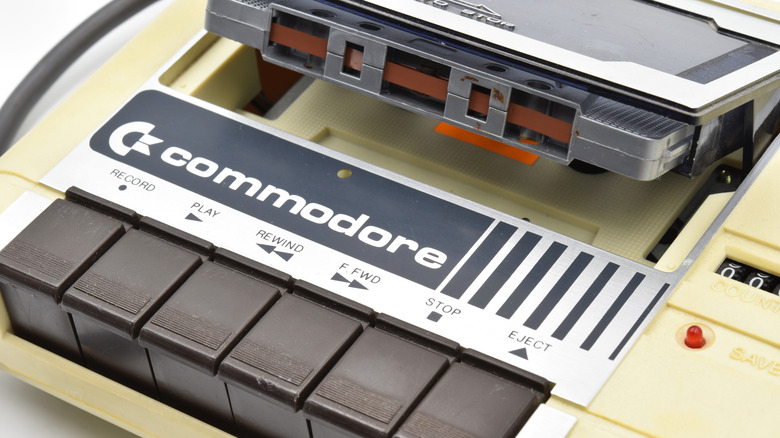
When you think of cassette tapes, you probably think of the tapes used to store and play music in a boombox. While that was their most prominent use, cassette tapes were also be used in the 70s and 80s as an old-school computing storage device. In fact, it was the format of choice for certain models of business and consumer computers like the Commodore 64 and Sinclair Spectrum. Early models of computer mainframes would store data on massive reel-to-reel recorders.
These reels would be loaded up with magnetic tape, onto which would be recorded a series of tones via a magnetizing electrical signal. The tones, when parsed by another computer, could be translated into binary code, which could then be read as plain information. Cassette tapes worked similarly, with the tapes in question being loaded up with magnetic tape and recorded in the same fashion. You could plug a tape deck into your Commodore 64 computer, run a save command, and the computer would record the necessary tones to save your information to the tape. Because tapes were so readily available, thanks to their ubiquity in the music industry, it was a cheap and plentiful means of storing data.
Floppy disks
Vladimir Sukhachev/Shutterstock
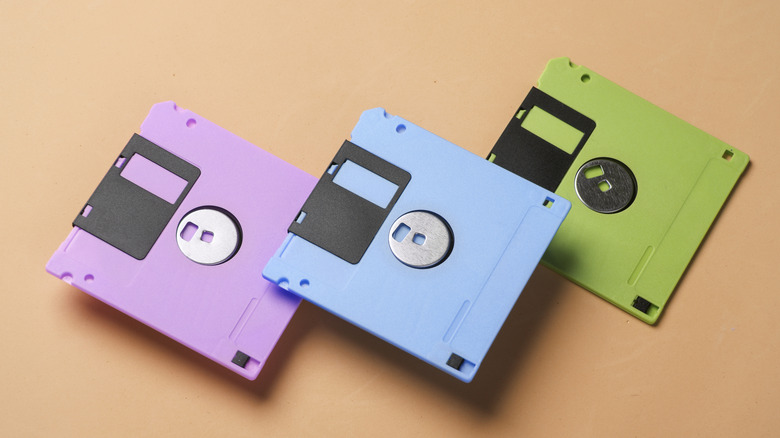
While cassette tapes were the storage medium of choice for some computers, others went in a different direction: Disks encased in a flexible sheet of plastic. It was that sheet that gave this old-school storage method its colloquial name of "floppy disks," even though the device was more square than round in shape.
Floppy disks arose as a data storage method in the late 60s and early 70s, eventually becoming the dominant choice thanks to the compact size and cheap pricing. A single disk could hold around 80KB of data, and was read via a dedicated 8-inch floppy disk drive. Data could be read and written on the disk's surface, but the disks were fragile. In 1984, Apple's Macintosh computer popularized a new format of floppy disk, one that was sized down to 3.5 inches. The disk was encased in a thicker shell of plastic, which had a sliding metal shutter to protect the disk's writable surface, and could store 1.4MB of data.
CD-ROM
Devonyu/Getty Images
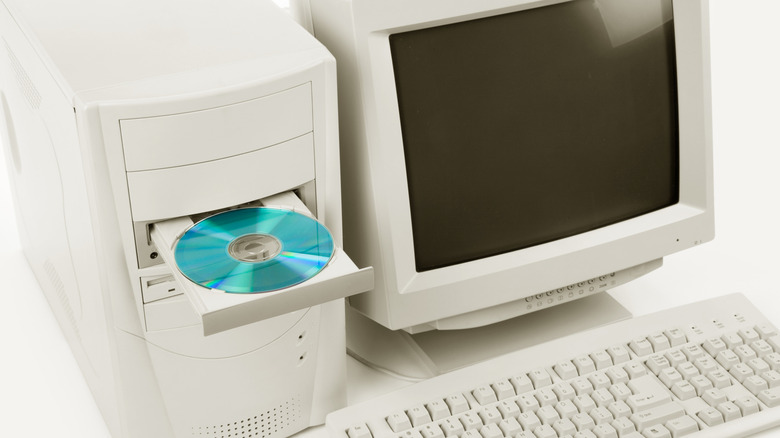
As seems to frequently be the case, music once again paved the way for better data storage formats with the advent of compact discs (CD) in the early 1980s. Sony conceived the first CDs as a new way to store and play music, but they swiftly became the dominant means of data storage as their speed and storage capacity outpaced that of floppy disks.
The original CD-ROMs (short for Read-Only Memory) were plastic discs with one side covered in tiny pits encoded with data that is read by a laser. This was great for storing information, with a capacity of over 600MB, but they could not be recorded with new information, unlike magnetic storage devices. This was resolved in the 90s with the development of the CD-Recordable, CD-R for short, which swapped the pits for a special dye layer.
This light-sensitive layer could have its chemical composition altered by the disc drive laser in a process commonly known as "burning." The process could only run once on a typical CD-R, but this was remedied with the introduction of rewritable CDs, or CD-RWs. Comact discs became the format of choice for saving data and distributing commercial programs up through the early 2000s, bolstered further by the release of higher-capacity DVDs and Blu-Rays.
Flash drives
Years/Getty Images
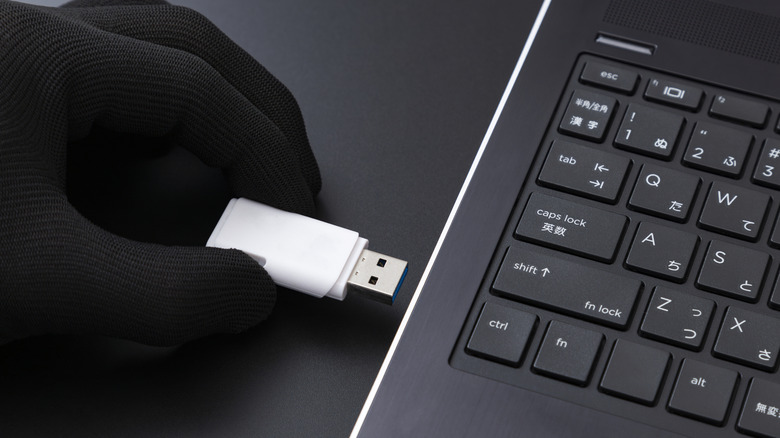
With mass adoption of the internet in the late 90s, physical data storage started falling out of fashion. After all, why go to the trouble of buying and burning a CD when you could just send data over the web? However, there was still a market for storage devices, particularly if you didn't have a reliable internet connection or wanted to quickly transfer things like school and business projects between computers. It was in this era that the USB flash drive found its niche.
Flash drives were introduced in the late 90s. These early drives contained a small printed circuit board that, when connected to a computer via its USB plug, allowed you to move data between the computer's hard drive and the flash drive's memory. The earliest USB flash drives offered just 8MB of storage space, but that figure jumped to 1GB within a few years due to better components, making them a popular medium for handling large quantities of data. While cloud storage is popular today and flash drives may not seem essential anymore, they are still available in various sizes and capacities for easy and convenient data storage.