









Deagreez/Getty Images
We may receive a commission on purchases made from links.
Gaming laptops have a, shall we say, problematic reputation with PC gamers. A reputation that, at one point, was completely justified. Early gaming laptops, like the Alienware Area-51m, came with an enormous price tag and a performance-to-dollar ratio that made purchasing one impossible to defend unless you were a very specific niche type of user.
PC gamers like to point and laugh at gaming laptops for this reason, but that overall sentiment is often based on very outdated ideas about these machines. A few years ago, there was a point when desktop CPU and GPU technology became so power-efficient that laptop versions of these chips significantly closed the gaps, with much fewer downsides and tradeoffs.
But perceptions die hard, and you may still be harboring some of them yourself. If you still think gaming laptops are a waste of money or provide a poor experience for too high a price, then you also probably believe a few of these myths. Let's dispense with them right here and right now.
Gaming laptops are hot and noisy

G-stockstudio/Getty Images
To be clear, gaming laptops definitely can be hot and noisy, in the same way that desktop PCs can also be hot and noisy. In the past, while doing something intensive such as running a video game, these laptops had no choice but to crank up the power, which generated heat and made the fans work overtime to keep the system as cool as possible. However, modern gaming laptops can give you enough performance for these apps while remaining relatively quiet. By enabling noiseless mode (or a similar option, depending on the machine maker and model), you get most of the performance without the noise. If you need to do something heavy like rendering 3D models or exporting video, you can let the fans go nuts while you step out for a coffee.
While laptops do allow components like the CPU and GPU to hit higher temperatures than in a desktop machine, it's always within the rated temperature range for that chip. In practice, modern gaming laptops can be pretty quiet while not gaming, and using the right custom fan curve (mapping fan speed to system temperature and use) can make a gaming session have a whoosh as its background noise rather than a banshee scream. That said, the need to run hotter than desktops and the average non-gaming laptop is one possible reason why gaming laptops can seem so unreliable.
They are always worse than gaming desktops
Dikushin Dmitry/Shutterstock
There's a sentiment among PC gamers that gaming laptops always perform worse than gaming desktops. The problem with this idea is that it doesn't stand up to even a little bit of logical scrutiny. If you look at the Steam Hardware Survey, for example, it's clear that most desktop PC gamers are not running high-performance PCs in the first place. While it is true that the fastest gaming laptop you can buy is much slower than the fastest desktop you can build, there's a huge section of overlap everywhere else.
It's not all that hard for a gaming laptop to perform as well or better than the average gaming PC desktop that the vast majority of people actually use. Sure, if you spend $1,000 on a desktop and the same on a gaming laptop, the desktop will leave the laptop in the dust on benchmarks like Frames Per Second (FPS) while gaming, but that's not the same as saying the laptop's performance is bad. It's also true that desktop PCs still have significantly better value for the money from a pure performance perspective. However, the actual experience of using these laptops and the performance that's available in this form factor is not inferior to desktops just by virtue of being in laptop form.
Price is not the main factor for everyone, either, but rather capability combined with portability. In that regard, gaming laptops can absolutely beat a large segment of desktop PCs that people are perfectly happy with already. And many (or most) everyday gamers will hardly even notice the performance differences between a desktop and a modern laptop.
They're always big and heavy
When people think of gaming laptops, they might have those big desktop-replacement machines like the MSI Titan in mind. For most of their existence, gaming laptops have indeed been rather bulky, but machines like the old MSI Stealth GS66 or the Razer Blade 18 pictured above are as thin as any standard non-gaming laptop.
While a thick gaming laptop has more headroom for power and cooling, it's entirely possible to build a gaming laptop that strikes a balance between size and performance. If you want laptops that are ridiculously overpowered, be prepared to book a physical therapist for the shoulder pain, but it's absolutely not necessary for modern gaming laptops to be big and bulky.
In fact, when we picked out gaming laptops more powerful than the PlayStation 5, all of them were reasonably sized. Compare that to the big and bulky console, and it's clear the technology is there to put plenty of performance in a svelte laptop chassis. You just have to be ready to pay for it! It's also worth pointing out that you don't need a laptop that's been formally categorized as a gaming laptop in order to play games. If you have a business or creator machine with the right specs, it can also do the same job, though sometimes with some tradeoffs since they're usually optimized for purposes other than gaming.
Gaming laptops are too expensive

Virojt Changyencham/Getty Images
OK, this is actually a tough one because "expensive" is a relative term. We've already established that when it comes down to performance-per-dollar, gaming laptops will cost you more for a certain level of performance than a desktop. However, if the only metric by which we judged gaming laptops was how much each frame per second would cost you, then no one would have any reason to buy one.
We can't forget that gaming laptops provide additional value besides raw gaming performance, the key one being portability. Many people have a lifestyle and living arrangement that just doesn't allow for a big gaming desktop setup. Also, keep in mind that a gaming laptop is a complete system that comes with a screen, speakers, trackpad, and keyboard. So the cost of all those peripherals needs to be factored in, as well.
If you need a laptop one way or another for school or work, then you're looking at the combined cost of a regular laptop and a desktop gaming PC. In some cases, combining those two costs into a single machine makes both financial and logistical sense. Some of the major gaming laptop brands are massive companies that sell millions of laptops of all types, so they can also offer these higher-performance machines at more reasonable prices. Gaming laptop prices also tend to follow a curve, where the best bang for buck is actually in the budget or midrange segment. Even then, gaming laptops are among the tech products you should never pay full price for.
Gaming laptops are no good for anything else

Rneaw/Getty Images
This builds on the whole idea of what overall value gaming laptops have, not just the price. A gaming laptop is still just a PC. The gaming part of it comes from the design philosophy and component choice. It's a machine that's designed to give you consistently high performance under load. However, that doesn't stop it from doing anything other computers can do. You can go grocery shopping in either a Ferrari or a Ford since both are still just cars at their core.
In fact, there are some aspects of gaming laptop design that make them great for professional tasks like video editing or 3D modeling. These have powerful CPUs and GPUs, lots of RAM, and fast SSDs. Clearly, if you need to crunch some numbers in Excel, gaming laptops will have no issues, and they're also capable of running an AI chatbot locally.
Many midrange or better gaming laptops have color-accurate screens, too, which means you can do color-sensitive work on them, including graphic design. You might even find that some laptops labeled "professional" or "for creators" have inflated prices compared to a gaming laptop with similar specs and capabilities.
Gaming laptops become obsolete quickly
Brizmaker/Getty Images
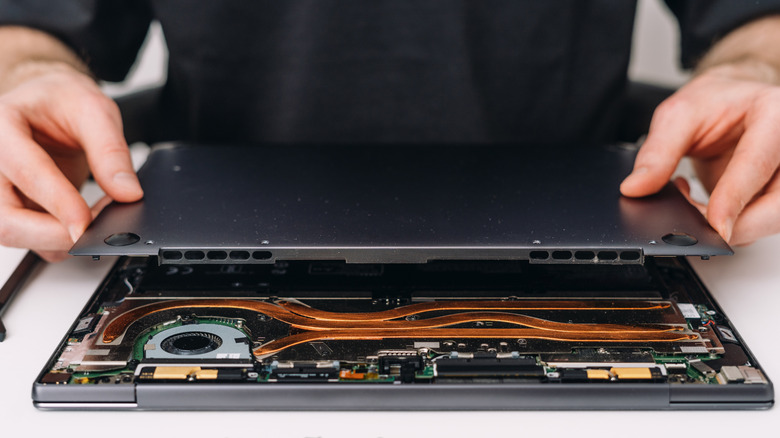
A major criticism of laptops in general is that you can't upgrade them much. You might have the choice to add storage or RAM, but the CPU and GPU you get are the ones you're stuck with until you buy a new laptop. Modular laptops might be the future, but they aren't the present, so for gamers who chase the latest hardware, a gaming laptop might be a hard pass for this reason.
The thing is, for the average PC gamer, the short upgrade cycle is a bit of a myth. There is no overriding need to upgrade frequently. Think about it for a second: Most video games are made for current-generation consoles. As long as your laptop meets or exceeds the performance levels of those consoles, which even budget models do these days, you'll be able to play new games using the same hardware for several years.
The desktop PC gamers who upgrade their computers every year for a 10% performance increase don't represent the hobby. There's no reason a new gaming laptop you buy today won't last you as long as a console cycle, as long as you expect that eventually you'll have to run newer games at lower settings. But a setting like medium or low is just a label, anyway. The high settings of today are the low settings of tomorrow, but they both look equally good. That said, you still need to do your homework when picking a laptop to make sure you get the longevity you want, of course!