









Maximilian Kaulfuss/Getty Images
A specialized robot is going where humans can't –- into the depths of the Mediterranean Sea to investigate a 16th-century shipwreck labeled a "genuine time capsule." A team armed with an ROV-C 4000 is recovering 500-year-old artifacts from the sunken merchant ship roughly 1.5 miles below the surface of the French coast – the deepest known shipwreck in French waters. However, the deep-diving ROV-C 4000 isn't the only high-tech gadgetry uncovering this preserved history.
In March 2025, a French Navy survey crew first discovered an anomaly on the seabed using high-resolution sonar. The crew then deployed an autonomous underwater drone equipped with a camera to investigate the anomaly. It captured images of a 98-foot-long ship filled with cargo from Northern Italy, now called the Camarat 4. The team ran the discovery up the chain of command, which contacted the Department of Underwater Archaeological Research (DRASSM), an organization responsible for protecting and studying France's underwater heritage.
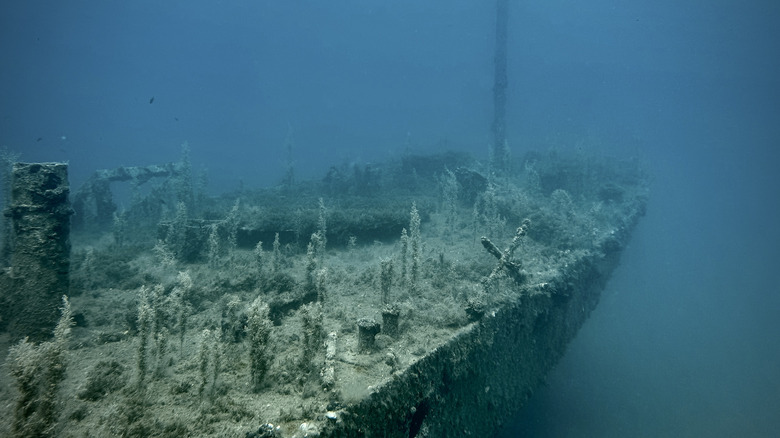
The DRASSM team was excited. At this depth, the wreck was protected from looting, sunlight, and strong currents. Researchers said the scene felt like time had stopped. The only issue was getting there, as it's far beyond the limits of human divers and too deep to even become an artificial reef. To investigate the site, researchers brought in the ROV-C 4000, a deep-sea robot capable of operating at depths up to 2.5 miles.
The deep-sea robot exploring France's deepest shipwreck
P. Heitmann/Shutterstock
At the depth of the wreck, the ocean is near-dark, the pressure is crushing, and temperatures are near-freezing. These conditions are life-threatening to humans and help explain why 99% of the deep-sea is still a mystery. The ROV-C 4000 was built for this environment. Its electronics, hydraulics, and cameras are housed in pressure-resistant systems built for prolonged cold-water operations. The robot carries powerful lighting and HD cameras, and unlike battery-powered autonomous drones or human divers, it is tethered to the ship, facilitating continuous power and live image-slash-data communication with the crew.
One of the key parts of the mission is delicate cargo retrieval. The ROV-C 4000 has manipulator arms designed for precision underwater work, allowing archaeologists to selectively recover fragile artifacts. During the April 2026 mission, it recovered three ceramic pitchers and one ceramic plate. The wreck still contains cannons, anchors, iron bars, cauldrons, and hundreds more ceramics. Despite not having the array of treasures found on some shipwrecks -– it naturally has significant value to historians.
Crews plan to explore the site for several more years using the ROV-C 4000, expanding the initial survey into a long-term deep-sea archaeology project. They want to create a 3D model of the wreck using 86,000 images captured during the mission. The 3D model would allow experts to closely study the ship's ceramics, naval architecture, artillery, and maritime trade artifacts without further disturbing the site.