




惯性聚合 高效追踪和阅读你感兴趣的博客、新闻、科技资讯
阅读原文 在惯性聚合中打开

推荐订阅源

月光博客
月光博客
钛媒体:引领未来商业与生活新知
钛媒体:引领未来商业与生活新知
人人都是产品经理
人人都是产品经理
IT之家
IT之家
Cyberwarzone
Cyberwarzone
T
Troy Hunt's Blog
有赞技术团队
有赞技术团队
阮一峰的网络日志
阮一峰的网络日志
T
Threat Research - Cisco Blogs
S
SegmentFault 最新的问题
Apple Machine Learning Research
G
GRAHAM CLULEY
cs.CL updates on arXiv.org
博客园 - 叶小钗
Last Week in AI
Last Week in AI
C
CERT Recently Published Vulnerability Notes
The Hacker News
The Hacker News
Jina AI
Jina AI
T
Tor Project blog
V
Vulnerabilities – Threatpost
酷 壳 – CoolShell
酷 壳 – CoolShell
Spread Privacy
Spread Privacy
博客园_首页
C
Cybersecurity and Infrastructure Security Agency CISA
Threat Intelligence Blog | Flashpoint
freeCodeCamp Programming Tutorials: Python, JavaScript, Git & More
Simon Willison's Weblog
Security Latest
Security Latest
cs.CV updates on arXiv.org
cs.AI updates on arXiv.org
博客园 - 司徒正美
V2EX - 技术
V2EX - 技术
I
Intezer
The Cloudflare Blog
Cisco Talos Blog
Cisco Talos Blog
SecWiki News
SecWiki News
博客园 - 【当耐特】
奇客Solidot–传递最新科技情报
奇客Solidot–传递最新科技情报
L
Lohrmann on Cybersecurity
Scott Helme
Scott Helme
Google Online Security Blog
量子位
The Last Watchdog
The Last Watchdog
AI
AI
Application and Cybersecurity Blog
S
Security Affairs
P
Palo Alto Networks Blog
S
Secure Thoughts
OSCHINA 社区最新新闻
OSCHINA 社区最新新闻
Attack and Defense Labs

ImageKit.io Blog

Next.js Image Optimization with ImageKit Use Video as a Background in Your Next.js Project How to Fix Autoplay Video in Next.js How Durian Scaled a Visual-First Retail Experience to 350K Monthly Visitors Online How Matsmart accelerated image delivery across countries with ImageKit AI in Digital Asset Management: From Smart Workflows to Agentic Automation How Joseph Joseph unified and secured global video delivery with ImageKit How Modall powers fast, effortless media delivery across 40+ projects with ImageKit Digital Asset Management (DAM) Trends: 2026 Report How to add a poster image to Video.js player (and automate it) HLS streaming with Video.js + React Building the future of storytelling with fast, AI-powered video delivery How PushOwl delivers 100M+ image-rich notifications seamlessly with ImageKit How Homify delivers millions of interior design images seamlessly with ImageKit Better event discovery with lightning‑fast videos & images Adding video player in React Native Video player in Angular applications Crop and resize videos in React Next.js image and video upload React image and video upload React video optimization How we quadrupled our traffic to 625K monthly page views How Apollo 24|7 boosted performance & reduced costs with ImageKit Simplify your media workflows with ImageKit DAM integrations Extending Lighthouse for custom image and video optimization analysis Brand Asset Management: What is it? How does it work? WordPress Digital Asset Management Guide - Manage your WP media assets better Why Shopify retailers need a digital asset management solution DAM vs. SharePoint: Which is best for you? AI-powered Metadata and Tagging in Digital Asset Management How Hopscotch built India's largest online Kids' fashion brand with ImageKit Dropbox Vs. DAM: Which Is The Right Tool For Digital Asset Management Digital Asset Management for Photographers: A Complete Guide Why digital asset management for agencies is essential Helping both Top and Bottom Line: SaffronStays rapid, profitable growth with ImageKit How KreditBee simplified media experiences with ImageKit Google Drive alternatives for businesses (with fast-growing teams) Node.js image upload ImageKit: The Secret Ingredient in Swiggy’s Expansion Journey Streamlining the Design Approval Process: A Comprehensive Guide AV1 Codec - Complete guide for video application devs PHP image and video upload Angular image & video upload AV1 vs VP9: Which codec should you choose? Adding video player in Next.js React Video Player VP8 vs VP9 - In the context of online video delivery Exploring WebM vs MP4 7 Free Digital Asset Management Software that are not Open-Source Comparing 9 Top Digital Asset Management Tools in the Market What are Brand Standards and Why do they Matter? Boost Sales and Brand Appeal: Essential Tips for eCommerce Image Management Brand Recall: The Strategy to Create Unforgettable Brands How to upload files in HTML? Branding for Small Businesses (2025 Edition) Everything you need to know about VP9 codec Recent updates from ImageKit and what's next Best Ways to Write RFP For Digital Asset Management (+ with free RFP template) What is Brand Dilution? How to Avoid It? Explained with [Examples] The Importance of Brand Identity: Leveraging Digital Asset Management for Impact From Launch to Scale: How to Launch a Brand Campaign Digital Asset Management Requirements - What do You Need to Evaluate and How? Marketing Collateral Management: A Quick End-to-End Guide Video Content Management System: What Is It And How To Choose One? Dropbox vs. Google Drive vs. Onedrive: The Best Cloud Storage Solution How to Build Brand Trust: Get Started In 2025 Google Drive vs. Box: A Detailed Comparison How Digital Asset Management Solutions Help Protect Brand Equity A DAM Solution Can Safeguard Your Digital Intellectual Property - Here’s How WebP Vs. PNG: Which Image Format Should You Use and Why? How to Resize Images in Bootstrap Easily Progressive jpegs (PJPEG): the key to loading images faster on your website Dropbox vs. Google Drive: The Best Cloud Storage For Digital Assets Dropbox Pros & Cons In 2024: An In-Depth Analysis and Why A DAM Solution Stands Out Google Drive Vs OneDrive: The Better Storage Option For Digital Assets Manage your video assets better with video metadata Understanding DAM's Role in Strengthening Brand Identity Digital asset management strategy: What to know before creating one The Ultimate Guide To Marketing Agency Onboarding 6 Solutions To Simplify Large File Sharing Over The Web A Step-by-Step Breakdown of a Video Production Workflow 13 Digital Asset Management Use Cases You Should Know How to Conduct a Brand Audit and Manage Your Brand Assets Costly Consequences of Inconsistent Branding And How DAM Can Help Dynamic Asset Transformation: What It Is, Why You Need It, and How ImageKit Can Help Everything You Need to Know About HTML Video Autoplay How To Select Your DAM Vendor: A Complete Guide How to Boost User Experience with Smart Digital Asset Management React Image Optimization: A Guide for Web Developers Why Should DAM Be A Part Of Your MarTech Stack? Unleashing the Power of Content Repurposing with ImageKit MKV vs MP4: Which Video File Format Is Better for Your Needs? Digital Asset Management For Ecommerce: A Complete Guide How an Image Tagging Software can Transform Your Image Search How to Manage Your Content Lifecycle Effectively M4V vs MP4: Which Video Format Should You Use and Why? Why Every Business Needs An Image Management System All The Questions To Ask During A Dam Demo Which is the Best Image Format for Your Website? Uploading Multiple Files Using JavaScript: A Comprehensive Guide
How To Reduce Unauthorized Use Of Image URLs
Rahul Nanwani · 2017-06-01 · via ImageKit.io Blog

It is not uncommon to find one of your images, the one you spent hours clicking and perfecting, being used on another website without your permission. What is worse is the offender not giving proper credit for the image.

The open nature of internet does not prevent anyone from using your image URL on their personal website or app. Or from downloading your image and saving it to their computer and then using it on their website or app.

This post looks at a few basic techniques that can reduce the possibilities of someone directly using your URL on their website or app.

The methods are more applicable to real-time image transformation servers, the ones that modify images on-the-fly using certain parameters in the URL. But some of them can be extended to even non real-time image servers, the ones that serve pre-transformed images from an existing image storage.

For this post, we would be using the following image as an example.

https://ik.imagekit.io/demo/img/tr:f-jpg/medium_cafe_B1iTdD0C.jpg

unauthorised use of image URLs

Now let’s say, to prevent misuse or get the deserved credit for the image, you'll want to overlay a watermark on the image.

Also, instead of sharing the larger original image, suppose a 500px x 500px image, it's best to use a lower resolution one. You could do this using Photoshop or any other image-editing software. But this is not scalable if you are handling several thousands of images.

If you were to use a real-time image transformation service like ImageKit.io, you can get the required image by specifying these transformations in the URL. Note that the URL contains tr:h-500,w-500,l-image,i-logo-white_SJwqB4Nfe.png,l-end/medium_cafe_B1iTdD0C.jpg to specify the height (h), width (w) and the overlay logo image.

https://ik.imagekit.io/demo/img/tr:f-jpg,h-500,w-500,l-image,i-logo-white_SJwqB4Nfe.png,l-end/medium_cafe_B1iTdD0C.jpg

unauthorised use of image URLs

The very purpose of URL-based transformations is to provide flexibility around different image operations. This means that any of the transformations that are applied from the URL can be modified or removed from the URL to get a different variation of the image.

A third-party with the intention of misusing the above URL could just change the transformation string and access a watermark-less, resized image like this.

http://ik.imagekit.io/demo/img/tr:h-500,w-500/medium_cafe_B1iTdD0C.jpg

reduce unauthorized use of image URLs

To prevent this unauthorized change in the transformed image, here are a few methods that will, to a certain extent, prevent unauthorized use of your image URLs or prevent modification to your image URLs without authorisation.

These methods are not just specific to ImageKit, but even to an image server that you might want to build.

1. Transformation restrictions

Limiting the transformations that are allowed on your images is the easiest way to prevent modification to your image URLs. This is something that you would need to code on your image server.

The incoming transformation request is checked against the allowed transformations. If a match is found, then the image is served else an appropriate error response is sent to the client.

Advantages

  • Restricting transformations is useful in keeping a large development team on the same page in terms of image transformations to be used.

Disadvantages

  • The image transformations get bound to the user interface of your application.
  • Any update to the user interface that requires a new image transformation would require a change in the application logic to permit the new transformation.
  • The list could potentially become unmaintainable over years of development and design changes.

2. Signature-based restrictions

You don’t need to check each image transformation from a map to confirm its validity. After all, the basic check that we need to make is that the image URL has originated from an authorised source.

To accomplish this, whenever your application server creates an image URL, it should calculate an HMAC-SHA1 digest (or any hash) of all the transformations in the URL and the image name, and use a secret key that is known only to your application server and your image server. This hash needs to be passed as a query parameter or a path parameter to the image URL.

For example,

reduce unauthorized use of image URLs

Your image server, before serving the image, would check for the validity of the hash against the transformations and the image name provided in the URL using the same secret key that was used by the application server.

This ensures that the transformation or the image name cannot be changed without changing the hash. And since the hash uses a secret key that is known only to your servers, it is impossible for someone to guess the hash for a different transformation.

Advantages

  • None of the transformations are restricted and the logic of allowing or restricting an image is independent of the user interface.

This method just ensures that the new transformations can only be generated by authorised applications.

Disadvantages

  • The unmodified-URL can still be used in other applications.

3. Signature-based restrictions with expiry time

As the unmodified-URL can still be used in other applications in the aforementioned method, it's not an entirely reliable way of reducing unauthorized use of image URLs.

To avoid theft, we can add upon the hash that we calculated in the aforementioned method.

Suppose you set the URLs to automatically expire at the end of the month (choosing such an expiry has other advantages like CDN and client-side caching).

This means that even if someone gets a hold of an image URL from your application, he would only be able to use that up to the end of the current month. Post that, a new URL would be needed for the same image.

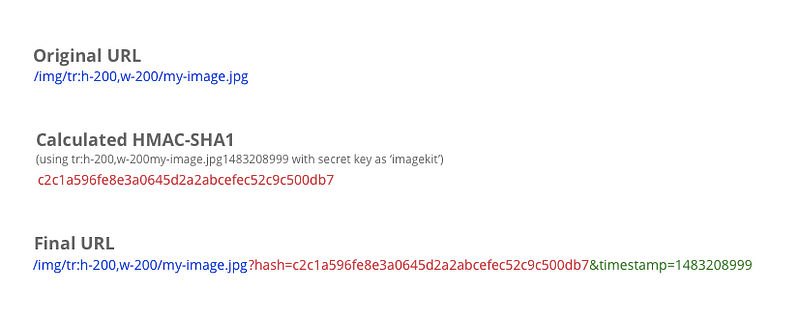
To accomplish this, we will get the UNIX timestamp of the end of the current month, i.e. the intended expiry time. So if the current month is December 2016, then we get the timestamp for 31 December 2016, 23:59:59. This timestamp is 1483208999. We will use this timestamp to calculate the HMAC-SHA1 hash and also add this as a parameter in the URL.

For example,
reduce unauthorized use of image URLs

The image server would then check for the validity of the hash against the transformations, image name, and the expiry timestamp. If the hash is valid and the expiry timestamp in the URL is still in the future, only then can the image be served.

Also, if someone tries to change the expiry time in the URL or remove it completely, the hash would become invalid. The same would happen when someone tries to change the image transformation.

Note: The idea of choosing the expiry time as month-end ensures that all URLs generated for a resource in the current month are the same. This ensures caching on the CDN (if any) and the user’s device given that the URL does not change for that month. The image server, to accommodate edge cases where the image URL generation and the actual request are on either side of the specified expiry time, can allow for a grace period of a few minutes over the expiry time.

The above techniques can be applied to your own image server or are readily available when you use ImageKit.io.

Drop a comment with your suggestions and feedback about the above techniques. And if you use some other technique at your organisation, let us know!