






Creating content is no longer the bottleneck.
With generative AI, teams can produce 42% more content every month than they could before. Images, videos, copy, 3D variants, localized versions, all at a speed and scale that would have needed entire departments just a few years ago.
But the real problem has shifted to managing what happens after that content exists.
Teams are dealing with more assets, more versions, more channels, more markets, and more compliance requirements. They need to repurpose content quickly, keep brand usage consistent, manage rights across regions, and still help people find the right file without digging through folders, Slack threads, or old campaign drives.
Naturally, digital asset management has become one of the most important investments for marketing and creative teams. The DAM market is expected to reach $16.18 billion by 2032 and with AI in the picture, businesses are critically evaluating systems that can meet a broader and more complex set of requirements.
Here are eleven key trends shaping the future of the DAM industry, drawn from our research with customers and prospects, and supported by broader industry insights.
1. AI readiness, not AI adoption, is becoming the new DAM differentiator
AI adoption is no longer the main story in digital asset management. The bigger question in 2026 is whether organizations are actually ready to use AI in a scalable, governed, and measurable way.
According to Kristina Huddart's 2026 State of AI in DAM & Content Operations report, nearly 4 out of 5 organizations are already actively using AI. But the same research notes while 79% of organizations are using AI, only 54% say they are successful with it.
This is the tension defining AI in DAM and content operations today. AI is no longer experimental for most teams, but it is also not fully embedded into how they work.
The organizations seeing the strongest results are the ones with greater AI maturity. The report found a 42-point success gap between organizations that are still experimenting with AI and those where AI is fully embedded. Organizations still experimenting report only 35% average success with AI, while leading organizations with AI fully embedded report 77% success.
For DAM teams, this has an important implication: AI features alone will not create value. A DAM may offer AI tagging, search, workflow automation, content creation, or asset recommendations, but these capabilities only work well when the surrounding foundations are strong. That means clean metadata, connected systems, clear approval paths, defined governance, skilled users, and measurable outcomes.
This is why DAM buyers in 2026 should move beyond asking, "Does this platform have AI?" A better question is, "Can this DAM help us operationalize AI safely and effectively?" That includes supporting metadata quality, workflow automation, rights-aware search, governance, human review, and integrations across the content stack.
2. More SMBs and mid-market teams are adopting DAM (but only if setup stays lightweight)
Digital asset management platforms were once considered tools built primarily for enterprises. But that's no longer the case. The digital marketing industry is projected to hit $1.3 trillion by 2033, with nearly 58% of small businesses expected to leverage some form of digital marketing. Running content-heavy campaigns is now the norm for SMBs and mid-market teams, whether through social media, influencer partnerships, UGC initiatives, paid campaigns, websites, marketplaces, or creator-led content.
As marketing and content-led growth become the default, even smaller teams are turning to DAM systems to help them move faster, stay consistent, and scale content production without chaos. For these teams, the problem is no longer just where to store assets. It is how to find the right version quickly, reuse approved content, avoid duplicate work, maintain brand consistency, and prevent assets from getting buried across Google Drive, Dropbox, SharePoint, Slack, email threads, and local folders.
Our internal research reflects this shift. Nearly 60% of new digital asset management requirements now come from businesses with fewer than 20 seats.
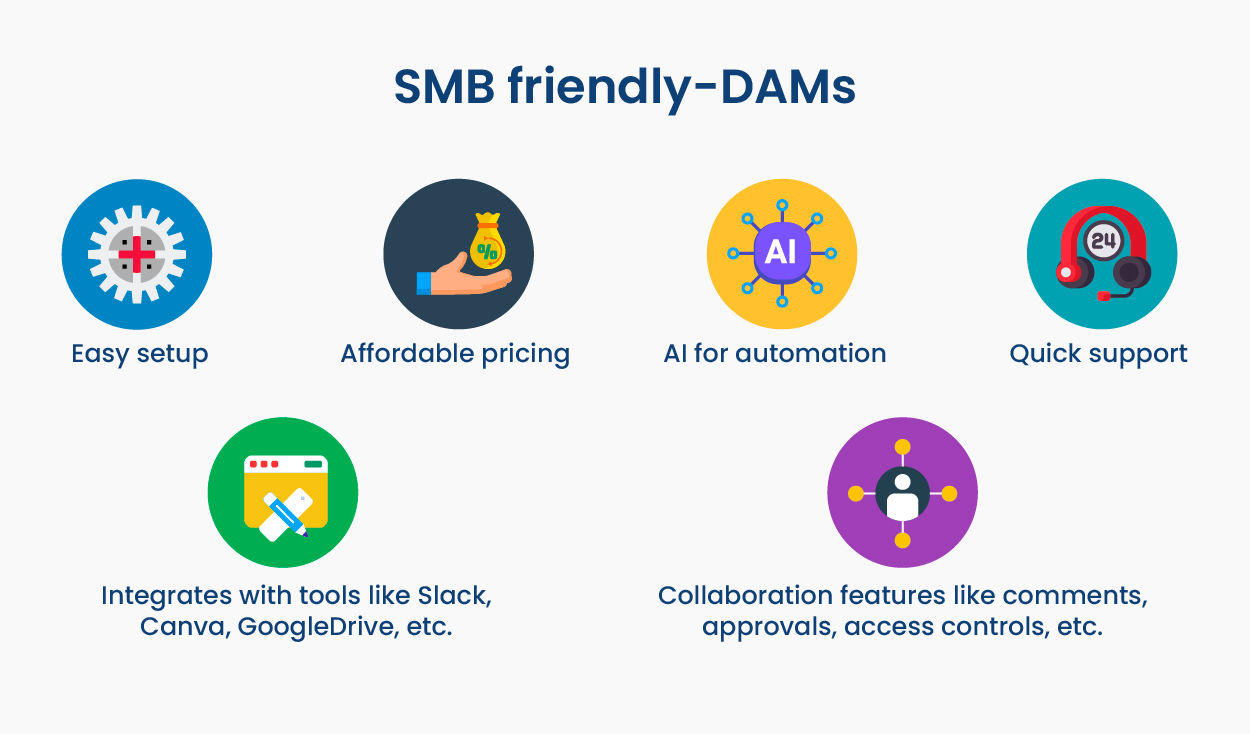
But these organizations are not looking for heavy, IT-led rollouts. They want instant access through free trials or pay-per-use models, flexible pricing that scales with growth, self-serve setup, intuitive search, easy sharing, and integrations with everyday tools. They also need DAM features that deliver value quickly, such as AI-powered organization, lightweight approval workflows, simple portals, and plug-and-play integrations.
The winning SMB-friendly DAM will not be a stripped-down enterprise product. It will be designed for lean teams that do not have the luxury of long training cycles, complex setups, or huge budgets. Faster onboarding, simplified workflows, transparent pricing, and quick time-to-value will matter just as much as advanced enterprise features.
3. Integrations, APIs, and agent-ready access will shape DAM adoption
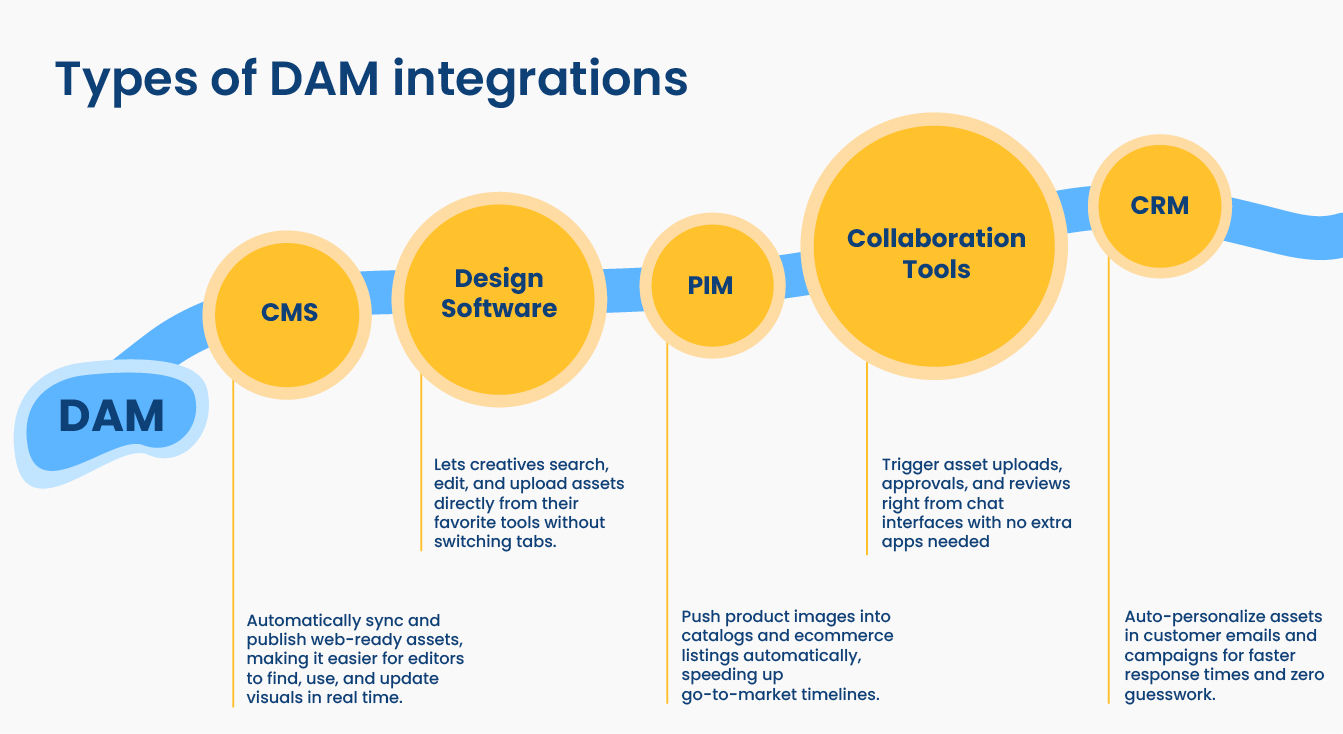
A DAM platform is central to the media supply chain, but rarely works in isolation. Teams expect it to connect seamlessly with their existing workflows, from design and animation tools to project management, ads management, website building tools - the list goes on. In fact, Scott Brinker points out that one of the key factors in choosing any martech tool is how well it works with the rest of a company's existing tool stack.
One way DAM providers can reduce this friction is by building native integrations with widely used tools like HubSpot, Salesforce, WordPress, or social media platforms. These integrations reduce the technical effort required by customer teams and help drive adoption. Our conversations with enterprise-scale teams, those with more than 400 employees, reinforce this point: 100% of them expected either native integrations with their core tools or the flexibility of headless DAM APIs to keep their workflows intact.
That expectation makes robust, well-documented APIs just as critical as native integrations. A robust API should support every core operation: uploading, managing, and searching assets, handling metadata, and more. These capabilities are especially essential for enterprises working with proprietary platforms or unique workflows.
Looking ahead, Model Context Protocol (MCP) may become an important part of this integration story. In a DAM context, MCP can act as a standardized layer on top of an existing API, making selected DAM capabilities discoverable and callable by AI agents or AI assistants. Timo Faber describes this as a shift from bespoke, point-to-point integrations toward systems that can work together more dynamically, where a DAM, PIM, CMS, and project management tool can each expose capabilities that an agent can orchestrate across. For now, MCP is still emerging, but DAM vendors serving enterprise and e-commerce teams should start treating agent-ready access as part of their integration roadmap.
4. DAM workflows are becoming more customizable and AI-assisted
Different teams within an organization use media assets in very different ways.
A brand team may need a multi-step approval chain before anything goes live. A product team might want assets to auto-tag themselves with SKU data and flow into product catalogs. Meanwhile, agencies might need client-specific folders with custom access controls and feedback loops.
A modern DAM must be flexible enough to support all these use cases. That means having the capability to handle assets through customizable workflows.
An approval workflow, for example, helps teams quickly evaluate and approve assets for distribution. Once approved, the asset moves smoothly to the next stage, whether that involves publishing or handoff. Similarly, a pre-publish workflow can be set up so an image is automatically resized, reviewed, and published to the right channels with minimal manual intervention.
AI agents are increasingly becoming part of this automation. Acting as intelligent intermediaries, they can manage repetitive tasks such as tagging, categorization, routing files based on content type or usage intent, understanding a brand's vocabulary, and triggering follow-up actions like sending reminders or publishing approved assets. Their ability to learn from historical workflows can enable more intelligent decision-making and faster execution, improving efficiency across content pipelines.
As workflows become more automated, speed needs guardrails. AI-assisted workflows should respect approvals, permissions, usage rights, metadata rules, and brand guidelines, with human review and audit trails built in where needed.
Our internal research reinforces this. We found that 75% of enterprise teams with more than 50 contributor seats consider AI agents critical for consistent metadata, team-specific vocabulary, and automatic tagging. This makes AI-assisted workflows an important factor when these teams evaluate or switch DAM platforms.
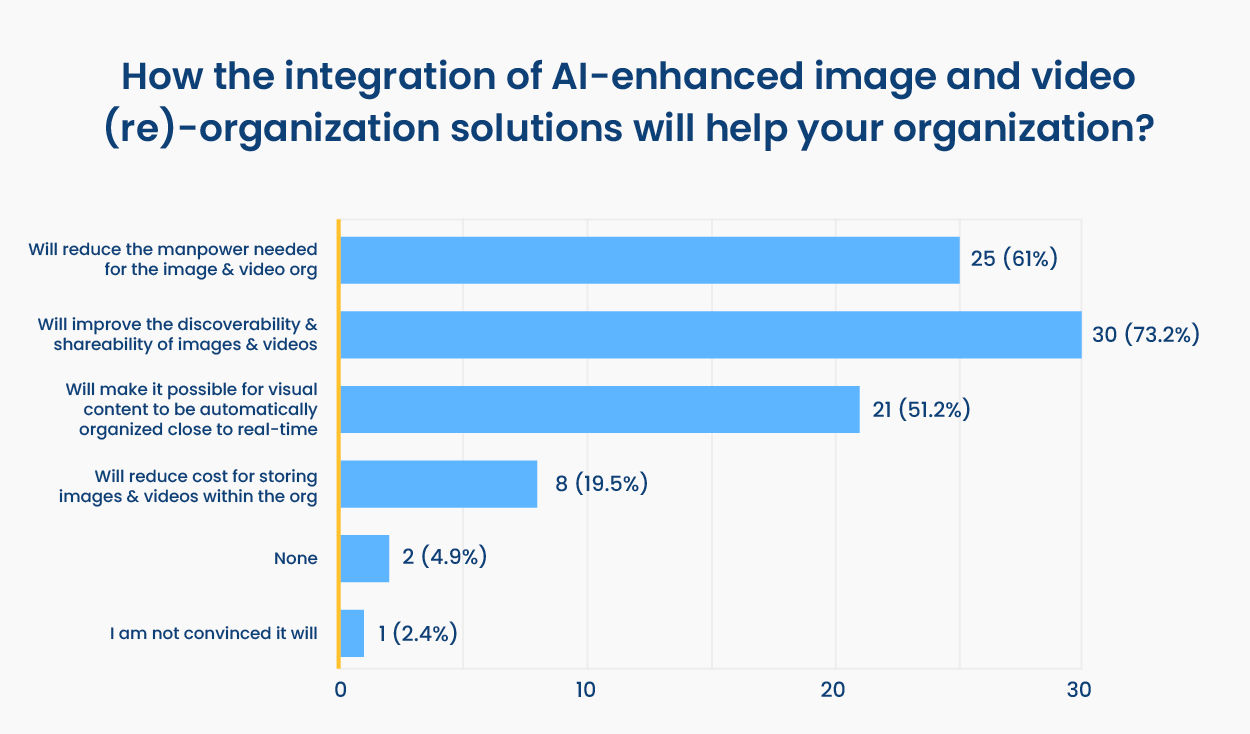
AI is changing how teams expect to organize and find assets. Users no longer want to rely only on folder structures, file names, or manual tags. They expect to search using natural language, visual references, facial recognition, and contextual cues across images, videos, documents, and templates.
Our internal research reflects this shift. We found that 60% of businesses consider AI-powered search vital. Teams want to locate assets using natural language, visual references, or facial recognition across multiple asset types, making discovery faster and more aligned with how they already work.
Huddart's latest report affirms our internal study finding that more than half of DAM users are using AI to make large asset libraries easier to navigate. But it also states the limitations that advanced AI use cases depend on clean, consistent metadata, integrated systems, governance, and standardized processes.
This means DAM teams need metadata that goes beyond file names and basic tags. Controlled vocabularies, campaign taxonomies, product and SKU details, region and language tags, usage rights, approval status, expiry dates, and channel-specific rules all help AI understand not just what an asset is, but where, when, and how it can be used.
Along with asset detection, AI-driven organization and search makes duplicate detection more feasible. As asset libraries grow, teams often upload the same or near-identical files across campaigns, channels, and regions. AI can help identify exact and near-duplicate assets by comparing visual content, metadata, file names, creation dates, and tags at the point of upload. This prevents libraries from becoming cluttered, reduces redundant storage, and helps teams reuse approved assets instead of creating new versions unnecessarily.
6. Built-in AI content creation is becoming essential for DAM systems
Content creation is quickly becoming one of the most valuable applications of AI in marketing. Approximately 72% of marketers using AI and automation report that it helps them personalize customer experiences. And more than half are already using AI to generate images and videos.
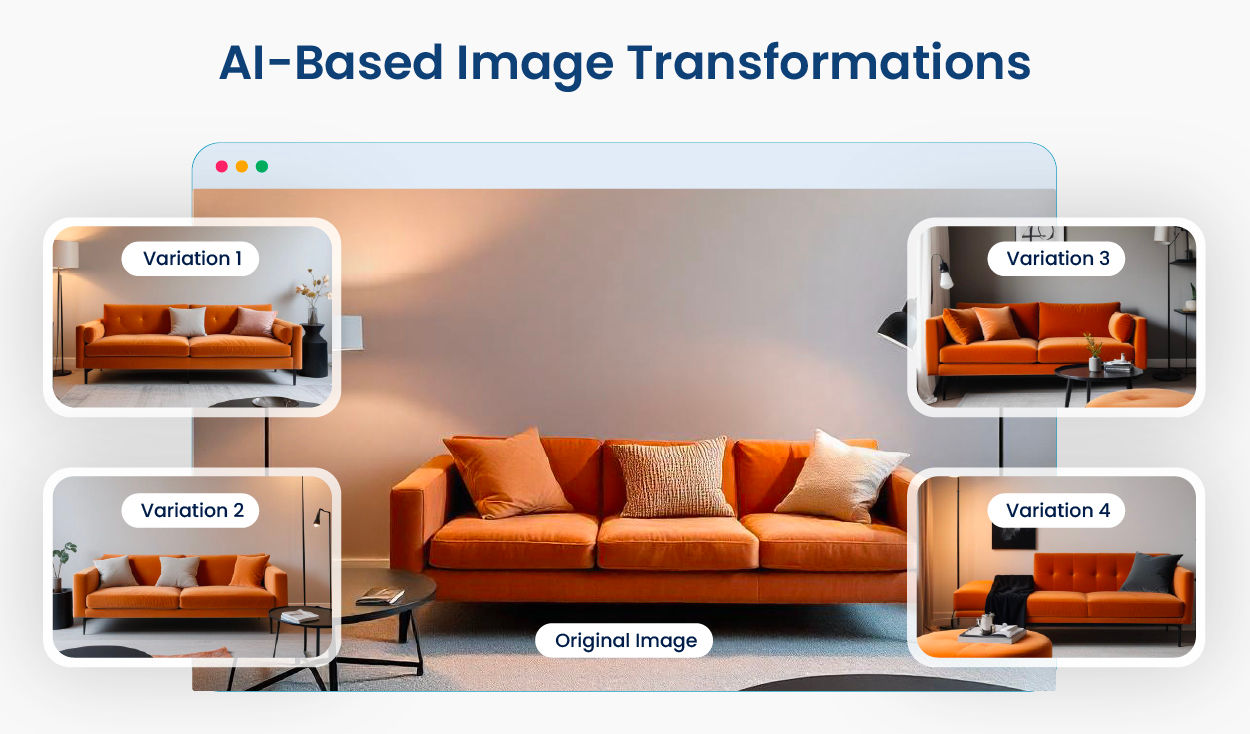
For DAM platforms, this would mean giving users the capability to generate AI content directly through the DAM, eliminating the need for a separate tool. From our conversations, we found that a quarter of DAM-focused prospects intended to choose a DAM with built-in content creation and editing tools, with a large chunk favoring integrations with existing AI tools used internally.
Capterra's 2022 AI Marketing Survey confirms that 82% of marketers believe content generated by AI or machine learning software is just as good or even better than human-created content. This growing confidence in AI is pushing teams to expect more from their tools. For smaller agencies or lean creative teams, this opens up the ability to produce on-brand visuals at scale, without long wait times or large production budgets.
Even routine edits like simple edits like removing or changing the background of a product shoot, or generating videos from images or text should be supported within the DAM. Bringing these features into the platform makes sure creative teams can move faster without sacrificing quality.
7. AI guardrails now include provenance, disclosure, and content authenticity
Although AI-generated content is widely trusted, using it without proper checks can create serious risks. Gen AI has become so human-like that it's getting harder to tell what's real and what's not. Images, videos, and even voices can be faked using tools that are easily accessible. Some of this content ends up being used to mislead, scam, or harm reputations.
Providers like Adobe have already invested in adopting a standard called C2PA. When integrated, it functions like a nutrition label for digital files, offering more visibility into the content's history, available for access at any time. C2PA lets DAMs embed secure metadata into digital assets at key stages like creation, editing, and export. This metadata includes details like who created the asset, when it was made, and what changes were applied. It is cryptographically signed, traceable, and can even serve as legal evidence if required.
The EU AI Act, which comes fully into force on August 2, 2026, requires organizations to clearly label AI-generated content (including deepfakes) and to inform users when they are interacting with an AI system. As these regulations take hold, we can expect all DAMs with capabilities to modify or create content to follow suit.
Content authenticity is only one piece of the puzzle. In parallel, DAMs will also need to prevent misuse and ensure that every asset aligns with brand values.
NSFW and inappropriate content detection This could be especially useful for fashion brands collecting user-submitted photos. To cater to such cases, DAMs must automatically scan uploads for nudity, violence, or hate symbols, and if something looks off, it must be blocked from entering the library.
Celebrity and copyrighted image flagging Crucial to media companies working with freelance photographers, the DAM system would need to detect and flag any image containing recognizable celebrities, giving teams a chance to review and confirm proper usage rights.
Legal issues aren't the only concern. There is also the matter of brand consistency. When content comes from different teams, regions, or contributors, results often vary. If AI tools are used without limits, there's a real risk of off-brand visuals, mismatched messaging, or outdated assets being pushed live.
So to solve this modern DAMs would need to set visual guardrails:
Brand compliance checks: DAMs must possess capabilities that enable the automatic verification of the correct logo version being used and that brand colors adhere to the latest guidelines while flagging creatives that don't meet the standards immediately.
A 2021 study by Marc (formerly Lucidpress) found that companies with consistent branding saw a 10–20% boost in overall growth and revenue. Yet, while 85% of businesses claim to have clear brand guidelines, only 30% apply them consistently across all touchpoints. That's a problem AI with proper guardrails can solve.
Custom rules for visual consistency: DAMs should also enforce highly specific visual compliance rules, ranging from ethnicity, gender-inclusivity, cropping or padding requirements to object placement, aspect ratios, background consistency, and more.
8. DAMs need to adapt to new video asset management requirements
Video remains one of the most important asset types for DAM platforms. Teams are using video across social media, product pages, advertising, training, support, internal communications, events, and sales enablement. Our internal data reflects this too, with 40% of our DAM users storing some form of video content in their asset repository.
But video DAM is no longer just about uploading, storing, and delivering large files. Videos behave differently from static assets because a single video can contain multiple usable moments, each with its own context, audience value, and rights considerations.
That means DAMs need to manage video at the timeline level, not just the file level, through temporal indexing. Instead of returning a list of full video files, a DAM should be able to surface specific timestamped moments: a customer testimonial, an outdoor product shot, a spokesperson clip, or a scene featuring a specific product. This makes repurposing easier and reduces the need to commission new shoots simply because existing footage is hard to find.
Rights management also needs to evolve for video. A file-level rights model may not be enough when different people, music tracks, locations, or AI-generated edits appear at different points in the same video. DAMs should be able to flag usage restrictions at the segment level and carry those restrictions into any derivative clips.
Once teams can find and reuse the right video moments, the next requirement is making those moments ready for the right channel. DAMs must be able to optimize videos on the fly, adjust resolution, convert formats, crop for different platforms, and enable adaptive bitrate streaming to ensure smooth playback across devices and network conditions. All of this should be backed by global CDN delivery to guarantee speed and reliability at scale.
As video libraries grow, analytics will also play a bigger role. If a DAM can identify which videos are downloaded, reused, or requested most often, it can help teams spot content gaps, recommend short-form variants, and connect performance insights back into production planning.
9. 3D asset support is a vertical-specific growth lever
The demand for managing 3D assets is picking up fast. Industries like architecture, automotive, retail, gaming, and healthcare are starting to use 3D models as a regular part of their workflows. This shift is pushing the 3D DAM market forward, with projections showing it could grow from $29 billion in 2024 to almost $98 billion by 2034.
There are plenty of real-world use cases already. In retail, 3D files are behind virtual try-ons and product configurators that help customers get a better feel for what they're buying. In other industries, they're being used for simulations, prototypes, or design previews that save time and effort.
But most DAM systems today were built with 2D images in mind. Investing in capabilities of being able to support 3D formats like GLB, GLTF, OBJ, or STL, and integrate with other 3D asset creation tools like Blender, Unity, or Adobe Substance, will help serious DAM players expand their market reach.
10. Mobile and embedded DAM experiences matter more than ever
Teams today are distributed across various geographies, and work often occurs on the go. Since this is the new normal, DAM providers looking to stay ahead of the curve should offer the ability to operate via mobile through an app that allows:
- Uploading or reviewing assets directly from the phone
- Approving campaign visuals without needing a laptop
- Sharing links in Slack, Teams, or even WhatsApp from the DAM app instantly
Surpassing mere convenience, the provision of a mobile DAM app will help reduce feedback delays and speed up go-to-market timelines.
11. DAM security and compliance are expanding into AI governance
As digital asset libraries grow, DAM security becomes a business-critical requirement. These systems often store brand files, licensed media, campaign assets, product visuals, employee images, customer-facing content, and other sensitive business materials. Protecting them requires more than basic access control.
That's why modern DAM systems must be built on trusted security frameworks. SOC 2 helps validate infrastructure controls around security, availability, and monitoring, while ISO 27001 shows that information security is managed across people, processes, and technology.
Data from ImageKit indicates that both SOC 2 and ISO 27001 are mandatory requirements for organizations with over 500 employees.
GDPR readiness is also essential, especially for DAM vendors catering to EU businesses. DAM libraries can contain personal data through employee headshots, customer testimonials, model images, event footage, user-generated content, and metadata linked to identifiable individuals. In ImageKit, we found a 50% increase in requests to sign country-specific privacy policies in line with EU GDPR requirements.
AI adds another layer of risk. Ralph Windsor frames this risk clearly, warning that many organizations are adopting AI tools whose behavior they cannot predict, whose data handling they cannot verify, and whose compliance implications they have not fully considered. He also points out that many cloud-based AI features send assets to third-party providers, raising questions around retention, model training, jurisdiction, and extracted metadata.
Modern DAM systems should provide transparency into AI processing, permission-aware AI search, human review for sensitive actions, audit trails for AI-driven changes, clear opt-outs, and controls around third-party model usage. NIST's Generative AI Profile offers a useful risk-management lens here, helping organizations incorporate trustworthiness into the design, development, use, and evaluation of AI systems.
Conclusion
Traditional storage tools can help teams store files. But modern content teams need much more than storage. They need a governed, integrated, AI-ready content operations layer that helps every team work faster without losing control.
That is where DAM is heading in 2026.