



惯性聚合 高效追踪和阅读你感兴趣的博客、新闻、科技资讯
阅读原文 在惯性聚合中打开

推荐订阅源

小众软件
小众软件
量子位
博客园 - 叶小钗
Apple Machine Learning Research
U
Unit 42
IT之家
IT之家
F
Fortinet All Blogs
GbyAI
GbyAI
MongoDB | Blog
MongoDB | Blog
H
Hackread – Cybersecurity News, Data Breaches, AI and More
大猫的无限游戏
大猫的无限游戏
freeCodeCamp Programming Tutorials: Python, JavaScript, Git & More
The Register - Security
NISL@THU
NISL@THU
Webroot Blog
Webroot Blog
A
Arctic Wolf
钛媒体:引领未来商业与生活新知
钛媒体:引领未来商业与生活新知
V
Visual Studio Blog
Recent Announcements
Threat Intelligence Blog | Flashpoint
Blog — PlanetScale
Blog — PlanetScale
L
LangChain Blog
P
Palo Alto Networks Blog
Y
Y Combinator Blog
WordPress大学
WordPress大学
让小产品的独立变现更简单 - ezindie.com
AWS News Blog
AWS News Blog
有赞技术团队
有赞技术团队
Engineering at Meta
Engineering at Meta
C
Cybersecurity and Infrastructure Security Agency CISA
aimingoo的专栏
aimingoo的专栏
Know Your Adversary
Know Your Adversary
Cyberwarzone
Cyberwarzone
Martin Fowler
Martin Fowler
The Hacker News
The Hacker News
P
Privacy International News Feed
T
Threat Research - Cisco Blogs
G
GRAHAM CLULEY
宝玉的分享
宝玉的分享
博客园 - 聂微东
cs.CL updates on arXiv.org
Cyber Security Advisories - MS-ISAC
奇客Solidot–传递最新科技情报
奇客Solidot–传递最新科技情报
The GitHub Blog
The GitHub Blog
S
Securelist
T
The Exploit Database - CXSecurity.com
T
Threatpost
Microsoft Azure Blog
The Cloudflare Blog
F
Full Disclosure

ImageKit.io Blog

Next.js Image Optimization with ImageKit Use Video as a Background in Your Next.js Project How to Fix Autoplay Video in Next.js How Durian Scaled a Visual-First Retail Experience to 350K Monthly Visitors Online How Matsmart accelerated image delivery across countries with ImageKit AI in Digital Asset Management: From Smart Workflows to Agentic Automation How Joseph Joseph unified and secured global video delivery with ImageKit How Modall powers fast, effortless media delivery across 40+ projects with ImageKit Digital Asset Management (DAM) Trends: 2026 Report How to add a poster image to Video.js player (and automate it) HLS streaming with Video.js + React Building the future of storytelling with fast, AI-powered video delivery How PushOwl delivers 100M+ image-rich notifications seamlessly with ImageKit How Homify delivers millions of interior design images seamlessly with ImageKit Better event discovery with lightning‑fast videos & images Adding video player in React Native Video player in Angular applications Crop and resize videos in React Next.js image and video upload React image and video upload React video optimization How we quadrupled our traffic to 625K monthly page views How Apollo 24|7 boosted performance & reduced costs with ImageKit Simplify your media workflows with ImageKit DAM integrations Extending Lighthouse for custom image and video optimization analysis Brand Asset Management: What is it? How does it work? WordPress Digital Asset Management Guide - Manage your WP media assets better Why Shopify retailers need a digital asset management solution DAM vs. SharePoint: Which is best for you? AI-powered Metadata and Tagging in Digital Asset Management How Hopscotch built India's largest online Kids' fashion brand with ImageKit Dropbox Vs. DAM: Which Is The Right Tool For Digital Asset Management Digital Asset Management for Photographers: A Complete Guide Why digital asset management for agencies is essential Helping both Top and Bottom Line: SaffronStays rapid, profitable growth with ImageKit How KreditBee simplified media experiences with ImageKit Google Drive alternatives for businesses (with fast-growing teams) Node.js image upload ImageKit: The Secret Ingredient in Swiggy’s Expansion Journey Streamlining the Design Approval Process: A Comprehensive Guide AV1 Codec - Complete guide for video application devs PHP image and video upload Angular image & video upload AV1 vs VP9: Which codec should you choose? Adding video player in Next.js React Video Player VP8 vs VP9 - In the context of online video delivery Exploring WebM vs MP4 7 Free Digital Asset Management Software that are not Open-Source Comparing 9 Top Digital Asset Management Tools in the Market What are Brand Standards and Why do they Matter? Boost Sales and Brand Appeal: Essential Tips for eCommerce Image Management Brand Recall: The Strategy to Create Unforgettable Brands How to upload files in HTML? Branding for Small Businesses (2025 Edition) Everything you need to know about VP9 codec Best Ways to Write RFP For Digital Asset Management (+ with free RFP template) What is Brand Dilution? How to Avoid It? Explained with [Examples] The Importance of Brand Identity: Leveraging Digital Asset Management for Impact From Launch to Scale: How to Launch a Brand Campaign Digital Asset Management Requirements - What do You Need to Evaluate and How? Marketing Collateral Management: A Quick End-to-End Guide Video Content Management System: What Is It And How To Choose One? Dropbox vs. Google Drive vs. Onedrive: The Best Cloud Storage Solution How to Build Brand Trust: Get Started In 2025 Google Drive vs. Box: A Detailed Comparison How Digital Asset Management Solutions Help Protect Brand Equity A DAM Solution Can Safeguard Your Digital Intellectual Property - Here’s How WebP Vs. PNG: Which Image Format Should You Use and Why? How to Resize Images in Bootstrap Easily Progressive jpegs (PJPEG): the key to loading images faster on your website Dropbox vs. Google Drive: The Best Cloud Storage For Digital Assets Dropbox Pros & Cons In 2024: An In-Depth Analysis and Why A DAM Solution Stands Out Google Drive Vs OneDrive: The Better Storage Option For Digital Assets Manage your video assets better with video metadata Understanding DAM's Role in Strengthening Brand Identity Digital asset management strategy: What to know before creating one The Ultimate Guide To Marketing Agency Onboarding 6 Solutions To Simplify Large File Sharing Over The Web A Step-by-Step Breakdown of a Video Production Workflow 13 Digital Asset Management Use Cases You Should Know How to Conduct a Brand Audit and Manage Your Brand Assets Costly Consequences of Inconsistent Branding And How DAM Can Help Dynamic Asset Transformation: What It Is, Why You Need It, and How ImageKit Can Help Everything You Need to Know About HTML Video Autoplay How To Select Your DAM Vendor: A Complete Guide How to Boost User Experience with Smart Digital Asset Management React Image Optimization: A Guide for Web Developers Why Should DAM Be A Part Of Your MarTech Stack? Unleashing the Power of Content Repurposing with ImageKit MKV vs MP4: Which Video File Format Is Better for Your Needs? Digital Asset Management For Ecommerce: A Complete Guide How an Image Tagging Software can Transform Your Image Search How to Manage Your Content Lifecycle Effectively M4V vs MP4: Which Video Format Should You Use and Why? Why Every Business Needs An Image Management System All The Questions To Ask During A Dam Demo Which is the Best Image Format for Your Website? Uploading Multiple Files Using JavaScript: A Comprehensive Guide Headless DAM: Why API-Driven Digital Asset Management is the Way Forward
Recent updates from ImageKit and what's next
Rahul Nanwani · 2024-02-13 · via ImageKit.io Blog

In recent years, ImageKit has evolved from a straightforward image optimization service to a comprehensive media management, transformation, and collaboration platform.

In this blog, we reflect on some recent updates and offer a glimpse into the exciting future ahead as we move towards managing the end-to-end media lifecycle on a single platform.

Improvements to Digital Asset Management (DAM)

Marketing and Technology teams (and even other departments) operate in the silos of their tools. While marketing and creative teams would use Google Drive to share and collaborate on resources, tech would build their own CMS backed by cloud storage to deliver optimized content on the web.

As the world moves towards increasingly digital experiences, there needs to be a unified platform for all digital content to accelerate collaboration and release cycles, making building great, unified visual experiences easier.

Our latest updates have significantly enhanced how teams across marketing, tech, and other domains collaborate and manage media assets.

Granular access control and sharing in the DAM

With enhanced access control and sharing features, ImageKit now serves as a platform where stakeholders from diverse teams can collaborate. Marketing and creative teams can iterate on assets and control at an asset or folder level who can access which assets and what actions they can perform. Assets from the same DAM platform can be published by the tech team directly on the web, with built-in optimization, transformation, and streaming capabilities over a CDN.

Easily import assets into the DAM with rclone, APIs, and other integrations

Importing any file type from platforms you use, like Drive and Dropbox, or stock photography websites like Unsplash, has been made available within our dashboard.

Also, thanks to our recently released rclone integration and an array of media APIs, bulk copy and sync operations from cloud storage like S3, Azure, Google Drive, Dropbox, and FTP have become more straightforward.

These integrations help your team to move from simple cloud storage to an evolved DAM system.

Media collections to create virtual, shareable groups

Media collections are game-changing in enabling the sharing of assets with different groups without creating multiple copies of the asset.

E.g., suppose your company logo has to be shared with different teams for different campaigns. In that case, you can group the logo file and other campaign-specific assets in virtual, shareable collections as per your requirements. If you have to update the logo file, update the underlying asset, and it gets updated in all collections.
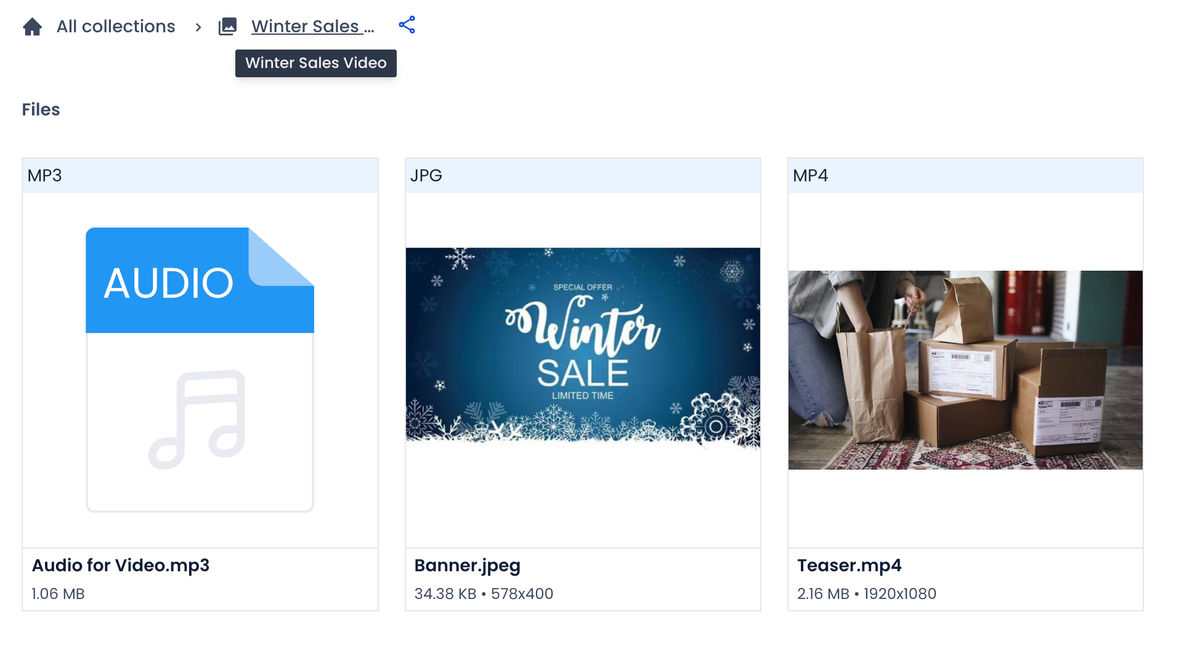
Media collections virtually combine related assets in a single shareable group

Instead of sharing cumbersome ZIP attachments via email, you can now use public links to share assets with external stakeholders without inviting them as collaborators to the DAM. For example, if you have to share a media kit on your website, you can create a collection inside the DAM and share it via a public link whenever needed.

Share assets with external stakeholders using Public Links

Draft assets, versioning, and comments

A centralized location for tracking asset versions and gathering feedback ensures team alignment. We also added the ability to keep assets in draft state, making them accessible inside the DAM but not to the world until ready for publication.

Improved search autocomplete

The enhanced search autocomplete, including file names, folder names, and tags, makes finding the right assets swift and efficient as you type.

ImageKit's enhanced search autocomplete

While our DAM brings marketing and tech teams closer with a unified platform for digital assets, we have continued to innovate on how media is optimized and delivered in real time.

Support for arithmetic expressions in real-time transformations

ImageKit now supports arithmetic expressions for transformations that allow you to specify transformations, mathematical operations, and conditions relative to the current image attributes instead of absolute hard-coded values.

For example, with images with varying widths, you can create an overlay that is always 10% of the image width instead of a fixed value like 100px. This has been demonstrated in the example URL below. Combine this with conditional transformations; there is no limit on what you can achieve with real-time transformations.

Image with a black overlay on the left side that is 10% of the base image's width and equal to the base image's height
https://ik.imagekit.io/ikmedia/example_image.jpg?tr=w-600:l-image,i-ik_canvas,bg-09000050,w-bw_mul_0.1,h-bh,lx-0,ly-0,l-end 

Blurred background, gradient, and shadow effects

Customizing images with blurred backgrounds, gradients, and shadows can now be done directly from the image URL, enhancing the visual experience for end-users.

Image with blurred background using real-time URL-based transformations
https://ik.imagekit.io/ikmedia/example_image.jpg?tr=w-900,h-400,cm-pad_resize,bg-blurred_20

Support for the latest Client Hints specification

The latest Client Hints specification parameters Sec-CH-Width, Sec-CH-DPR, and Save-Data are now supported in ImageKit. With this, you can automatically deliver responsive images in the correct dimension and respect a user's preference for data saver mode without changing the image URL or writing complex and verbose responsive image code blocks.

AV1 codec support for better video optimization

AV1 video codec provides superior compression and output quality compared to VP9 and H264, which ImageKit supported earlier. With the additional AV1 codec support, ImageKit automatically streams content in AV1 on supported devices, improving the video streaming experience.

Updated SDKs for easier integration

  • We launched a major update to our Android SDK (v3.0.0) with features such as responsive image loading, video URL construction, file uploads with upload policy, upload pre-processing, and integrations with popular image loading libraries like Glide, Picasso, Coil, and Fresco.
  • Our new SDK for Vue3 is also available along with updates to all other SDKs, making using ImageKit's latest features easier across platforms.

A peek into the Future: AI-Enhanced Capabilities

At ImageKit, we are working with our customers to introduce AI-powered innovations across the media lifecycle to simplify media management and delivery at scale. The following features are just the first ones coming out, with a list of AI-powered features on our roadmap.

  • AI-Powered semantic search in DAM: Prepare for a game-changing update allowing you to use natural language queries like "find me a red car", or "beach with sunset" to find assets, thanks to AI analyzing actual image content.
  • Real-time image enhancements and improved transformations with AI: With improved object and face detection, background removal, generative fill, and image upscaling, our AI-powered transformations will redefine how you deliver and enhance media.
  • Create and edit images with GenAI: Soon, you'll be able to create new images and variations of existing images or adjust product placement and backgrounds using simple prompts and actions within the media library.
  • Native DAM App for better workflows: We're developing a native application for desktops and laptops that will allow you to search, browse, and move assets to and from the ImageKit DAM. The native application will work seamlessly with any other tool like Photoshop, Figma, an internal CMS, and more, enhancing your workflow across platforms.
  • Commenting on assets re-imagined: Look forward to a vastly improved commenting feature, including threads, reactions, contextual comments, and more, facilitating easier collaboration within the DAM.

As we continue to evolve, your feedback remains invaluable to us. Whether you're keen to explore these new features, have suggestions for future updates, or wish to share your thoughts, contact us at support@imagekit.io. We're all ears.

Together, let's continue to push the boundaries of what's possible with ImageKit.io.