

惯性聚合 高效追踪和阅读你感兴趣的博客、新闻、科技资讯
阅读原文 在惯性聚合中打开

推荐订阅源

P
Privacy & Cybersecurity Law Blog
WordPress大学
WordPress大学
Last Week in AI
Last Week in AI
腾讯CDC
人人都是产品经理
人人都是产品经理
小众软件
小众软件
V
Visual Studio Blog
S
Secure Thoughts
J
Java Code Geeks
V
V2EX
量子位
The Hacker News
The Hacker News
酷 壳 – CoolShell
酷 壳 – CoolShell
Security Latest
Security Latest
博客园_首页
钛媒体:引领未来商业与生活新知
钛媒体:引领未来商业与生活新知
Threat Intelligence Blog | Flashpoint
Spread Privacy
Spread Privacy
博客园 - 叶小钗
T
Threat Research - Cisco Blogs
Security Archives - TechRepublic
T
Tailwind CSS Blog
Cloudbric
Cloudbric
S
SegmentFault 最新的问题
AI
AI
奇客Solidot–传递最新科技情报
奇客Solidot–传递最新科技情报
Application and Cybersecurity Blog
IT之家
IT之家
T
Tenable Blog
S
Security @ Cisco Blogs
月光博客
月光博客
雷峰网
雷峰网
博客园 - 【当耐特】
Know Your Adversary
Know Your Adversary
C
Cybersecurity and Infrastructure Security Agency CISA
Exploit-DB.com RSS Feed
OSCHINA 社区最新新闻
OSCHINA 社区最新新闻
Hugging Face - Blog
Hugging Face - Blog
爱范儿
爱范儿
Attack and Defense Labs
博客园 - 三生石上(FineUI控件)
Hacker News - Newest:
Hacker News - Newest: "LLM"
有赞技术团队
有赞技术团队
N
News and Events Feed by Topic
阮一峰的网络日志
阮一峰的网络日志
TaoSecurity Blog
TaoSecurity Blog
宝玉的分享
宝玉的分享
让小产品的独立变现更简单 - ezindie.com
The Cloudflare Blog
K
Kaspersky official blog

ImageKit.io Blog

Next.js Image Optimization with ImageKit Use Video as a Background in Your Next.js Project How to Fix Autoplay Video in Next.js How Durian Scaled a Visual-First Retail Experience to 350K Monthly Visitors Online How Matsmart accelerated image delivery across countries with ImageKit AI in Digital Asset Management: From Smart Workflows to Agentic Automation How Joseph Joseph unified and secured global video delivery with ImageKit How Modall powers fast, effortless media delivery across 40+ projects with ImageKit Digital Asset Management (DAM) Trends: 2026 Report How to add a poster image to Video.js player (and automate it) HLS streaming with Video.js + React Building the future of storytelling with fast, AI-powered video delivery How PushOwl delivers 100M+ image-rich notifications seamlessly with ImageKit How Homify delivers millions of interior design images seamlessly with ImageKit Better event discovery with lightning‑fast videos & images Adding video player in React Native Video player in Angular applications Crop and resize videos in React Next.js image and video upload React image and video upload React video optimization How we quadrupled our traffic to 625K monthly page views How Apollo 24|7 boosted performance & reduced costs with ImageKit Simplify your media workflows with ImageKit DAM integrations Extending Lighthouse for custom image and video optimization analysis Brand Asset Management: What is it? How does it work? WordPress Digital Asset Management Guide - Manage your WP media assets better Why Shopify retailers need a digital asset management solution DAM vs. SharePoint: Which is best for you? AI-powered Metadata and Tagging in Digital Asset Management How Hopscotch built India's largest online Kids' fashion brand with ImageKit Dropbox Vs. DAM: Which Is The Right Tool For Digital Asset Management Digital Asset Management for Photographers: A Complete Guide Why digital asset management for agencies is essential Helping both Top and Bottom Line: SaffronStays rapid, profitable growth with ImageKit How KreditBee simplified media experiences with ImageKit Google Drive alternatives for businesses (with fast-growing teams) Node.js image upload ImageKit: The Secret Ingredient in Swiggy’s Expansion Journey Streamlining the Design Approval Process: A Comprehensive Guide AV1 Codec - Complete guide for video application devs PHP image and video upload Angular image & video upload AV1 vs VP9: Which codec should you choose? Adding video player in Next.js React Video Player VP8 vs VP9 - In the context of online video delivery Exploring WebM vs MP4 7 Free Digital Asset Management Software that are not Open-Source Comparing 9 Top Digital Asset Management Tools in the Market What are Brand Standards and Why do they Matter? Boost Sales and Brand Appeal: Essential Tips for eCommerce Image Management Brand Recall: The Strategy to Create Unforgettable Brands How to upload files in HTML? Branding for Small Businesses (2025 Edition) Everything you need to know about VP9 codec Recent updates from ImageKit and what's next Best Ways to Write RFP For Digital Asset Management (+ with free RFP template) What is Brand Dilution? How to Avoid It? Explained with [Examples] The Importance of Brand Identity: Leveraging Digital Asset Management for Impact From Launch to Scale: How to Launch a Brand Campaign Digital Asset Management Requirements - What do You Need to Evaluate and How? Marketing Collateral Management: A Quick End-to-End Guide Video Content Management System: What Is It And How To Choose One? Dropbox vs. Google Drive vs. Onedrive: The Best Cloud Storage Solution How to Build Brand Trust: Get Started In 2025 Google Drive vs. Box: A Detailed Comparison How Digital Asset Management Solutions Help Protect Brand Equity A DAM Solution Can Safeguard Your Digital Intellectual Property - Here’s How WebP Vs. PNG: Which Image Format Should You Use and Why? How to Resize Images in Bootstrap Easily Progressive jpegs (PJPEG): the key to loading images faster on your website Dropbox vs. Google Drive: The Best Cloud Storage For Digital Assets Dropbox Pros & Cons In 2024: An In-Depth Analysis and Why A DAM Solution Stands Out Google Drive Vs OneDrive: The Better Storage Option For Digital Assets Manage your video assets better with video metadata Understanding DAM's Role in Strengthening Brand Identity Digital asset management strategy: What to know before creating one The Ultimate Guide To Marketing Agency Onboarding 6 Solutions To Simplify Large File Sharing Over The Web A Step-by-Step Breakdown of a Video Production Workflow 13 Digital Asset Management Use Cases You Should Know How to Conduct a Brand Audit and Manage Your Brand Assets Costly Consequences of Inconsistent Branding And How DAM Can Help Dynamic Asset Transformation: What It Is, Why You Need It, and How ImageKit Can Help Everything You Need to Know About HTML Video Autoplay How To Select Your DAM Vendor: A Complete Guide How to Boost User Experience with Smart Digital Asset Management React Image Optimization: A Guide for Web Developers Why Should DAM Be A Part Of Your MarTech Stack? Unleashing the Power of Content Repurposing with ImageKit MKV vs MP4: Which Video File Format Is Better for Your Needs? Digital Asset Management For Ecommerce: A Complete Guide How an Image Tagging Software can Transform Your Image Search How to Manage Your Content Lifecycle Effectively M4V vs MP4: Which Video Format Should You Use and Why? Why Every Business Needs An Image Management System All The Questions To Ask During A Dam Demo Which is the Best Image Format for Your Website? Uploading Multiple Files Using JavaScript: A Comprehensive Guide
Weltbild switched to a modular, high-quality image delivery architecture while reducing costs
Rahul Nanwani · 2020-06-25 · via ImageKit.io Blog

Weltbild is one of Germany's largest multi-channel media publisher and is a renowned book retail brand in Germany. What started as a small catholic publishing house in 1948 has now grown from selling books to one of the largest media & internet companies in Europe.

The Challenges

Being a pioneer in online media publishing, Weltbild heavily relies on image content development and delivery. The operations grew exponentially in publishing and retail with their venture into the online space, and so did the image deliver requirements. However, their existing solution had the following constraints

  1. Weltbild had been using a third-party service for image delivery and storage for quite a few years. This meant that all their images were stored, transformed, and delivered via that single provider. With the business growing, it became increasingly important to have access to the images and to be able to use them outside of the third-party’s ecosystem. Weltbild wanted to control each of the components individually - image storage, the final delivery - only leaving the processing bit to a third-party provider, if and when needed.
  2. Visual quality is of prime importance for Weltbild. They need to compress the image to the required size and format, but the results should not come at the expense of its visual quality.
  3. Weltbild needed a more cost-effective solution that leveraged the best of the advancements in the image optimization space. At the same time, the solution should be reliable enough to be able to work without any disruptions at their scale.

How ImageKit.io helped

Hubert Ried, a member of the Frontend Engineering team at Weltbild,  started working on the three core issues (as stated above), starting with moving the entire image library out of their existing image solution provider's storage system to an external storage system on AWS S3.

The next step was to find an image optimization provider that can integrate with their newly acquired AWS S3 storage. The images needed to be optimized and transformed with high-quality output. Along with that, the image delivery was supposed to take place only via their Content Delivery Network.

ImageKit was the perfect solution, as it can integrate into any company’s existing infrastructure in minutes, making it simple to get started with image optimization. In this case, ImageKit’s processing network was integrated with Weltbild’s AWS S3 storage and CDN, facilitating a streamlined image delivery workflow.

Additionally, ImageKit worked closely with the Weltbild team to tweak the output image quality settings to match or improve upon past results.

During our evaluation, we tried throwing different kinds of images at ImageKit, even ones with an incorrect format or URL extension, and ImageKit would always deliver the right output format. It has worked great for us till now, and I don't need to go back to their dashboard at all, because the service just works!

Hubert Ried

Let’s look at some of the details about how ImageKit is working with Weltbild to deliver high-quality images across devices.

1. Real-Time Image Resizing & Optimization with AWS S3 storage and Weltbild’s CDN

ImageKit natively integrates with AWS S3 storage, both public and private buckets, to provide real-time image optimization and resizing, along with other complex transformations.

With ImageKit's processing regions spread across seven global locations, including one in Frankfurt, Germany, the time it takes to access images for the first time from Weltbild's storage is cut down to single-digit milliseconds.

Once ImageKit accesses the original image, it processes it in real-time and sends it to the user via Weltbild's CDN. At the same time, copies of the processed image are cached on the CDN and in ImageKit's internal network to ensure faster delivery in the future. ImageKit's team worked with Weltbild's team to set up the CDN configuration to ensure the correct caching of different image variants on the CDN.

2. Delivering high-quality images

Weltbild did not want to compromise on the image quality.

Initially, it took some time to figure out the right image quality settings on ImageKit. It also involved some new feature development at ImageKit to support the visual quality requirements with enhancements around contrast, and sharpening getting added to the product.

But once done, these enhancements, along with proper resizing of images for different devices using ImageKit, enabled Weltbild to deliver a visually-superior image experience compared to other solutions available in the market.

The entire team approved of the image quality, which made Weltbild even more sure about ImageKit’s capabilities.

3. Named Transforms

One of the most interesting features for Weltbild has been the use of named transformations. It helps in abstracting the complexities of the actual image transformation from the developers and the users of the website.

Weltbild uses a complex set of parameters to obtain the final optimized and enhanced image. Instead of adding the entire transformation string in the URL, named transforms help you define an easy-to-remember alias for a transformation. For example, a resize to 300x200 image can be aliased and used in the URL as “thumbnail”.
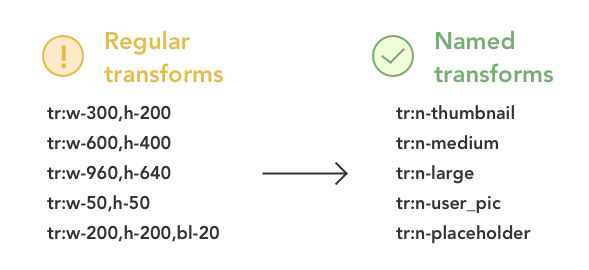
Examples of named transformations

The delinking also makes it easier to update to new dimensions, if needed. For example, if the dimension requirement changes from 300x200 to 400x300 in the future, then you need to make a change in the ImageKit dashboard only. Your code would still refer to this transformation as "thumbnail".

4. A Cost-Effective Pricing Model

Reducing infrastructure costs was also the aim of this project. The entire architecture was now modular, with the CDN and storage being controlled by Weltbild directly. They wanted to go for image optimization solutions that would integrate well with these two and charge based on the exact use of that particular component.

This was also a perfect use case of  ImageKit, as it bills customers only based on the final output size of the optimized image. It does not charge for the storage or the number of requests or number of transformations. For example, after resizing and optimization, if a 1MB input image is delivered at 100KB output size, the customer is charged only for the 100KB output bandwidth.

If your company is facing a similar challenge and is stuck with a complex and expensive content delivery architecture, reach out to us at support@imagekit.io for a quick consultation session. You can also try out the product by creating a free account here.