


Paying respect to our new techno-king
Before we begin: Thanks so much to everyone who joined Creative Good after my official announcement last week. If you missed it, please join today and be a part of our Forum community. -mark
- - -
In a bit of harmless fun recently, Tesla filed a Form 8-K to notify its investors that, henceforth, Elon Musk would be officially known as "Technoking of Tesla." (Here's the actual filing.)
The announcement shows a familiar blend of arrogance and casual flippancy that is typical of Musk's proclamations. But it's hard to imagine what, exactly, would lead a company to make such a strange filing. "Technoking." Was it just for lulz? PR puffery? An ego trip? Getting back at the SEC for charging Musk with securities fraud? Whatever it is, I think we're supposed to laugh it off.
But all kidding aside - if that's even possible in this moment of memes and Dogecoin and hosting SNL, more on which below - I think it's helpful to take Tesla at its word, and acknowledge a certain kind of kingship now enjoyed by Elon Musk. Because Musk's decisions (or perhaps "decrees") affect all of us. We're all subjects, in a way, and the next generation and the one after that will likely be even more affected by Musk's activities today.
So it's worth getting to know the kingdom that we've been thrust into, and perhaps even understanding the motives of the monarch who rules it.
A view of the technokingdom
Elon Musk is a centibillionaire, richer than Bill Gates, and the second richest person in the world, after Jeff Bezos. (Musk momentarily edged out Bezos for the #1 slot earlier this year when the Tesla stock price surged.) It's hard to describe how unimaginably huge this sum of money is, but Matt Korostoff's Wealth, shown to scale is a good start. Scroll right to see Jeff Bezos's wealth, keeping in mind that depending on the day, Elon Musk might have even more.
Musk's companies are certainly ambitious. Everyone knows about Tesla, the electric car company which has undoubtedly spurred on investment and momentum in electric vehicles throughout the car industry. And most people have heard about SpaceX, the rocket company that Musk hopes will bring people to Mars. Less well-known is The Boring Company, which digs tunnels underneath cities (it seems like a failure so far - or maybe it's brilliant?). And then there's Neuralink, which intends to implant a chip in people's brains and has already shown off a chimpanzee, with an implant, playing "mind Pong" through a neural interface. (Experts are skeptical. I also wrote about this in February.)
Perhaps least well-known within Musk's portfolio is Starlink, technically a subsidiary of SpaceX, which is launching a vast fleet of small satellites to orbit the Earth, in order to provide Internet access from the sky. Can you guess how many satellites Starlink intends to throw up into orbit? Many thousands. The company has applied for clearance to send up over 40,000 satellites into our night sky. (There are several competitors, but Starlink is in the lead, with over 1,500 satellites already in orbit.) It's not a good trajectory. As the Wall Street Journal reported last August, "astronomers and aerospace engineers have been grappling with disruptive lighting changes in the sky itself." As more and more satellites obscure our view of the stars, we'll have the additional problem of falling space junk, as terrifyingly detailed in this New Yorker article last September.
(Update May 14, 2021: Google and Starlink have announced a partnership. Now Google will surveil us from tens of thousands of devices orbiting Earth.)
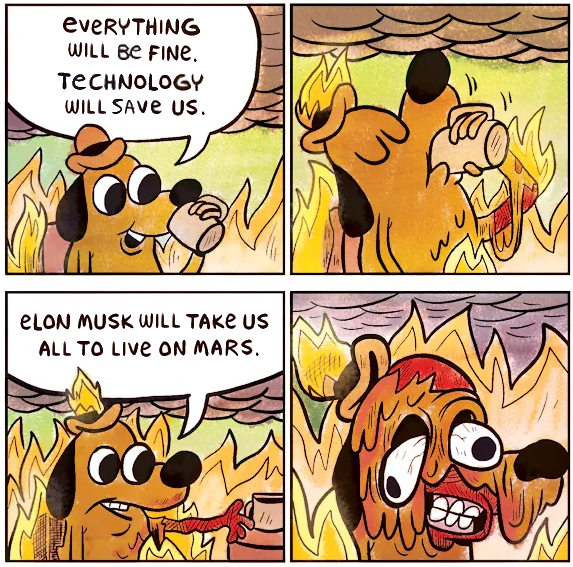
Look at the entire portfolio and our future as subjects in the Musk techno-kingdom starts to take shape. With chips in our brains, cars liable to be hacked inside deathtrap tunnels, and a sky swarming with tens of thousands of computers, we'll have extra reason to welcome an escape to Mars. And all of it will be owned by one technoking.
Just be careful about questioning the king too publicly.
A scepter on Twitter
Similar to the disgraced recent occupant of the White House, Musk has made the most of his Twitter account - with over 54 million followers and counting - issuing pronouncements, pointing to memes (often uncredited, but OK), pumping up his investments, and striking down anyone who questions him too directly.
For example:
• The Thai rescue incident: Musk went onto Twitter in 2018 to falsely accuse a leader of the Thai rescue effort who had disparaged a mini-submarine that Musk had shipped over. Musk's outburst drew a defamation lawsuit, which Musk handily won, in large part due to his "fame" (says Reuters), though his unlimited legal budget probably didn't hurt.
• Musk has shown contempt for any media outside of Big Tech. In 2018, Musk decried "the holier-than-thou hypocrisy of big media companies ... [which] is why the public no longer respects them." Inside the techno-kingdom, Musk - and Twitter, I suppose - are alone worth our faith and trust.
• As for pronouncements, Musk's most famous appeared on Twitter on March 6, 2020. "The coronavirus panic is dumb". Of the millions of followers who saw this, did anyone take him seriously and get sick? Did anyone die? I haven't heard, and Musk hasn't apologized.
• Another famous pronouncement, originally from a 2016 conference but often quoted on Twitter since then, is about autonomous driving: it's "basically a solved problem," said Musk. We do know that people have died from putting too much faith in their Tesla, and it turns out at least one Tesla engineer tried - and failed - to tone down Musk's promises (source: Ars Technica, May 2021).
Failure and amnesia
The wealth, the fame, and the Twitter megaphone all reinforce each other: repeating the positive, amplifying the spectacular, and ridiculing the skeptical. Which is why all week we've been hearing more about Elon's hosting gig on Saturday Night Live, and a lot less about defective products or fraudulent behavior. What doesn't get amplified, in other words, are the negative outcomes, the failures, the "externalities." Examples:
• Earlier this year the National Highway Traffic Safety Administration requested a recall of 158,000 Teslas, due to failures of the touchscreen. That's in addition to the hack of a Tesla touchscreen last fall, by Consumer Watchdog, and the McAfee researchers who hacked a Tesla with a 2-inch strip of tape. All of this didn't get much attention. Instead, "was he funny on SNL?"
• Consumer Reports pointed out last month that "certain Tesla vehicles now record and transmit video footage of drivers and passengers from in-car cameras. [Tesla] said it studies some footage recorded from these cameras after the fact as part of its research into self-driving technology." In other words, Teslas appear to be spying on drivers in the same way that Amazon, Google, and Facebook devices spy on people in their homes. But let's talk more about Elon in that Mario skit on SNL.
• This is from back in 2019, but it's one of my favorites, the time when Tesla solar panels set fire to seven Walmarts. I've always found that hilarious, but it's negative toward the technoking, so the story didn't go very far.
• Just yesterday, Musk announced that Tesla would no longer accept bitcoin as payment. This is a really significant announcement. Back in February, Tesla bought $1.5 billion of bitcoin. Then in March, Musk announced that Tesla would accept bitcoin to purchase cars. So - why the switch yesterday to no longer accepting bitcoin? Pam Martens put it best, in Wall Street on Parade today: "In the first quarter of this year, Tesla sold 10 percent of its stake in Bitcoin and booked a profit of approximately $101 million from the sale, neatly helping its earnings picture for the quarter."
Let's review: Buy an asset - could be bitcoin, as above, or Dogecoin, as Musk boosted on SNL. Then post on Twitter to your 53 million followers about your excitement, and watch the price go up. Finally, sell the asset for a profit, and say something about climate change to cover your tracks, as though bitcoin critics haven't been warning about that for years. I'm not a lawyer, but I know that pump and dump scams qualify as securities fraud - the same category of crime that, as noted above, the SEC charged Musk with in 2018.
What can we conclude about our technoking, one of the most powerful humans in all of history?
Maybe you drive one of his vehicles. Maybe you're inspired by his rockets and talk of Mars. But don't miss the larger view: our new technoking has a habit of not telling the whole truth - and sometimes actively stamping it out. Forget SNL, this is the Elon video to watch. It's a song from the British series "Spitting Image," featuring an Elon Musk puppet singing his defense.
"But I'm a car man, Earth is my garage." (Almost sounds like "con man"!)
Comment on this column: Creative Good members, post a comment on the Creative Good Forum. If you're not a Creative Good member, read last week's announcement and join us!
Until next time,
-mark
Mark Hurst, founder, Creative Good - join as a member!
Email: mark@creativegood.com
Read my non-toxic tech reviews at Good Reports (see the new entry on Best tech podcasts)
Listen to my podcast/radio show: techtonic.fm
Subscribe to my email newsletter
Sign up for my to-do list with privacy built in, Good Todo
Twitter: @markhurst
- - -