


Microsoft Recall should make you consider Linux
It was hard to miss the irony in Microsoft’s latest product announcement. A new feature named “Recall” takes snapshots of whatever is on-screen on a Windows 11 computer, every few seconds, and then stores it locally on-disk. Unfortunately it turns out that the analyzed data is stored in plaintext, leaving users’ private activity vulnerable to hackers. As security researcher Kevin Beaumont pointed out, “Stealing everything you’ve ever typed or viewed on your own Windows PC is now possible with two lines of code.”
And yet Microsoft named it “Recall.” It’s an interesting choice, given the problems it’s likely to create:
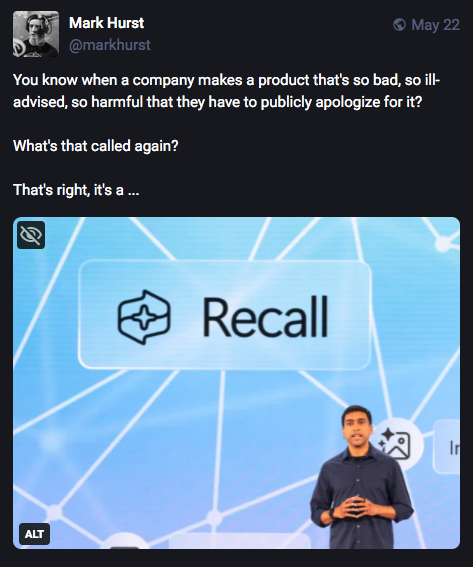
Whatever blowback Microsoft faces if and when users are hacked because of Recall, there’s no chance the feature gets killed. Even Google, after going bananums for AI (per my most recent column) and suffering a PR disaster as a result of wildly inaccurate search results, isn’t backing off from AI Overviews. Once a few tweaks are in place, the AI results will return soon. Multi-trillion-dollar Big Tech companies don’t stop a product juggernaut just because it tells people to add glue to their pizza.
Neither will Recall be recalled. It’s important to understand what’s at stake here. A feature like Recall is critical to Microsoft because it drastically increases the amount of surveillance data that the company is able to harvest and analyze. Big Tech is obsessed with finding more surveillance data, because the AI models are running out of training material. Everything online has been harvested, chewed up, and regurgitated already. As Christopher Mims puts it in The AI Revolution Is Already Losing Steam (WSJ gift link, May 31, 2024):
There aren’t 10 more internets’ worth of human-generated content for today’s AIs to inhale.
Microsoft would protest, of course, that Recall isn’t a surveillance feature, it’s for your convenience. Right. Just like all the other bossware, spyware, and malware launched by Big Tech companies in the past few years. Laptop and desktop computers are slowly, and inexorably, turning into the same kind of surveillance device that the “smartphone” [sic] has been for years: tracking your actions, claiming to keep it all private, while leaving the data available for hackers, data brokers, and Big Tech companies to use as they wish. Whatever privacy Recall might – in the best case – afford users today, it’s unlikely to be preserved once users are fully habituated to a Microsoft AI-spy watching their every move in Windows.
In my role as user advocate (and citizen advocate, patient advocate, student advocate – all of the above), as I watch the latest poisonous idea spewing from Silicon Valley’s board rooms, I think: what do we do now? What are ordinary people supposed to do, when multi-trillion-dollar companies have launched yet another type of surveillance, leaving them more vulnerable than ever to the predations of Big Tech and hackers alike?
Charlie Stross put it well. In Is Microsoft trying to commit suicide? (June 5, 2024), after discussing the many problems with Recall, Stross suggests one possible next step for users:
Some commentators are snarking that Microsoft really really wants to make 2025 the year of Linux on the Desktop, and it’s kind of hard to refute them right now.
“Linux on the Desktop.” The free, open-source operating system of Linux is not owned by any company (Big Tech or otherwise), doesn’t contain any opaque surveillance code, and enjoys a worldwide community of developers who actually want to make the software better – not, as in Microsoft’s case, worse.
My most recent Techtonic show was called We should all switch to Linux (May 27, 2024). My guest was a security and privacy expert from Switzerland who explained why, and how, to make the switch. (Stream the show / jump to the interview.) The show’s playlist contains helpful links, and there are even more pointers on the Creative Good Forum, in our resource list of Linux distributions.
Big Tech isn’t going to roll back its plans to toxify our digital lives. It’s up to us to move forward. I plan for the Creative Good community to provide resources to anyone who wants to live better with technology.
If you want to support what I’m creating, and get access to the resources the community has posted, join Creative Good. You’ll be among friends – and away from the Big Tech algorithms.
For teams out there that are trying to create digital products and services that respect the user, drop me a line. I give keynote presentations, lead workshops on UX and AI, and run research and advisory projects.
As Big Tech continues to expand its user-hostile ambitions, it’s up to us to support each other. Let’s build a better way in tech.
Until next time,
-mark
Mark Hurst, founder, Creative Good – see our services or join as a member
Email: mark@creativegood.com
Listen to my podcast/radio show: techtonic.fm
Subscribe to my email newsletter
Sign up for my to-do list with privacy built in, Good Todo
On Mastodon: @markhurst@mastodon.social
- – -