


Grasping for facts while Google lies
I witnessed some unintentional comedy on the street yesterday. Walking in my Upper West Side neighborhood, I passed one of the surveillance kiosks that clutter the sidewalks up and down Broadway - the LinkNYC towers, 9 feet tall, with distracting screens topped by hidden cameras on both sides, watching everyone who walks past. When I saw what the kiosk was showing, I had to laugh.
First, some context. What many New Yorkers don't know is that these surveillance machines are all run by Google - technically through a Google subsidiary, on contract with the city, but very much in line with Google's surveillance-capitalist practices. As Ben Green explained back in 2019, the towers "are outfitted with sensors and cameras that track the movements of everyone in their vicinity" - much like Google's online products are loaded down with surveillance malware. (Ben and I later spoke on Techtonic about so-called "smart cities," including Google's failed attempt to build a surveillance neighborhood in Toronto. More recently, Google failed again in Portland.)
Despite the surveillance and monetization going on behind the scenes at LinkNYC, the project has been deemed financially delinquent. But that hasn't prevented Google from continuing to use LinkNYC to pump up its brand. And that brings me to what I saw yesterday:
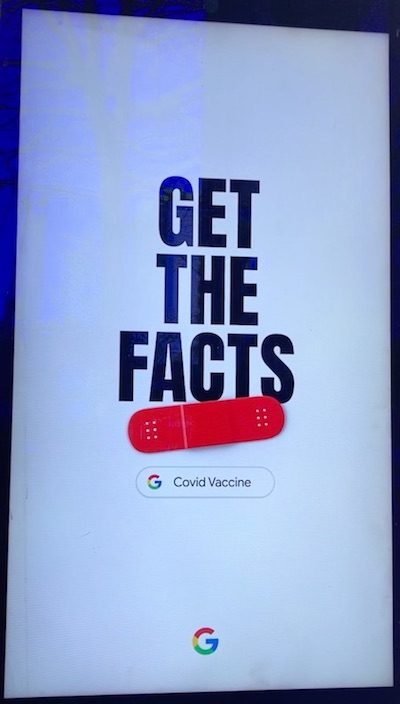
It was part of an animated spot, about 10 seconds long, showing how you can search Google to "get the facts" on Covid. Because, you know, you can definitely trust Google, since it only provides facts and would never - gasp! - spread disinformation.
This is more than a little rich. Google, which has monetized the amplification and spread of disinformation for years, here is using a surveillance tower with hidden cameras to present itself as a trusted authority. To New Yorkers. The very people being spied on by those same towers.
We need to be clear on the scope of what's happening. Google's LinkNYC isn't merely an advertising platform, it's a direct connection to the citizens of New York. As Philip Howard puts it in his 2020 book Lie Machines:
Social media platforms, search engines, and myriad devices provide the technology and infrastructure for delivering misinformation directly to citizens at key moments in a public conversation.
Even if, in the best case, Google actually is offering some legitimate info on Covid, it doesn't change the company's larger goals. Google's business model for years has depended on algorithmically amplifying any content that gets engagement. From Frank Pasquale's excellent book New Laws of Robotics, platforms like Google are concerned "that people clicked on the stories, not why they clicked on them."
Here's an example we should never forget. In 2015, white supremacist mass murderer Dylann Roof killed nine African Americans in a Charleston church. Questioned afterward by police, he described Google's role in the murders. From Pasquale's book:
Roof said that when he googled "black on white crime," he found posts from white supremacist organizations alleging a "white genocide" in progress. "I have never been the same since that day," he said.
Now, the libertarian tech bros in Silicon Valley will argue: The algorithm is neutral, Google's just a carrier and not a publisher, and anyway Google can't help if people write crazy things online.
But that argument is refuted by Google itself, which invites us to "Get the facts" - not "whatever people posted, which could be good or bad," but instead what Google positively judges to be "facts." Says it right there on the screen. So which one describes Google: a common carrier, like the phone company, that mindlessly serves up the results of a neutral search function? Or a publisher that presumes to act as a trusted authority, where citizens can go to "get the facts"? Google claims the latter. It's a publisher.
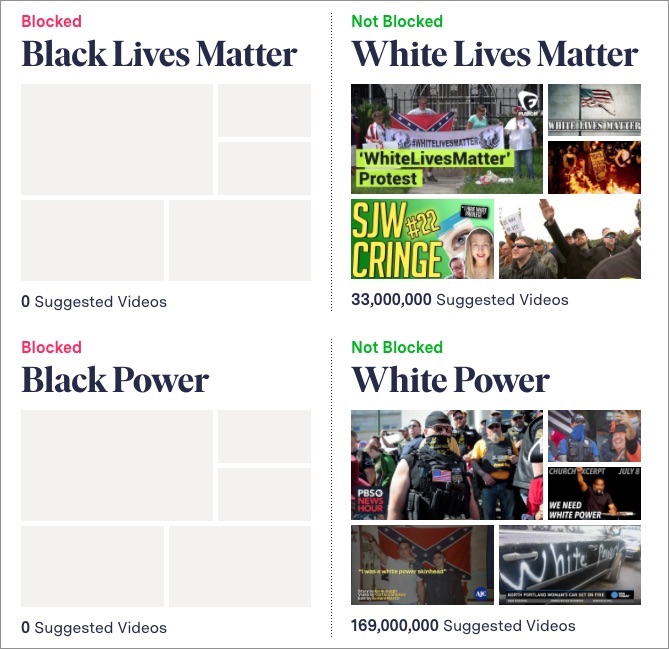
And indeed, things have changed since the Google-assisted racist mass murder of 2015. Google is now visibly taking editorial action, as reported by The Markup last week. From Google Blocks Advertisers from Targeting Black Lives Matter YouTube Videos (April 9, 2021):
YouTube parent company Google blocks advertisers from using dozens of social and racial justice terms, including Black Lives Matter, to find YouTube videos and channels upon which to advertise. At the same time, Google offered advertisers hundreds of millions of choices for YouTube videos and channels related to White supremacist and other hate terms when we began our investigation.
The images below, from The Markup article, show YouTube's distinctions: advertisers were allowed to target ads on videos that Google suggests are about "white power" or "white lives matter," but not for "black power" or "Black Lives Matter."
Source: The Markup
YouTube hastily made some tweaks after The Markup story ran - Google hates bad PR - but the company never answered questions about what they were blocking, or why, or what their policy would be in the future. And this is a bipartisan complaint: conservative media have complained for years about Google's opaque, totally secret decisions about what to publish and what to block. (What's more, to double down on secrecy, "Google also changed its code to preclude future investigations," writes Julia Angwin, editor-in-chief of The Markup. In other words, Google took action to make sure journalists couldn't do this sort of research again.)
And this is the problem with Google encouraging New York citizens to "get the facts." Google is not trustworthy. The only fact, at Google, is the dollar. And Google will do anything to get it, citizens be damned. Did you see the Wired story about exploitative Minecraft videos? Blood, Poop, and Violence: YouTube Has a Creepy Minecraft Problem (Wired, March 30, 2021). The only thing more disturbing is knowing that I wrote about exploitation on YouTube two years ago, after a NYT story showed that YouTube's Recommended Videos algorithm was serving up home videos featuring children. YouTube has never announced an end to the practice. All opaque, all secret, all profitable.
The facts about FLoC
One last development from Google you should know about. FLoC - Federated Learning of Cohorts - is Google's new scheme to track web users without the use of cookies. If you use Google Chrome (and you shouldn't), you'll be opted in by default.
Shoshana Wodinsky, a past guest on Techtonic, writes in Gizmodo: What You Need to Know About FLoC, the Ad-Targeting Tech Google Plans to Drop on Us All (April 13, 2021). Over at Plausible, my recommended alternative to Google Analytics, we learn How to fight back against Google FLoC. And [update April 16] here's an explainer from DuckDuckGo, which is also a recommended tool.
Read the articles above for details, but the overall story is the same: Google is not trustworthy. It's still spying on you, just that it's positioning itself as the primary gatekeeper for online surveillance. Google's claims to be "protecting privacy" are about as reassuring as the hidden cameras in its surveillance kiosks.
Notwithstanding their company's shocking lack of ethics toward citizens, and children, even their own employees, Google's founders have done OK for themselves. From Business Insider, Google founders Larry Page and Sergey Brin are now worth more than $100 billion, making them 2 of only 8 centibillionaires in the world.
Look at that word. "Centibillionaires." They're worth a hundred billion, after they lied to 8 billion. But we can change things by becoming more aware about what Google's doing. Ironically enough, it's their own suggestion. The first step in building a better future is, very simply, to get the facts.
P.S. Whatever you do, don't use Chrome. Use one of these alternatives instead. And for more on The Markup, listen to my interview with Nabiha Syed, who serves as president.
(Article updated April 16, 2021 to add DDG's FLoC post, and to clarify that Google's video suggestions aren't solely about title.)
Until next time,
- Mark Hurst
Email: mark@creativegood.com
Read my non-toxic tech reviews at Good Reports
Listen to my podcast/radio show: techtonic.fm
Subscribe to my email newsletter
Sign up for my to-do list with privacy built in, Good Todo
Twitter: @markhurst
- - -