Addressing long term data preservation but also other applications
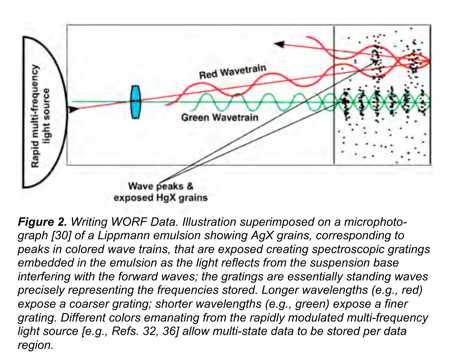
This is a Press Release edited by StorageNewsletter.com on June 17, 2026 at 2:01 pmWe had the opportunity to meet Wave Domain for the 1st time during the recent 68th edition of The IT Press Tour held last week in Boston, MA. When StorageNewsletter first covered Wave Domain in July 2023, the New Jersey-based outfit had just signed with open-innovation firm yet2 to license its WORF (Write Once, Read Forever) permanent digital archiving technology. Three years on, the company emerged from deep stealth at The IT Press Tour #68 in Boston, now branding the platform Standing Wave Storage (SWS), with co-inventor and physicist Clark Johnson, a 95-year-old industry veteran of 3M magnetic recording, the US Congress’ digital HDTV transition, and ARPA, joined by spokesperson Bob Miller, who has spun off from yet2 to drive commercialization. The underlying physics is unchanged and unusual: a repurposing of Gabriel Lippmann’s 1891 Nobel Prize-winning interferential color photography process, which captures full-color images as standing-wave interference patterns frozen into a silver-halide emulsion, no dyes required. Whereas conventional media store one bit per location, SWS stacks multiple colored wavelengths at each pixel, yielding multi-state encoding, Wave Domain has demonstrated four superimposed wavelengths per location, with up to 32 theoretically available, and combinatorial math suggesting an addressable state space orders of magnitude higher (the “deck-of-cards” example invoked in the session: 52-factorial possible orderings). The 2023 announcement claimed >80% savings on media and energy versus the best archival media in use today, and a >90% reduction in archiving-associated carbon footprint, since written plates require no power, no migration, and no environmental controls.
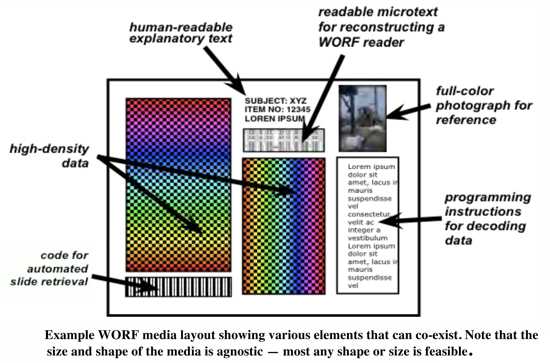
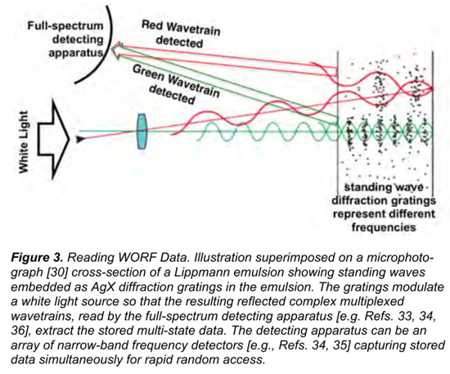
The Boston demonstration emphasized just how far the engineering has progressed. The write head is a stack of standard, off-the-shelf cell-phone components: an array of monochromatic LED light sources, a fiber-optic bundle that forces light perpendicular, an LCD shutter matrix that selectively opens over individual storage locations, and the silver-halide media itself. Firmware tells the shutters which pixels to expose; the LEDs then flash each chosen wavelength, with shutters open only over locations meant to receive that color. After chemical development, reading reverses the process: each color is flashed again, and a dimensionally matched CCD detects the absent (i.e., absorbed) wavelengths to reconstruct the stored data, the media acts as a Rugate filter. Exposure times that took Lippmann hours in 1891 are now under half a second; location size has dropped to two microns; an entire plate can be read in under one second in parallel. Forward error correction is built into the channel since the media cannot be re-read for bad blocks. Validation runs deep: the WORF media survived NASA’s 8-month HELIOS (Hardened Extremely Long-Life Information Optical Storage) mission on the International Space Station, splashing down January 2020 after exposure to microgravity and ionizing radiation, and MITRE ran a systematic government-backed test program proving multi-wavelength superposition, fast exposure, and color recovery. DARPA, NASA, and other US agencies have collectively invested several million dollars to date.
The business model is licensing, not manufacturing, closer to an ARM-style IP play than a vertically integrated storage vendor. Seven US patents have been issued, with more pending. Two external optics specialists are competing to build the SS1 prototype, defined as four-color encoding on slide-sized plates of roughly 4 to 5 inches; Eric Rosenthal (CEO, ex-VP of R&D at Disney Imagineering and original co-inventor) is leading the partner negotiations alongside a newly recruited younger CTO, Pedro, formerly Rosenthal’s student. The urgency is genuine: one of the three original inventors died last year (Richard Solomon, the co-founder/CTO quoted in the 2023 announcement), and Johnson is 95. Wave Domain says roughly $5M would be enough to deliver an early commercial system within three years, a fraction of what Microsoft has invested in its Silica glass archival research. Conversations with US national labs and government archival agencies have grown harder under the current funding environment, and the team is now openly considering looking abroad, including in Europe and Australia, for licensees and development partners willing to take SWS from laboratory curiosity to deployable permanent-archive product line.
Share this news :