


惯性聚合 高效追踪和阅读你感兴趣的博客、新闻、科技资讯
阅读原文 在惯性聚合中打开

推荐订阅源

博客园 - 【当耐特】
让小产品的独立变现更简单 - ezindie.com
AI
AI
酷 壳 – CoolShell
酷 壳 – CoolShell
D
Docker
宝玉的分享
宝玉的分享
Hugging Face - Blog
Hugging Face - Blog
云风的 BLOG
云风的 BLOG
Cyber Security Advisories - MS-ISAC
奇客Solidot–传递最新科技情报
奇客Solidot–传递最新科技情报
博客园 - 三生石上(FineUI控件)
J
Java Code Geeks
cs.CL updates on arXiv.org
Y
Y Combinator Blog
P
Palo Alto Networks Blog
P
Privacy & Cybersecurity Law Blog
T
Tenable Blog
B
Blog
大猫的无限游戏
大猫的无限游戏
L
LINUX DO - 热门话题
Cisco Talos Blog
Cisco Talos Blog
IT之家
IT之家
Engineering at Meta
Engineering at Meta
C
CERT Recently Published Vulnerability Notes
A
Arctic Wolf
Scott Helme
Scott Helme
C
Cisco Blogs
F
Fortinet All Blogs
Jina AI
Jina AI
W
WeLiveSecurity
Hacker News: Ask HN
Hacker News: Ask HN
GbyAI
GbyAI
L
LangChain Blog
P
Privacy International News Feed
Martin Fowler
Martin Fowler
The GitHub Blog
The GitHub Blog
Project Zero
Project Zero
TaoSecurity Blog
TaoSecurity Blog
A
About on SuperTechFans
N
News | PayPal Newsroom
Threat Intelligence Blog | Flashpoint
G
GRAHAM CLULEY
I
InfoQ
K
Kaspersky official blog
钛媒体:引领未来商业与生活新知
钛媒体:引领未来商业与生活新知
T
Troy Hunt's Blog
博客园_首页
K
KPMG report finds enterprise disconnect between AI and its ROI | CIO
I
Intezer
博客园 - 聂微东

StorageNewsletter

Vast Data Valued at $30 Billion as AI Drives a New Infrastructure Stack Wasabi Technologies Closes $250M Credit Facility to Expand Cloud Storage Innovation NAB Show 2026: TVC Soho Selects EditShare High-Performance NVMe Storage to Support Resolve Finishing Workflows KIOXIA Unveils Value-Oriented QLC-based EG7 Series SSDs for PC OEMs NinjaOne Unified Backup Surpasses Fifteen Thousand Customers Portworx by Everpure is Redefining Modern Virtualization for Customers with Proven, Enterprise-Ready Solutions Peer Software Strengthens Global Partner Program to Unify Fragmented File Environments for the AI Era NetApp Collaborates with Google Cloud to Power Data Infrastructure for Distributed Cloud Sidus Space Expands Existing Agreement with Lonestar Data Holdings, Inc. to Support Additional StarVault Orbital Data Storage Payload From SNIA: SCSI Continues to Innovate Data Storage with SBC-5 Microsoft Technology Licensing Assigned Patent Linux Kernel 7.0 is Out NAB Show 2026: ATTO Technology Ignites Next Era of Media Connectivity NAB Show 2026: Promise Technology to Showcase Integrated Storage Plug-in for Video and Image Creative Workflows NAB Show 2026: EditShare Advances Analytical AI and NVMe Performance for Modern Broadcast and Post NAB Show 2026: Elements Introduces GRID, a New Node-Based Scale-Out NAS Platform NAB Show 2026: MASV Expands Global Partner Ecosystem to Accelerate End-to-End Media Workflows NAB Show 2026: UnifyDrive to Showcase Full NAS Lineup NAB Show 2026: Strada Releases Easiest Remote Editing Platform on the Market Synology: Three Security Advisories on Resolved Vulnerabilities Mastercard International Assigned Patent NAB Show 2026: Promise Technology to Unveil AI-Optimized Storage Solutions NAB Show 2026: QNAP Releases HDP Recovery Media Creator: Building Windows DR Media in USB and ISO Formats NAB Show 2026: SNS Unveils Three New Products, Expanded Ecosystem NAB Show 2026: Symply Unveils Centara Platform, World’s First Quad-Interface LTO with Thunderbolt 5, and Spark One Portable NVMe NAB Show 2026: Other World Computing Launches OWC Express 4M2 Ultra Thunderbolt 5 Four-Slot NVMe M.2 SSD Enclosure Panmnesia to Mass-Produce PCIe 6.4-CXL 3.2 Fusion Switch CIQ Delivers the First Enterprise Linux Compliance Platform for Federal Cryptographic Validation and Post-Quantum Readiness Adata Launches Urban Tapsafe Up to 2TB USB 3.2 Gen2 External SSD Raidon Technology Introduces 4-Bay STARDOM SR4-BA32 20Gb/s USB-C RAID-5 Desktop Storage System ExaGrid Announces its Best Q1 Bookings and Revenue, with Double Digit Increase in Revenue YoY ControlUp Hits $100M ARR, Pioneering the Shift from Digital Employee Experience to Autonomous Endpoint Management NAB Show 2026: Lexar to Showcase High-Capacity Storage Solutions Built for Professionals and Creators NAB Show 2026: Facilis Technology Announces Partnership with Ortana Media Group for Secure Web Administration of HUB Servers NAB Show 2026: Sonnet Technologies to Showcase Thunderbolt 5 Solutions NAB Show 2026: OWC to Showcase Storage, Workflow Acceleration, and Reliability Solutions for Creatives and Post-Production Professionals Scale Computing Launches Velocity Partner Program Veeam Report Reveals a Market-Wide Shift From Recovery Confidence to Proven Data Resilience Amid Ransomware Threats and AI Adoption Silicon Storage Technology Assigned Four Patents Startup Profile: Caeves Technology NAB Show 2026: LucidLink Brings the Most Complete File Streaming Platform for Media and Entertainment StorMagic Marks 20 Years of Edge Innovation as Demand Grows for Virtualization Alternatives AWS Plans $430 Million Data Center in Navi Mumbai, India Celestica’s Storage Platforms Anchor Record-Breaking AI Supercomputer Storage Microchip Expands dsPIC33A DSC Family for High-Density AI Data Center Power, Complex Motor Control and Intelligent Sensing For EMEA Market, Toshiba Launches Metallic Blue Canvio Flex Portable 2.5-Inch USB-C Up to 4TB HDD Piodata SecureX USB Flash Drive with Enterprise-Grade Security VergeOS Implements the oVirt Standard euNetworks Named as Connectivity Partner for the AWS European Sovereign Cloud The OpenMP ARB  Launches Python Subcommittee, Welcomes Anaconda as Newest Member Wasabi Technologies to Acquire Seagate’s Lyve Cloud Business Palo Alto Networks Completes Acquisition of Koi to Secure the Agentic Endpoint NAB Show 2026: XenData Announces Backup, Archive and Cloud-Connect for LucidLink NAB Show 2026: Disk Archive to Address “De-Clouding” and Post-LTO Strategies JEDEC May 2026 Forums Focused on Next-Gen Memory for AI, Server, Cloud, and Mobile Computing From ACM: Proceedings of MemSys’25 International Symposium on Memory Systems Conference Commvault Introduces Innovations to Advance Secure, Controlled Agentic Transformation in the Enterprise Cryptsoft Demonstrates Hybrid-PQC Authentication Token Use for Quantum-Safe Systems and Infrastructure Backblaze Appoints Anuj Kumar as Chief Revenue Officer Virtuozzo Expands Board of Directors to Support Next Phase of Growth OWC Appoints Rob Steffens, Chief Financial Officer Recap of the 67th IT Press Tour in Sofia, Bulgaria Lightbits Labs Sweeps Industry Awards in Recognition of Their Critical Role in Data Infrastructure Modernization Project Clover: €1 Billion Investment in Finland for New Data Center by TikTok NAB Show 2026: OpenDrives Unveils Edge, a Hybrid Cloud-Edge Performance Accelerator for Distributed Video & Rich Media Workflows Raidon Technology Introduces SR4‑B32A 4‑Bay Hardware RAID Desktop Storage System for USB‑A Systems Cloud Storage Security Announces the Official Launch of DataDefender, a Novel DSPM Platform Focused on Data Stored in the Cloud Certes Extends Breakthrough PQC Protection Delivering Quantum-Safe Data Security Across Any App, Any Infrastructure, Anywhere Commvault Announces Leadership Appointments SNIA Launches MRAM Alliance SIG to Support Expanding use of MRAM Summary of Week 15 – April 6-10, 2026 SambaNova and Intel Announce Blueprint for Heterogeneous Inference: GPUs for Prefill, SambaNova RDUs for Decode, and Intel Xeon 6 CPUs for Agentic Tools NAB Show 2026: Facilis Showcases New HUB performance, Security, and Protection; FastCache Accelerator, and FastTracker MAM NAB Show 2026: Leaseweb USA to Showcase Cloud and Infrastructure Solutions for AI, Media, and Enterprise Workloads JetStor Delivers 80PB High-Density Archive for Government Agency Using WD’s Trusted High-Capacity Ultrastar Drives SSD Prices Jump Almost 24% in Just Three Weeks as Flash Volatility Intensifies Hitachi Vantara Announces CEO Sheila Rohra’s Resignation and Leadership Succession Panzura Appoints Karthik Ramamurthy as Chief Executive Officer University of Missouri/Mizzou Researchers Developing Rewritable DNA Hard Drive Ceramic Data Solutions Assigned Patent Panmnesia Expands Into AI Accelerator Interconnects Including UALink and Ethernet Nasuni Unveils Expanded Strategy, Brand, and Platform Enhancements for File Data Activation to Help Maximize AI Investments and Productivity Data4 Inaugure son Deuxième Data Center en Pologne, près de Varsovie SK hynix Begins Supply of 321-layer QLC NAND Up to 2TB cSSD Cloudera Advances Hybrid Data Platform with Long-Term Stability, Elastic Scale, and Open Data Interoperability Data Pipeline Failures Cost Enterprises $3 Million per Month, Fivetran Benchmark Finds NAB Show 2026: DigitalGlue Challenges AI Fatigue with creative.space Platform, the Only Creative Operating System Built for Video Catalogic Software Delivers Full NDMP Web Management and Advanced Encryption Controls with DPX 4.15 Quinas Technology Links Device Physics to AI System Performance Using Ultraram Twenty-Four Bays! Introducing the Lockerstor 24R Pro Gen2 Everspin Technologies Expands On-Shore MRAM Manufacturing Capacity Why Your Next Archive Should Be Cold AWS Launches S3 Files, Making S3 Buckets Accessible as File Systems Semidynamics Secures a Strategic Investment to Advance Memory-Centric AI Inference Chips .NEXT 2026: Nutanix Delivers Complete Platform for the Agentic AI Era .NEXT 2026: Nutanix Introduces NKP Metal, Bringing Bare-Metal Kubernetes to its Platform Gitex Africa 2026: Sandisk Brings Optimus SSD Product Brand and New Portable SSD Lineup to Africa Japan IT Week 2026: Pegatron Showcases End-to-End AI Server Solutions and Strengthens Japan Presence HighPoint Announces Rocket 1604L Compact PCIe Gen5 x16 Retimer AIC for AI and Industrial Edge Open Compute Project Foundation Launches Collaboration Acceleration Fund to Advance Open Hardware Innovation
Announcing the Databricks Storage Ecosystem: Governing the Enterprise Data Estate, Wherever it Lives
Philippe Nicolas · 2026-06-24 · via StorageNewsletter

Blog written by Rupal Jain, technology partner management director, and Denis Dubeau, principal, partner engineering, Databricks, published June 10, 2026

The Data That Can’t Move
For years, the enterprise data strategy was simple: move everything to the cloud. Migrate the data lakes and the warehouses to the cloud, and then governance follows. It was a clean story — until it wasn’t.

Today, some of the world’s most sophisticated enterprises are telling us clearly: they cannot — and will not — move all of their data to the cloud. Leading semiconductor manufacturers are training models on engineering-classified datasets that must never leave their premises. Global trading firms sit on massive volumes of historical tick data where the economics of cloud egress make migration impossible. Tier-1 banks have adopted “Hybrid Forever” strategies, modernizing on-premises storage while maintaining strict data sovereignty. Major pharmaceutical companies run millions of daily drug experiments against petabyte-scale on-premises data estates subject to stringent regulatory controls.

These aren’t edge cases. They represent a structural shift in how enterprises think about data: from “Migrate Everything” to “Govern Everything.”

The drivers are real and compounding:

  • Data sovereignty & regulation: Financial services, healthcare, and government organizations operate under mandates — GDPR, HIPAA, NIS2, sector-specific data residency rules — that require data to remain within specific jurisdictions or air-gapped environments. Cloud migration is not optional; it is legally prohibited for certain datasets
  • Data gravity & costs: At petabyte and exabyte scale, the economics of cloud migration break down entirely. Egress fees, storage costs, and sheer data volume make the “move it once” model financially unsustainable. Some of the world’s largest retailers are actively repatriating analytics workloads from cloud back to on-premises infrastructure for precisely this reason
  • Latency & edge workloads: Retail, manufacturing, and telco workloads require low-latency access to on-premises and edge data. Telecommunications providers ingest enormous volumes of network telemetry on-premises daily to power AI-driven network operations that cannot tolerate cloud round-trips
  • AI on dark data: Vast stores of backup data, unstructured archives, and secondary datasets — representing hundreds of exabytes across the enterprise — contain immense AI value that has never been unlocked because governance didn’t reach it

The signal is unmistakable. We have received requests from hundreds of customers explicitly requesting on-premises and hybrid storage connectivity to Unity Catalog. The Software-Defined Storage (SDS) market stands at hundreds of billions of dollars in 2026, and the enterprise partners who manage this estate — collectively holding more than 2 Zettabytes of data under management — are building with us.

Introducing the Databricks Storage Ecosystem
Today, we are excited to announce the Databricks Software-Defined Storage (SDS) Ecosystem — a new partner category purpose-built to bring Databricks Intelligence Platform to enterprise data wherever it lives: on-premises, in private clouds, and at the edge environments. If you are an enterprise running petabytes of data on these platforms today, you no longer have to choose between your existing non-cloud storage infrastructure and Databricks AI.

For too long, enterprises had to choose between the on-premises storage infrastructure they rely on and the cloud-native AI they want to build. Forcing customers to migrate massive amounts of data using complex pipelines just to unlock that intelligence is a broken model. By uniting these industry-leading partners, we are ending that compromise and delivering Databricks Intelligence directly to where the enterprise data lives. But this launch is just day one. We are building the foundation to ensure that soon, every piece of hybrid data–structured or unstructured–is instantly ready for generative AI without ever copying a byte,” said Stephen Orban, SVP, product partnerships & ecosystem, Databricks.

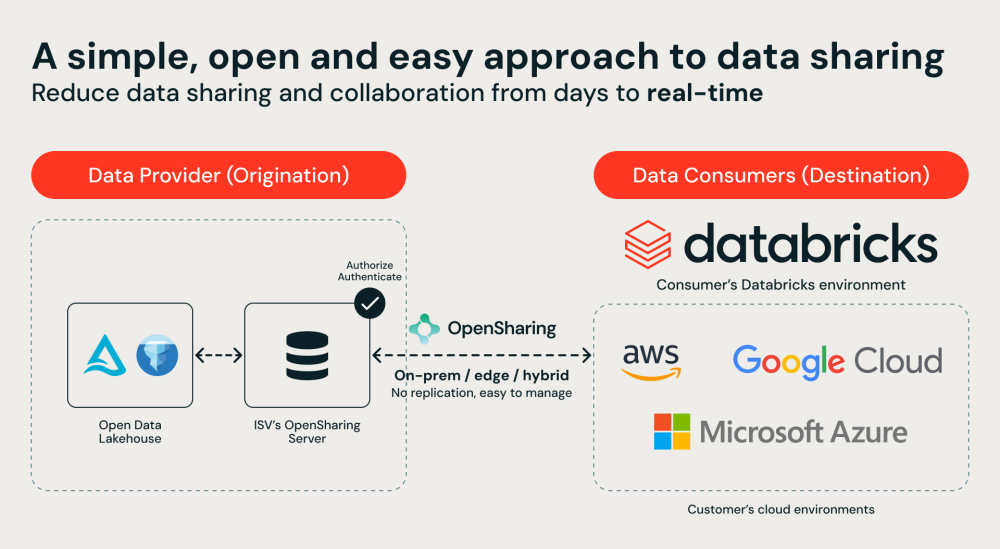
At the heart of this ecosystem is OpenSharing, an open-source protocol for secure, governed data sharing. Our storage partners are implementing OpenSharing servers to expose their data estates directly to Databricks Serverless Compute. The path is simple: the storage partner stands up a OpenSharing endpoint, you connect it to Unity Catalog, and you instantly gain secure, governed access to your on-premise data in Databricks without data migration.

This integration provides a single, unified catalog across your entire hybrid environment. Customers can now use Databricks Serverless Compute, Genie, AgentBricks, and model training to query and reason over data that never leaves the premises. The result? Zero data movement, no duplication of data and zero compliance risk.

This is not a roadmap aspiration. Customers can try these integrations today. Partners building these integrations follow the Partner Well-Architected Framework — a technical blueprint covering architecture, security, and certification criteria.

Customers want to break down data silos and unify all of their Data and AI estate – including large amounts of data that still sits on-premises. Thanks to on-premises storage partners leveraging the open source Open Sharing protocol, customers can now seamlessly unify, govern, and analyze all of their data estate in Databricks Unity Catalog – unlocking the full value of their data in the Databricks Data Intelligence Platform,” added Jonathan Keller, VP, product management, Databricks.

Click to enlarge
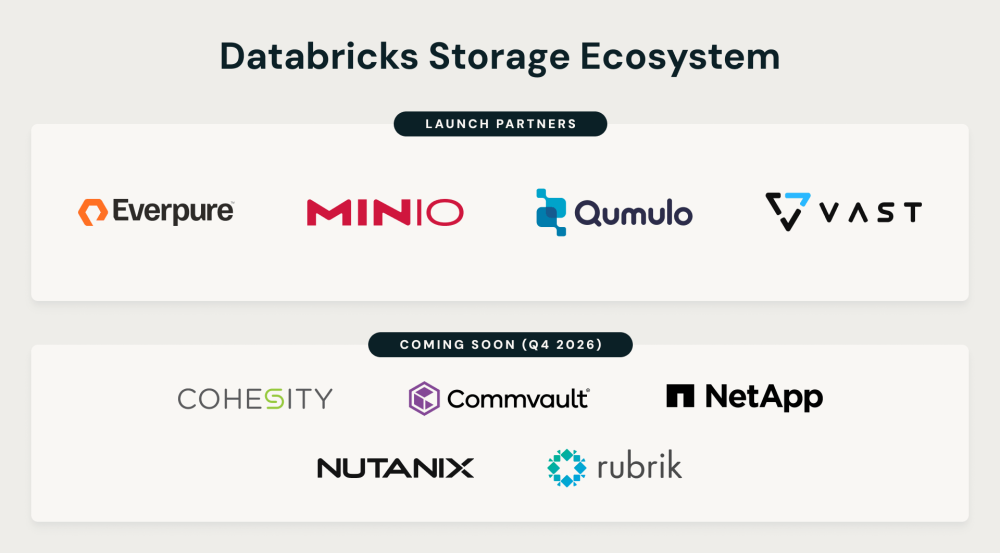
Our Launch Partners
We are proud to announce integrations with the following leading storage providers:

Click to enlarge
MinIO — General Availability
MinIO AIStor is the bridge that seamlessly connects the Databricks Data Intelligence Platform with enterprise data that can’t move to the cloud. By natively implementing the open Open Sharing protocol at the storage layer, AIStor eliminates complexity and enables Databricks customers to efficiently query live on-premises Apache Iceberg™️ and Delta tables under full Unity Catalog governance. It extends Serverless Compute, Genie, and Agent Bricks to on-premises data, bringing the full power of the Databricks Platform to an enterprise’s most critical data.

“AI and analytics initiatives are often constrained by where data resides, particularly in environments with strict security, sovereignty, or operational requirements. By bringing native OpenSharing to AIStor, we’re enabling organizations to securely expose data where it lives while giving Databricks seamless access through open standards. This removes a major barrier between enterprise data and AI, allowing organizations to activate previously inaccessible data for AI, analytics, and agentic applications without compromising control,” said Ugur Tigli, CTO, MinIO.

Everpure (formerly Pure Storage) — Private Preview
Everpure and Databricks enable organizations to use on-prem data directly in the cloud removing the need for data replication or duplication.This is delivered through an OpenSharing connector that bridges data in object storage with databricks core workspaces in a secure and gated manner.

“Everpure and Databricks enable organizations to access and analyze on-premises data directly from the cloud without the need for replication or duplication. Continuously moving data between environments is costly and unsustainable at scale. Customers are looking for a simpler approach that balances cost, compliance, and data sovereignty while reducing operational complexity,” said Chadd Kenney, VP, product management, Everpure.

Qumulo — Private Preview in July 2026
Qumulo has integrated OpenSharing with its new NeuralSearch, allowing customers to securely share Qumulo-stored data with Databricks across core, cloud, and edge environments—without replication, extra costs, or complexity. Using NeuralSearch, users can discover relevant datasets, including unstructured content, via natural-language queries and seamlessly share those curated tables with Databricks via OpenSharing.

“Organizations can no longer afford the cost, complexity, and delays of copying massive datasets across environments just to support AI and analytics. By combining Qumulo NeuralSearch with Databricks OpenSharing, customers can securely discover, govern, and share both tabular and unstructured data across core data centers, edge locations, and public clouds – in real time, without moving the data itself. Together, we’re helping organizations accelerate AI initiatives, unify governance, and unlock faster time-to-insights from globally distributed data while maintaining a single source of truth,” said Brandon Whitelaw, SVP, head, product, Qumulo.

Vast Data — Private Preview in August 2026
Vast Data is extending the Vast AI Operating System with OpenSharing support to help enterprises bridge Databricks workflows with data that resides across on-premises and hybrid infrastructure – without requiring massive data movement or migration. The integration will give customers more flexibility to access, process and operationalize data across cloud, data center and emerging AI infrastructure environments while supporting modern hybrid AI and analytics workloads.

“AI infrastructure is becoming fundamentally hybrid. Customers increasingly want the ability to process data wherever it makes the most sense economically and operationally, while still maintaining seamless access across environments. OpenSharing support extends the Vast AI Operating System’s ability to bridge Databricks workflows with data that resides across cloud and on-premises infrastructure for modern AI and analytics applications. Unlike traditional storage platforms, Vast combines data services, distributed processing and AI infrastructure orchestration into a unified operating system for AI data at scale,” said John Mao, VP, global technology alliances, Vast Data.

What’s Next

Integrations Coming Soon
In addition to our launch partners, momentum across the storage ecosystem continues to accelerate. We have secured commitments from Cohesity, Commvault, HPE, NetApp, Nutanix, and Rubrik —to build native integrations by the end of the year.

Collectively, these partners, along with launch partners, manage hundreds of exabytes of enterprise data, spanning high-performance unstructured media, secondary backup archives, cost-effective cloud storage, and hyperconverged private cloud estates. 

Unlocking Unstructured Data
Today’s launch establishes structured, tabular data as fully governed and accessible across this ecosystem. But we know that exciting opportunity lies ahead in unstructured data: the images, PDFs, videos, medical scans, engineering simulations, and backup archives that represent the majority of enterprise data under management — and the raw material for the next generation of RAG pipelines and fine-tuned models.

We are actively working to extend the OpenSharing protocol with Volumes APIs — exposing unstructured files from on-premises storage directly to Databricks for GenAI workloads. With this coming, partners managing massive unstructured estates — from media and imaging archives to enterprise backup repositories — will unlock an entirely new class of AI use cases for their customers.

This is what it means to govern everything.

The era of “Migrate Everything” is over. The era of “Govern Everything” starts today.