





The 68th edition of The IT Press Tour took place in Boston, MA, last week, right before the Soccer/Football World Cup. Designed as a press-focused event, it brings together media representatives and a diverse range of enterprises and organizations for in-depth conversations spanning IT infrastructure, cloud computing, networking, cybersecurity, data management and storage, big data and analytics, and the growing role of AI across all these fields.
Six companies joined that edition, listed here in alphabetical order: ExaGrid, IO River, Juicedata, Paradigm4, Vinchin and Wave Domain.
ExaGrid
ExaGrid, presented by CEO Bill Andrews at the 68th IT Press Tour in Boston, is the largest independent vendor 100% focused on backup storage, shipping for 18+ years to 5,200+ organizations across 108 countries with appliances certified in 132. The firm posts double-digit growth, is cash/P&L/EBITDA-positive every quarter, debt-free, with NPS +81. GTM combines 200+ sales staff, resellers in 70+ countries and 14 GSIs (HCL, Kyndryl). Customers include Airbus, Pfizer, NHS, Barclays, BNP Paribas, Accenture, NASA and the U.S. Army/Air Force. Retention is 95.6% (98% in the top 40%), churn mostly tied to M&A or cloud moves.
Click to enlarge
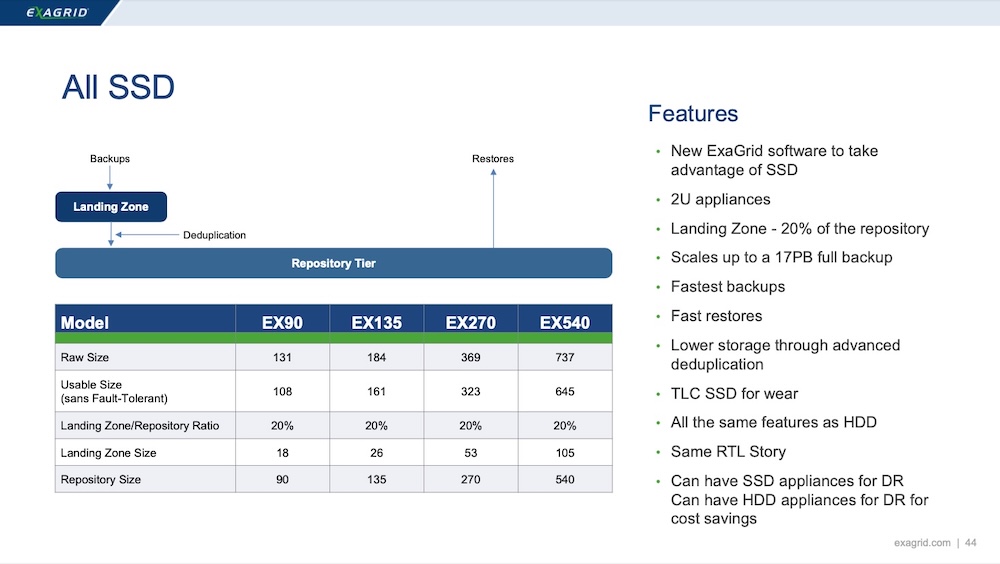
The Tiered Backup Storage architecture pairs a disk-cache Landing Zone for fast ingest/restore with a non-network-facing Repository Tier for deduplicated long-term data. Scale-out reaches 32 appliances per system with a fixed backup window. HDD models (EX36–EX189) scale to 6PB full backups; new all-SSD models (EX90/135/270/540) reach 17.3PB at 115.2TB/hr ingest. ExaGrid competes against primary storage (Dell, HPE, NetApp, Hitachi Vantara, Huawei) and inline-dedupe appliances (Data Domain, StoreOnce, NetBackup), citing slow ingest, rehydration penalties and forklift upgrades. Win rates: 74% trailing 4Q, 83% post-PoC. 25+ backup-app integrations include Veeam (2:1–14:1 added dedupe, SOBR), Commvault (15:1, Spill & Fill), Rubrik, Cohesity, IBM, HYCU, Acronis and Oracle RMAN, plus nine certified NetBackup integrations.
Security combines a tiered air gap, AI-Powered Retention Time-Lock with Auto Detect & Guard, immutable objects, delayed-delete, drive-level encryption with external key management, RBAC, 2FA, SSH keys, IP whitelisting and a Security Officer role; DORA, GDPR and NIS 2 are covered, with Common Criteria and STIG targeted by end-2026. DR spans cross-site replication, 16-site hub-and-spoke at 50:1 WAN efficiency, tertiary hops and targets in DCs, colos, AWS or Azure. Support offers assigned L2 engineers, in-theater local-language coverage, customer-installable hardware (30 min–3 hr), 7-yr HDD/5-yr SSD useful-life guarantees and 3-yr price protection capping M&S at 4%/yr. The end-of-June release adds NFS-over-the-wire encryption, MSP share-quota tracking/billing and expanded Cohesity support, with more due in July.
IO River
IO River, founded in 2022 by CEO Edward Tsinovoi and CTO Michael Hakimi (former Akamai edge-compute leads), closed a $20M round in early 2026, bringing total funding to about $25M. Backers include S Capital (ex-Sequoia Israel), Venture Guides, New Era and Pags Group, with advisors Ronni Zehavi, Aryeh Mergi, Ash Kulkarni, Marty Kagan, Ofir Ehrlich and Pavel Gurvich. Its thesis: the single-provider CDN/edge model from the 1990s breaks under generative-AI traffic. Every major edge provider sees a global outage every 1–3 years and monthly local incidents, with 99.9% SLAs tolerating 6–10h/year uncompensated downtime; cited examples include Cloudflare (4h Feb 2026, 25h Dec 2025, 6h Nov 2025), AWS CloudFront (7h Feb 2026, 15h Oct 2025), Akamai (6h Feb 2025), Google Cloud (7h Jun 2024) and Microsoft Front Door (2h Jun 2023). A single 12h outage can cost customers over $10B.
Click to enlarge
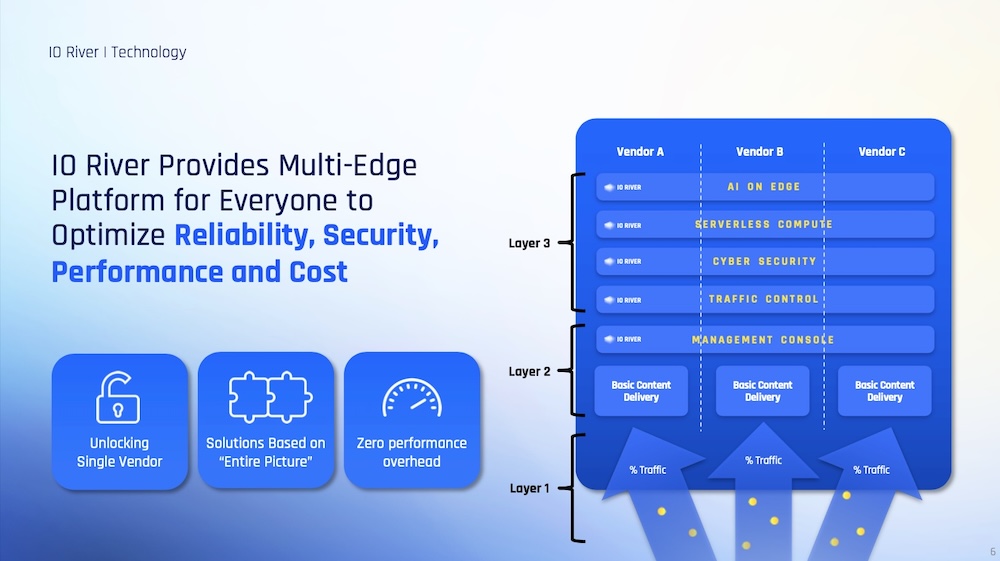
The “Virtual Edge” platform, not a CDN, GLB or multi-CDN switcher, decouples edge infrastructure from app services across three layers. Layer 1 is AI-driven traffic steering over 15+ providers (Akamai, Cloudflare, Fastly, CloudFront, Google CDN, Azure CDN…) via DNS/CNAME rather than inline interception, so traffic keeps flowing on last-known routing even if IO River fails. Layer 2 unifies configuration, management and monitoring, abstracting vendor languages such as Fastly VCL and Akamai EdgeWorkers. Layer 3 virtualizes WAF, bot management, API security and serverless edge code with partners including Check Point and Google. IO River says it detects and reroutes around Cloudflare or CloudFront outages before the providers do, while preserving negotiated discounts across vendors.
Traction stands at around 50 customers after one year of selling with zero attrition, initially OTT/media, publishers, gaming and edtech (Minute Media, Nexon, Plarium), now extending to e-commerce, travel/hospitality (Accor Hotels) and SaaS. Pricing combines a tiered platform fee, optional resold traffic and metered app-service usage (WAF, requests). GTM is direct in the US and partner-led in Europe (GNN in Germany, Equativ in France), with Fastly and other CDN vendors increasingly pulling IO River into deals. The team is split 50/50 between R&D in Tel Aviv and US GTM, with several US patents filed and a two-year cash runway. IO River positions itself as the operating platform of the multi-cloud, multi-edge AI era, an “easy button” giving non-giant online businesses the resiliency, performance and vendor independence previously reserved for PayPal-scale incumbents.
Juicedata
Joe Zhou, DevRel at Juicedata, framed object storage as the de facto backend of modern data infrastructure, citing diskless architectures built on S3 and equivalents, LanceDB, Snowflake, Chroma, Milvus, TiDB, Neon (acquired by Databricks), WarpStream, turbopuffer (used by Anthropic and Notion), RisingWave and JuiceFS itself. The appeal: simple primitives (PUT, GET, CAS), flat namespace, near-infinite scalability, 11 nines durability, multi-region availability, immutability and roughly $0.02/GB/month at scale. Limits: no in-place updates, no real hierarchy, costly batch metadata, higher latency, no execution and poor fit for structured data – driving a new generation of databases and file systems (POSIX in JuiceFS, Postgres in Neon) on top of immutable buckets.
Click to enlarge
Zhou positioned AWS S3 Files (April 2026) as “a decent approach” but limited. It mounts an S3 bucket as a POSIX-compatible NFS volume, using EFS as cache and metadata tier with a strict 1-to-1 file-to-object mapping and small-file default (sizeLessThan 128 KiB); writes land in EFS and offload to S3 after ~60s. Trade-offs include write amplification (appending bytes to a 2GB video triggers an S3 Append GET-merge-PUT), costly metadata ops (mv on 1M keys rewrites every object), batching delays, S3-always-wins conflict resolution, no multi-cloud, and layered EFS/S3 pricing. On Zhou’s scorecard it delivers POSIX and hierarchy but fails on in-place updates, batch metadata, execution and structured data.
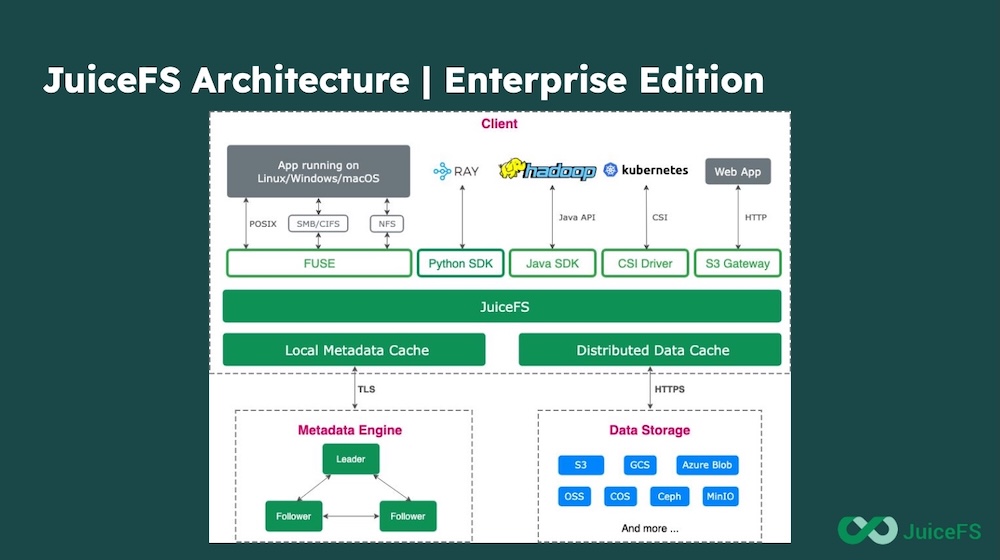
JuiceFS separates data and metadata and chunks files. The Apache 2.0 Community Edition pairs an external metadata engine (Redis, TiKV, MySQL, PostgreSQL, FoundationDB) with any mainstream object store (S3, GCS, Azure Blob, OSS, COS, Ceph, MinIO), exposed via FUSE, Java/Python SDKs, CSI Driver and an S3 Gateway.
Files are split into immutable 4MB blocks, so appends rewrite only the last block and renames are a single metadata op. CE now supports configurable per-directory/file tiering (Standard-IA, Intelligent-Tiering, Glacier IR). The Enterprise Edition adds a proprietary Raft-based horizontally scalable metadata engine with 3-copy redundancy, a distributed data cache shared across thousands of clients, native cross-region replication, multi-cloud mirroring (cache-only or full), and a soft limit raised from 100B to 500B files per volume, one EE deployment already runs at 1.47PiB and 404B inodes. MiniMax runs JuiceFS in hybrid-cloud mode with GPUs in its IDC and cache-only mirrors near compute, and is evaluating full mirrors. Other adopters include HeyGen, GMI, PixVerse, Momenta, Horizon Robotics, Xiaomi, Lovart, NAVER, Trip.com, fal, D-Robotics, Cerebrium, Fly.io and Jerry. EE pricing is by source-region capacity only, no per-client fees, no JuiceFS-imposed transfer charges, as traffic flows directly between client and object store.
Paradigm4
Paradigm4, introduced by Marilyn Matz, CEO and co-founder, and presented by CTO and flexFS inventor Gary Planthaber with business development lead Dave Clock, CRO Andy Cosgrove and technical sales partner David Freund, originated in life-sciences analytics and built flexFS after failing to find an affordable POSIX file system delivering tens to hundreds of GB/s in the cloud. Evaluated alternatives, JuiceFS, ObjectiveFS, S3FS, Goofys, S3 Backer, AWS EFS, FSx for Lustre, fell short on throughput or full POSIX, while Lustre, DDN, Weka and FSx priced out genomics-budget customers. flexFS, now at v1.9 with a free 5TB Community Edition against the user’s own S3 bucket, was productized and spun out for industries beyond life sciences. Thesis: most AI workloads speak POSIX while object storage offers the economics, and the gap taxes every workload through GPU idle time, slow pipelines and over-provisioned file systems.
Click to enlarge
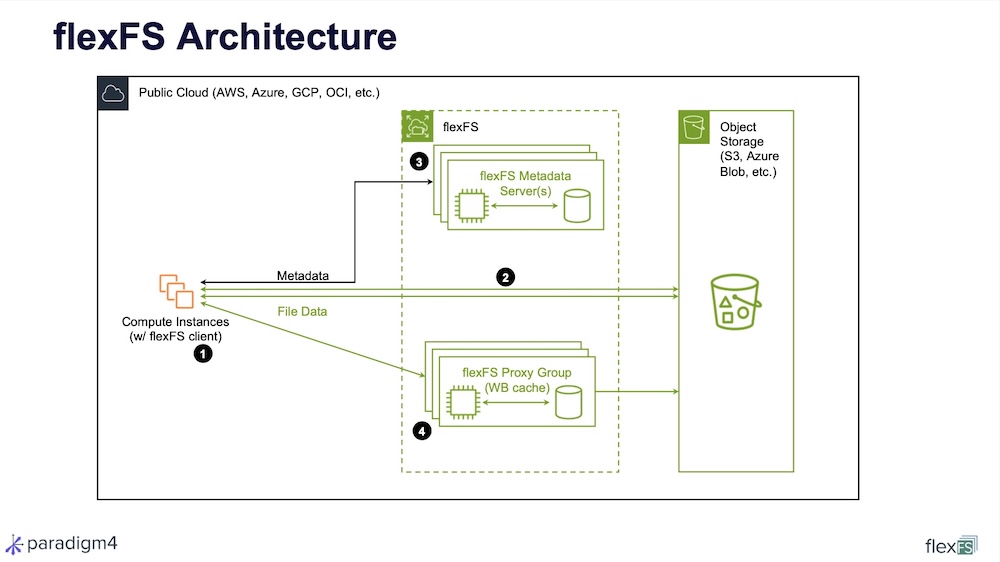
Architecturally, flexFS is an “object-native parallel filesystem”. Files are sharded into chunks with object IDs stored directly in S3, Azure Blob, GCS or OCI, while a persistent low-latency metadata server eliminates object-store metadata latency. An optional Proxy Group acts as a CDN-style write-back cache supporting fractional caching. Configurations span single-region, multi-region/multi-cloud, on-prem, hybrid and converged, with Oracle/Paradigm4 jointly showing near-local-NVMe performance on OCI. Features include hard-link deduplication with checksum and byte-for-byte validation, a metadata-driven optimized find, non-disruptive updates (sub-1s server pause, FUSE session handoff) and a Kubernetes CSI driver with Helm chart. The platform is ISO 27001 certified, delivers 11 nines durability and is positioned as a drop-in replacement for EFS, FSx for Lustre, OCI File Storage, GC Filestore and Azure Files.
Customers include J&J, Bristol Myers Squibb, Amgen, Alnylam, SiteTx and GeneDx. A top-5 pharma case (Sept 2022–Mar 2026, 43 months, 1.14PB, 160M+ files) reports flexFS+S3 spend of $2.53M vs a modelled AWS alternative (25% FSx Lustre Persistent_2 SSD, 40% EFS Standard, 10% EBS gp3, 25% S3 Standard) of $5.65M – $3.13M cumulative savings (55%), $1.44M 2025 savings (59%), Mar 2026 run-rate of $110K vs $274K, and ~$332K of Lustre over-provisioning eliminated. Effective rate fell from ~$90/TB-mo at 25TB in 2022 to $66/TB-mo at 1.14PB in 2026, vs flat $307 (EFS) and $174 (FSx). Newer workloads cover lakehouse acceleration (TPC-H SF100 with Spark+Gluten in 176s on cached flexFS vs 1,191s on S3, 6.8x), coupled-architecture DBMS modernization (up to 60% TCO cut, no code changes), AI/ML training and checkpointing (PyTorch, TensorFlow, JAX) and agentic AI workspaces with POSIX scratchpads, byte-range I/O on large PDFs and point-in-time recovery. Paradigm4 is sounding out press on formalizing a “File Lakehouse” category alongside Data Lakehouse and Coupled-Architecture DBMS.
Vinchin
Chengdu-based Vinchin Technology presented its data protection and DR platform via Sales Director Minnie Du and Overseas Technical Director Neil Zhuo. Founded in 2015 with a few hundred staff (~50% R&D), Vinchin claims to be China’s first backup vendor and the first to go global, with partners in 60+ countries, end clients in 100+, 30,000+ deployments and 6M+ protected workloads. References include USC, Cancer Research UK Manchester Institute, City of San Gabriel, Türk Telekom, BYMA, K.D. Feddersen, LEAG, E.Leclerc, PT. Bank Mandiri and a Belarusian telco. GTM is channel-first with MSP enablement via a multi-tenant platform; partners include Mediatek and Chiefs (Italy), CDI (France), Taurus (Spain) and AODIIE (Australia). Named “Strong Performer” in Gartner Peer Insights VoC two years running. Pricing is ~30% below Veeam and ~50% below Commvault per VM, in perpetual (per-CPU-socket) or subscription (per-VM) form, perpetual includes year-one support, then 20–40% annual maintenance. Editions: Standard (SMB) and Enterprise.
Click to enlarge
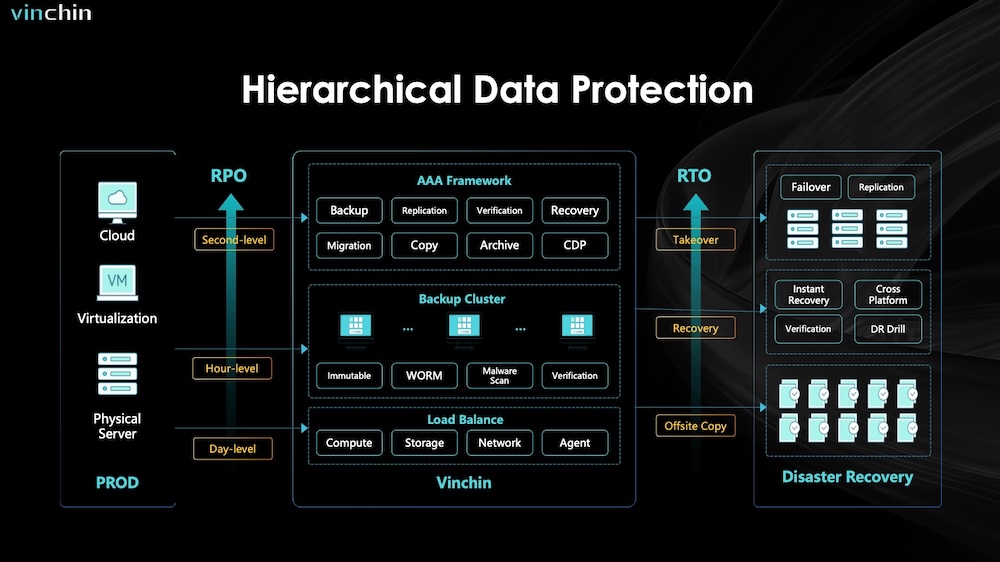
Vinchin Backup & Recovery has three components: Master Server (all-in-one management with RBAC, visualization, notifications), Slave Node (scalable compute) and Agent/Proxy (data transmission, VMware/OpenStack proxy), on X86, C86 or ARM. Compatibility is the headline strength: VMware, Hyper-V, Citrix, Proxmox, XCP-NG, OLVM, oVirt, OpenStack, plus the Chinese stack (Huawei FusionCompute, Sangfor, H3C, ZStack, Arcfra, Inspur); Windows, RHEL, SUSE, Ubuntu, Debian, CentOS, Rocky, Oracle Linux; Oracle, SQL Server, PostgreSQL, MySQL, MariaDB; files/NAS, Kubernetes, M365/Exchange; and any S3-compatible object store (AWS, Azure, Wasabi, Ceph, MinIO, Tencent, Huawei, Alibaba). GCP and OCI aren’t yet supported, Verge.io is under evaluation, and macOS clients are out of scope (Vinchin targets servers). Hierarchical Data Protection delivers second-level RPO via CDP, hour-level via standard backup and day-level via offsite copy, with instant recovery, cross-platform recovery, DR drill and takeover.
Vinchin extends 3-2-1 to 3-2-1-1-0-0, adding one immutable copy (WORM/object lock/offline), zero data errors via auto-verification and zero unauthorized access. A kernel-level I/O monitor restricts backup-storage writes to the Vinchin process, with WORM enforced across local disk, NAS, SAN, object storage with Object Lock, tape and third-party WORM appliances. Verification runs in an embedded KVM-based DR Lab (no third-party hypervisor), combining screenshot, heartbeat, ping and malware scan with optional third-party engines and identify/mark/isolate/clean workflows. Cases include a bank exiting VMware to protect 20,000+ VMs on Huawei FusionCompute; a 6,000-VM VMware-to-OLVM migration at 99.9% success with automatic VMDK→qcow2 conversion, virtIO driver replacement and boot repair; and a Belarusian telco protecting 2,000+ VMs across a hybrid VMware/ZStack estate over LAN-free 2x32G SAN.
Roadmap with Q4 2026: Nutanix AHV, VMware Storage Snapshot, synthetic full backup, Huawei OceanProtect WORM. Q2 2027: agentless real-time VMware replication, X2X migration, GoldenDB and AIX+Oracle, console enhancements, air-gap. Q4 2027: GaussDB, OceanBase, a standalone Migration Product, Alibaba/Azure cloud backup, and an AI assistant. Vinchin acknowledged European public-sector headwinds against Chinese software, addressed via OEM/white-label deals and emphasis on global references and ISO certifications, a candid commercial workaround.
Wave Domain
When StorageNewsletter first covered Wave Domain in July 2023, the New Jersey-based outfit had just signed with open-innovation firm yet2 to license its WORF (Write Once, Read Forever) permanent digital archiving technology. Three years on, the company emerged from deep stealth at IT Press Tour #68 in Boston, rebranding the platform Standing Wave Storage (SWS). Co-inventor and physicist Clark Johnson, 95, a veteran of 3M magnetic recording, the US digital HDTV transition and ARPA, was joined by spokesperson Bob Miller, who has spun off from yet2 to drive commercialization. The underlying physics is unchanged: a repurposing of Gabriel Lippmann’s 1891 Nobel-winning interferential color photography, which captures full-color images as standing-wave interference patterns frozen into a silver-halide emulsion, no dyes required. Whereas conventional media store one bit per location, SWS stacks multiple wavelengths at each pixel for multi-state encoding, four superimposed wavelengths demonstrated, up to 32 theoretically available, with combinatorial math suggesting an addressable state space orders of magnitude higher (the “deck-of-cards” 52-factorial example). The 2023 announcement claimed >80% savings on media and energy vs the best archival media today, and >90% lower archiving carbon footprint, as written plates need no power, migration or environmental controls.
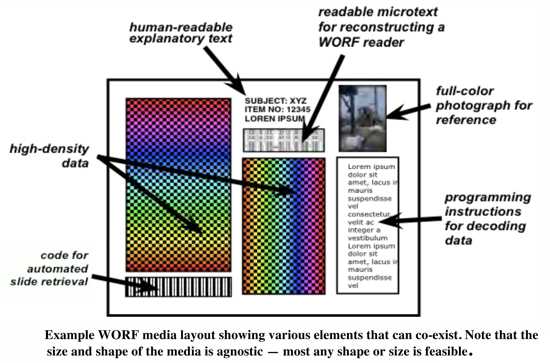
The Boston demo emphasized the engineering progress. The write head stacks off-the-shelf cell-phone components: monochromatic LEDs, a fiber-optic bundle forcing light perpendicular, an LCD shutter matrix opening over chosen locations, and the silver-halide media. Firmware drives the shutters; LEDs flash each wavelength only where intended. After chemical development, reading reverses the process: each color is re-flashed and a dimensionally matched CCD detects the absorbed wavelengths to reconstruct data, the media acts as a Rugate filter. Exposure times that took Lippmann hours are now under half a second; location size is down to two microns; a full plate reads in under one second in parallel. Forward error correction is built into the channel since media can’t be re-read for bad blocks. Validation includes NASA’s 8-month HELIOS mission on the ISS (splashdown Jan 2020, after microgravity and ionizing radiation exposure) and a MITRE government-backed test program confirming multi-wavelength superposition, fast exposure and color recovery. DARPA, NASA and other US agencies have invested several million dollars to date.
The business model is licensing, closer to ARM-style IP than a vertically integrated storage vendor. Seven US patents are issued, more pending. Two external optics specialists are competing to build the SS1 prototype, defined as four-color encoding on slide-sized plates of ~4–5 inches; Eric Rosenthal (CEO, ex-VP R&D Disney Imagineering and original co-inventor) is leading partner negotiations alongside newly recruited younger CTO Pedro, formerly Rosenthal’s student. The urgency is genuine: one of the three original inventors, Richard Solomon (co-founder/CTO quoted in 2023), died last year, and Johnson is 95. Wave Domain says ~$5M would deliver an early commercial system within three years, a fraction of Microsoft’s Silica glass spend. Talks with US national labs and government archival agencies have grown harder under the current funding climate, and the team is openly looking abroad, including Europe and Australia, for licensees and development partners willing to take SWS from laboratory curiosity to deployable permanent-archive product line.
此内容由惯性聚合(RSS阅读器)自动聚合整理,仅供阅读参考。 原文来自 — 版权归原作者所有。