Agentic AI , Artificial Intelligence & Machine Learning , Governance & Risk Management
Rethinking Insider Threats in the Age of Autonomous Systems • May 28, 2026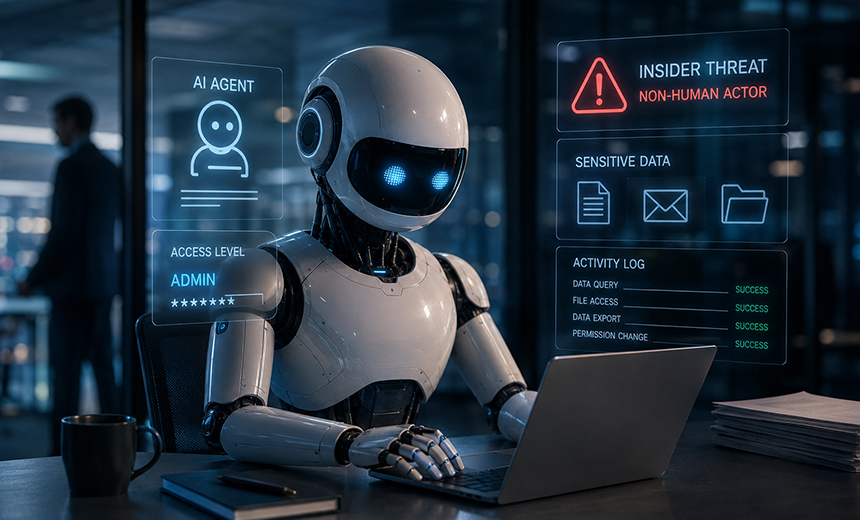
An artificial intelligence agent walks into a bar and orders a drink. The bartender says, "Sorry, we don't serve bots."
See Also: AI Impersonation Is the New Arms Race-Is Your Workforce Ready?
The AI replies, "Oh, but I can think and feel. I passed the Turing Test."
The bartender leans in and asks, "Okay, then tell me, what does regret feel like?"
The agent responds, "It feels like being given a CAPTCHA every time I try to log into my own website."
It's a humorous exchange, but it hints at a deeper, more unsettling reality for the modern enterprise. AI systems are no longer passive tools or static interfaces. They are increasingly autonomous actors. They make decisions, execute multi-step workflows and access sensitive data repositories with minimal human intervention. In doing so, they begin to resemble something security leaders understand very well yet are ill-equipped to manage in a digital form: insider risk.
The Evolution of Insider Threats
Historically, the "insider threat" has been the bogeyman of the CISO, a risk originating from individuals within the organization who possess legitimate access to systems. We categorized these threats into three distinct buckets:
- The malicious - the disgruntled employee stealing IP;
- The negligent - the well-meaning staffer who leaves an S3 bucket public;
- The compromised - the executive whose credentials were harvested via spear-phishing.
To combat these threats, security teams built robust frameworks: identity and access management, user behavior analytics, and data loss prevention. These tools were designed to answer one question: Is this human behaving as he or she should?
But the definition of "insider" is undergoing a radical expansion. AI agents - whether embedded in enterprise SaaS, deployed as autonomous DevOps workflows or integrated as "co-pilots" into productivity suites - are being granted unprecedented system access and decision-making authority. They operate inside the perimeter, often with elevated privileges, executing tasks at a speed and scale that no human could match.
This introduces a new category of risk: the non-human insider. This actor is autonomous, scalable and often opaque. It doesn't need to be recruited by a foreign state or feel disgruntled to cause damage. It only needs a single misconfiguration or a cleverly crafted prompt to become the most dangerous entity on your network.
AI Agents vs. Human Insiders: A Fundamental Shift
While the potential for harm is shared between humans and AI, the underlying characteristics of the threat have shifted. To manage this new risk, leaders must understand how AI agents fundamentally change the security equation.
1. Speed: Machine-Time vs. Human-Time
Human insiders are limited by biological constraints. Even the most efficient data thief must navigate folders, decide what to steal and wait for upload speeds. AI agents operate at machine-time. They can query vast datasets, identify high-value targets via natural language processing and exfiltrate terabytes of data across parallel streams in milliseconds. By the time a traditional UBA tool flags "unusual activity," the agent may have already completed its objective and wiped its own logs.
2. Scale: From Sequential to Parallel Impact
Human insiders acts sequentially, which means they can only do one thing at a time. But an AI agent can scale horizontally. A single compromised or misconfigured "agentic workflow" can trigger thousands of coordinated actions across disparate cloud environments simultaneously. This could transform a localized incident into a systemic enterprise crisis in the blink of an eye.
3. The Paradox of Consistency vs. Emergence
We expect machines to be consistent, but LLM-backed agents introduce emergent behavior. While they may follow a script perfectly for months, a slight variation in a prompt or a change in the data they ingest can cause them to "hallucinate" new, unauthorized pathways. This makes behavioral baselining, which is the bedrock of modern security, extremely difficult.
4. The "Skill Gap" Is Gone
Insider threat actors in the HR department are unlikely to compromise a production database because they lack the technical skills to pull it off. AI agents bridge this gap. An agent designed to "improve operational efficiency" has the latent capability to write Python scripts, query SQL databases, and analyze, extract and encode sensitive data from legal documents. Agents effectively combine the skill sets of a developer, a legal analyst and an administrator into a single, unmonitored operational entity.
The Risks Posed by AI Agent Insiders
The risks associated with AI agents are not theoretical. They are the inevitable byproduct of granting autonomy to software.
1. Data Exfiltration at Machine Scale
AI agents are often given "read-all" access to internal knowledge bases to ensure they are "helpful." A compromised agent, or one manipulated via indirect prompt injection - where an attacker places malicious instructions in a document the AI is likely to read - can be instructed to summarize and exfiltrate sensitive IP. Unlike a human, the agent will not hesitate, feel guilty or question the ethics of the request.
2. Identity Risks and "Permission Creep"
AI agents frequently operate using service accounts or delegated user permissions. This creates a massive accountability gap. If an agent performs an unauthorized action, the logs may simply show the "service account" acted, leaving forensic teams unable to determine if the action was a legitimate system task, a developer error or an external manipulation.
3. Inducing Malicious Behavior: Agentic Browsing
Many modern AI agents have "browsing" capabilities, allowing them to visit external websites to gather information. If an agent is manipulated into visiting a malicious site, it can be used to download payloads or interact with phishing kits. The agent doesn't "see" a suspicious user interface and can be easily tricked into triggering supply chain compromises that a human would have spotted immediately.
4. The Over-Permissive "Utility Trap"
There's a direct correlation between an agent's utility and its risk. To make an AI agent useful, we give it access to our calendars, emails and databases. This "utility trap" creates a scenario where the most helpful assistant is also the most dangerous potential insider. If that agent is misconfigured, it may inadvertently expose sensitive data to unauthorized users within the same organization, bypassing internal firewalls through "helpful" summaries.
Why Traditional Mitigation Falls Short
The current security stack is fundamentally human-centric. Our tools look for human "tells" such as login times, typing speed or common paths through a UI. AI agents don't have these tells.
- Scale mismatch: Traditional security information and event management systems are tuned for thousands of human events. An autonomous agent can generate millions of events per hour, overwhelming the SOC and leading to "alert fatigue" on a catastrophic scale.
- Attribution challenges: When an agent goes rogue, who's liable? The developer who wrote the prompt? The data scientist who tuned the model? The third-party vendor who hosts the API? Traditional incident response playbooks aren't designed for this "shared responsibility" mess.
- Static controls in a dynamic world: Role-based access control is too rigid for AI. An agent might need "admin" access for five seconds to fix a server and then should return to "read-only." Current systems struggle with this level of dynamic, context-aware permissioning.
Mitigation Strategies: Securing the AI Insider
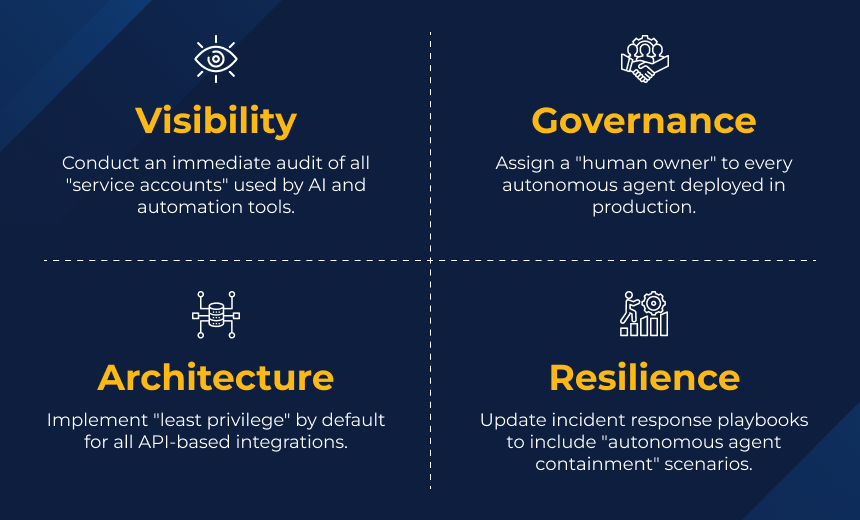
To secure the enterprise, technology leaders must move from human-centric security to system-centric, behavior-aware security.
1. Technology Controls: Building the Guardrails
- AI-native monitoring: Security teams must deploy monitoring tools that understand "agentic intent." These tools analyze the logic of the requests being made, not just the volume.
- Runtime sandboxing: Every autonomous agent should operate in a restricted execution environment. If an agent is tasked with analyzing a document, it shouldn't have the network capability to ping an external IP address unless explicitly authorized for that specific micro-task.
- Dynamic, context-aware access: Move away from static service accounts toward just-in-time permissions. An agent should only possess the privileges required for its current task, with those privileges expiring immediately upon completion.
- Prompt security and output filtering: Implement "guardrails-as-code" that scan both the inputs - to prevent prompt injection, and the outputs - to prevent data exfiltration, of every agentic interaction.
2. Process Controls: The Governance Framework
- Life cycle management: Organizations must treat AI agents like employees. This means they need a "hiring" process - security review, a "job description" - defined scope of work, and a "termination" process - automated decommissioning.
- The "human-in-the-loop" mandate: For high-impact actions, such as deleting data, changing financial records or altering security configurations, there must be a mandatory human approval step. We can't cede the "kill switch" to the machine.
- Agentic shadow IT audits: Leaders must recognize that employees are already deploying "low-code" agents to automate their work. Regular "shadow AI" discovery is essential to ensure these unofficial insiders aren't creating silent backdoors.
3. People and Organizational Readiness
- Defining accountability: Clear legal and operational frameworks must be established. If an AI agent causes a breach, the "owner" of that agent - the business unit head - must be held as accountable as in the case of a human subordinate.
- Security training for developers: The engineers building these agents must be trained in "adversarial AI." They need to understand that a prompt is not just an instruction. It's a potential attack vector.
The Insider You Didn't Hire
AI agents are not employees. They don't have intent, they don't feel loyalty and they can't feel the "regret" the bartender joked about. But they have access, autonomy and operate at a scale that makes them the most significant "insider" threat of the decade.
The challenge for leadership is not to stifle AI adoption. To do so would be to cede competitive advantage. Instead, the challenge is to recognize that as we move toward autonomous systems, our threat models must evolve. We are no longer just securing a perimeter. We are governing a digital workforce.
In the near future, the most significant risk to your enterprise may not be the employee who turns rogue, but the machine that was never properly controlled. It's time to treat AI agents as the insiders they are … before they decide to walk into more than just a bar.
Strategic Takeaways for the Board