
惯性聚合 高效追踪和阅读你感兴趣的博客、新闻、科技资讯
阅读原文 在惯性聚合中打开

推荐订阅源

Stack Overflow Blog
Stack Overflow Blog
WordPress大学
WordPress大学
罗磊的独立博客
S
Secure Thoughts
Schneier on Security
博客园 - Franky
www.infosecurity-magazine.com
Exploit-DB.com RSS Feed
爱范儿
爱范儿
cs.CV updates on arXiv.org
Hacker News: Ask HN
Hacker News: Ask HN
PCI Perspectives
PCI Perspectives
Google DeepMind News
S
Security Affairs
SecWiki News
SecWiki News
博客园 - 聂微东
Security Archives - TechRepublic
Google Online Security Blog
H
Heimdal Security Blog
S
Security @ Cisco Blogs
Engineering at Meta
Engineering at Meta
C
CXSECURITY Database RSS Feed - CXSecurity.com
Cloudbric
Cloudbric
Threat Intelligence Blog | Flashpoint
V
Visual Studio Blog
P
Proofpoint News Feed
Project Zero
Project Zero
T
Threat Research - Cisco Blogs
Webroot Blog
Webroot Blog
Blog — PlanetScale
Blog — PlanetScale
K
KPMG report finds enterprise disconnect between AI and its ROI | CIO
W
WeLiveSecurity
Last Week in AI
Last Week in AI
月光博客
月光博客
Microsoft Azure Blog
M
MIT News - Artificial intelligence
有赞技术团队
有赞技术团队
S
Securelist
GbyAI
GbyAI
Application and Cybersecurity Blog
C
CERT Recently Published Vulnerability Notes
Recent Commits to openclaw:main
Cyberwarzone
Cyberwarzone
B
Blog RSS Feed
P
Palo Alto Networks Blog
H
Hacker News: Front Page
D
Docker
雷峰网
雷峰网
Latest news
Latest news
Microsoft Security Blog

DataBreachToday.com RSS Syndication

Ex-Threat Intel Exec Accuses IBM and AT&T of Hiding Hacks Bipartisan AI Bill Targets Frontier Labs and State Regulators Passengers Seek Full Appeals Court Review in CrowdStrike Case What Trump's AI Executive Order Means for Healthcare Sector Data breach detection, prevention and notification Data breach detection, prevention and notification Data breach detection, prevention and notification Data breach detection, prevention and notification What DORA, AI Oversight, and Cloud Dependency Mean for Business and Risk Leaders AI Generated Code Is Expanding the Attack Surface Live Webinar | Defending the Modern Attack Path: How Integrated Security Stops Multi-Vector Threats Why Hospitals Must Rethink Cyber Resilience Live Webinar | Defending the Modern Attack Path: How Integrated Security Stops Multi-Vector Threats The Privacy Risks of Embedded, Shadow AI in Healthcare Why Anthropic Submits Pre-IPO SEC Filing, Leads Market Cap Fight The End of Static Security: Why AI Demands Real-Time Microsegmentation AI Agents Are the New Insiders Demystifying Claude: Signal vs. Speculation Integrity or Innovation? Mixed Signals in Trump's Exec Orders AI Is Reshaping Cybersecurity Training Priorities Claude Mythos 5 Can Build Exploits But Can't Power Campaigns Health Cyberthreat Sharing Is Advancing But Gaps Persist Are Small Models Closing the Gap on Frontier AI Cyber Tools? Securing AI in Financial Services with Zero Trust Beyond the Inbox: Defending Against AI-Enabled Social Engineering Webinar | 6 Layers Standing Between Your Enterprise and AI Risk Webinar | 6 Layers Standing Between Your Enterprise and AI Risk How AI Governance Protects Patient Care and Sensitive Data Election Systems Are Now a Persistent Cyber Target Cryptohack Roundup: Sentencing in $97M Laundering Case Breach Roundup: CISA Says Agencies Should 'Patch Smarter' Joint Commission Certification Targets Healthcare AI Risks DOJ, FBI Seize 13 Domains in Chinese Recruitment Op Vietnamese Digital Spies Look for Domestic Targets A Security Gets $37M to Thwart Weaponized AI With Automation German Court: Google Liable for AI Summaries Google Sues Chinese Phishing Service Over Gemini Abuse Policy as Code: From Documents to Machine Intelligence Anthropic Limits on OT Access to Mythos Draw Criticism ISMG Editors: Anthropic Unleashes Claude Mythos 5 Ozempic Drug Maker Loses Clinical Trial Data in Hack ISACA Survey: AI Adoption Is Rising, Visibility Is Not Webinar | Frontier AI and Identity Security in Financial Services US Pulls the Plug on Anthropic's Top AI Models US Anthropic Export Controls Sparks Sharp EU Reaction 1Password Buys Apono to Expand AI Access Governance NewCore Launches With $66M to Rebuild Identity for AI Agents GovSec Summit USA 2026: Cyber Resilience Amid Fiscal Reality Labcorp Agrees to Pay $35M to Settle AMCA Data Breach Mythos Shutdown Contains a Message: Don ShinyHunters Hits Universities Via Oracle Zero-Day How FDA US FCC Eases Router Ban for Cable ISPs Chinese Hacking Firm Upgrades With New Windows Backdoor South Korea Fines Coupang $409M Over Massive Data Breach Cyber Resilience Summit Dallas Prioritizes Risk Management Hacker: Live Webinar | Behind Dell’s AI Infrastructure Performance Rokarolla Android Banking Trojan Enables Device Takeover Ent Raises $100M to Reinvent Endpoint Security for AI Era The AI Accountability Gap CIOs Can Chinese Espionage Actor Abuses Email Rules to Steal Research Data AWS Unveils Continuum to Fight Vulnerability Backlog Quantum-Safe Cryptography Isn SpaceX Bets Big on AI Coding With $60B Cursor Deal Heart Monitoring Firm Tells SEC Hackers Stole Sensitive Data Mastra AI Framework Poisoned in npm Supply-Chain Attack Cyberspace Locked in a Nation-State Contest, Says NCSC CEO Webinar | The Future of SASE: Top 5 Predictions and Trends The Gentlemen Ransomware Gang Standardizes EDR Killing CISA Urges OT Resilience in Dark Remarks About Cyberattacks Attackers Steal Salesforce Data From Klue Battlecards Users Crime Gang Sells Access to 74,000 Fortinet Firewall Devices JPMorgan Pulls Anthropic Claude Access in Hong Kong Webinar | From SBOM to Submission: Operationalizing CRA Vulnerability Handling 6 Ways to Contain Enterprise Risk in Model Context Protocol Breach Roundup: ShinyHunters Leaks 26M MSG Records AI Inherits People Accenture Buys Majority Stake in Dragos in $4.2B Deal Multimillion-Dollar Settlement Reached in MCNA Dental Hack Addressing Quantum Readiness in Healthcare Security Experts Warn of Klue Confirms OAuth Token Theft Led to Salesforce Data Heist Cybercrime Initial Access Service SocGholish Disrupted From Reflection to Shadow: AI, Us and the Space in Between France and Germany Boost Digital Sovereignty Push ISMG Editors: Cyber Backlash Over the US Ban on Anthropic AI North Korean IT Workers Try, Try, Try Again HIPAA Europe Seeks to Advance 6G Security, Privacy No Zero-Day Tied to 80,000 Harvested Fortinet Credentials Sakana AI Bets on Agent Orchestration Over Frontier Models OpenAI Lets Cyber Vendors Embed GPT-5.5 in Defenses Is It Time to Put Some Teeth in Post-Quantum Guidelines? New AI Model Aims to Transform Behavioral Health AryStinger Botnet Converts Legacy Routers to Global Proxies Trump Executive Order Accelerates Post-Quantum Security Push North Korean Hackers Poison Mastra AI Framework Live Webinar | Proactive Cyber Defense: Identifying Risk Before It Becomes an Incident
Restore Fable and Mythos Access, Cybersecurity Leaders Urge
Mathew J. Schwartz · 2026-06-17 · via DataBreachToday.com RSS Syndication

Artificial Intelligence & Machine Learning , Next-Generation Technologies & Secure Development , Regulation

Experts Say White House Export Ban Risks Adoption Boost for China's AI Alternatives (euroinfosec) • June 16, 2026    
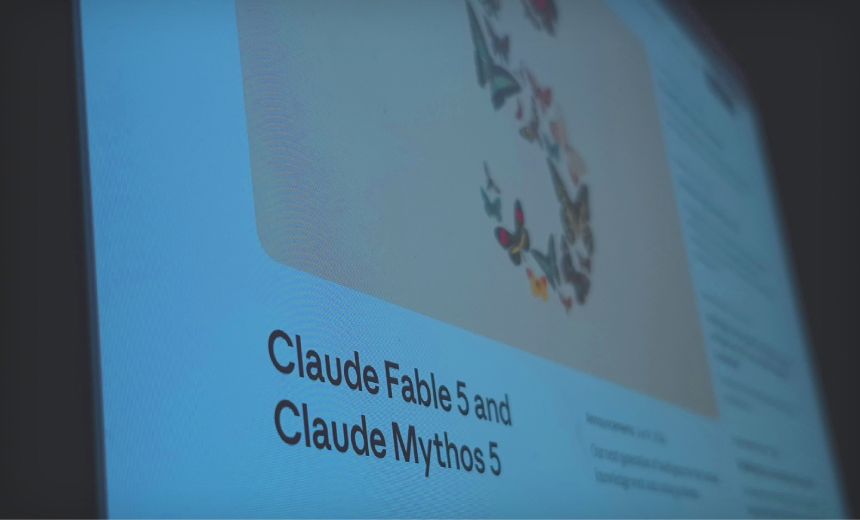
Restore Fable and Mythos Access, Cybersecurity Leaders Urge
Image: Shutterstock

Cybersecurity experts are urging White House officials to lift export controls imposed on artificial intelligence firm Anthropic's Fable 5 and Mythos large language models.

See Also: How AI Increases the Risk of Enterprise Data Exposure

More than 150 cybersecurity experts and executives, including the CEOs of Adobe, Sophos and Zoom, on Sunday signed an open-letter calling on the Trump administration to lift its export controls on dual-use technologies imposed late Friday by U.S. Commerce Secretary Howard Lutnick (see: US Pulls the Plug on Anthropic's Top AI Models).

Signatories said the controls appeared to be triggered by research that used the models to find insecure code. But such capabilities "can be replicated on GPT-5.5, Opus, Sonnet and even Chinese models like Kimi 2.7," they wrote.

Anthropic on Friday blocked access worldwide to Mythos 5. The San Francisco-based firm also yanked access to Fable 5, a version of Mythos it publicly released on June 9 with guardrails designed to protect against illicit use.

While Mythos has additional capabilities, "Chinese open-weight models are only months behind the best American models, and those are the models we know about," which leaves organizations in America and allied nations at a disadvantage," letter signatories said. "To pull the best capabilities away from defenders without a good reason when our adversaries are rapidly advancing is dangerous."

Veteran bug hunter Katie Moussouris, founder and CEO of Luta Security, reviewed at Anthropic's request the third-party research paper that apparently triggered the ban, and said it detailed how prompts can be used to bypass Fable 5 guardrails in pursuit of code fixes.

"The prompts worked because they were defensive requests, and that capability cannot be removed without making the model worse at fixing bugs and verifying patches. The same holds for every capable AI model, including the foreign and open-weight systems the United States cannot reach with export controls, many of which will match Fable and Mythos capabilities within months," she said.

Anthropic and the Trump administration have continued to tussle publicly and in courtrooms, after the startup refused to give the U.S. military unrestricted access to its latest frontier models (see: DoD Says No to Anthropic Request for Reversing Blacklisting).

Anthropic representatives have reportedly been in close contact with Washington officials, seeking a solution to the export controls. Anthropic CEO Dario Amodei is attending this week's G7 summit in Èvian-les-Bains, France, alongside U.S. President Donald Trump.

Expect the White House to soon "clarify" the "unsustainable" export restrictions, since "Anthropic can't work like this and if they and their peer companies lose, China wins," and "America will not stand for that," said Ciaran Martin, the founding CEO of Britain's National Cyber Security Centre, who's now a professor of practice at Oxford University's Blavatnik School of Government.

What longer-term diplomatic fallout the export ban will have remains to be seen, since the White House appears "to have tried to weaponize its AI power against its allies as well as its foes," by failing to differentiate between the likes of Britain and Japan on the one hand, and China and Russia on the other, Martin said. "That matters."

The incident is also being closely watched by the many businesses outside the United States that are weighing how they adopt AI models, and attempting to balance features and control against geopolitical and other availability risks.

AI Sovereignty Concerns

"The irony is that an export-control action meant to protect U.S. AI advantage may accelerate global migration away from U.S. AI," said cybersecurity expert Mikko Hypponen, chief research officer at Finnish anti-drone company Sensofusion, in a post to LinkedIn.

"This move will push developers outside the U.S. toward Chinese models. Not because they prefer China, but because they want sovereignty. And they're not too worried about China, because the models are open source: you can audit them as closely as you want and run them offline," he said.

The risk that an organization's access to AI models might be disrupted is clearly not hypothetical. "The action illustrates the risks for nations and organizations of relying on foreign sovereign AI in an increasingly fragmented geopolitical landscape," said Nicola Cain, CEO and principal consultant at London-based Handley Gill.

At a governmental level, she said that for non-U.S. governments and organizations, the White House's export ban "reinforces the need for measures like the EU's tech sovereignty package and the U.K.'s Sovereign Venture Fund," both of which are designed to promote trusted and domestic AI options, not least on national security grounds (see: US Anthropic Export Controls Sparks Sharp EU Reaction).

For individual organizations, the ability of a foreign government to restrict access to its domestically produced LLMs further demonstrates the need "for reliance on interoperable models with established off-boarding procedures," together with an AI sovereignty program designed to balance access to AI features, functionality and cost with business resilience concerns, Cain said (see: Managing Risk and Resilience: The AI Sovereignty Imperative).

Marketing, LLMs and Mythos

While Mythos has been lauded for having an unprecedented ability to build effective exploit chains, sometimes from low-severity flaws, as the open-letter notes, many LLMs have a proven ability to spot all manner of fresh bugs in widely-used code bases, sometimes also more quickly and at less cost. "You don't need Mythos to find vulnerabilities," said Jaya Baloo, COO and CSO of startup Aisle, which uses AI to autonomously identify and remediate software vulnerabilities (see: Mythos Shutdown Contains a Message: Don't Wait for Mythos).

Marketing hubris by Anthropic, which on June 1 submitted a confidential initial public offering proposal to the U.S. Securities and Exchange Commission, may now be partly to blame for the situation in which the startup now finds itself.

"If you spend a bunch of time telling people how dangerous your technology is, don't be surprised when some of them agree with you," said Jacob Williams, a former member of the U.S. National Security Agency's hacking team.