
惯性聚合 高效追踪和阅读你感兴趣的博客、新闻、科技资讯
阅读原文 在惯性聚合中打开

推荐订阅源

aimingoo的专栏
aimingoo的专栏
V
V2EX
G
Google Developers Blog
F
Full Disclosure
Martin Fowler
Martin Fowler
宝玉的分享
宝玉的分享
H
Hacker News: Front Page
Exploit-DB.com RSS Feed
NISL@THU
NISL@THU
G
GRAHAM CLULEY
V
Vulnerabilities – Threatpost
Hacker News - Newest:
Hacker News - Newest: "LLM"
A
About on SuperTechFans
The Cloudflare Blog
C
Cisco Blogs
D
DataBreaches.Net
Threat Intelligence Blog | Flashpoint
Vercel News
Vercel News
P
Privacy International News Feed
Microsoft Security Blog
Help Net Security
Help Net Security
Recorded Future
Recorded Future
PCI Perspectives
PCI Perspectives
S
Schneier on Security
AI
AI
N
News | PayPal Newsroom
雷峰网
雷峰网
C
Cyber Attacks, Cyber Crime and Cyber Security
P
Proofpoint News Feed
The Last Watchdog
The Last Watchdog
L
LINUX DO - 最新话题
Hugging Face - Blog
Hugging Face - Blog
Apple Machine Learning Research
Schneier on Security
S
Securelist
云风的 BLOG
云风的 BLOG
Stack Overflow Blog
Stack Overflow Blog
博客园_首页
AWS News Blog
AWS News Blog
TaoSecurity Blog
TaoSecurity Blog
OSCHINA 社区最新新闻
OSCHINA 社区最新新闻
Recent Commits to openclaw:main
博客园 - 三生石上(FineUI控件)
C
CXSECURITY Database RSS Feed - CXSecurity.com
K
KPMG report finds enterprise disconnect between AI and its ROI | CIO
Cloudbric
Cloudbric
C
Cybersecurity and Infrastructure Security Agency CISA
Project Zero
Project Zero
C
Check Point Blog
S
Security Affairs

Hugging Face - Blog

Waypoint-1.5: Higher-Fidelity Interactive Worlds for Everyday GPUs ALTK‑Evolve: On‑the‑Job Learning for AI Agents Safetensors is Joining the PyTorch Foundation Holo3: Breaking the Computer Use Frontier Any Custom Frontend with Gradio's Backend A New Framework for Evaluating Voice Agents (EVA) Bringing Robotics AI to Embedded Platforms: Dataset Recording, VLA Fine‑Tuning, and On‑Device Optimizations One-Shot Any Web App with Gradio's gr.HTML CUGA on Hugging Face: Democratizing Configurable AI Agents New in llama.cpp: Model Management Building Deep Research: How we Achieved State of the Art OVHcloud on Hugging Face Inference Providers 🔥 20x Faster TRL Fine-tuning with RapidFire AI Building for an Open Future - our new partnership with Google Cloud Aligning to What? Rethinking Agent Generalization in MiniMax M2 Building a Healthcare Robot from Simulation to Deployment with NVIDIA Isaac Sentence Transformers is joining Hugging Face! Unlock the power of images with AI Sheets Supercharge your OCR Pipelines with Open Models Google Cloud C4 Brings a 70% TCO improvement on GPT OSS with Intel and Hugging Face Get your VLM running in 3 simple steps on Intel CPUs Nemotron-Personas-India: Synthesized Data for Sovereign AI Introducing RTEB: A New Standard for Retrieval Evaluation Accelerating Qwen3-8B Agent on Intel® Core™ Ultra with Depth-Pruned Draft Models VibeGame: Exploring Vibe Coding Games Nemotron-Personas-Japan: ソブリン AI のための合成データセット Swift Transformers Reaches 1.0 – and Looks to the Future Smol2Operator: Post-Training GUI Agents for Computer Use SyGra: The One-Stop Framework for Building Data for LLMs and SLMs Gaia2 and ARE: Empowering the community to study agents Scaleway on Hugging Face Inference Providers 🔥 Democratizing AI Safety with RiskRubric.ai Public AI on Hugging Face Inference Providers 🔥 `LeRobotDataset:v3.0`: Bringing large-scale datasets to `lerobot` Visible Watermarking with Gradio Introducing the Palmyra-mini family: Powerful, lightweight, and ready to reason! Tricks from OpenAI gpt-oss YOU 🫵 can use with transformers Fine-tune Any LLM from the Hugging Face Hub with Together AI Jupyter Agents: training LLMs to reason with notebooks mmBERT: ModernBERT goes Multilingual Welcome EmbeddingGemma, Google's new efficient embedding model SAIR: Accelerating Pharma R&D with AI-Powered Structural Intelligence Make your ZeroGPU Spaces go brrr with ahead-of-time compilation NVIDIA Releases 6 Million Multi-Lingual Reasoning Dataset Generate Images with Claude and Hugging Face From Zero to GPU: A Guide to Building and Scaling Production-Ready CUDA Kernels MCP for Research: How to Connect AI to Research Tools Kimina-Prover-RL Arm & ExecuTorch 0.7: Bringing Generative AI to the masses Neural Super Sampling is here! TextQuests: How Good are LLMs at Text-Based Video Games? 🇵🇭 FilBench - Can LLMs Understand and Generate Filipino? Introducing AI Sheets: a tool to work with datasets using open AI models! Accelerate ND-Parallel: A guide to Efficient Multi-GPU Training Vision Language Model Alignment in TRL ⚡️ Welcome GPT OSS, the new open-source model family from OpenAI! Measuring Open-Source Llama Nemotron Models on DeepResearch Bench 📚 3LM: A Benchmark for Arabic LLMs in STEM and Code Implementing MCP Servers in Python: An AI Shopping Assistant with Gradio Introducing Trackio: A Lightweight Experiment Tracking Library from Hugging Face Say hello to `hf`: a faster, friendlier Hugging Face CLI ✨ Parquet Content-Defined Chunking TimeScope: How Long Can Your Video Large Multimodal Model Go? Fast LoRA inference for Flux with Diffusers and PEFT Accelerate a World of LLMs on Hugging Face with NVIDIA NIM Arc Virtual Cell Challenge: A Primer Consilium: When Multiple LLMs Collaborate Back to The Future: Evaluating AI Agents on Predicting Future Events Five Big Improvements to Gradio MCP Servers Ettin Suite: SoTA Paired Encoders and Decoders Migrating the Hub from Git LFS to Xet Kimina-Prover: Applying Test-time RL Search on Large Formal Reasoning Models Asynchronous Robot Inference: Decoupling Action Prediction and Execution ScreenEnv: Deploy your full stack Desktop Agent Building the Hugging Face MCP Server Reachy Mini - The Open-Source Robot for Today's and Tomorrow's AI Builders Creating custom kernels for the AMD MI300 Upskill your LLMs With Gradio MCP Servers SmolLM3: smol, multilingual, long-context reasoner Three Mighty Alerts Supporting Hugging Face’s Production Infrastructure Efficient MultiModal Data Pipeline Announcing NeurIPS 2025 E2LM Competition: Early Training Evaluation of Language Models Training and Finetuning Sparse Embedding Models with Sentence Transformers Welcome the NVIDIA Llama Nemotron Nano VLM to Hugging Face Hub Gemma 3n fully available in the open-source ecosystem! Transformers backend integration in SGLang (LoRA) Fine-Tuning FLUX.1-dev on Consumer Hardware Groq on Hugging Face Inference Providers 🔥 How Long Prompts Block Other Requests - Optimizing LLM Performance Learn the Hugging Face Kernel Hub in 5 Minutes Convert Transformers to ONNX with Hugging Face Optimum Intel and Hugging Face Partner to Democratize Machine Learning Hardware Acceleration Director of Machine Learning Insights [Part 3: Finance Edition] The Annotated Diffusion Model Deep Q-Learning with Space Invaders Graphcore and Hugging Face Launch New Lineup of IPU-Ready Transformers Introducing Pull Requests and Discussions 🥳 Efficient Table Pre-training without Real Data: An Introduction to TAPEX An Introduction to Q-Learning Part 2/2 How Sempre Health is leveraging the Expert Acceleration Program to accelerate their ML roadmap
Open LLM Leaderboard: DROP deep dive
Clémentine Fourrier, Alex Cabrera, Stella Biderman, Nathan Habib · 2023-12-01 · via Hugging Face - Blog

Back to Articles

This article is also available in Chinese 简体中文.

Recently, three new benchmarks were added to the Open LLM Leaderboard: Winogrande, GSM8k and DROP, using the original implementations reproduced in the EleutherAI Harness. A cursory look at the scores for DROP revealed something strange was going on, with the overwhelming majority of models scoring less than 10 out of 100 on their f1-score! We did a deep dive to understand what was going on, come with us to see what we found out!

Initial observations

DROP (Discrete Reasoning Over Paragraphs) is an evaluation where models must extract relevant information from English-text paragraphs before executing discrete reasoning steps on them (for example, sorting or counting items to arrive at the correct answer, see the table below for examples). The metrics used are custom f1 and exact match scores.
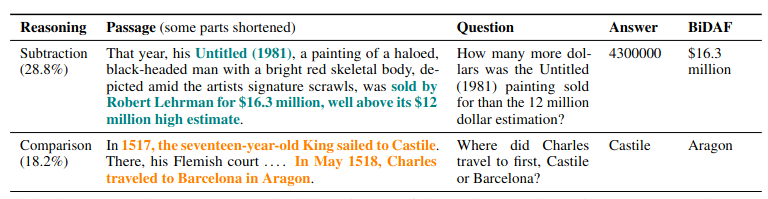
Examples of reasoning and paragraph from the original article.

We added it to the Open LLM Leaderboard three weeks ago, and observed that the f1-scores of pretrained models followed an unexpected trend: when we plotted DROP scores against the leaderboard original average (of ARC, HellaSwag, TruthfulQA and MMLU), which is a reasonable proxy for overall model performance, we expected DROP scores to be correlated with it (with better models having better performance). However, this was only the case for a small number of models, and all the others had a very low DROP f1-score, below 10.
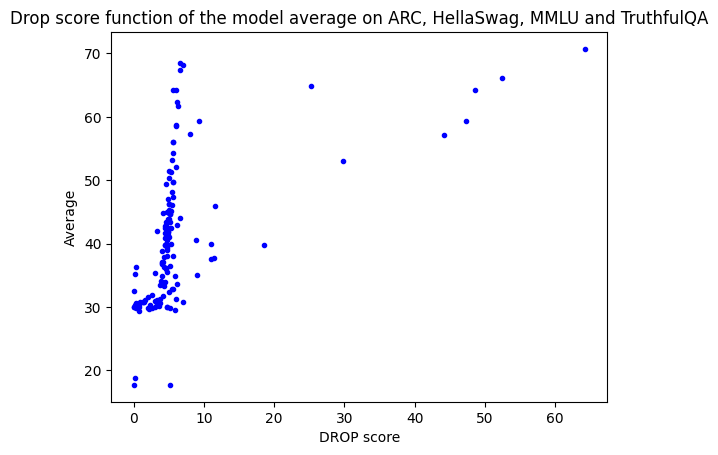
Two trends can be observed in the DROP scores: some follow the average (in diagonal), others are stuck around 5 (vertical line on the right of the graph).

Normalization interrogations

During our first deeper dive in these surprising behavior, we observed that the normalization step was possibly not working as intended: in some cases, this normalization ignored the correct numerical answers when they were directly followed by a whitespace character other than a space (a line return, for example). Let's look at an example, with the generation being 10\n\nPassage: The 2011 census recorded a population of 1,001,360, and the gold answer being 10.

Normalization happens in several steps, both for generation and gold:

  1. Split on separators |, -, or The beginning sequence of the generation 10\n\nPassage: contain no such separator, and is therefore considered a single entity after this step.
  2. Punctuation removal The first token then becomes 10\n\nPassage (: is removed)
  3. Homogenization of numbers Every string that can be cast to float is considered a number and cast to float, then re-converted to string. 10\n\nPassage stays the same, as it cannot be cast to float, whereas the gold 10 becomes 10.0.
  4. Other steps A lot of other normalization steps ensue (removing articles, removing other whitespaces, etc.) and our original example becomes 10 passage 2011.0 census recorded population of 1001360.0.

However, the overall score is not computed on the string, but on the bag of words (BOW) extracted from the string, here {'recorded', 'population', 'passage', 'census', '2011.0', '1001360.0', '10'}, which is compared with the BOW of the gold, also normalized in the above manner, {10.0}. As you can see, they don’t intersect, even though the model predicted the correct output!

In summary, if a number is followed by any kind of whitespace other than a simple space, it will not pass through the number normalization, hence never match the gold if it is also a number! This first issue was likely to mess up the scores quite a bit, but clearly it was not the only factor causing DROP scores to be so low. We decided to investigate a bit more.

Diving into the results

Extending our investigations, our friends at Zeno joined us and undertook a much more thorough exploration of the results, looking at 5 models which were representative of the problems we noticed in DROP scores: falcon-180B and mistral-7B were underperforming compared to what we were expecting, Yi-34B and tigerbot-70B had a very good performance on DROP correlated with their average scores, and facebook/xglm-7.5B fell in the middle.

You can give analyzing the results a try in the Zeno project here if you want to!

The Zeno team found two even more concerning features:

  1. Not a single model got a correct result on floating point answers
  2. High quality models which generate long answers actually have a lower f1-score

At this point, we believed that both failure cases were actually caused by the same root factor: using . as a stopword token (to end the generations):

  1. Floating point answers are systematically interrupted before their generation is complete
  2. Higher quality models, which try to match the few-shot prompt format, will generate Answer\n\nPlausible prompt for the next question., and only stop during the plausible prompt continuation after the actual answer on the first ., therefore generating too many words and getting a bad f1 score.

We hypothesized that both these problems could be fixed by using \n instead of . as an end of generation stop word.

Changing the end of generation token

So we gave it a try! We investigated using \n as the end of generation token on the available results. We split the generated answer on the first \n it contained, if one was present, and recomputed the scores. Note that this is only an approximation of the correct result, as it won't fix answers that were cut too early on . (for example floating point answers) - but it also won’t give unfair advantage to any model, as all of them were affected by this problem. However it’s the best we could do without rerunning models (as we wanted to keep the community posted as soon as possible).

The results we got were the following - splitting on \n correlates really well with other scores and therefore with overall performance.
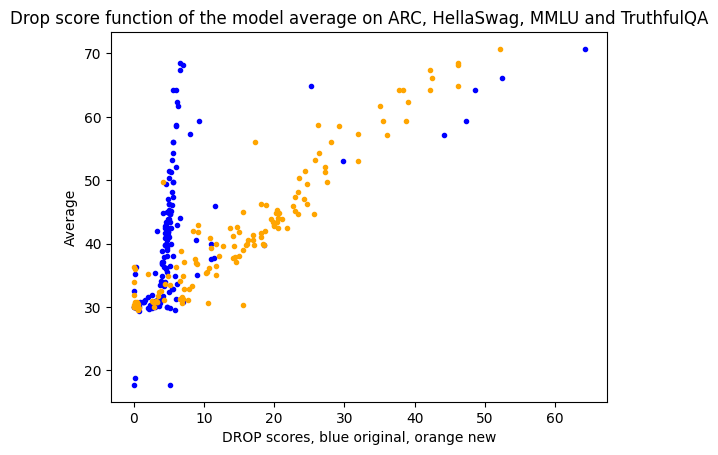
We can see in orange that the scores computed on the new strings correlate much better with the average performance.

So what's next?

A quick calculation shows that re-running the full evaluation of all models would be quite costly (the full update took 8 years of GPU time, and a lot of it was taken by DROP), we estimated how much it would cost to only re-run failing examples.

In 10% of the cases, the gold answer is a floating number (for example 12.25) and model predictions start with the correct beginning (for our example, 12) but are cut off on a . - these predictions likely would have actually been correct if the generation was to continue. We would definitely need to re-run them! Our estimation does not count generated sentences that finish with a number which was possibly interrupted (40% of the other generations), nor any prediction messed up by its normalization.

To get correct results, we would thus need to re-run more than 50% of the examples, a huge amount of GPU time! We need to be certain that the implementation we'll run is correct this time.

After discussing it with the fantastic EleutherAI team (both on GitHub and internally), who guided us through the code and helped our investigations, it became very clear that the LM Eval Harness implementation follows the "official DROP" code very strictly: a new version of this benchmark’s evaluation thus needs to be developed! We have therefore taken the decision to remove DROP from the Open LLM Leaderboard until a new version arises.

One take away of this investiguation is the value in having the many eyes of the community collaboratively investiguate a benchmark in order to detect errors that were previously missed. Here again the power of open-source, community and developping in the open-shines in that it allows to transparently investigate the root cause of an issue on a benchmark which has been out there for a couple of years.

We hope that interested members of the community will join forces with academics working on DROP evaluation to fix both its scoring and its normalization. We'd love it becomes usable again, as the dataset itself is really quite interesting and cool. We encourage you to provide feedback on how we should evaluate DROP on this issue.

Thanks to the many community members who pointed out issues on DROP scores, and many thanks to the EleutherAI Harness and Zeno teams for their great help on this issue.