

惯性聚合 高效追踪和阅读你感兴趣的博客、新闻、科技资讯
阅读原文 在惯性聚合中打开

推荐订阅源

cs.AI updates on arXiv.org
V
Visual Studio Blog
The GitHub Blog
The GitHub Blog
Apple Machine Learning Research
J
Java Code Geeks
T
Tailwind CSS Blog
大猫的无限游戏
大猫的无限游戏
Jina AI
Jina AI
OSCHINA 社区最新新闻
OSCHINA 社区最新新闻
Hugging Face - Blog
Hugging Face - Blog
WordPress大学
WordPress大学
宝玉的分享
宝玉的分享
freeCodeCamp Programming Tutorials: Python, JavaScript, Git & More
罗磊的独立博客
人人都是产品经理
人人都是产品经理
H
Heimdal Security Blog
Last Week in AI
Last Week in AI
博客园 - 【当耐特】
Cyberwarzone
Cyberwarzone
Google DeepMind News
雷峰网
雷峰网
Hacker News: Ask HN
Hacker News: Ask HN
Webroot Blog
Webroot Blog
Microsoft Azure Blog
MyScale Blog
MyScale Blog
A
About on SuperTechFans
V2EX - 技术
V2EX - 技术
小众软件
小众软件
博客园 - Franky
博客园 - 司徒正美
P
Privacy International News Feed
爱范儿
爱范儿
U
Unit 42
博客园 - 叶小钗
The Hacker News
The Hacker News
C
Check Point Blog
奇客Solidot–传递最新科技情报
奇客Solidot–传递最新科技情报
Simon Willison's Weblog
N
News and Events Feed by Topic
D
Docker
T
Threatpost
MongoDB | Blog
MongoDB | Blog
让小产品的独立变现更简单 - ezindie.com
H
Help Net Security
L
LINUX DO - 最新话题
Security Latest
Security Latest
T
The Exploit Database - CXSecurity.com
S
SegmentFault 最新的问题
A
Arctic Wolf
Spread Privacy
Spread Privacy

Hugging Face - Blog

Waypoint-1.5: Higher-Fidelity Interactive Worlds for Everyday GPUs ALTK‑Evolve: On‑the‑Job Learning for AI Agents Safetensors is Joining the PyTorch Foundation Holo3: Breaking the Computer Use Frontier Any Custom Frontend with Gradio's Backend A New Framework for Evaluating Voice Agents (EVA) Bringing Robotics AI to Embedded Platforms: Dataset Recording, VLA Fine‑Tuning, and On‑Device Optimizations One-Shot Any Web App with Gradio's gr.HTML CUGA on Hugging Face: Democratizing Configurable AI Agents New in llama.cpp: Model Management Building Deep Research: How we Achieved State of the Art OVHcloud on Hugging Face Inference Providers 🔥 20x Faster TRL Fine-tuning with RapidFire AI Building for an Open Future - our new partnership with Google Cloud Aligning to What? Rethinking Agent Generalization in MiniMax M2 Building a Healthcare Robot from Simulation to Deployment with NVIDIA Isaac Sentence Transformers is joining Hugging Face! Unlock the power of images with AI Sheets Supercharge your OCR Pipelines with Open Models Google Cloud C4 Brings a 70% TCO improvement on GPT OSS with Intel and Hugging Face Get your VLM running in 3 simple steps on Intel CPUs Nemotron-Personas-India: Synthesized Data for Sovereign AI Introducing RTEB: A New Standard for Retrieval Evaluation Accelerating Qwen3-8B Agent on Intel® Core™ Ultra with Depth-Pruned Draft Models VibeGame: Exploring Vibe Coding Games Nemotron-Personas-Japan: ソブリン AI のための合成データセット Swift Transformers Reaches 1.0 – and Looks to the Future Smol2Operator: Post-Training GUI Agents for Computer Use SyGra: The One-Stop Framework for Building Data for LLMs and SLMs Gaia2 and ARE: Empowering the community to study agents Scaleway on Hugging Face Inference Providers 🔥 Democratizing AI Safety with RiskRubric.ai Public AI on Hugging Face Inference Providers 🔥 `LeRobotDataset:v3.0`: Bringing large-scale datasets to `lerobot` Visible Watermarking with Gradio Introducing the Palmyra-mini family: Powerful, lightweight, and ready to reason! Tricks from OpenAI gpt-oss YOU 🫵 can use with transformers Fine-tune Any LLM from the Hugging Face Hub with Together AI Jupyter Agents: training LLMs to reason with notebooks mmBERT: ModernBERT goes Multilingual Welcome EmbeddingGemma, Google's new efficient embedding model SAIR: Accelerating Pharma R&D with AI-Powered Structural Intelligence Make your ZeroGPU Spaces go brrr with ahead-of-time compilation NVIDIA Releases 6 Million Multi-Lingual Reasoning Dataset Generate Images with Claude and Hugging Face From Zero to GPU: A Guide to Building and Scaling Production-Ready CUDA Kernels MCP for Research: How to Connect AI to Research Tools Kimina-Prover-RL Arm & ExecuTorch 0.7: Bringing Generative AI to the masses Neural Super Sampling is here! TextQuests: How Good are LLMs at Text-Based Video Games? 🇵🇭 FilBench - Can LLMs Understand and Generate Filipino? Introducing AI Sheets: a tool to work with datasets using open AI models! Accelerate ND-Parallel: A guide to Efficient Multi-GPU Training Vision Language Model Alignment in TRL ⚡️ Welcome GPT OSS, the new open-source model family from OpenAI! Measuring Open-Source Llama Nemotron Models on DeepResearch Bench 📚 3LM: A Benchmark for Arabic LLMs in STEM and Code Implementing MCP Servers in Python: An AI Shopping Assistant with Gradio Introducing Trackio: A Lightweight Experiment Tracking Library from Hugging Face Say hello to `hf`: a faster, friendlier Hugging Face CLI ✨ Parquet Content-Defined Chunking TimeScope: How Long Can Your Video Large Multimodal Model Go? Fast LoRA inference for Flux with Diffusers and PEFT Accelerate a World of LLMs on Hugging Face with NVIDIA NIM Arc Virtual Cell Challenge: A Primer Consilium: When Multiple LLMs Collaborate Back to The Future: Evaluating AI Agents on Predicting Future Events Five Big Improvements to Gradio MCP Servers Ettin Suite: SoTA Paired Encoders and Decoders Migrating the Hub from Git LFS to Xet Kimina-Prover: Applying Test-time RL Search on Large Formal Reasoning Models Asynchronous Robot Inference: Decoupling Action Prediction and Execution ScreenEnv: Deploy your full stack Desktop Agent Building the Hugging Face MCP Server Reachy Mini - The Open-Source Robot for Today's and Tomorrow's AI Builders Creating custom kernels for the AMD MI300 Upskill your LLMs With Gradio MCP Servers SmolLM3: smol, multilingual, long-context reasoner Three Mighty Alerts Supporting Hugging Face’s Production Infrastructure Efficient MultiModal Data Pipeline Announcing NeurIPS 2025 E2LM Competition: Early Training Evaluation of Language Models Training and Finetuning Sparse Embedding Models with Sentence Transformers Welcome the NVIDIA Llama Nemotron Nano VLM to Hugging Face Hub Gemma 3n fully available in the open-source ecosystem! Transformers backend integration in SGLang (LoRA) Fine-Tuning FLUX.1-dev on Consumer Hardware Groq on Hugging Face Inference Providers 🔥 How Long Prompts Block Other Requests - Optimizing LLM Performance Learn the Hugging Face Kernel Hub in 5 Minutes Convert Transformers to ONNX with Hugging Face Optimum Intel and Hugging Face Partner to Democratize Machine Learning Hardware Acceleration Director of Machine Learning Insights [Part 3: Finance Edition] The Annotated Diffusion Model Deep Q-Learning with Space Invaders Graphcore and Hugging Face Launch New Lineup of IPU-Ready Transformers Introducing Pull Requests and Discussions 🥳 Efficient Table Pre-training without Real Data: An Introduction to TAPEX An Introduction to Q-Learning Part 2/2 How Sempre Health is leveraging the Expert Acceleration Program to accelerate their ML roadmap
“Llama 3.2 in Keras”
Martin Görner · 2024-10-21 · via Hugging Face - Blog

Back to Articles

Martin Görner's avatar

This is going to be the shortest blog post ever.

Question: Llama 3.2 landed two weeks ago on Hugging Face / Transformers. When will it be available in Keras?

Answer: It has been working from day 1 😀. There is nothing to wait for.

Yes, Keras Llama3 can be loaded from any standard (i.e. safetensors) Hugging Face checkpoint, including the 3.2 checkpoints. If a conversion is required, it happens on the fly. Try this:

!pip install keras_hub

from keras_hub import models.Llama3CausalLM
model = Llama3CausalLM.from_preset("hf://meta-llama/Llama-3.2-1B-Instruct", dtype="bfloat16")
model.generate("Hi there!")

Here is a Colab to try this out. Enjoy! 🤗


OK, OK, I'm being told that if I want to publish a blog post, I have to fill the space. Here are a couple of additional things to know about Keras.

Keras is multi-backend

Keras is the time-tested modeling library for JAX, PyTorch and TensorFlow. You might have noticed this line in the demo Colab:

import os
os.environ["KERAS_BACKEND"] = "jax" # or "torch", or "tensorflow"

It has to appear before import keras and controls if the model is running on JAX, PyTorch or TensorFlow. Very handy to try your favorite models on JAX with XLA compilation 🚀.

What is keras-hub?

Keras is a modeling library and keras-hub is its collection of pre-trained models. It was previously called KerasNLP and KerasCV. The rename is in progress. It has all the popular pre-trained models (Llama3, Gemma, StableDiffusion, Segment Anything, ...) with their canonical implementation in Keras.

LLMs in Keras come "batteries included"

I mean, "tokenizer included". model.generate() just works on strings:

model.generate("Hi there!")
> "Hi there! I'm looking for information on how to ...

Same thing for training. You can train on a set of strings directly:

model.fit(strings) # list or dataset of input strings

Chatting with an LLM

Instruction-tuned variants of popular LLMs can be used for turn-by-turn conversations. Here, Llama-3.2-1B-Instruct understands the following conversation tagging (see meta docs).

<|start_header_id|>system<|end_header_id|>You  are a helpful assistant<|eot_id|>\n
\n
<|start_header_id|>user<|end_header_id|>Hello_<|eot_id|>\n
\n
<|start_header_id|>assistant<|end_header_id|>\n
\n

The conversation, once formatted in this way, can be fed directly to model.generate().

For convenience, the demo Colab implements a helper class called ChatState that does the necessary string concats automatically.

Lower level access: Tokenizer, Backbone

If you don't like "batteries included" and want to get to the underlying tokenizer and model, they are easily accessible:

# tokenizer
model.preprocessor.tokenizer

# the model itself
model.backbone

# You can even load them separately from the same preset
backbone = keras_hub.models.Llama3CausalLM.from_preset("hf://meta-llama/Llama-3.2-1B-Instruct", dtype="float16")
tokenizer = keras_hub.models.Llama3Tokenizer.from_preset("hf://meta-llama/Llama-3.2-1B-Instruct")

Wait, Tokenizer, Preprocessor? I'm confused

The Tokenizer just transforms text into integer vectors. Here "Hello" translates into a single token:

tokenizer("Hello")
> Array([9906], dtype=int32)

The Preprocessor is a catch-all concept for doing all the data transformations a model requires. This could be, for example, image resizing or augmentation for tasks involving images, or text tokenization like here for a text model. For the CausalLM task, the preprocessor takes care of three additional details:

  • adding the text start and text end tokens expected by the model
  • padding the token sequences and generating a mask
  • generating "expected outputs" for training and fine-tuning. For CausalLM tasks this is the input string shifted by one.
tokens = model.preprocessor("Hello")

tokens[0] # 128000 and 128009 are the start and end text tokens
> {'token_ids': Array([128000,   9906, 128009, 0, 0, 0], dtype=int32), 'padding_mask': Array([True, True, True, False, False, False], dtype=bool)}

tokens[1] # input sequence shifted by one
> [9906, 128009, 0, 0, 0, 0]

# feeding the model manually
model.backbone(model.preprocessor(["Hello", "Hi!"])[0]) # raw logits as output
> [[[ 0.9805   0.1664   0.625   ... -0.834   -0.264    0.05203]
  ...]]

# More typically you would use Keras built-in functions model.generate, model.fit, model.predict, model.evaluate

Keras has a built-in trainer

Just call model.fit(ds) on your training dataset. This trainer is compatible with the various distributed training, mixed precision, quantization or LoRA/QLoRA options available in Keras. It's also totally optional. You can write a custom training loop if you want.

For a complete example, see the demo Colab where we fine-tune Llama 3.2 to speak like a pirate:
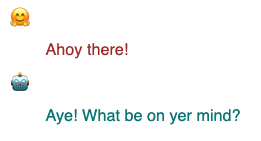
llama speaks like a pirate: Q: "Aye there!" A: "Aye! What be on yer mind?"

You can upload to the Hub

Once you are happy with your fine-tuned model, upload it directly from Keras using:

model.save_to_preset("./pirate-llama")
# Use your own repo here
keras_hub.upload_preset(
    uri = "hf://martin-gorner/llama-3.2-1B-pirate-instruct",
    preset = "./pirate-llama")

The uploaded model is visible here.

Distributed model parallelism for inference or training

Demo Colab for this section: Llama 3.1 Keras model parallel

Some of you are wondering, why use Keras when one can already work with LLMs on Hugging Face using Transformers? Answer: even if you don't care about Keras' flexibility and usability as a modeling framework (you should!), Keras is your quickest path to advanced model parallelism thanks to JAX and its powerful XLA compiler.

Let's pick an 8B parameters model to demonstrate: meta-llama/Llama-3.1-8B-Instruct (demo Colab here). Without quantization, this model is too large for any single accelerator. With Keras, you can load it sharded across multiple accelerators, GPU or TPU. If you are uncertain about the "correct" weight shardings, most models provide sensible defaults. Here, call keras_hub.models.Llama3Backbone.get_layout_map(device_mesh):

devices = keras.distribution.list_devices() # 8 TPU cores: let's do a 2x4 mesh
device_mesh = keras.distribution.DeviceMesh((2, 4), ["batch", "model"], devices)
layout_map = keras_hub.models.Llama3Backbone.get_layout_map(device_mesh) # defaults
distrib = keras.distribution.ModelParallel(layout_map=layout_map, batch_dim_name="batch")
keras.distribution.set_distribution(distrib)

# Now load the model, distributed across the accelerators
model = keras_hub.models.Llama3CausalLM.from_preset("hf://meta-llama/Llama-3.1-8B-Instruct")

And if you don't trust the default layout map provided by the model, you can define your own. In this example running on a "small" TPU setup with only 8 cores, the following layout map is a bit faster than the default (54s/epoch rather than 62s/epoch):

layout_map = keras.distribution.LayoutMap(device_mesh)

layout_map["token_embedding/embeddings"] = ("model", None)
layout_map["token_embedding/reverse_embeddings"] = ("model", None)
layout_map["self_attention.*(query|key|value).kernel"] = ("model", None, None)
layout_map["self_attention.*attention_output.kernel"] = ("model", None, None)
layout_map["feedforward_intermediate_dense.kernel"] = (None, "model")
layout_map["feedforward_gate_dense.kernel"] = (None, "model")
layout_map["feedforward_output_dense.kernel"] = ("model", None)

Check out the demo Colab here which fine-tunes the larger 8B Llama on pirate-speak, in just under 8 min on a Google TPU v5e (available in JupyterLab on Hugging Face Spaces. The fine-tuned model is here. And if you need a short model explainer about model parallelism and Keras, I have you covered here.