
惯性聚合 高效追踪和阅读你感兴趣的博客、新闻、科技资讯
阅读原文 在惯性聚合中打开

推荐订阅源

Spread Privacy
Spread Privacy
P
Palo Alto Networks Blog
P
Proofpoint News Feed
AI
AI
Help Net Security
Help Net Security
S
Securelist
T
Troy Hunt's Blog
K
KPMG report finds enterprise disconnect between AI and its ROI | CIO
C
Cisco Blogs
Scott Helme
Scott Helme
Hacker News - Newest:
Hacker News - Newest: "LLM"
Vercel News
Vercel News
Exploit-DB.com RSS Feed
CTFtime.org: upcoming CTF events
B
Blog
GbyAI
GbyAI
Recent Commits to openclaw:main
D
Darknet – Hacking Tools, Hacker News & Cyber Security
P
Proofpoint News Feed
S
Security Affairs
Cisco Talos Blog
Cisco Talos Blog
AWS News Blog
AWS News Blog
T
Tenable Blog
H
Help Net Security
NISL@THU
NISL@THU
F
Fortinet All Blogs
博客园_首页
G
GRAHAM CLULEY
L
LINUX DO - 最新话题
P
Privacy International News Feed
G
Google Developers Blog
博客园 - Franky
Cyber Security Advisories - MS-ISAC
cs.CL updates on arXiv.org
Security Archives - TechRepublic
The Register - Security
L
LangChain Blog
aimingoo的专栏
aimingoo的专栏
T
Tor Project blog
P
Privacy & Cybersecurity Law Blog
量子位
C
Cyber Attacks, Cyber Crime and Cyber Security
Forbes - Security
Forbes - Security
S
Secure Thoughts
Simon Willison's Weblog
D
Docker
Recorded Future
Recorded Future
博客园 - 三生石上(FineUI控件)
L
Lohrmann on Cybersecurity
T
Tailwind CSS Blog

Hugging Face - Blog

Waypoint-1.5: Higher-Fidelity Interactive Worlds for Everyday GPUs ALTK‑Evolve: On‑the‑Job Learning for AI Agents Safetensors is Joining the PyTorch Foundation Holo3: Breaking the Computer Use Frontier Any Custom Frontend with Gradio's Backend A New Framework for Evaluating Voice Agents (EVA) Bringing Robotics AI to Embedded Platforms: Dataset Recording, VLA Fine‑Tuning, and On‑Device Optimizations One-Shot Any Web App with Gradio's gr.HTML CUGA on Hugging Face: Democratizing Configurable AI Agents New in llama.cpp: Model Management Building Deep Research: How we Achieved State of the Art OVHcloud on Hugging Face Inference Providers 🔥 20x Faster TRL Fine-tuning with RapidFire AI Building for an Open Future - our new partnership with Google Cloud Aligning to What? Rethinking Agent Generalization in MiniMax M2 Building a Healthcare Robot from Simulation to Deployment with NVIDIA Isaac Sentence Transformers is joining Hugging Face! Unlock the power of images with AI Sheets Supercharge your OCR Pipelines with Open Models Google Cloud C4 Brings a 70% TCO improvement on GPT OSS with Intel and Hugging Face Get your VLM running in 3 simple steps on Intel CPUs Nemotron-Personas-India: Synthesized Data for Sovereign AI Introducing RTEB: A New Standard for Retrieval Evaluation Accelerating Qwen3-8B Agent on Intel® Core™ Ultra with Depth-Pruned Draft Models VibeGame: Exploring Vibe Coding Games Nemotron-Personas-Japan: ソブリン AI のための合成データセット Swift Transformers Reaches 1.0 – and Looks to the Future Smol2Operator: Post-Training GUI Agents for Computer Use SyGra: The One-Stop Framework for Building Data for LLMs and SLMs Gaia2 and ARE: Empowering the community to study agents Scaleway on Hugging Face Inference Providers 🔥 Democratizing AI Safety with RiskRubric.ai Public AI on Hugging Face Inference Providers 🔥 `LeRobotDataset:v3.0`: Bringing large-scale datasets to `lerobot` Visible Watermarking with Gradio Introducing the Palmyra-mini family: Powerful, lightweight, and ready to reason! Tricks from OpenAI gpt-oss YOU 🫵 can use with transformers Fine-tune Any LLM from the Hugging Face Hub with Together AI Jupyter Agents: training LLMs to reason with notebooks mmBERT: ModernBERT goes Multilingual Welcome EmbeddingGemma, Google's new efficient embedding model SAIR: Accelerating Pharma R&D with AI-Powered Structural Intelligence Make your ZeroGPU Spaces go brrr with ahead-of-time compilation NVIDIA Releases 6 Million Multi-Lingual Reasoning Dataset Generate Images with Claude and Hugging Face From Zero to GPU: A Guide to Building and Scaling Production-Ready CUDA Kernels MCP for Research: How to Connect AI to Research Tools Kimina-Prover-RL Arm & ExecuTorch 0.7: Bringing Generative AI to the masses Neural Super Sampling is here! TextQuests: How Good are LLMs at Text-Based Video Games? 🇵🇭 FilBench - Can LLMs Understand and Generate Filipino? Introducing AI Sheets: a tool to work with datasets using open AI models! Accelerate ND-Parallel: A guide to Efficient Multi-GPU Training Vision Language Model Alignment in TRL ⚡️ Welcome GPT OSS, the new open-source model family from OpenAI! Measuring Open-Source Llama Nemotron Models on DeepResearch Bench 📚 3LM: A Benchmark for Arabic LLMs in STEM and Code Implementing MCP Servers in Python: An AI Shopping Assistant with Gradio Introducing Trackio: A Lightweight Experiment Tracking Library from Hugging Face Say hello to `hf`: a faster, friendlier Hugging Face CLI ✨ Parquet Content-Defined Chunking TimeScope: How Long Can Your Video Large Multimodal Model Go? Fast LoRA inference for Flux with Diffusers and PEFT Accelerate a World of LLMs on Hugging Face with NVIDIA NIM Arc Virtual Cell Challenge: A Primer Consilium: When Multiple LLMs Collaborate Back to The Future: Evaluating AI Agents on Predicting Future Events Five Big Improvements to Gradio MCP Servers Ettin Suite: SoTA Paired Encoders and Decoders Migrating the Hub from Git LFS to Xet Kimina-Prover: Applying Test-time RL Search on Large Formal Reasoning Models Asynchronous Robot Inference: Decoupling Action Prediction and Execution ScreenEnv: Deploy your full stack Desktop Agent Building the Hugging Face MCP Server Reachy Mini - The Open-Source Robot for Today's and Tomorrow's AI Builders Creating custom kernels for the AMD MI300 Upskill your LLMs With Gradio MCP Servers SmolLM3: smol, multilingual, long-context reasoner Three Mighty Alerts Supporting Hugging Face’s Production Infrastructure Efficient MultiModal Data Pipeline Announcing NeurIPS 2025 E2LM Competition: Early Training Evaluation of Language Models Training and Finetuning Sparse Embedding Models with Sentence Transformers Welcome the NVIDIA Llama Nemotron Nano VLM to Hugging Face Hub Gemma 3n fully available in the open-source ecosystem! Transformers backend integration in SGLang (LoRA) Fine-Tuning FLUX.1-dev on Consumer Hardware Groq on Hugging Face Inference Providers 🔥 How Long Prompts Block Other Requests - Optimizing LLM Performance Learn the Hugging Face Kernel Hub in 5 Minutes Convert Transformers to ONNX with Hugging Face Optimum Intel and Hugging Face Partner to Democratize Machine Learning Hardware Acceleration Director of Machine Learning Insights [Part 3: Finance Edition] The Annotated Diffusion Model Deep Q-Learning with Space Invaders Graphcore and Hugging Face Launch New Lineup of IPU-Ready Transformers Introducing Pull Requests and Discussions 🥳 Efficient Table Pre-training without Real Data: An Introduction to TAPEX An Introduction to Q-Learning Part 2/2 How Sempre Health is leveraging the Expert Acceleration Program to accelerate their ML roadmap
Welcome aMUSEd: Efficient Text-to-Image Generation
Isamu Isozaki, Suraj Patil, Will Berman, Sayak Paul · 2024-01-04 · via Hugging Face - Blog

Back to Articles

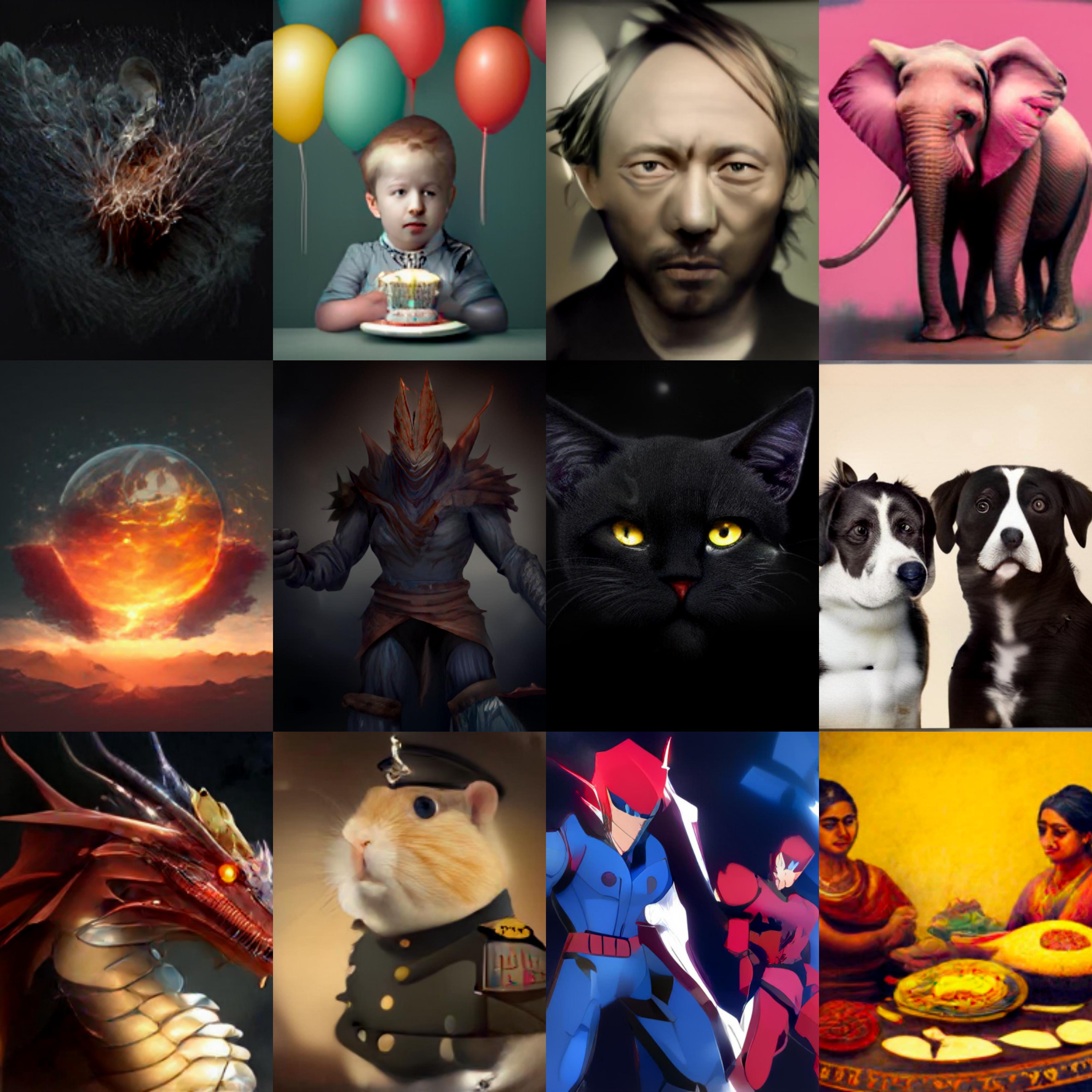
amused_grid

We’re excited to present an efficient non-diffusion text-to-image model named aMUSEd. It’s called so because it’s a open reproduction of Google's MUSE. aMUSEd’s generation quality is not the best and we’re releasing a research preview with a permissive license.

In contrast to the commonly used latent diffusion approach (Rombach et al. (2022)), aMUSEd employs a Masked Image Model (MIM) methodology. This not only requires fewer inference steps, as noted by Chang et al. (2023), but also enhances the model's interpretability.

Just as MUSE, aMUSEd demonstrates an exceptional ability for style transfer using a single image, a feature explored in depth by Sohn et al. (2023). This aspect could potentially open new avenues in personalized and style-specific image generation.

In this blog post, we will give you some internals of aMUSEd, show how you can use it for different tasks, including text-to-image, and show how to fine-tune it. Along the way, we will provide all the important resources related to aMUSEd, including its training code. Let’s get started 🚀

Table of contents

We have built a demo for readers to play with aMUSEd. You can try it out in this Space or in the playground embedded below:

How does it work?

aMUSEd is based on Masked Image Modeling. It makes for a compelling use case for the community to explore components that are known to work in language modeling in the context of image generation.

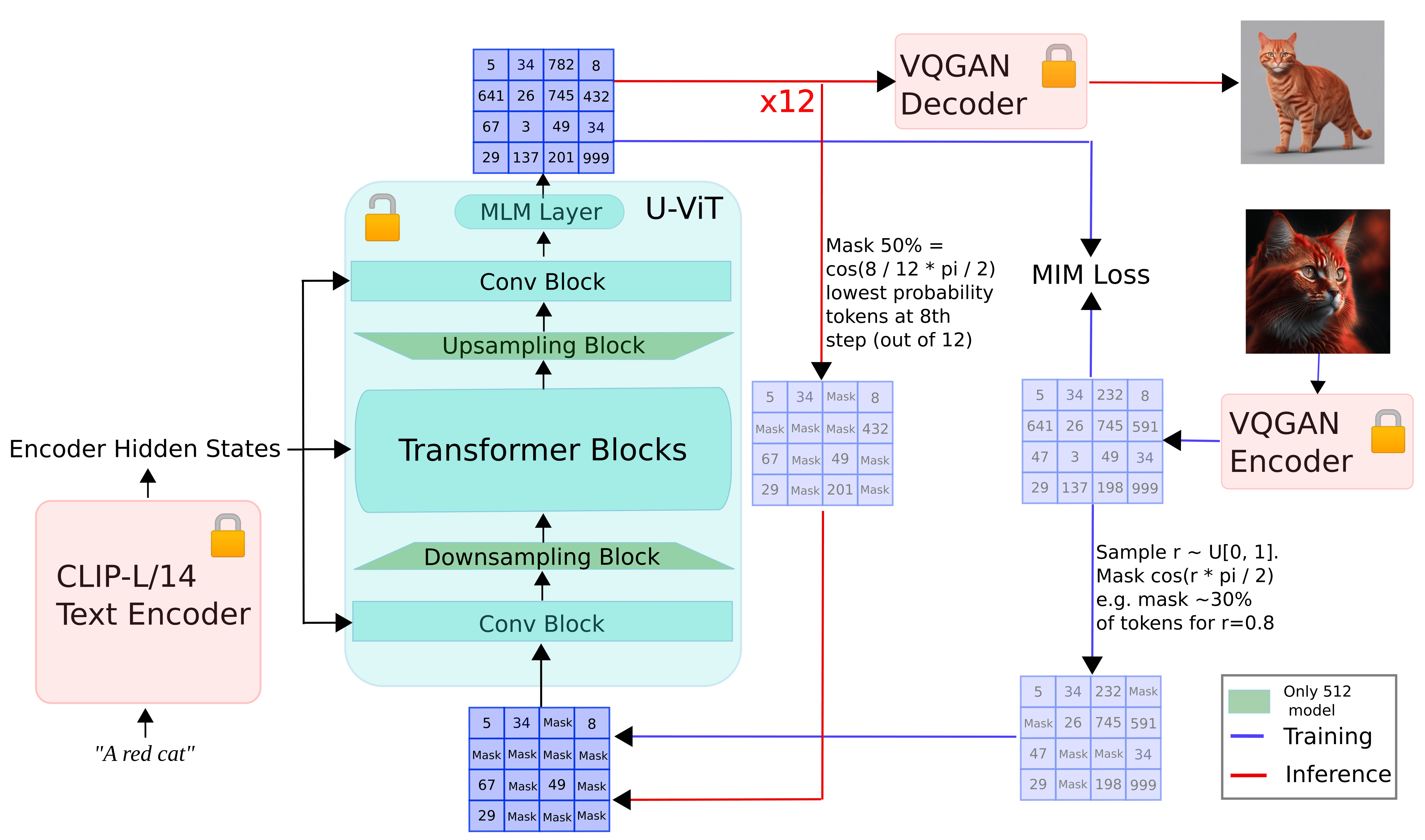
The figure below presents a pictorial overview of how aMUSEd works.
amused_architecture

During training:

  • input images are tokenized using a VQGAN to obtain image tokens
  • the image tokens are then masked according to a cosine masking schedule.
  • the masked tokens (conditioned on the prompt embeddings computed using a CLIP-L/14 text encoder are passed to a U-ViT model that predicts the masked patches

During inference:

  • input prompt is embedded using the CLIP-L/14 text encoder.
  • iterate till N steps are reached:
    • start with randomly masked tokens and pass them to the U-ViT model along with the prompt embeddings
    • predict the masked tokens and only keep a certain percentage of the most confident predictions based on the N and mask schedule. Mask the remaining ones and pass them off to the U-ViT model
  • pass the final output to the VQGAN decoder to obtain the final image

As mentioned at the beginning, aMUSEd borrows a lot of similarities from MUSE. However, there are some notable differences:

  • aMUSEd doesn’t follow a two-stage approach for predicting the final masked patches.
  • Instead of using T5 for text conditioning, CLIP L/14 is used for computing the text embeddings.
  • Following Stable Diffusion XL (SDXL), additional conditioning, such as image size and cropping, is passed to the U-ViT. This is referred to as “micro-conditioning”.

To learn more about aMUSEd, we recommend reading the technical report here.

Using aMUSEd in 🧨 diffusers

aMUSEd comes fully integrated into 🧨 diffusers. To use it, we first need to install the libraries:

pip install -U diffusers accelerate transformers -q

Let’s start with text-to-image generation:

import torch
from diffusers import AmusedPipeline

pipe = AmusedPipeline.from_pretrained(
    "amused/amused-512", variant="fp16", torch_dtype=torch.float16
)
pipe = pipe.to("cuda")

prompt = "A mecha robot in a favela in expressionist style"
negative_prompt = "low quality, ugly"

image = pipe(prompt, negative_prompt=negative_prompt, generator=torch.manual_seed(0)).images[0]
image

text2image_512.png

We can study how num_inference_steps affects the quality of the images under a fixed seed:

from diffusers.utils import make_image_grid 

images = []
for step in [5, 10, 15]:
    image = pipe(prompt, negative_prompt=negative_prompt, num_inference_steps=step, generator=torch.manual_seed(0)).images[0]
    images.append(image)

grid = make_image_grid(images, rows=1, cols=3)
grid

image_grid_t2i_amused.png

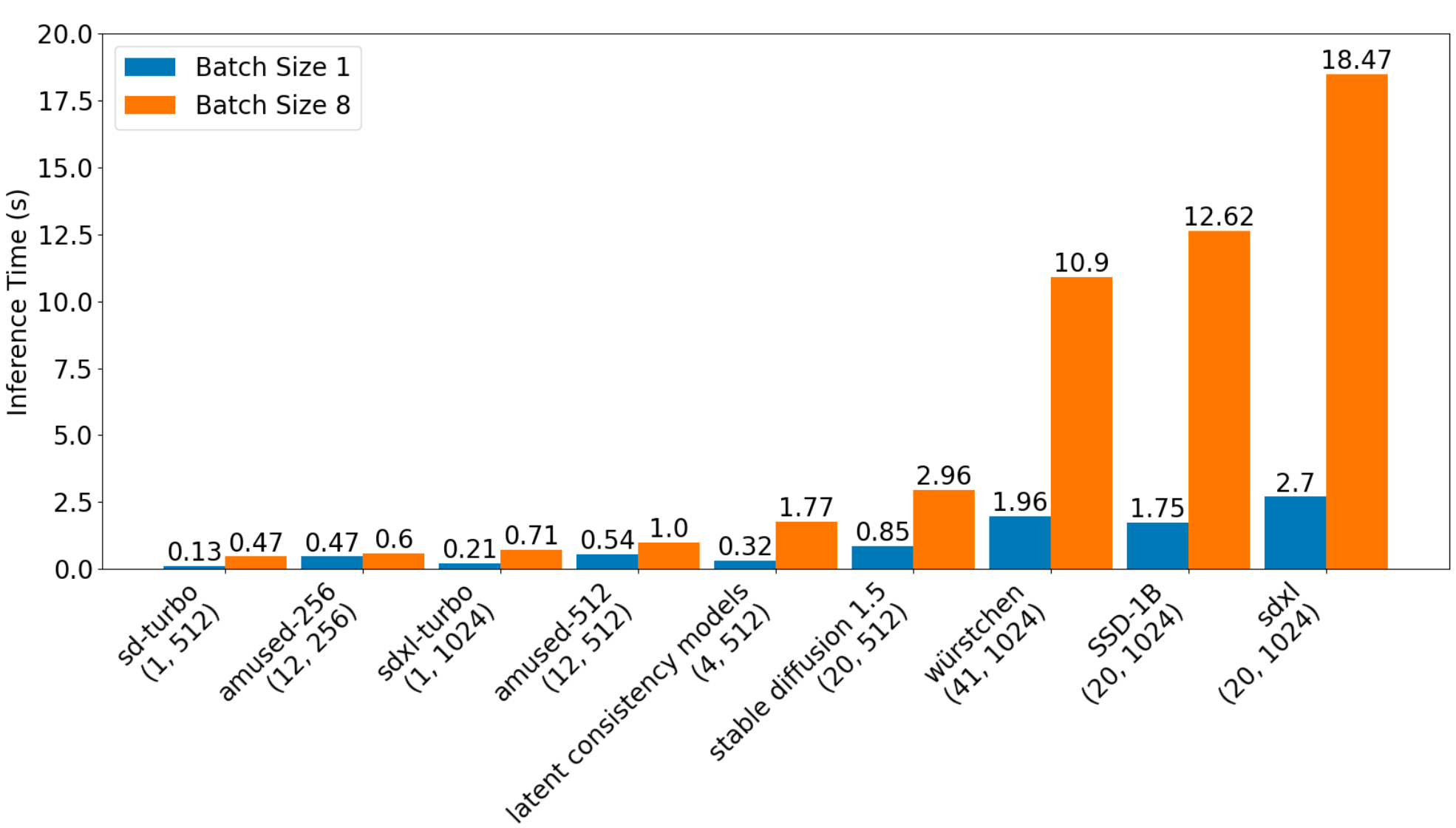
Crucially, because of its small size (only ~800M parameters, including the text encoder and VQ-GAN), aMUSEd is very fast. The figure below provides a comparative study of the inference latencies of different models, including aMUSEd:
Speed Comparison
Tuples, besides the model names, have the following format: (timesteps, resolution). Benchmark conducted on A100. More details are in the technical report.

As a direct byproduct of its pre-training objective, aMUSEd can do image inpainting zero-shot, unlike other models such as SDXL.

import torch
from diffusers import AmusedInpaintPipeline
from diffusers.utils import load_image
from PIL import Image

pipe = AmusedInpaintPipeline.from_pretrained(
    "amused/amused-512", variant="fp16", torch_dtype=torch.float16
)
pipe = pipe.to("cuda")

prompt = "a man with glasses"
input_image = (
    load_image(
        "https://huggingface.co/amused/amused-512/resolve/main/assets/inpainting_256_orig.png"
    )
    .resize((512, 512))
    .convert("RGB")
)
mask = (
    load_image(
        "https://huggingface.co/amused/amused-512/resolve/main/assets/inpainting_256_mask.png"
    )
    .resize((512, 512))
    .convert("L")
)   

image = pipe(prompt, input_image, mask, generator=torch.manual_seed(3)).images[0]

inpainting_grid_amused.png

aMUSEd is the first non-diffusion system within diffusers. Its iterative scheduling approach for predicting the masked patches made it a good candidate for diffusers. We are excited to see how the community leverages it.

We encourage you to check out the technical report to learn about all the tasks we explored with aMUSEd.

Fine-tuning aMUSEd

We provide a simple training script for fine-tuning aMUSEd on custom datasets. With the 8-bit Adam optimizer and float16 precision, it's possible to fine-tune aMUSEd with just under 11GBs of GPU VRAM. With LoRA, the memory requirements get further reduced to just 7GBs.

Fine-tuned result.
a pixel art character with square red glasses

aMUSEd comes with an OpenRAIL license, and hence, it’s commercially friendly to adapt. Refer to this directory for more details on fine-tuning.

Limitations

aMUSEd is not a state-of-the-art image generation regarding image quality. We released aMUSEd to encourage the community to explore non-diffusion frameworks such as MIM for image generation. We believe MIM’s potential is underexplored, given its benefits:

  • Inference efficiency
  • Smaller size, enabling on-device applications
  • Task transfer without requiring expensive fine-tuning
  • Advantages of well-established components from the language modeling world

(Note that the original work on MUSE is close-sourced)

For a detailed description of the quantitative evaluation of aMUSEd, refer to the technical report.

We hope that the community will find the resources useful and feel motivated to improve the state of MIM for image generation.

Resources

Papers:

Code + misc:

Acknowledgements

Suraj led training. William led data and supported training. Patrick von Platen supported both training and data and provided general guidance. Robin Rombach did the VQGAN training and provided general guidance. Isamu Isozaki helped with insightful discussions and made code contributions.

Thanks to Patrick von Platen and Pedro Cuenca for their reviews on the blog post draft.