
惯性聚合 高效追踪和阅读你感兴趣的博客、新闻、科技资讯
阅读原文 在惯性聚合中打开

推荐订阅源

T
Threat Research - Cisco Blogs
OSCHINA 社区最新新闻
OSCHINA 社区最新新闻
The Register - Security
A
About on SuperTechFans
Cyber Security Advisories - MS-ISAC
L
LangChain Blog
N
Netflix TechBlog - Medium
量子位
博客园 - 三生石上(FineUI控件)
宝玉的分享
宝玉的分享
H
Help Net Security
D
Docker
D
DataBreaches.Net
T
Tailwind CSS Blog
阮一峰的网络日志
阮一峰的网络日志
B
Blog
博客园 - 聂微东
Apple Machine Learning Research
Google DeepMind News
The Cloudflare Blog
F
Full Disclosure
GbyAI
GbyAI
F
Fortinet All Blogs
Last Week in AI
Last Week in AI
Y
Y Combinator Blog
人人都是产品经理
人人都是产品经理
Recent Announcements
博客园 - Franky
MongoDB | Blog
MongoDB | Blog
有赞技术团队
有赞技术团队
博客园 - 叶小钗
小众软件
小众软件
V
Visual Studio Blog
月光博客
月光博客
Stack Overflow Blog
Stack Overflow Blog
The GitHub Blog
The GitHub Blog
Recorded Future
Recorded Future
J
Java Code Geeks
雷峰网
雷峰网
P
Privacy & Cybersecurity Law Blog
C
Cisco Blogs
C
Cyber Attacks, Cyber Crime and Cyber Security
AWS News Blog
AWS News Blog
Webroot Blog
Webroot Blog
美团技术团队
N
News | PayPal Newsroom
G
Google Developers Blog
Security Archives - TechRepublic
博客园_首页
V
Vulnerabilities – Threatpost

Hugging Face - Blog

Waypoint-1.5: Higher-Fidelity Interactive Worlds for Everyday GPUs ALTK‑Evolve: On‑the‑Job Learning for AI Agents Safetensors is Joining the PyTorch Foundation Holo3: Breaking the Computer Use Frontier Any Custom Frontend with Gradio's Backend A New Framework for Evaluating Voice Agents (EVA) Bringing Robotics AI to Embedded Platforms: Dataset Recording, VLA Fine‑Tuning, and On‑Device Optimizations One-Shot Any Web App with Gradio's gr.HTML CUGA on Hugging Face: Democratizing Configurable AI Agents New in llama.cpp: Model Management Building Deep Research: How we Achieved State of the Art OVHcloud on Hugging Face Inference Providers 🔥 20x Faster TRL Fine-tuning with RapidFire AI Building for an Open Future - our new partnership with Google Cloud Aligning to What? Rethinking Agent Generalization in MiniMax M2 Building a Healthcare Robot from Simulation to Deployment with NVIDIA Isaac Sentence Transformers is joining Hugging Face! Unlock the power of images with AI Sheets Supercharge your OCR Pipelines with Open Models Google Cloud C4 Brings a 70% TCO improvement on GPT OSS with Intel and Hugging Face Get your VLM running in 3 simple steps on Intel CPUs Nemotron-Personas-India: Synthesized Data for Sovereign AI Introducing RTEB: A New Standard for Retrieval Evaluation Accelerating Qwen3-8B Agent on Intel® Core™ Ultra with Depth-Pruned Draft Models VibeGame: Exploring Vibe Coding Games Nemotron-Personas-Japan: ソブリン AI のための合成データセット Swift Transformers Reaches 1.0 – and Looks to the Future Smol2Operator: Post-Training GUI Agents for Computer Use SyGra: The One-Stop Framework for Building Data for LLMs and SLMs Gaia2 and ARE: Empowering the community to study agents Scaleway on Hugging Face Inference Providers 🔥 Democratizing AI Safety with RiskRubric.ai Public AI on Hugging Face Inference Providers 🔥 `LeRobotDataset:v3.0`: Bringing large-scale datasets to `lerobot` Visible Watermarking with Gradio Introducing the Palmyra-mini family: Powerful, lightweight, and ready to reason! Tricks from OpenAI gpt-oss YOU 🫵 can use with transformers Fine-tune Any LLM from the Hugging Face Hub with Together AI Jupyter Agents: training LLMs to reason with notebooks mmBERT: ModernBERT goes Multilingual Welcome EmbeddingGemma, Google's new efficient embedding model SAIR: Accelerating Pharma R&D with AI-Powered Structural Intelligence Make your ZeroGPU Spaces go brrr with ahead-of-time compilation NVIDIA Releases 6 Million Multi-Lingual Reasoning Dataset Generate Images with Claude and Hugging Face From Zero to GPU: A Guide to Building and Scaling Production-Ready CUDA Kernels MCP for Research: How to Connect AI to Research Tools Kimina-Prover-RL Arm & ExecuTorch 0.7: Bringing Generative AI to the masses Neural Super Sampling is here! TextQuests: How Good are LLMs at Text-Based Video Games? 🇵🇭 FilBench - Can LLMs Understand and Generate Filipino? Introducing AI Sheets: a tool to work with datasets using open AI models! Accelerate ND-Parallel: A guide to Efficient Multi-GPU Training Vision Language Model Alignment in TRL ⚡️ Welcome GPT OSS, the new open-source model family from OpenAI! Measuring Open-Source Llama Nemotron Models on DeepResearch Bench 📚 3LM: A Benchmark for Arabic LLMs in STEM and Code Implementing MCP Servers in Python: An AI Shopping Assistant with Gradio Introducing Trackio: A Lightweight Experiment Tracking Library from Hugging Face Say hello to `hf`: a faster, friendlier Hugging Face CLI ✨ Parquet Content-Defined Chunking TimeScope: How Long Can Your Video Large Multimodal Model Go? Fast LoRA inference for Flux with Diffusers and PEFT Accelerate a World of LLMs on Hugging Face with NVIDIA NIM Arc Virtual Cell Challenge: A Primer Consilium: When Multiple LLMs Collaborate Back to The Future: Evaluating AI Agents on Predicting Future Events Five Big Improvements to Gradio MCP Servers Ettin Suite: SoTA Paired Encoders and Decoders Migrating the Hub from Git LFS to Xet Kimina-Prover: Applying Test-time RL Search on Large Formal Reasoning Models Asynchronous Robot Inference: Decoupling Action Prediction and Execution ScreenEnv: Deploy your full stack Desktop Agent Building the Hugging Face MCP Server Reachy Mini - The Open-Source Robot for Today's and Tomorrow's AI Builders Creating custom kernels for the AMD MI300 Upskill your LLMs With Gradio MCP Servers SmolLM3: smol, multilingual, long-context reasoner Three Mighty Alerts Supporting Hugging Face’s Production Infrastructure Efficient MultiModal Data Pipeline Announcing NeurIPS 2025 E2LM Competition: Early Training Evaluation of Language Models Training and Finetuning Sparse Embedding Models with Sentence Transformers Welcome the NVIDIA Llama Nemotron Nano VLM to Hugging Face Hub Gemma 3n fully available in the open-source ecosystem! Transformers backend integration in SGLang (LoRA) Fine-Tuning FLUX.1-dev on Consumer Hardware Groq on Hugging Face Inference Providers 🔥 How Long Prompts Block Other Requests - Optimizing LLM Performance Learn the Hugging Face Kernel Hub in 5 Minutes Convert Transformers to ONNX with Hugging Face Optimum Intel and Hugging Face Partner to Democratize Machine Learning Hardware Acceleration Director of Machine Learning Insights [Part 3: Finance Edition] The Annotated Diffusion Model Deep Q-Learning with Space Invaders Graphcore and Hugging Face Launch New Lineup of IPU-Ready Transformers Introducing Pull Requests and Discussions 🥳 Efficient Table Pre-training without Real Data: An Introduction to TAPEX An Introduction to Q-Learning Part 2/2 How Sempre Health is leveraging the Expert Acceleration Program to accelerate their ML roadmap
Share your open ML datasets on Hugging Face Hub!
Daniel van Strien, Caleb Fahlgren, Quentin Lhoest, Ann Huang · 2024-11-12 · via Hugging Face - Blog

Back to Articles

This article is also available in Chinese 简体中文.

If you're working on data-intensive research or machine learning projects, you need a reliable way to share and host your datasets. Public datasets such as Common Crawl, ImageNet, Common Voice and more are critical to the open ML ecosystem, yet they can be challenging to host and share.

Hugging Face Hub makes it seamless to host and share datasets, trusted by many leading research institutions, companies, and government agencies, including Nvidia, Google, Stanford, NASA, THUDM and Barcelona Supercomputing Center.

By hosting a dataset on the Hugging Face Hub, you get instant access to features that can maximize your work's impact:

Generous Limits

Support for large datasets

The Hub can host terabyte-scale datasets, with high per-file and per-repository limits. If you have data to share, the Hugging Face datasets team can help suggest the best format for uploading your data for community usage. The 🤗 Datasets library makes it easy to upload and download your files, or even create a dataset from scratch. 🤗 Datasets also enables dataset streaming , making it possible to work with large datasets without needing to download the entire thing. This can be invaluable to allow researchers with less computational resources to work with your datasets, or to select small portions of a huge dataset for testing, development or prototyping.
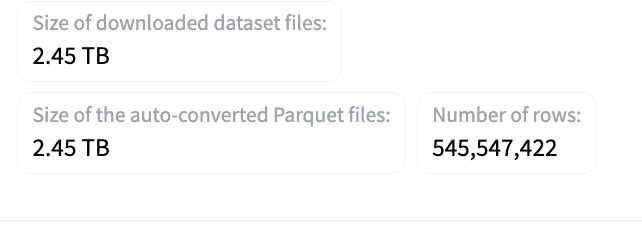
Screenshot of the file size information for a dataset
The Hugging Face Hub can host the large datasets often created for machine learning research.

Note: The Xet team is currently working on a backend update that will increase per-file limits from the current 50 GB to 500 GB while also improving storage and transfer efficiency.

Dataset Viewer

Beyond just hosting your data, the Hub provides powerful tools for exploration. With the Datasets Viewer, users can explore and interact with datasets hosted on the Hub directly in their browser. This provides an easy way for others to view and explore your data without downloading it first.

Hugging Face datasets supports many different modalities (audio, images, video, etc.) and file formats (CSV, JSON, Parquet, etc.), and compression formats (Gzip, Zip, etc.). Check out the Datasets File Formats page for more details.

Screenshot of the Datasets Viewer
The Dataset Viewer for the Infinity-Instruct dataset.

The Datasets Viewer also includes a few features which make it easier to explore a dataset.

Full Text Search

Built-in Full Text Search is one of the most powerful features of the Datasets Viewer. Any text columns in a dataset immediately become searchable.

The Arxiver dataset contains 63.4k rows of arXiv research papers converted to Markdown. By using Full Text Search, it's easy to find the papers containing a specific author such as Ilya Sutskever below.

Sorting

The Datasets Viewer allows you to sort the dataset by clicking on the column headers. This makes it easy to find the most relevant examples in a dataset.

Below is an example of a dataset sorted by the helpfulness column in descending order for the HelpSteer2 dataset.

Third Party Library Support

Hugging Face is fortunate to have third party integrations with the leading open source data tools. By hosting a dataset on the Hub, it instantly makes the dataset compatible with the tools users are most familiar with.

Here are some of the libraries Hugging Face supports out of the box:

Library Description Monthly PyPi Downloads (2024)
Pandas Python data analysis toolkit. 258M
Spark Real-time, large-scale data processing tool in a distributed environment. 29M
Datasets 🤗 Datasets is a library for accessing and sharing datasets for Audio, Computer Vision, and Natural Language Processing (NLP). 17M
Dask Parallel and distributed computing library that scales the existing Python and PyData ecosystem. 12M
Polars A DataFrame library on top of an OLAP query engine. 8.5M
DuckDB In-process SQL OLAP database management system. 6M
WebDataset Library to write I/O pipelines for large datasets. 871K
Argilla Collaboration tool for AI engineers and domain experts that value high quality data. 400k

Most of these libraries enable you to load or stream a dataset in 1 single line of code.

Here are some examples with Pandas, Polars and DuckDB:

# Pandas example
import pandas as pd
df = pd.read_parquet("hf://datasets/neuralwork/arxiver/data/train.parquet")

# Polars example 
import polars as pl
df = pl.read_parquet("hf://datasets/neuralwork/arxiver/data/train.parquet")

# DuckDB example - SQL queries
import duckdb
duckdb.sql("SELECT * FROM 'hf://datasets/neuralwork/arxiver/data/train.parquet' LIMIT 10")

You can find more information about integrated libraries in the Datasets documentation. Along with the libraries listed above, there are many more community supported tools which support the Hugging Face Hub such as Lilac and Spotlight.

SQL Console

The SQL Console provides an interactive SQL editor that runs entirely in your browser, enabling instant data exploration without any setup. Key features include:

  • One-Click: Open a SQL Console to query a dataset with a single click
  • Shareable and Embeddable Results: Share and embed interesting query results
  • Full DuckDB Syntax: Use full SQL syntax with built-in functions for regex, lists, JSON, embeddings, and more

On every public dataset you should see a new SQL Console badge. With just one click you can open a SQL Console to query that dataset.

Querying the Magpie-Ultra dataset for excellent, high quality reasoning instructions.

Security

While making datasets accessible is important, protecting sensitive data is equally crucial. The Hugging Face Hub provides robust security features to help you maintain control over your data while sharing it with the right audiences.

Access Controls

The Hugging Face Hub supports unique access control options for who has access to the dataset.

  • Public: Anyone can access the dataset.
  • Private: Only you and those in your organization can access the dataset.
  • Gated: Control access to your dataset through two options:
    • Automatic Approval: Users must provide required information (like name and email) and agree to terms before gaining access
    • Manual Approval: You review and manually approve/reject each access request

For more details about gated datasets, see the gated datasets documentation. For more fine-grained controls, there are Enterprise plan features where organizations can create resource security groups, use SSO, and more.

Built-in Security Scanning

Along with access controls, the Hugging Face Hub offers several security scanners:

Feature Description
Malware Scanning Scans files for malware and suspicious content at each commit and visit
Secrets Scanning Blocks datasets with hardcoded secrets and environment variables
Pickle Scanning Scans pickle files and shows vetted imports for PyTorch weights
ProtectAI Uses Guardian tech to block datasets with pickle, Keras and other exploits
Security scanner status banner showing various security checks
To learn more about these scanners, see the security scanners documentation.

Reach and Visibility

Having a secure platform with powerful features is valuable, but the true impact of research comes from reaching the right audience. Reach and visibility are crucial for researchers sharing datasets - it helps maximize research impact, enables reproducibility, facilitates collaboration, and ensures valuable data can benefit the broader scientific community.

With over 5M builders actively using the platform, the Hugging Face Hub provides researchers with powerful tools for community engagement and visibility. Here's what you can expect:
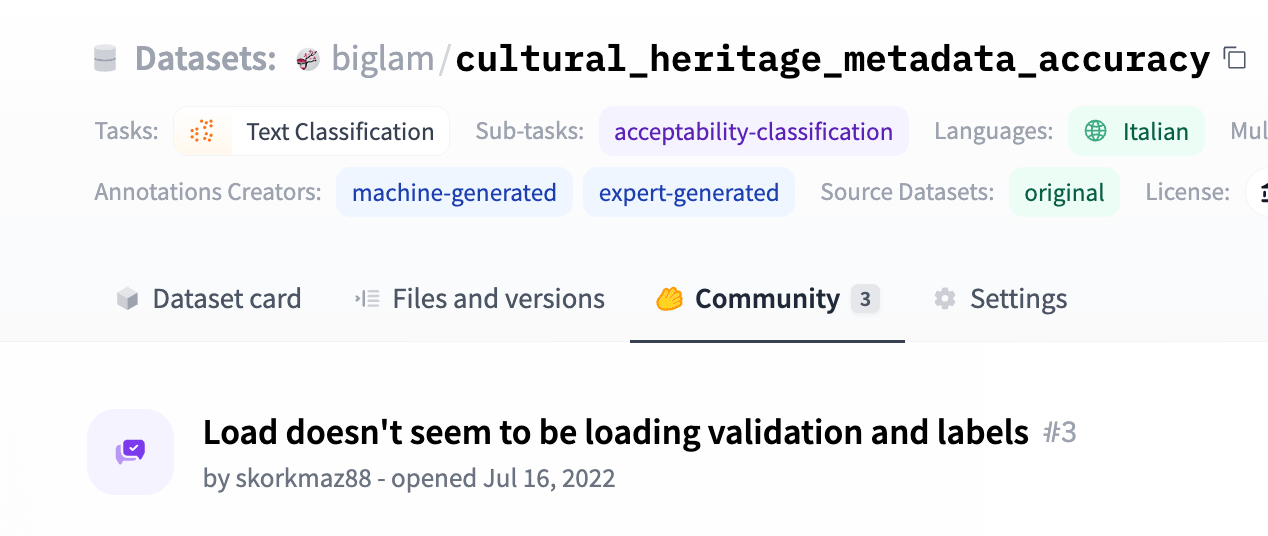
Better Community Engagement

  • Built-in discussion tabs for each dataset for community engagement
  • Organizations as a centralized place for grouping and collaborating on multiple datasets
  • Metrics for dataset usage and impact

Wider Reach

  • Access to a large, active community of researchers, developers, and practitioners
  • SEO-optimized URLs making your dataset easily discoverable
  • Integration with the broader ecosystem of models, datasets, and libraries
  • Clear links between your dataset and related models, papers, and demos

Improved Documentation

  • Customizable README files for comprehensive documentation
  • Support for detailed dataset descriptions and proper academic citations
  • Links to related research papers and publications

Screenshot of a discussion for a dataset on the Hub.
The Hub makes it easy to ask questions and discuss datasets.

How can I host my dataset on the Hugging Face Hub?

Now that you understand the benefits of hosting your dataset on the Hub, you might be wondering how to get started. Here are some comprehensive resources to guide you through the process:

The following pages will be useful if you want to share large datasets:

If you want any further help uploading a dataset to the Hub or want to upload a particularly large dataset, please contact datasets@huggingface.co.