
惯性聚合 高效追踪和阅读你感兴趣的博客、新闻、科技资讯
阅读原文 在惯性聚合中打开

推荐订阅源

T
The Exploit Database - CXSecurity.com
F
Fortinet All Blogs
U
Unit 42
F
Full Disclosure
雷峰网
雷峰网
博客园 - 司徒正美
云风的 BLOG
云风的 BLOG
钛媒体:引领未来商业与生活新知
钛媒体:引领未来商业与生活新知
T
Tailwind CSS Blog
The Cloudflare Blog
Last Week in AI
Last Week in AI
罗磊的独立博客
D
DataBreaches.Net
C
Check Point Blog
www.infosecurity-magazine.com
CTFtime.org: upcoming CTF events
O
OpenAI News
C
CXSECURITY Database RSS Feed - CXSecurity.com
aimingoo的专栏
aimingoo的专栏
S
Security @ Cisco Blogs
大猫的无限游戏
大猫的无限游戏
让小产品的独立变现更简单 - ezindie.com
S
SegmentFault 最新的问题
NISL@THU
NISL@THU
OSCHINA 社区最新新闻
OSCHINA 社区最新新闻
The Hacker News
The Hacker News
Webroot Blog
Webroot Blog
Security Latest
Security Latest
cs.CL updates on arXiv.org
Google DeepMind News
酷 壳 – CoolShell
酷 壳 – CoolShell
N
News | PayPal Newsroom
P
Proofpoint News Feed
B
Blog RSS Feed
MongoDB | Blog
MongoDB | Blog
C
Cybersecurity and Infrastructure Security Agency CISA
N
News and Events Feed by Topic
Google Online Security Blog
H
Help Net Security
Spread Privacy
Spread Privacy
T
Threat Research - Cisco Blogs
GbyAI
GbyAI
I
Intezer
Application and Cybersecurity Blog
M
MIT News - Artificial intelligence
Vercel News
Vercel News
Cyber Security Advisories - MS-ISAC
IT之家
IT之家
MyScale Blog
MyScale Blog
腾讯CDC

Hugging Face - Blog

Waypoint-1.5: Higher-Fidelity Interactive Worlds for Everyday GPUs ALTK‑Evolve: On‑the‑Job Learning for AI Agents Safetensors is Joining the PyTorch Foundation Holo3: Breaking the Computer Use Frontier Any Custom Frontend with Gradio's Backend A New Framework for Evaluating Voice Agents (EVA) Bringing Robotics AI to Embedded Platforms: Dataset Recording, VLA Fine‑Tuning, and On‑Device Optimizations One-Shot Any Web App with Gradio's gr.HTML CUGA on Hugging Face: Democratizing Configurable AI Agents New in llama.cpp: Model Management Building Deep Research: How we Achieved State of the Art OVHcloud on Hugging Face Inference Providers 🔥 20x Faster TRL Fine-tuning with RapidFire AI Building for an Open Future - our new partnership with Google Cloud Aligning to What? Rethinking Agent Generalization in MiniMax M2 Building a Healthcare Robot from Simulation to Deployment with NVIDIA Isaac Sentence Transformers is joining Hugging Face! Unlock the power of images with AI Sheets Supercharge your OCR Pipelines with Open Models Google Cloud C4 Brings a 70% TCO improvement on GPT OSS with Intel and Hugging Face Get your VLM running in 3 simple steps on Intel CPUs Nemotron-Personas-India: Synthesized Data for Sovereign AI Introducing RTEB: A New Standard for Retrieval Evaluation Accelerating Qwen3-8B Agent on Intel® Core™ Ultra with Depth-Pruned Draft Models VibeGame: Exploring Vibe Coding Games Nemotron-Personas-Japan: ソブリン AI のための合成データセット Swift Transformers Reaches 1.0 – and Looks to the Future Smol2Operator: Post-Training GUI Agents for Computer Use SyGra: The One-Stop Framework for Building Data for LLMs and SLMs Gaia2 and ARE: Empowering the community to study agents Scaleway on Hugging Face Inference Providers 🔥 Democratizing AI Safety with RiskRubric.ai Public AI on Hugging Face Inference Providers 🔥 `LeRobotDataset:v3.0`: Bringing large-scale datasets to `lerobot` Visible Watermarking with Gradio Introducing the Palmyra-mini family: Powerful, lightweight, and ready to reason! Tricks from OpenAI gpt-oss YOU 🫵 can use with transformers Fine-tune Any LLM from the Hugging Face Hub with Together AI Jupyter Agents: training LLMs to reason with notebooks mmBERT: ModernBERT goes Multilingual Welcome EmbeddingGemma, Google's new efficient embedding model SAIR: Accelerating Pharma R&D with AI-Powered Structural Intelligence Make your ZeroGPU Spaces go brrr with ahead-of-time compilation NVIDIA Releases 6 Million Multi-Lingual Reasoning Dataset Generate Images with Claude and Hugging Face From Zero to GPU: A Guide to Building and Scaling Production-Ready CUDA Kernels MCP for Research: How to Connect AI to Research Tools Kimina-Prover-RL Arm & ExecuTorch 0.7: Bringing Generative AI to the masses Neural Super Sampling is here! TextQuests: How Good are LLMs at Text-Based Video Games? 🇵🇭 FilBench - Can LLMs Understand and Generate Filipino? Introducing AI Sheets: a tool to work with datasets using open AI models! Accelerate ND-Parallel: A guide to Efficient Multi-GPU Training Vision Language Model Alignment in TRL ⚡️ Welcome GPT OSS, the new open-source model family from OpenAI! Measuring Open-Source Llama Nemotron Models on DeepResearch Bench 📚 3LM: A Benchmark for Arabic LLMs in STEM and Code Implementing MCP Servers in Python: An AI Shopping Assistant with Gradio Introducing Trackio: A Lightweight Experiment Tracking Library from Hugging Face Say hello to `hf`: a faster, friendlier Hugging Face CLI ✨ Parquet Content-Defined Chunking TimeScope: How Long Can Your Video Large Multimodal Model Go? Fast LoRA inference for Flux with Diffusers and PEFT Accelerate a World of LLMs on Hugging Face with NVIDIA NIM Arc Virtual Cell Challenge: A Primer Consilium: When Multiple LLMs Collaborate Back to The Future: Evaluating AI Agents on Predicting Future Events Five Big Improvements to Gradio MCP Servers Ettin Suite: SoTA Paired Encoders and Decoders Migrating the Hub from Git LFS to Xet Kimina-Prover: Applying Test-time RL Search on Large Formal Reasoning Models Asynchronous Robot Inference: Decoupling Action Prediction and Execution ScreenEnv: Deploy your full stack Desktop Agent Building the Hugging Face MCP Server Reachy Mini - The Open-Source Robot for Today's and Tomorrow's AI Builders Creating custom kernels for the AMD MI300 Upskill your LLMs With Gradio MCP Servers SmolLM3: smol, multilingual, long-context reasoner Three Mighty Alerts Supporting Hugging Face’s Production Infrastructure Efficient MultiModal Data Pipeline Announcing NeurIPS 2025 E2LM Competition: Early Training Evaluation of Language Models Training and Finetuning Sparse Embedding Models with Sentence Transformers Welcome the NVIDIA Llama Nemotron Nano VLM to Hugging Face Hub Gemma 3n fully available in the open-source ecosystem! Transformers backend integration in SGLang (LoRA) Fine-Tuning FLUX.1-dev on Consumer Hardware Groq on Hugging Face Inference Providers 🔥 How Long Prompts Block Other Requests - Optimizing LLM Performance Learn the Hugging Face Kernel Hub in 5 Minutes Convert Transformers to ONNX with Hugging Face Optimum Intel and Hugging Face Partner to Democratize Machine Learning Hardware Acceleration Director of Machine Learning Insights [Part 3: Finance Edition] The Annotated Diffusion Model Deep Q-Learning with Space Invaders Graphcore and Hugging Face Launch New Lineup of IPU-Ready Transformers Introducing Pull Requests and Discussions 🥳 Efficient Table Pre-training without Real Data: An Introduction to TAPEX An Introduction to Q-Learning Part 2/2 How Sempre Health is leveraging the Expert Acceleration Program to accelerate their ML roadmap
Building an AI WebTV
ARCHIVED ACCOUNT · 2023-07-17 · via Hugging Face - Blog

Back to Articles

ARCHIVED ACCOUNT's avatar

The AI WebTV is an experimental demo to showcase the latest advancements in automatic video and music synthesis.

👉 Watch the stream now by going to the AI WebTV Space.

If you are using a mobile device, you can view the stream from the Twitch mirror.

thumbnail.gif

Concept

The motivation for the AI WebTV is to demo videos generated with open-source text-to-video models such as Zeroscope and MusicGen, in an entertaining and accessible way.

You can find those open-source models on the Hugging Face hub:

The individual video sequences are purposely made to be short, meaning the WebTV should be seen as a tech demo/showreel rather than an actual show (with an art direction or programming).

Architecture

The AI WebTV works by taking a sequence of video shot prompts and passing them to a text-to-video model to generate a sequence of takes.

Additionally, a base theme and idea (written by a human) are passed through a LLM (in this case, ChatGPT), in order to generate a variety of individual prompts for each video clip.

Here's a diagram of the current architecture of the AI WebTV:
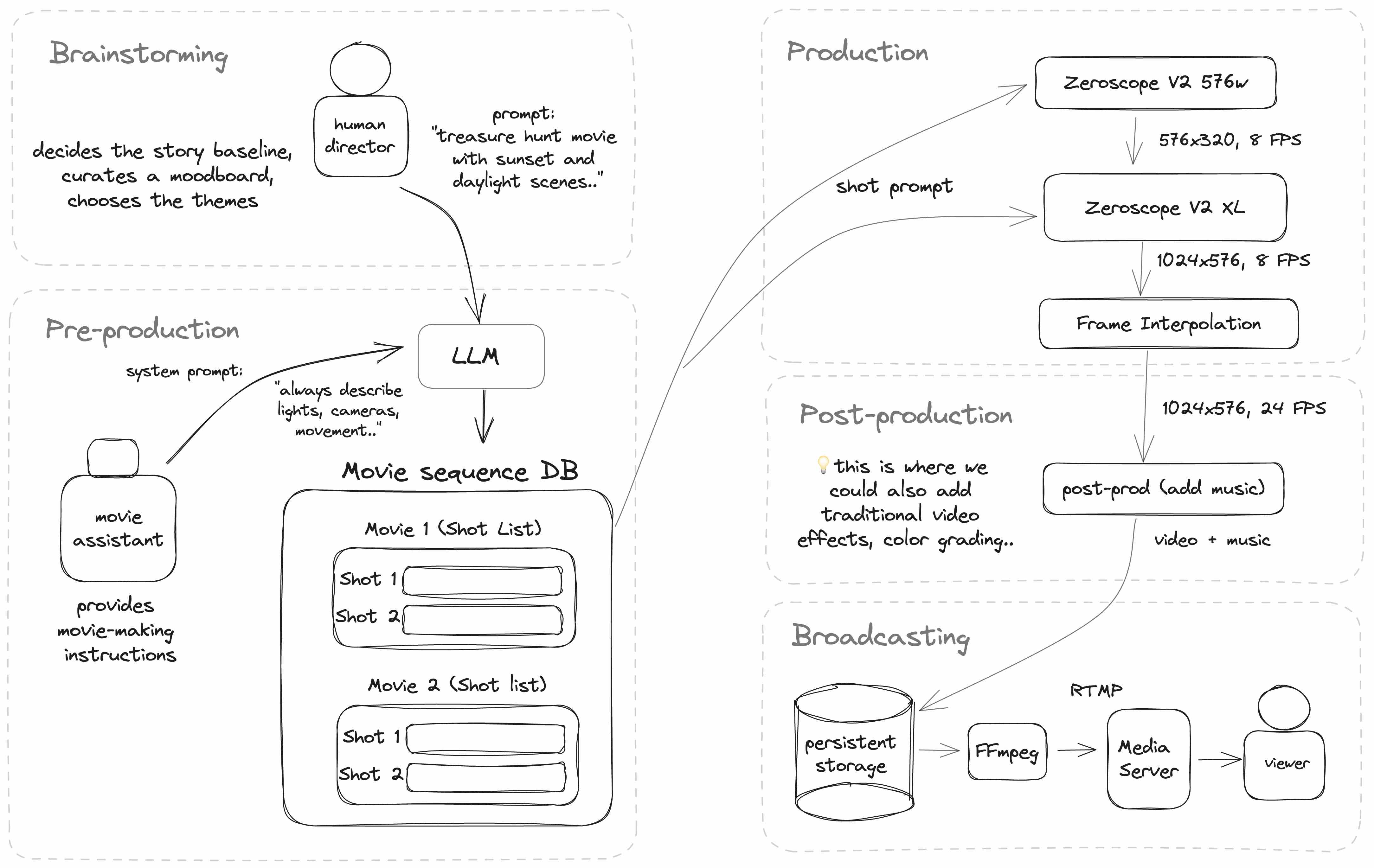
diagram.jpg

Implementing the pipeline

The WebTV is implemented in NodeJS and TypeScript, and uses various services hosted on Hugging Face.

The text-to-video model

The central video model is Zeroscope V2, a model based on ModelScope.

Zeroscope is comprised of two parts that can be chained together:

👉  You will need to use the same prompt for both the generation and upscaling.

Calling the video chain

To make a quick prototype, the WebTV runs Zeroscope from two duplicated Hugging Face Spaces running Gradio, which are called using the @gradio/client NPM package. You can find the original spaces here:

Other spaces deployed by the community can also be found if you search for Zeroscope on the Hub.

👉  Public Spaces may become overcrowded and paused at any time. If you intend to deploy your own system, please duplicate those Spaces and run them under your own account.

Using a model hosted on a Space

Spaces using Gradio have the ability to expose a REST API, which can then be called from Node using the @gradio/client module.

Here is an example:

import { client } from "@gradio/client"

export const generateVideo = async (prompt: string) => {
  const api = await client("*** URL OF THE SPACE ***")

  // call the "run()" function with an array of parameters
  const { data } = await api.predict("/run", [		
    prompt,
    42,	// seed	
    24, // nbFrames
    35 // nbSteps
  ])
  
  const { orig_name } = data[0][0]

  const remoteUrl = `${instance}/file=${orig_name}`

  // the file can then be downloaded and stored locally
}

Post-processing

Once an individual take (a video clip) is upscaled, it is then passed to FILM (Frame Interpolation for Large Motion), a frame interpolation algorithm:

During post-processing, we also add music generated with MusicGen:

Broadcasting the stream

Note: there are multiple tools you can use to create a video stream. The AI WebTV currently uses FFmpeg to read a playlist made of mp4 videos files and m4a audio files.

Here is an example of creating such a playlist:

import { promises as fs } from "fs"
import path from "path"

const allFiles = await fs.readdir("** PATH TO VIDEO FOLDER **")
const allVideos = allFiles
  .map(file => path.join(dir, file))
  .filter(filePath => filePath.endsWith('.mp4'))

let playlist = 'ffconcat version 1.0\n'
allFilePaths.forEach(filePath => {
  playlist += `file '${filePath}'\n`
})
await fs.promises.writeFile("playlist.txt", playlist)

This will generate the following playlist content:

ffconcat version 1.0
file 'video1.mp4'
file 'video2.mp4'
...

FFmpeg is then used again to read this playlist and send a FLV stream to a RTMP server. FLV is an old format but still popular in the world of real-time streaming due to its low latency.

ffmpeg -y -nostdin \
  -re \
  -f concat \
  -safe 0 -i channel_random.txt -stream_loop -1 \
  -loglevel error \
  -c:v libx264 -preset veryfast -tune zerolatency \
  -shortest \
  -f flv rtmp://<SERVER>

There are many different configuration options for FFmpeg, for more information in the official documentation.

For the RTMP server, you can find open-source implementations on GitHub, such as the NGINX-RTMP module.

The AI WebTV itself uses node-media-server.

💡 You can also directly stream to one of the Twitch RTMP entrypoints. Check out the Twitch documentation for more details.

Observations and examples

Here are some examples of the generated content.

The first thing we notice is that applying the second pass of Zeroscope XL significantly improves the quality of the image. The impact of frame interpolation is also clearly visible.

Characters and scene composition

Prompt: Photorealistic movie of a llama acting as a programmer, wearing glasses and a hoodie, intensely staring at a screen with lines of code, in a cozy, dimly lit room, Canon EOS, ambient lighting, high details, cinematic, trending on artstation
Prompt: 3D rendered animation showing a group of food characters forming a pyramid, with a banana standing triumphantly on top. In a city with cotton candy clouds and chocolate road, Pixar's style, CGI, ambient lighting, direct sunlight, rich color scheme, ultra realistic, cinematic, photorealistic.
Prompt: Intimate close-up of a red fox, gazing into the camera with sharp eyes, ambient lighting creating a high contrast silhouette, IMAX camera, high detail, cinematic effect, golden hour, film grain.

Simulation of dynamic scenes

Something truly fascinating about text-to-video models is their ability to emulate real-life phenomena they have been trained on.

We've seen it with large language models and their ability to synthesize convincing content that mimics human responses, but this takes things to a whole new dimension when applied to video.

A video model predicts the next frames of a scene, which might include objects in motion such as fluids, people, animals, or vehicles. Today, this emulation isn't perfect, but it will be interesting to evaluate future models (trained on larger or specialized datasets, such as animal locomotion) for their accuracy when reproducing physical phenomena, and also their ability to simulate the behavior of agents.

Prompt: Cinematic movie shot of bees energetically buzzing around a flower, sun rays illuminating the scene, captured in 4k IMAX with a soft bokeh background.
Prompt: Dynamic footage of a grizzly bear catching a salmon in a rushing river, ambient lighting highlighting the splashing water, low angle, IMAX camera, 4K movie quality, golden hour, film grain.
Prompt: Aerial footage of a quiet morning at the coast of California, with waves gently crashing against the rocky shore. A startling sunrise illuminates the coast with vibrant colors, captured beautifully with a DJI Phantom 4 Pro. Colors and textures of the landscape come alive under the soft morning light. Film grain, cinematic, imax, movie

💡 It will be interesting to see these capabilities explored more in the future, for instance by training video models on larger video datasets covering more phenomena.

Styling and effects

Prompt: 3D rendered video of a friendly broccoli character wearing a hat, walking in a candy-filled city street with gingerbread houses, under a bright sun and blue skies, Pixar's style, cinematic, photorealistic, movie, ambient lighting, natural lighting, CGI, wide-angle view, daytime, ultra realistic.
Prompt: Cinematic movie, shot of an astronaut and a llama at dawn, the mountain landscape bathed in soft muted colors, early morning fog, dew glistening on fur, craggy peaks, vintage NASA suit, Canon EOS, high detailed skin, epic composition, high quality, 4K, trending on artstation, beautiful
Prompt: Panda and black cat navigating down the flowing river in a small boat, Studio Ghibli style > Cinematic, beautiful composition > IMAX camera panning following the boat > High quality, cinematic, movie, mist effect, film grain, trending on Artstation

Failure cases

Wrong direction: the model sometimes has trouble with movement and direction. For instance, here the clip seems to be played in reverse. Also the modifier keyword green was not taken into account.

Prompt: Movie showing a green pumpkin falling into a bed of nails, slow-mo explosion with chunks flying all over, ambient fog adding to the dramatic lighting, filmed with IMAX camera, 8k ultra high definition, high quality, trending on artstation.

Rendering errors on realistic scenes: sometimes we can see artifacts such as moving vertical lines or waves. It is unclear what causes this, but it may be due to the combination of keywords used.

Prompt: Film shot of a captivating flight above the Grand Canyon, ledges and plateaus etched in orange and red. Deep shadows contrast with the fiery landscape under the midday sun, shot with DJI Phantom 4 Pro. The camera rotates to capture the vastness, textures and colors, in imax quality. Film grain, cinematic, movie.

Text or objects inserted into the image: the model sometimes injects words from the prompt into the scene, such as "IMAX". Mentioning "Canon EOS" or "Drone footage" in the prompt can also make those objects appear in the video.

In the following example, we notice the word "llama" inserts a llama but also two occurrences of the word llama in flames.

Prompt: Movie scene of a llama acting as a firefighter, in firefighter uniform, dramatically spraying water at roaring flames, amidst a chaotic urban scene, Canon EOS, ambient lighting, high quality, award winning, highly detailed fur, cinematic, trending on artstation.

Recommendations

Here are some early recommendations that can be made from the previous observations:

Using video-specific prompt keywords

You may already know that if you don’t prompt a specific aspect of the image with Stable Diffusion, things like the color of clothes or the time of the day might become random, or be assigned a generic value such as a neutral mid-day light.

The same is true for video models: you will want to be specific about things. Examples include camera and character movement, their orientation, speed and direction. You can leave it unspecified for creative purposes (idea generation), but this might not always give you the results you want (e.g., entities animated in reverse).

Maintaining consistency between scenes

If you plan to create sequences of multiple videos, you will want to make sure you add as many details as possible in each prompt, otherwise you may lose important details from one sequence to another, such as the color.

💡 This will also improve the quality of the image since the prompt is used for the upscaling part with Zeroscope XL.

Leverage frame interpolation

Frame interpolation is a powerful tool which can repair small rendering errors and turn many defects into features, especially in scenes with a lot of animation, or where a cartoon effect is acceptable. The FILM algorithm will smoothen out elements of a frame with previous and following events in the video clip.

This works great to displace the background when the camera is panning or rotating, and will also give you creative freedom, such as control over the number of frames after the generation, to make slow-motion effects.

Future work

We hope you enjoyed watching the AI WebTV stream and that it will inspire you to build more in this space.

As this was a first trial, a lot of things were not the focus of the tech demo: generating longer and more varied sequences, adding audio (sound effects, dialogue), generating and orchestrating complex scenarios, or letting a language model agent have more control over the pipeline.

Some of these ideas may make their way into future updates to the AI WebTV, but we also can’t wait to see what the community of researchers, engineers and builders will come up with!