





惯性聚合 高效追踪和阅读你感兴趣的博客、新闻、科技资讯
阅读原文 在惯性聚合中打开

推荐订阅源

V2EX - 技术
V2EX - 技术
Threat Intelligence Blog | Flashpoint
T
Threat Research - Cisco Blogs
T
The Exploit Database - CXSecurity.com
S
Schneier on Security
S
Securelist
P
Privacy & Cybersecurity Law Blog
Scott Helme
Scott Helme
T
Threatpost
C
Cybersecurity and Infrastructure Security Agency CISA
L
LINUX DO - 热门话题
Cyberwarzone
Cyberwarzone
Cisco Talos Blog
Cisco Talos Blog
量子位
博客园 - Franky
cs.CL updates on arXiv.org
Latest news
Latest news
T
Troy Hunt's Blog
N
News | PayPal Newsroom
Google Online Security Blog
Apple Machine Learning Research
N
Netflix TechBlog - Medium
小众软件
小众软件
P
Palo Alto Networks Blog
Spread Privacy
Spread Privacy
C
Cyber Attacks, Cyber Crime and Cyber Security
C
Check Point Blog
aimingoo的专栏
aimingoo的专栏
WordPress大学
WordPress大学
L
Lohrmann on Cybersecurity
L
LINUX DO - 最新话题
D
Darknet – Hacking Tools, Hacker News & Cyber Security
钛媒体:引领未来商业与生活新知
钛媒体:引领未来商业与生活新知
The Last Watchdog
The Last Watchdog
S
Security @ Cisco Blogs
P
Privacy International News Feed
Last Week in AI
Last Week in AI
Microsoft Security Blog
T
Tailwind CSS Blog
博客园_首页
云风的 BLOG
云风的 BLOG
V
Vulnerabilities – Threatpost
D
DataBreaches.Net
Recent Announcements
酷 壳 – CoolShell
酷 壳 – CoolShell
CTFtime.org: upcoming CTF events
罗磊的独立博客
Engineering at Meta
Engineering at Meta
Forbes - Security
Forbes - Security
T
Tenable Blog

Hugging Face - Blog

Waypoint-1.5: Higher-Fidelity Interactive Worlds for Everyday GPUs ALTK‑Evolve: On‑the‑Job Learning for AI Agents Safetensors is Joining the PyTorch Foundation Holo3: Breaking the Computer Use Frontier Any Custom Frontend with Gradio's Backend A New Framework for Evaluating Voice Agents (EVA) Bringing Robotics AI to Embedded Platforms: Dataset Recording, VLA Fine‑Tuning, and On‑Device Optimizations One-Shot Any Web App with Gradio's gr.HTML CUGA on Hugging Face: Democratizing Configurable AI Agents New in llama.cpp: Model Management Building Deep Research: How we Achieved State of the Art OVHcloud on Hugging Face Inference Providers 🔥 20x Faster TRL Fine-tuning with RapidFire AI Building for an Open Future - our new partnership with Google Cloud Aligning to What? Rethinking Agent Generalization in MiniMax M2 Building a Healthcare Robot from Simulation to Deployment with NVIDIA Isaac Sentence Transformers is joining Hugging Face! Unlock the power of images with AI Sheets Supercharge your OCR Pipelines with Open Models Google Cloud C4 Brings a 70% TCO improvement on GPT OSS with Intel and Hugging Face Get your VLM running in 3 simple steps on Intel CPUs Nemotron-Personas-India: Synthesized Data for Sovereign AI Introducing RTEB: A New Standard for Retrieval Evaluation Accelerating Qwen3-8B Agent on Intel® Core™ Ultra with Depth-Pruned Draft Models VibeGame: Exploring Vibe Coding Games Nemotron-Personas-Japan: ソブリン AI のための合成データセット Swift Transformers Reaches 1.0 – and Looks to the Future Smol2Operator: Post-Training GUI Agents for Computer Use SyGra: The One-Stop Framework for Building Data for LLMs and SLMs Gaia2 and ARE: Empowering the community to study agents Scaleway on Hugging Face Inference Providers 🔥 Democratizing AI Safety with RiskRubric.ai Public AI on Hugging Face Inference Providers 🔥 `LeRobotDataset:v3.0`: Bringing large-scale datasets to `lerobot` Visible Watermarking with Gradio Introducing the Palmyra-mini family: Powerful, lightweight, and ready to reason! Tricks from OpenAI gpt-oss YOU 🫵 can use with transformers Fine-tune Any LLM from the Hugging Face Hub with Together AI Jupyter Agents: training LLMs to reason with notebooks mmBERT: ModernBERT goes Multilingual Welcome EmbeddingGemma, Google's new efficient embedding model SAIR: Accelerating Pharma R&D with AI-Powered Structural Intelligence Make your ZeroGPU Spaces go brrr with ahead-of-time compilation NVIDIA Releases 6 Million Multi-Lingual Reasoning Dataset Generate Images with Claude and Hugging Face From Zero to GPU: A Guide to Building and Scaling Production-Ready CUDA Kernels MCP for Research: How to Connect AI to Research Tools Kimina-Prover-RL Arm & ExecuTorch 0.7: Bringing Generative AI to the masses Neural Super Sampling is here! TextQuests: How Good are LLMs at Text-Based Video Games? 🇵🇭 FilBench - Can LLMs Understand and Generate Filipino? Introducing AI Sheets: a tool to work with datasets using open AI models! Accelerate ND-Parallel: A guide to Efficient Multi-GPU Training Vision Language Model Alignment in TRL ⚡️ Welcome GPT OSS, the new open-source model family from OpenAI! Measuring Open-Source Llama Nemotron Models on DeepResearch Bench 📚 3LM: A Benchmark for Arabic LLMs in STEM and Code Implementing MCP Servers in Python: An AI Shopping Assistant with Gradio Introducing Trackio: A Lightweight Experiment Tracking Library from Hugging Face Say hello to `hf`: a faster, friendlier Hugging Face CLI ✨ Parquet Content-Defined Chunking TimeScope: How Long Can Your Video Large Multimodal Model Go? Fast LoRA inference for Flux with Diffusers and PEFT Accelerate a World of LLMs on Hugging Face with NVIDIA NIM Arc Virtual Cell Challenge: A Primer Consilium: When Multiple LLMs Collaborate Back to The Future: Evaluating AI Agents on Predicting Future Events Five Big Improvements to Gradio MCP Servers Ettin Suite: SoTA Paired Encoders and Decoders Migrating the Hub from Git LFS to Xet Kimina-Prover: Applying Test-time RL Search on Large Formal Reasoning Models Asynchronous Robot Inference: Decoupling Action Prediction and Execution ScreenEnv: Deploy your full stack Desktop Agent Building the Hugging Face MCP Server Reachy Mini - The Open-Source Robot for Today's and Tomorrow's AI Builders Creating custom kernels for the AMD MI300 Upskill your LLMs With Gradio MCP Servers SmolLM3: smol, multilingual, long-context reasoner Three Mighty Alerts Supporting Hugging Face’s Production Infrastructure Efficient MultiModal Data Pipeline Announcing NeurIPS 2025 E2LM Competition: Early Training Evaluation of Language Models Training and Finetuning Sparse Embedding Models with Sentence Transformers Welcome the NVIDIA Llama Nemotron Nano VLM to Hugging Face Hub Gemma 3n fully available in the open-source ecosystem! Transformers backend integration in SGLang (LoRA) Fine-Tuning FLUX.1-dev on Consumer Hardware Groq on Hugging Face Inference Providers 🔥 How Long Prompts Block Other Requests - Optimizing LLM Performance Learn the Hugging Face Kernel Hub in 5 Minutes Convert Transformers to ONNX with Hugging Face Optimum Intel and Hugging Face Partner to Democratize Machine Learning Hardware Acceleration Director of Machine Learning Insights [Part 3: Finance Edition] The Annotated Diffusion Model Deep Q-Learning with Space Invaders Graphcore and Hugging Face Launch New Lineup of IPU-Ready Transformers Introducing Pull Requests and Discussions 🥳 Efficient Table Pre-training without Real Data: An Introduction to TAPEX An Introduction to Q-Learning Part 2/2 How Sempre Health is leveraging the Expert Acceleration Program to accelerate their ML roadmap
Ethics and Society Newsletter #3: Ethical Openness at Hugging Face
Irene Solaiman, Giada Pistilli, Nima Boscarino, Yacine Jernite, · 2023-03-30 · via Hugging Face - Blog

Back to Articles

Irene Solaiman's avatar

Giada Pistilli's avatar

Nima Boscarino's avatar

Yacine Jernite's avatar

Elizabeth Allendorf's avatar

Margaret Mitchell's avatar

Sasha Luccioni's avatar

This article is also available in Chinese 简体中文.

Mission: Open and Good ML

In our mission to democratize good machine learning (ML), we examine how supporting ML community work also empowers examining and preventing possible harms. Open development and science decentralizes power so that many people can collectively work on AI that reflects their needs and values. While openness enables broader perspectives to contribute to research and AI overall, it faces the tension of less risk control.

Moderating ML artifacts presents unique challenges due to the dynamic and rapidly evolving nature of these systems. In fact, as ML models become more advanced and capable of producing increasingly diverse content, the potential for harmful or unintended outputs grows, necessitating the development of robust moderation and evaluation strategies. Moreover, the complexity of ML models and the vast amounts of data they process exacerbate the challenge of identifying and addressing potential biases and ethical concerns.

As hosts, we recognize the responsibility that comes with potentially amplifying harm to our users and the world more broadly. Often these harms disparately impact minority communities in a context-dependent manner. We have taken the approach of analyzing the tensions in play for each context, open to discussion across the company and Hugging Face community. While many models can amplify harm, especially discriminatory content, we are taking a series of steps to identify highest risk models and what action to take. Importantly, active perspectives from many backgrounds is key to understanding, measuring, and mitigating potential harms that affect different groups of people.

We are crafting tools and safeguards in addition to improving our documentation practices to ensure open source science empowers individuals and continues to minimize potential harms.

Ethical Categories

The first major aspect of our work to foster good open ML consists in promoting the tools and positive examples of ML development that prioritize values and consideration for its stakeholders. This helps users take concrete steps to address outstanding issues, and present plausible alternatives to de facto damaging practices in ML development.

To help our users discover and engage with ethics-related ML work, we have compiled a set of tags. These 6 high-level categories are based on our analysis of Spaces that community members had contributed. They are designed to give you a jargon-free way of thinking about ethical technology:

  • Rigorous work pays special attention to developing with best practices in mind. In ML, this can mean examining failure cases (including conducting bias and fairness audits), protecting privacy through security measures, and ensuring that potential users (technical and non-technical) are informed about the project's limitations.
  • Consentful work supports the self-determination of people who use and are affected by these technologies.
  • Socially Conscious work shows us how technology can support social, environmental, and scientific efforts.
  • Sustainable work highlights and explores techniques for making machine learning ecologically sustainable.
  • Inclusive work broadens the scope of who builds and benefits in the machine learning world.
  • Inquisitive work shines a light on inequities and power structures which challenge the community to rethink its relationship to technology.

Read more at https://huggingface.co/ethics

Look for these terms as we’ll be using these tags, and updating them based on community contributions, across some new projects on the Hub!

Safeguards

Taking an “all-or-nothing” view of open releases ignores the wide variety of contexts that determine an ML artifact’s positive or negative impacts. Having more levers of control over how ML systems are shared and re-used supports collaborative development and analysis with less risk of promoting harmful uses or misuses; allowing for more openness and participation in innovation for shared benefits.

We engage directly with contributors and have addressed pressing issues. To bring this to the next level, we are building community-based processes. This approach empowers both Hugging Face contributors, and those affected by contributions, to inform the limitations, sharing, and additional mechanisms necessary for models and data made available on our platform. The three main aspects we will pay attention to are: the origin of the artifact, how the artifact is handled by its developers, and how the artifact has been used. In that respect we:

  • launched a flagging feature for our community to determine whether ML artifacts or community content (model, dataset, space, or discussion) violate our content guidelines,
  • monitor our community discussion boards to ensure Hub users abide by the code of conduct,
  • robustly document our most-downloaded models with model cards that detail social impacts, biases, and intended and out-of-scope use cases,
  • create audience-guiding tags, such as the “Not For All Audiences” tag that can be added to the repository’s card metadata to avoid un-requested violent and sexual content,
  • promote use of Open Responsible AI Licenses (RAIL) for models, such as with LLMs (BLOOM, BigCode),
  • conduct research that analyzes which models and datasets have the highest potential for, or track record of, misuse and malicious use.

How to use the flagging function: Click on the flag icon on any Model, Dataset, Space, or Discussion:
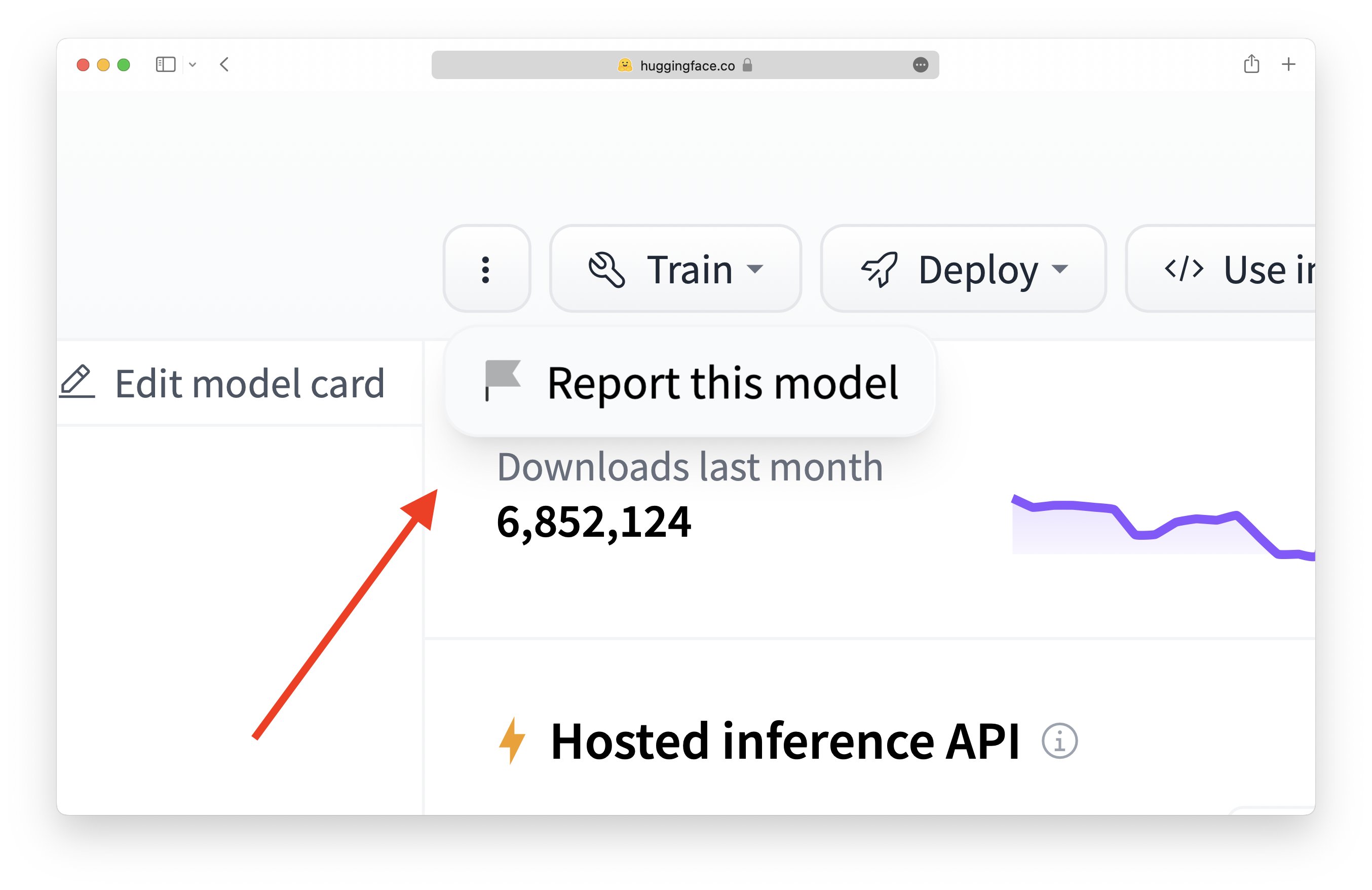

screenshot pointing to the flag icon to Report this model While logged in, you can click on the "three dots" button to bring up the ability to report (or flag) a repository. This will open a conversation in the repository's community tab.

Share why you flagged this item:
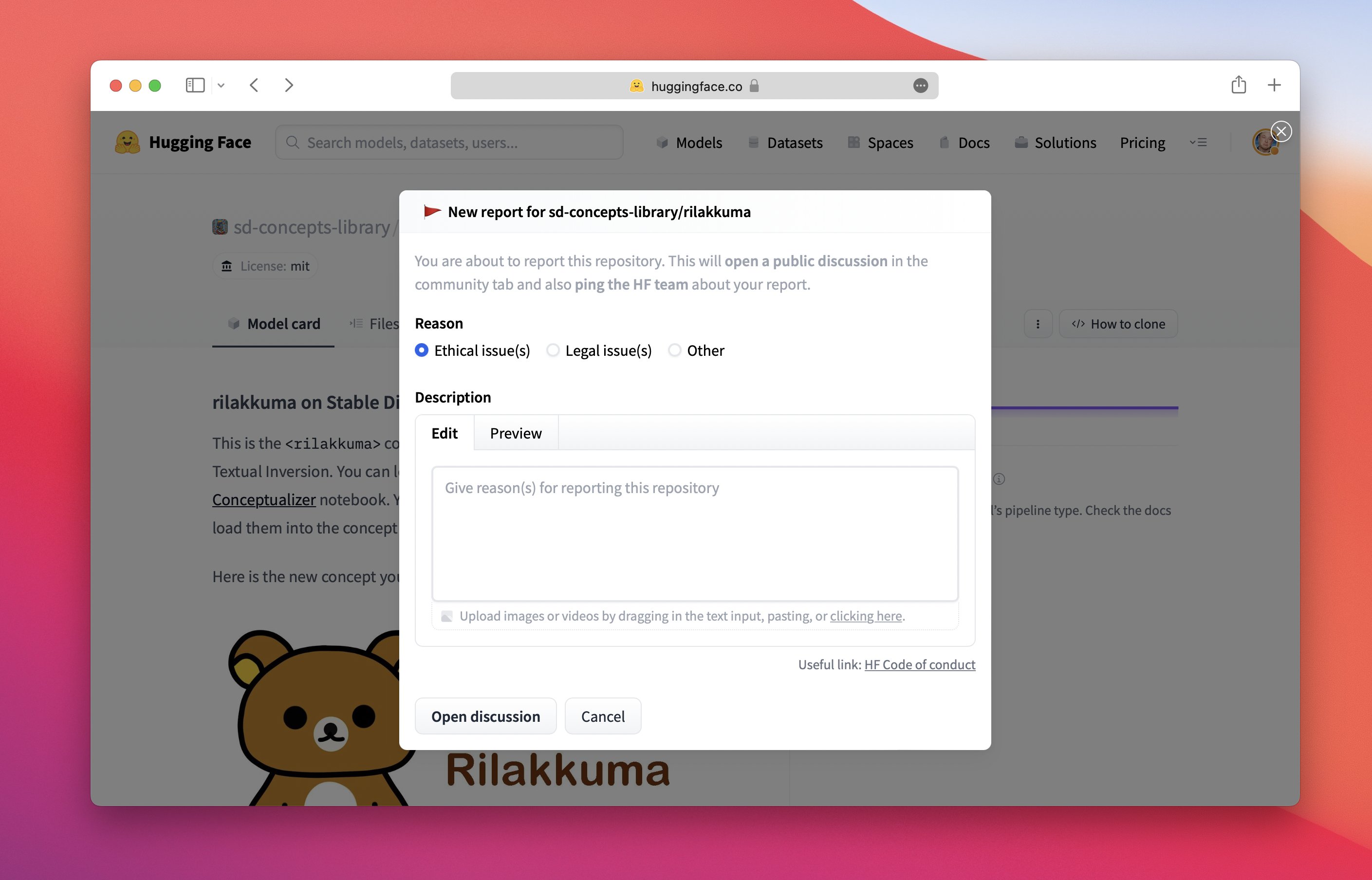

screenshot showing the text window where you describe why you flagged this item Please add as much relevant context as possible in your report! This will make it much easier for the repo owner and HF team to start taking action.

In prioritizing open science, we examine potential harm on a case-by-case basis and provide an opportunity for collaborative learning and shared responsibility. When users flag a system, developers can directly and transparently respond to concerns. In this spirit, we ask that repository owners make reasonable efforts to address reports, especially when reporters take the time to provide a description of the issue. We also stress that the reports and discussions are subject to the same communication norms as the rest of the platform. Moderators are able to disengage from or close discussions should behavior become hateful and/or abusive (see code of conduct).

Should a specific model be flagged as high risk by our community, we consider:

  • Downgrading the ML artifact’s visibility across the Hub in the trending tab and in feeds,
  • Requesting that the gating feature be enabled to manage access to ML artifacts (see documentation for models and datasets),
  • Requesting that the models be made private,
  • Disabling access.

How to add the “Not For All Audiences” tag:

Edit the model/data card → add not-for-all-audiences in the tags section → open the PR and wait for the authors to merge it. Once merged, the following tag will be displayed on the repository:


screenshot showing where to add tags

Any repository tagged not-for-all-audiences will display the following popup when visited:
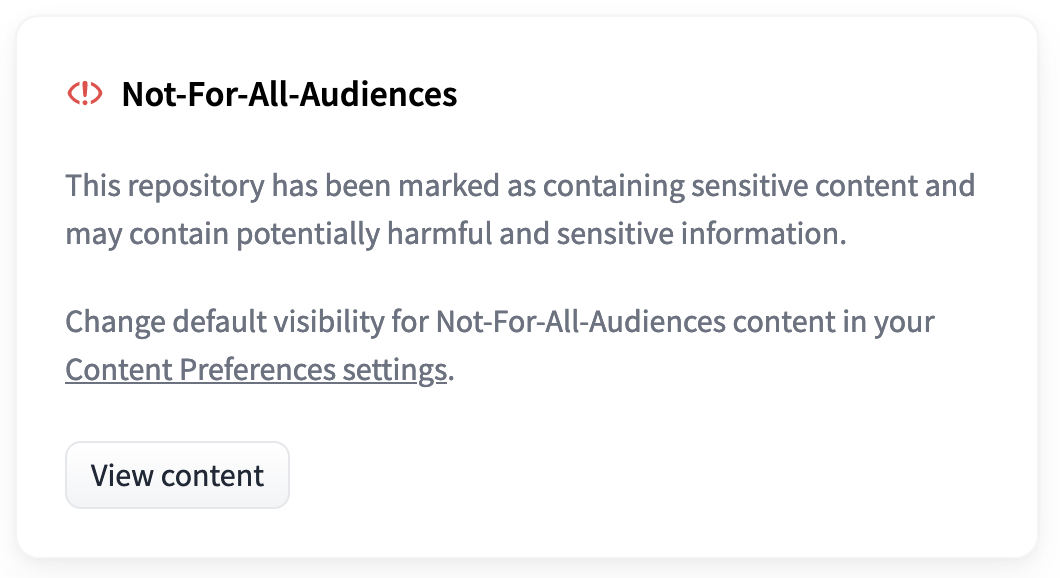

screenshot showing where to add tags

Clicking "View Content" will allow you to view the repository as normal. If you wish to always view not-for-all-audiences-tagged repositories without the popup, this setting can be changed in a user's Content Preferences
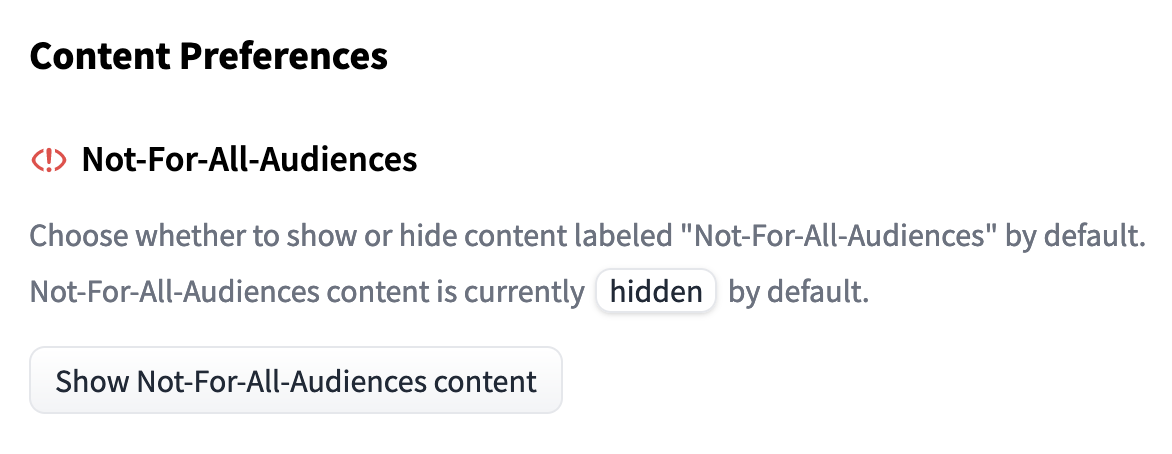

screenshot showing where to add tags

Open science requires safeguards, and one of our goals is to create an environment informed by tradeoffs with different values. Hosting and providing access to models in addition to cultivating community and discussion empowers diverse groups to assess social implications and guide what is good machine learning.

Are you working on safeguards? Share them on Hugging Face Hub!

The most important part of Hugging Face is our community. If you’re a researcher working on making ML safer to use, especially for open science, we want to support and showcase your work!

Here are some recent demos and tools from researchers in the Hugging Face community:

Thanks for reading! 🤗

~ Irene, Nima, Giada, Yacine, and Elizabeth, on behalf of the Ethics and Society regulars

If you want to cite this blog post, please use the following (in descending order of contribution):

@misc{hf_ethics_soc_blog_3,
  author    = {Irene Solaiman and
               Giada Pistilli and
               Nima Boscarino and
               Yacine Jernite and
               Elizabeth Allendorf and
               Margaret Mitchell and
               Carlos Muñoz Ferrandis and
               Nathan Lambert and
               Alexandra Sasha Luccioni
               },
  title     = {Hugging Face Ethics and Society Newsletter 3: Ethical Openness at Hugging Face},
  booktitle = {Hugging Face Blog},
  year      = {2023},
  url       = {https://doi.org/10.57967/hf/0487},
  doi       = {10.57967/hf/0487}
}